Cathodic protection vs. patch repair for a chloride-soaked parkade
On a downtown Vancouver parkade slab that has been taking road salt for thirty winters, a straight patch repair often fails within one to three years, because the chloride sitting in the concrete around the patch keeps corroding the steel and the repair edges spall again. Cathodic protection, either sacrificial anodes or a full impressed-current system, stops the corrosion across the whole slab instead of chasing one spall at a time.
Patch repair is the right and cheaper answer when the damage is a few isolated spalls in concrete that is still mostly clean, and anyone selling a whole-slab protection system for that condition is overscoping it. Cathodic protection earns its higher first cost on the slabs that have been patched two or three times already and keep failing at the edges, or where the chloride is so widespread that removing it all would mean demolishing the structure. Here is how to tell which one your parkade actually needs, and what to make the contractor prove before you approve the scope.
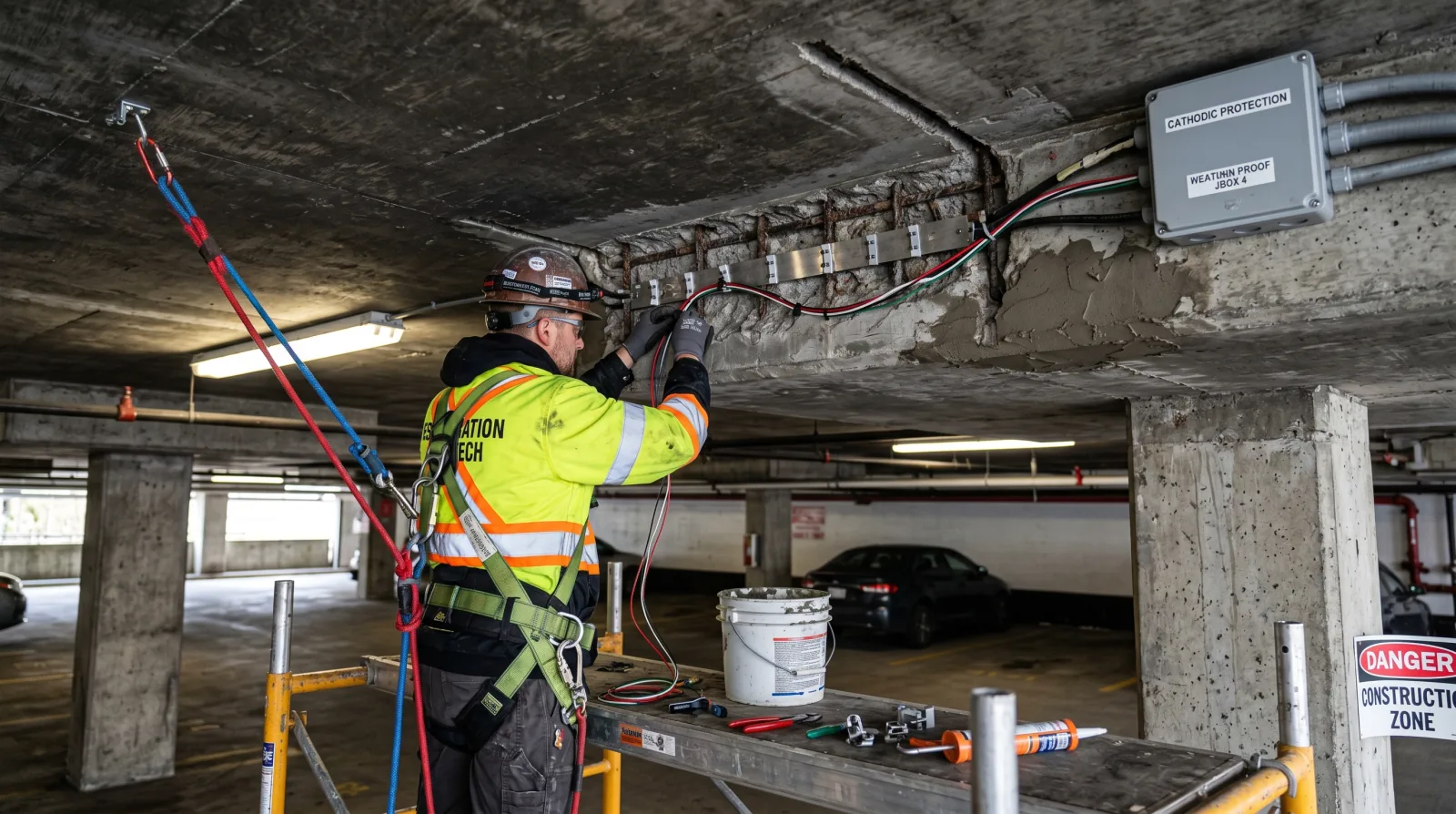
Why a good patch still fails on a salted slab
Patch repair is not a bad technique. It is the right fix for localized damage in clean concrete, and it is what CSA S448.1 describes for most building repairs. The problem is specific to chloride. On a parkade, cars track de-icing salt off winter roads onto the slab, water carries it down through the concrete, and it collects at the depth of the reinforcing steel over decades. By the time you see a spall, the chloride has already spread well past the piece that fell off.
The threshold that matters is small. Corrosion of ordinary reinforcing steel tends to start once the chloride at the bar reaches roughly 0.2 percent by mass of the cement, with published values ranging from about 0.17 to 0.26 percent depending on the concrete. That is not much salt. A slab that looks sound to the eye can be sitting well past that threshold across most of its area, with the steel already corroding everywhere and only the worst spots having spalled through the cover so far.
So you chip out the loose concrete, clean the bar, and place fresh repair mortar. The mortar is highly alkaline and re-protects the steel inside the patch. But a few centimetres away, the steel is still sitting in chloride-contaminated concrete. That difference in condition between the repaired steel and the surrounding steel drives a corrosion cell, and the corrosion moves to the edge of your new patch. The industry name for this is the incipient anode, ring anode, or halo effect, and both the American Concrete Institute repair literature and the major repair-material manufacturers document it as the predictable outcome of patching only the visible damage in a contaminated structure.
That is why a parkade patch can look perfect on handover and open a fresh crack next to itself the following winter. The repair did its job on the concrete it replaced. It did nothing about the corrosion in the concrete it left behind, and on a salted slab that leftover corrosion is the whole story.
What cathodic protection does differently
Cathodic protection attacks the corrosion itself, not just the broken concrete. It works by making the reinforcing steel the cathode in an electrical circuit, which holds the steel at a potential where it will not rust even with chloride still present. There are two ways to deliver that current.
Galvanic (sacrificial) protection uses embedded zinc anodes. The zinc corrodes in place of the steel and supplies a small protective current with no power supply, no wiring, and no monitoring. On a repair, engineers tie these anodes around the patch perimeter specifically to kill the ring anode effect, so the next spall does not form at the repair edge. The anodes have a finite life, and how long they last depends on the chloride load, so you cannot top them up on demand. In practice their working life often falls somewhere in the range of 10 to 20 years, but it is a consumable, and when the zinc is used up the protection ends.
Impressed current protection (ICCP) uses a permanent anode, usually a titanium mesh or ribbon, powered by a low-voltage DC rectifier. Because the current comes from an external supply, an engineer can adjust it and verify it over the life of the structure, and it can control corrosion at any chloride level even while more chloride keeps diffusing in. That control is why ICCP is the choice for large, heavily contaminated parkades. The trade-off is a higher up-front cost and the need for periodic monitoring of the system. Both approaches are designed and verified to ISO 12696, Cathodic protection of steel in concrete, which in its current 2022 edition sets the performance criteria a system has to meet.
How the testing decides the method
Nobody should be choosing between patching and protection off the look of the slab. The decision comes out of three pieces of site data, and a proposal that lacks them is guessing.
The first is sounding. The engineer or technician taps the slab with a hammer or drags a chain across it and listens for the hollow, drummy note that means the cover has delaminated from the steel. That maps where the concrete has already let go, including areas that have not yet fallen off.
The second is half-cell potential mapping to ASTM C876. A reference electrode is moved across the surface on a grid and reads the electrical potential of the steel below. As a broad guide, readings more negative than about -350 mV against a copper/copper-sulphate electrode indicate a greater than 90 percent probability of active corrosion, and readings more positive than about -200 mV indicate less than a 10 percent probability. The map shows how far the corrosion has spread past the visible spalls, which is exactly the information that separates a localized patch job from a whole-slab protection job.
The third is chloride sampling. Cores or powder samples are drilled at the depth of the bar and sent to a lab to measure the chloride content. If the salt is low across the element, patching is honest. If it is high and widespread, patching leaves live corrosion in everything you did not chip out. Read together, these three tests tell the engineer whether you are patching, adding sacrificial anodes at the edges, or protecting the whole structure.
The two systems compared
Conventional patch repair
Chip out the delaminated and spalled concrete back to sound material, clean or replace the steel, then rebuild the section with a polymer-modified repair mortar. The standard fix for localized damage under CSA S448.1.
Cathodic protection (galvanic or impressed current)
An electrochemical system that makes the reinforcing steel the cathode so it stops corroding. Galvanic uses embedded sacrificial zinc anodes with no power supply. Impressed current (ICCP) uses a permanent anode mesh or ribbon fed by a low-voltage DC rectifier.
Why Metro Vancouver parkades corrode faster than the design assumed
The coast is hard on parking structures for reasons that stack on top of each other. Road salt is the big one: every winter, cars carry de-icing chloride off the highways and drip it onto the slab, and the mild wet climate means the concrete rarely dries out fully, so the salt keeps migrating deeper instead of staying at the surface. On buildings near the water, sea-salt aerosol adds a second chloride source that never stops.
Then there is the legacy of the construction itself. Many Metro Vancouver parkades from the 1970s and 1980s were built with less concrete cover over the steel than current practice would use, and the leaky-condo era taught the region hard lessons about water management that were not yet standard when those structures went up. Thin cover means the chloride reaches the bar sooner. A failed or absent traffic membrane means water gets in freely. Blocked floor drains mean it ponds and soaks rather than draining away. None of these are exotic. They are the ordinary condition of a lot of the region\'s aging parking stock, and together they explain why a structure can be corroding far ahead of the schedule its original designer would have predicted.
This is also why the water and salt source has to be fixed as part of any repair. There is no point protecting the steel while the slab keeps drinking salted water through a dead membrane. The parkade waterproofing scope and the corrosion scope are planned as one job for exactly this reason.
The failure modes owners never budget for
Each approach has a way of disappointing an owner who did not understand what they were buying. With patching, the failure mode is the repeat visit. The strata approves a repair, it looks great, and eighteen months later a new spall opens next to it. Because the ring anode effect is invisible until it breaks through, the owner experiences it as bad luck or bad workmanship, when it is actually the predictable result of patching a contaminated slab without addressing the surrounding steel. The budget line nobody set aside is the second and third repair.
With impressed-current cathodic protection, the failure mode is neglect. The system is designed to protect the structure for decades, but only if the rectifier stays powered and someone reads the reference electrodes on schedule. A strata that installs ICCP and then lets the rectifier sit dead for three years has bought a system that is not protecting anything, and the corrosion resumes quietly under a slab everyone believes is handled. The budget line nobody set aside here is the annual monitoring and the eventual rectifier servicing.
With galvanic anodes, the failure mode is simply the end of their life. They are consumed by design, and when the zinc is spent the protection stops. That is not a defect, but an owner who was told "we installed cathodic protection" and never told it was a consumable with a finite window can be caught out when spalling resumes years later. The honest framing is that galvanic anodes buy a defined stretch of protection, not permanent protection.
Standards, testing, and what to verify
Three documents sit behind this work. The concrete repair itself, the breaking out, cleaning, and rebuilding, is carried out under CSA S448.1, "Repair of reinforced concrete in buildings and parking structures," in its current 2010 edition (reaffirmed 2020). That standard covers the investigation, design, and execution of repairs to regular reinforced concrete, and it explicitly excludes prestressed and post-tensioned structures, which is why a post-tensioned slab needs a specialist rather than a generic repair spec.
The cathodic protection system is designed and verified to ISO 12696:2022. Its performance criteria are the reason a properly installed system can be proven to work: with permanent reference electrodes embedded in the concrete, the engineer can run a potential decay test, switching the current off and measuring how far the steel potential recovers, with a decay of at least 100 mV commonly taken as evidence of protection. The surface preparation of the concrete before mortar or overlay goes on references ICRI 310.2R and its concrete surface profile system, so the bond line is specified rather than left to chance.
What to verify as an owner is simple: ask to see the chloride profile and the half-cell map, confirm the scope is signed by the assessing engineer, and for any impressed-current system make sure the monitoring plan and its cost are written into the proposal. The corrosion inhibitor vs. galvanic anode guide covers the smaller corrosion-control add-ons that sometimes get offered alongside these systems, and the rebar corrosion and spalling guide explains the mechanism these tests are measuring.
Realistic building scenarios
The right call is easier to see in real situations than in the abstract. Here are four that map onto common Metro Vancouver parkade conditions. In at least one, the honest answer is the simpler, cheaper option.
1970s concrete parkade, downtown Vancouver, patched three times already
Situation: A two-level suspended parking structure built in the 1970s. Spalls keep opening on the soffit and at column bases, always within a metre or two of last year's repairs. Chloride sampling at bar depth returns values well above the corrosion threshold across most of the deck, and half-cell mapping shows active potentials over roughly half the slab.
The call: Impressed current cathodic protection over the worst deck, phased in with membrane renewal.
The honest reason: This is textbook ring anode failure. The strata has already paid for three patch campaigns and the corrosion never stopped, because the salt is everywhere the patches are not. Patching a fourth time buys another year at best. An ICCP system holds the whole deck below the corrosion potential regardless of chloride, and the monitoring lets the engineer prove it is working. The higher first cost is offset by ending the two-year repeat cycle.
Newer surface lot deck, Burnaby, a handful of edge spalls
Situation: A concrete parking deck from the early 2000s with good drainage and a membrane that is aging but intact. Three or four isolated spalls at a construction joint. Chloride at bar depth is low across the samples except right at the joint, where water has been tracking through.
The call: Conventional patch repair with sacrificial anodes at the patch perimeters, plus resealing the joint.
The honest reason: This is the case where full cathodic protection would be overscoping. Chloride is low over the element, so the honest fix is to break out the spalled concrete, clean the bar, place mortar, and tie galvanic anodes around each patch edge to stop the ring anode effect locally. Sell this strata a whole-deck ICCP system and you are charging them for a problem they do not have.
Coastal high-rise parkade, West Vancouver, no on-site maintenance staff
Situation: An underground parkade under a strata tower near the water. Chloride is high and widespread from sea-salt aerosol and tracked-in road salt. The strata council is volunteer-run with no facilities staff and a history of deferring maintenance.
The call: Galvanic (sacrificial) cathodic protection combined with the concrete repairs, rather than ICCP.
The honest reason: The corrosion condition points to cathodic protection, but the ownership condition matters too. An impressed-current system needs a live rectifier and periodic monitoring, and a council that defers maintenance will not keep it running, so it will not deliver its design life. Galvanic anodes need no power and no monitoring. They give a finite but real protection window with nothing for the strata to neglect. Here the simpler system is the right call because it matches how the building is actually run.
Mixed condition suspended slab, North Vancouver, engineer still sampling
Situation: A 1980s strata parkade where the visible damage is modest but the concrete looks tired. The engineer has sounded the slab and is waiting on chloride profiles from cores before writing the repair spec.
The call: Wait for the numbers before committing to any method.
The honest reason: The honest answer here is that nobody can pick the method yet. If the profiles come back low and the corrosion is localized, this is a patch job. If they come back high and widespread, it moves toward cathodic protection. A contractor who quotes a full CP system before the chloride data is in is guessing, and a contractor who quotes a cheap patch is ignoring the risk. The data decides, which is the whole point of doing the assessment first.
Decision framework: eight questions that point to the right approach
| Question | Points to | Reason |
|---|---|---|
| Is chloride contamination widespread across the element? | Cathodic protection | Once chloride sits deep and across most of the slab, patching leaves live corrosion everywhere you did not chip out. A protective current treats the whole area instead of chasing spalls one at a time. |
| Is the damage a few isolated spalls in otherwise clean concrete? | Patch repair | If chloride at the bar is below threshold over most of the element, a conventional patch (with sacrificial anodes at the edges) is the honest and cheaper fix. |
| Has the parkade already been patched two or more times and it keeps coming back? | Cathodic protection | Recurring spalls next to old repairs are the ring anode effect in action. You are patching around concrete that will keep failing. A protection system breaks that cycle. |
| No electrical supply or ongoing monitoring possible? | Galvanic (sacrificial) CP | Galvanic anodes need no power supply and no monitoring, which suits a strata with no maintenance staff on site. The trade-off is a finite anode life you cannot control or top up on demand. |
| Long-term, controllable protection on a critical structure needed? | Impressed current CP | ICCP lets the engineer adjust and verify the current over the life of the structure. It costs more up front and needs a rectifier and periodic monitoring, but it protects at any chloride level. |
| Do half-cell readings show active corrosion over a wide area? | Cathodic protection | When ASTM C876 potentials are more negative than about -350 mV across large zones, corrosion is probable over that whole area, not just where the concrete has already spalled. Treating the zone beats treating the holes. |
| Is the element post-tensioned or prestressed? | Specialist review first | CSA S448.1 is written for regular reinforced concrete and excludes prestressed and post-tensioned work. Impressed current near prestressing raises hydrogen-embrittlement questions that need a corrosion specialist, not a standard repair spec. |
| Is the water and salt source still active (failed membrane, floor drains)? | Fix that first | No repair method holds while the slab is soaking up more chloride-laden water. The traffic membrane and drainage get addressed alongside any repair or protection scope. |
The life-cycle argument for a parkade
The reason cathodic protection ever makes sense on a strata parkade is repeat cost. A patch on a badly contaminated slab is cheap the first time and cheap the second time, but the strata is paying for a fresh mobilization, fresh traffic phasing, fresh barricading, and fresh engineering every couple of years, and the corrosion never actually stops. Add up three or four rounds of that against one protection system and the numbers often flip. This is the same reasoning a depreciation report tries to force: look at the cost over the building\'s life, not just the cheapest thing you can approve at this AGM.
In BC that life-cycle thinking is not just good sense, it is baked into how stratas are supposed to plan. Strata corporations with five or more lots must obtain a depreciation report under the Strata Property Act, and major repair or replacement work is normally funded by a special levy that needs a 3/4 vote at a general meeting. A council that keeps approving cheap patches to avoid a levy vote is often just deferring a larger levy later. Confirm the funding rules and the specific vote thresholds with your licensed strata manager or a strata lawyer, because the mechanics matter and they change with the details of your bylaws.
The honest catch is that cathodic protection is not free and not always right. Galvanic anodes have a finite life. Impressed-current systems need monitoring and a working rectifier, and a strata that will not maintain the system will not get the design life out of it. That is why the call belongs to the engineer who ran the chloride sampling, not to whoever is quoting the work. If your parkade is on its first spall in otherwise clean concrete, a conventional patch is the right answer and anyone selling you a full CP system is overscoping it.
Questions to ask before you approve the scope
You do not need to be an engineer to pressure-test a parkade proposal. You need to make the contractor show their evidence and account for how each method actually fails. These are the questions that separate a considered scope from a guess, along with the answers that should worry you.
Did you chloride-sample at the depth of the reinforcing steel, and can I see the profile?
Red flag: A quote with no chloride data behind it is a guess. If the answer is a shrug or "we will see when we open it up," you have no basis to choose between patching and protection.
What half-cell potential mapping did you run, and over what area?
Red flag: ASTM C876 readings show where the steel is actively corroding, not just where the concrete has already broken. No mapping means the extent of corrosion is unknown.
If we patch, are sacrificial anodes going in at the patch perimeters?
Red flag: On a salted slab, a patch with no perimeter anodes invites the ring anode effect. A contractor who does not mention them has not accounted for how patches fail.
Is this scope signed off by the engineer who assessed the structure?
Red flag: The choice between patching, galvanic anodes, and ICCP is an engineering decision under CSA S448.1. If the method is being chosen by the salesperson, that is a red flag.
For ICCP, who monitors the system and what does that cost per year?
Red flag: An impressed-current system with no monitoring plan will not reach its design life. If the annual monitoring and rectifier upkeep are not in the proposal, the life-cycle promise is empty.
What is the plan for the water and salt source, the membrane and drains?
Red flag: Any method fails if the slab keeps soaking up salted water. A repair scope that ignores the traffic membrane and floor drains is treating the symptom and leaving the cause.
Is the structure post-tensioned, and if so, who reviewed the corrosion approach?
Red flag: Impressed current near prestressing tendons raises hydrogen-embrittlement risk. If the building is post-tensioned and nobody has flagged it, the specifier does not understand the exclusion in CSA S448.1.
How will you phase the work so residents keep parking?
Red flag: On an occupied strata parkade the phasing is half the job. A contractor with no staging plan has not thought through the reality of working around cars.
How to read the two proposals side by side
When a patch quote and a cathodic protection quote land on the same table, they will not look comparable, and that is the trap. The patch quote will be a smaller number for a clearly defined piece of work: so many square metres broken out, cleaned, and rebuilt. The protection quote will be a larger number for something an owner cannot see the value of by looking at the slab. The instinct is to approve the cheaper one. The right move is to ask what each number actually buys over time.
Read the patch quote for what it leaves untreated. If the chloride data shows widespread contamination and the quote only addresses the visible spalls, the price is real but the scope is incomplete, and the missing work will come back as next year\'s repair. Read the protection quote for whether it is matched to how the building is run. An impressed-current proposal with no monitoring line item, or one handed to a strata with no capacity to keep a rectifier alive, is selling a design life the building will never see. A galvanic proposal should be honest that the anodes are a consumable with a finite window, not permanent protection.
The tell of a serious proposal is that it references the assessment. It cites the chloride profile, the half-cell map, and the sounding survey, it names the standards it is working to, and it explains why the recommended method fits the condition rather than just asserting it. A proposal that skips straight to a method and a price, with no assessment behind it, is asking you to trust a guess. On a structural slab over occupied space, that is not a reasonable thing to be asked to trust.
How this fits a Vancouver restoration project
Cathodic protection is rarely a standalone job. It goes into a wider building restoration campaign that also renews the failed traffic membrane, clears and repairs the floor drains, and repairs the spalls that have already let go. There is no point protecting the steel while the slab keeps soaking up salted water from a dead membrane, so the parkade waterproofing scope and the corrosion scope are planned together. The engineer sounds the slab, maps the delaminated areas, runs half-cell potential readings, and pulls chloride samples at the depth of the bar, and those numbers decide whether you are patching, adding sacrificial anodes at the edges, or protecting the whole structure.
The related guides pick up the neighbouring decisions. The repair vs. replace guide walks through the same testing from the question of whether the element can be saved at all. The partial-depth vs. full-depth guide covers how far into the section a repair has to go once you have decided to repair. And the shotcrete vs. form-and-pour guide covers how the concrete actually gets put back. Read together, they describe one continuous decision: what is wrong, how deep it goes, how to stop it coming back, and how to rebuild.
Quick answers
Why does patch repair keep failing on Vancouver parkade slabs?
On a salted parkade slab the chloride does not stop at the edge of the spall you can see. It has usually soaked through the concrete around and below the visible damage. When you chip out the failed area and drop in fresh alkaline mortar, you create a strong contrast between the new repair and the old chloride-laden concrete beside it. That contrast drives corrosion onto the steel just outside the patch, so the patch edges become the next spall. This is the incipient or "ring" anode effect, and it is the single most common reason a strata pays for the same parkade repair twice. Cathodic protection treats the whole area electrochemically, which is what breaks the cycle.
What is the ring anode or incipient anode effect in concrete repair?
When you repair only the actively corroding spots in a chloride-contaminated slab, the new repair mortar re-passivates the steel inside the patch while the surrounding steel stays contaminated. That difference sets up a small electrochemical cell: the newly protected steel and the still-contaminated steel next to it. Corrosion concentrates on the steel just outside the repair, forming a ring of new damage around yesterday's patch. Engineers manage it either by installing galvanic (sacrificial) anodes around the patch perimeter, by removing more of the surrounding contaminated concrete than the visible damage suggests, or by applying full cathodic protection across the element.
What is the difference between galvanic and impressed current cathodic protection?
Both make the reinforcing steel a cathode so it stops corroding, but they get there differently. Galvanic (sacrificial) cathodic protection uses embedded zinc anodes that corrode in place of the steel, with no power supply, no wiring, and no monitoring. It is simple and low-maintenance, but the anodes have a finite life you cannot control, and the protective current it can deliver is limited. Impressed current cathodic protection (ICCP) uses a permanent anode mesh or ribbon driven by a low-voltage DC rectifier, so an engineer can adjust and verify the current and protect the steel at any chloride level for the life of the structure. ICCP costs more up front and needs periodic monitoring; galvanic trades that control for simplicity.
Cathodic protection questions
Why does patch repair keep failing on Vancouver parkade slabs?
On a salted parkade slab the chloride does not stop at the edge of the spall you can see. It has usually soaked through the concrete around and below the visible damage. When you chip out the failed area and drop in fresh alkaline mortar, you create a strong contrast between the new repair and the old chloride-laden concrete beside it. That contrast drives corrosion onto the steel just outside the patch, so the patch edges become the next spall. This is the incipient or "ring" anode effect, and it is the single most common reason a strata pays for the same parkade repair twice. Cathodic protection treats the whole area electrochemically, which is what breaks the cycle.
What is the ring anode or incipient anode effect in concrete repair?
When you repair only the actively corroding spots in a chloride-contaminated slab, the new repair mortar re-passivates the steel inside the patch while the surrounding steel stays contaminated. That difference sets up a small electrochemical cell: the newly protected steel and the still-contaminated steel next to it. Corrosion concentrates on the steel just outside the repair, forming a ring of new damage around yesterday's patch. Engineers manage it either by installing galvanic (sacrificial) anodes around the patch perimeter, by removing more of the surrounding contaminated concrete than the visible damage suggests, or by applying full cathodic protection across the element.
What is the difference between galvanic and impressed current cathodic protection?
Both make the reinforcing steel a cathode so it stops corroding, but they get there differently. Galvanic (sacrificial) cathodic protection uses embedded zinc anodes that corrode in place of the steel, with no power supply, no wiring, and no monitoring. It is simple and low-maintenance, but the anodes have a finite life you cannot control, and the protective current it can deliver is limited. Impressed current cathodic protection (ICCP) uses a permanent anode mesh or ribbon driven by a low-voltage DC rectifier, so an engineer can adjust and verify the current and protect the steel at any chloride level for the life of the structure. ICCP costs more up front and needs periodic monitoring; galvanic trades that control for simplicity.
When is cathodic protection worth it on a strata parkade?
It pays off when chloride contamination is widespread and patching would either miss most of the corroding steel or require demolishing most of the element to remove all the salt. A common trigger is a parkade that has already been patched once or twice and keeps spalling at the repair edges. In that situation the strata is spending on repeated mobilizations, repeated traffic disruption, and repeated engineering, and the underlying corrosion never stops. A cathodic protection system, designed by the engineer against ISO 12696, arrests corrosion across the whole slab so you are not back doing the same work in two years. It is not the right answer for a few isolated spalls in clean concrete, where a conventional patch is cheaper and honest.
Does cathodic protection remove the chloride from the concrete?
No. Cathodic protection does not pull the salt out. What it does is stop the chloride from driving corrosion by keeping the steel electrically at a potential where it will not rust, even with the chloride still present. This is actually the point: on a badly contaminated parkade you often cannot remove all the chloride without removing most of the concrete, which is not practical on a structural slab. Protecting the steel in place lets you keep the sound concrete and stop the corrosion at the same time. There is a separate process called electrochemical chloride extraction that does draw chloride out, but it is a temporary treatment applied over weeks, not a permanent protection system.
What standard governs cathodic protection of concrete in Canada?
Cathodic protection of steel in concrete is designed and verified to ISO 12696, "Cathodic protection of steel in concrete," which sets the performance requirements and monitoring criteria for both galvanic and impressed-current systems in new and existing structures. The current edition is ISO 12696:2022. The concrete repair work that goes with it, including the patching and section rebuilding, is carried out under CSA S448.1, "Repair of reinforced concrete in buildings and parking structures." On a BC strata parkade, a qualified engineer scopes the assessment and specifies which approach fits the chloride condition. The contractor executes the design; the choice between patching, galvanic anodes, or a full impressed-current system is an engineering decision, not a sales pitch.
How do engineers confirm a cathodic protection system is actually working?
ISO 12696 sets performance criteria that are checked with reference electrodes built into the structure, not by looking at it. The most widely used criterion is the potential decay test: the current is switched off and the engineer measures how far the steel potential recovers over a set period, with a decay of at least 100 mV taken as evidence that the steel is protected. For an impressed-current system, permanent silver/silver-chloride or manganese-dioxide reference electrodes are embedded in the concrete so these readings can be taken over the years. This is the practical difference from a plain patch: cathodic protection can be measured and proven, while a patch is passive and you only learn it failed when the next spall opens.
How is half-cell potential testing used to decide the repair scope?
Half-cell potential testing to ASTM C876 maps the electrical potential of the reinforcing steel across the slab using a copper/copper-sulphate reference electrode on the surface. As a broad guide, readings more negative than about -350 mV indicate a greater than 90 percent probability of active corrosion, while readings more positive than about -200 mV indicate a less than 10 percent probability. On a parkade, that map shows the engineer how far the corrosion has spread beyond the visible spalls. If the active zone is small and isolated, a targeted patch makes sense. If it covers a large area, patching only the broken concrete leaves most of the corroding steel untreated, which pushes the decision toward cathodic protection. The potentials are read alongside chloride sampling and sounding, not on their own.
Can cathodic protection be installed while the parkade stays in use?
Mostly, yes, with phasing. Parkade restoration in Metro Vancouver almost always runs on an occupied building because residents need their parking. The work is sequenced so a portion of the slab is closed, prepared, and allowed to cure while the rest stays open, then the crew rotates. Galvanic anode installation is often quicker because it goes in during the patch repair itself with no separate wiring. An impressed-current system takes longer to install because of the anode mesh and the rectifier and monitoring connections, but it is still done in stages. Residents get notice before their level or bay is closed, and the drainage and traffic membrane work is coordinated into the same phasing.
Is cathodic protection safe near post-tensioned or prestressed concrete?
It needs a specialist, and it is outside the scope of the standard repair code. CSA S448.1 is written for regular reinforced concrete and explicitly excludes prestressed and post-tensioned components. The reason matters: impressed-current cathodic protection near high-strength prestressing steel can, if the current is not carefully controlled, drive a reaction that risks hydrogen embrittlement of the tendons. On a post-tensioned slab the corrosion approach has to be designed by a corrosion engineer who understands that risk, and it is not something to specify off a generic parkade repair template. If your building is post-tensioned, that fact should be front and centre in any corrosion-control discussion.
How much does the life-cycle cost differ between repeated patching and cathodic protection?
We do not quote dollar figures without assessing your specific building, but the shape of the comparison is consistent. A patch is cheap the first time and cheap the second time, but each round means a fresh mobilization, fresh traffic phasing, fresh barricading, and fresh engineering, and on a badly contaminated slab the corrosion never actually stops. Cathodic protection has a higher first cost, especially impressed current, but it ends the repeat cycle. Add up three or four patch campaigns over a decade or two against one protection system, and on a heavily contaminated parkade the protection system usually costs less over the building's life. The catch is that this only holds if the strata maintains the system, which is why the ownership situation is part of the recommendation.
Does a new traffic membrane make cathodic protection unnecessary?
A new membrane is necessary but not sufficient on an already-contaminated slab. Renewing the traffic membrane and clearing the drains stops fresh salted water from entering, which is essential, because no corrosion-control method holds while the concrete keeps soaking up chloride. But the salt that is already in the concrete at bar depth does not leave when you install a membrane, and it keeps corroding the steel. On a slab that is only lightly contaminated, a good membrane plus targeted patching can be enough. On a heavily contaminated one, the membrane protects against new chloride while cathodic protection deals with the chloride already there. The two scopes are planned together, not treated as either-or.
Parkade spalling coming back after every repair?
We assess and chloride-test parkade slabs and columns on strata and commercial buildings across Vancouver, North Vancouver, West Vancouver, and Burnaby, so the choice between patching, sacrificial anodes, and cathodic protection rests on data, not a guess.