Concrete Restoration in Vancouver
Concrete restoration brings a deteriorating structural element — a balcony slab edge, a column, a parkade soffit — back to a safe, load-carrying state by removing failed concrete, treating the corroded reinforcing steel, and rebuilding the section. This hub is the working reference we hand strata councils and property managers across Vancouver, North Vancouver, West Vancouver, and Burnaby when the cracking starts to spread.
Why this matters on the coast
Damage from the "leaky condo" crisis across 900+ Lower Mainland buildings built before rainscreen detailing was standard.
Average annual precipitation at Vancouver International Airport (1991–2020) — the moisture load driving envelope decay.
The depreciation-report cycle now required of BC strata corporations of 5+ lots under the Strata Property Act.
The three questions every building owner asks
Concrete restoration sounds like one job. In practice it splits into three decisions, and getting them in the right order saves a strata a lot of money. Work through them here.
 Diagnosis
 Rebar corrosion and concrete spalling explained
Why steel inside coastal concrete rusts, how carbonation and chloride break the passive layer, and the field signs that tell you it has already started.
Read the guide Decision
 Concrete repair vs. replacement: how the call gets made
The decision tree an envelope engineer actually uses — sounding surveys, half-cell potential, chloride sampling — and when patch repair stops being honest.
Read the guide Process
 The strata concrete restoration process, step by step
From the depreciation report flag to engineer scope, special levy, permits, and sign-off — how a BC strata gets a concrete repair project done without surprises.
Read the guide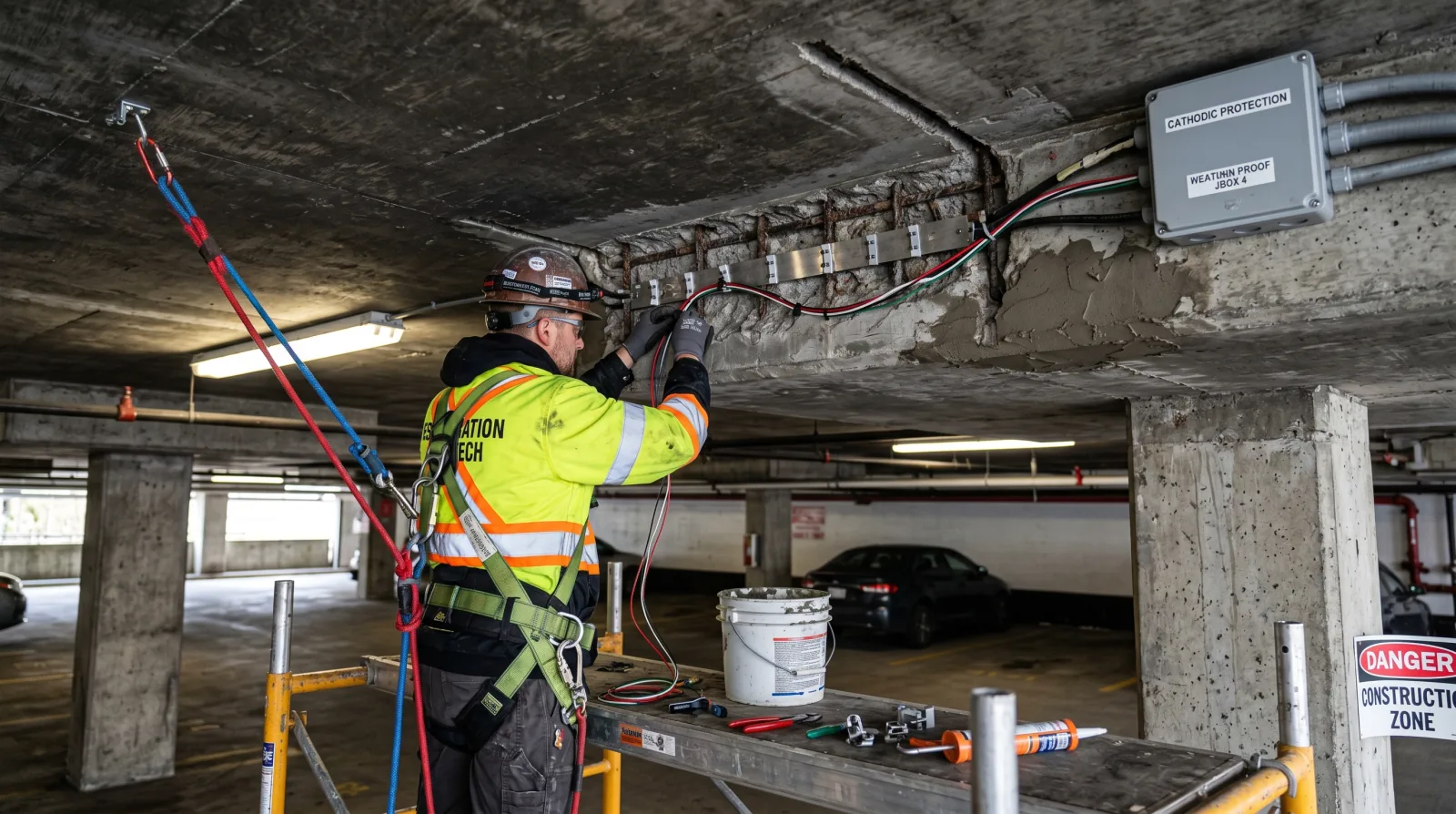 Compare
 Cathodic protection vs. patch repair for chloride-soaked parkades
Why patching keeps failing on salted parkade slabs (the ring anode effect), how galvanic and impressed-current cathodic protection stop it, and when CP pays off over repeat repairs.
Read the guide Compare
 Partial-depth vs. full-depth concrete repair
How the chloride profile, rebar condition, and sounding survey set the repair depth, and why a suspended slab going full-depth means shoring and a structural review first.
Read the guide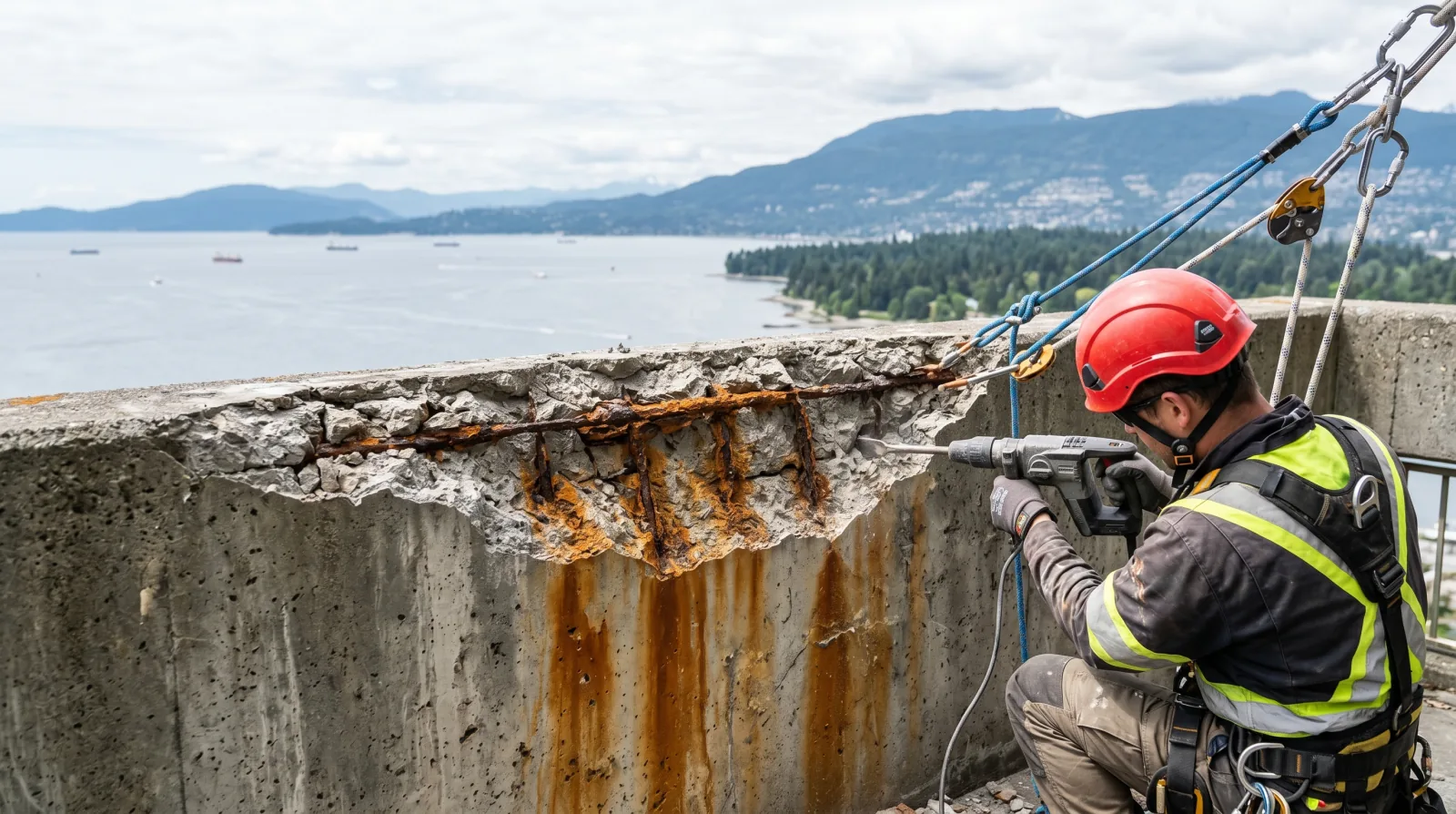 Compare
 Migrating corrosion inhibitors vs. galvanic anodes
How each extends a repair, where each fits, and the honest evidence limits: inhibitors weaken once corrosion has started, while galvanic anodes arrest it and stop the ring anode effect.
Read the guide Compare
 Shotcrete vs. form-and-pour vs. hand-applied mortar
Choosing how the section gets rebuilt: access, overhead and vertical work, quality control, and the quantity of repair that decides between spraying, forming, and trowelling.
Read the guide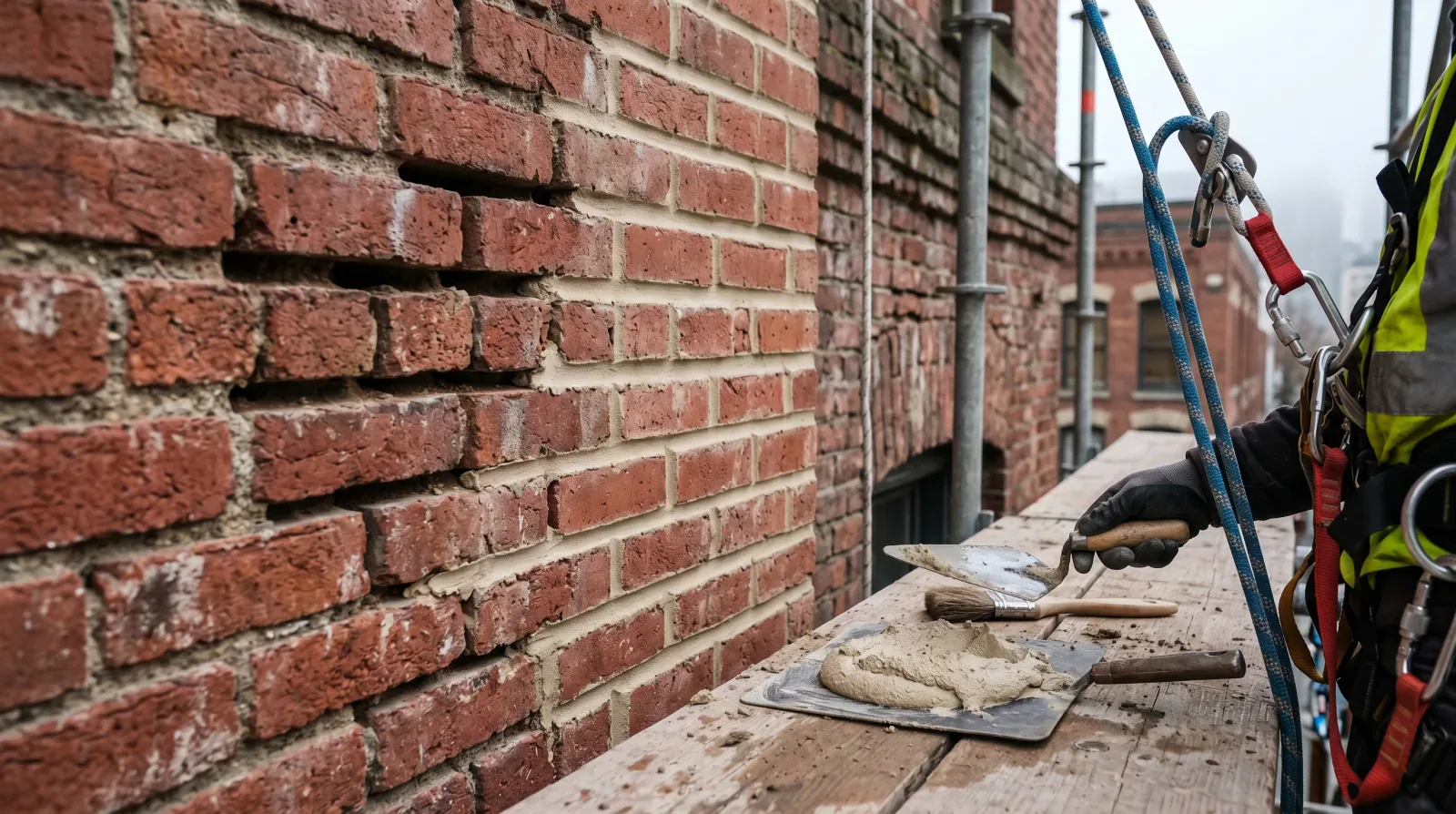 Compare
 Masonry repointing vs. rebuild
Whether failing mortar joints call for repointing alone or the brick itself has failed and needs rebuilding, plus real Vancouver cost ranges for each.
Read the guide Compare Parkade crack repair: injection vs. surface sealing
Epoxy structural injection vs. polyurethane waterproofing injection vs. surface sealing, and how to tell when a crack means the waterproofing membrane itself has failed.
Read the guideWhat "restoration" actually fixes
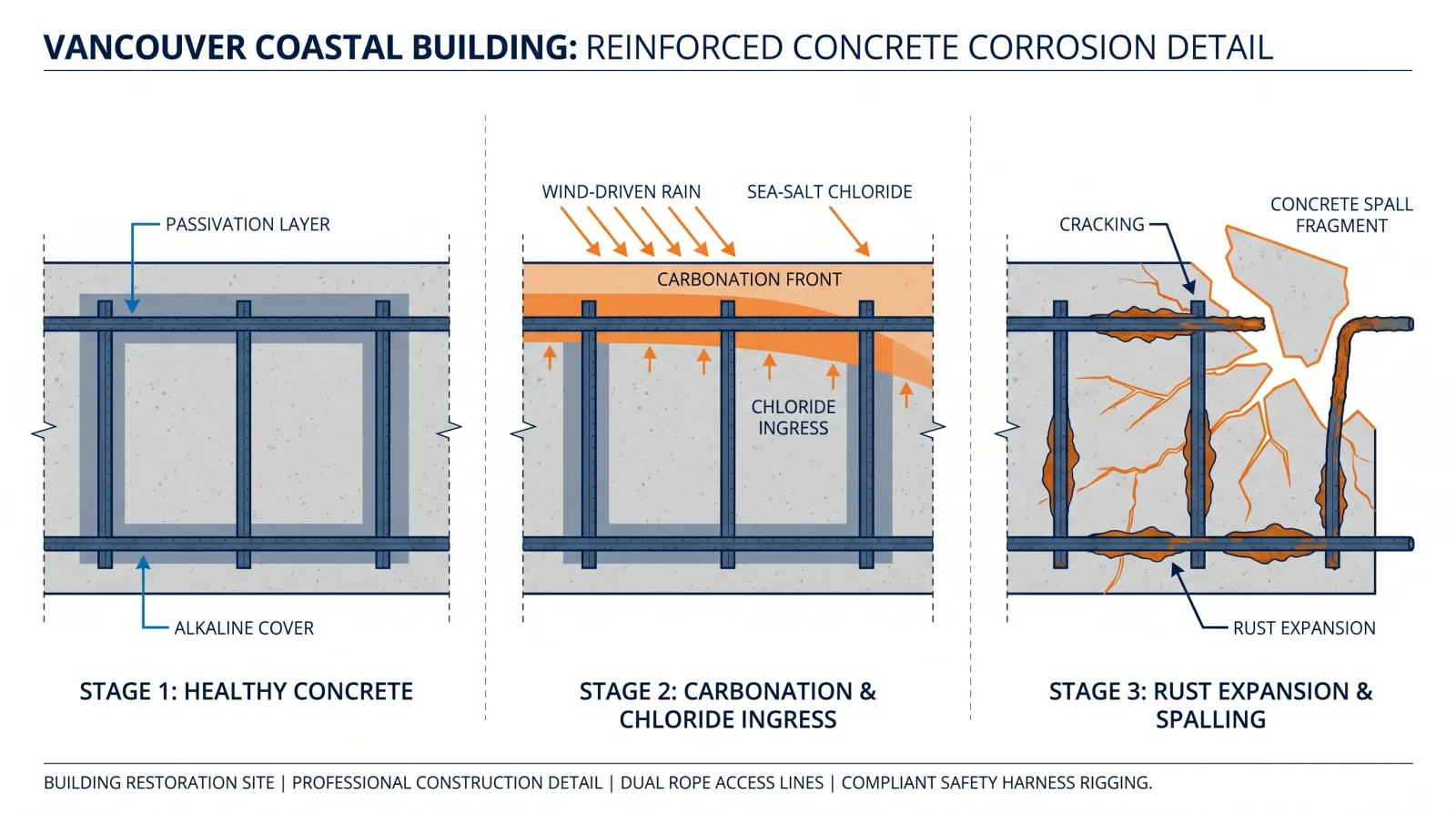
Concrete is strong in compression and weak in tension, so we cast steel reinforcing bar into it to carry the tension. That steel only survives because fresh concrete is highly alkaline — a thin passive film forms on the bar and stops it rusting. Restoration is, at its core, the job of getting that protection back after the chemistry has broken down.
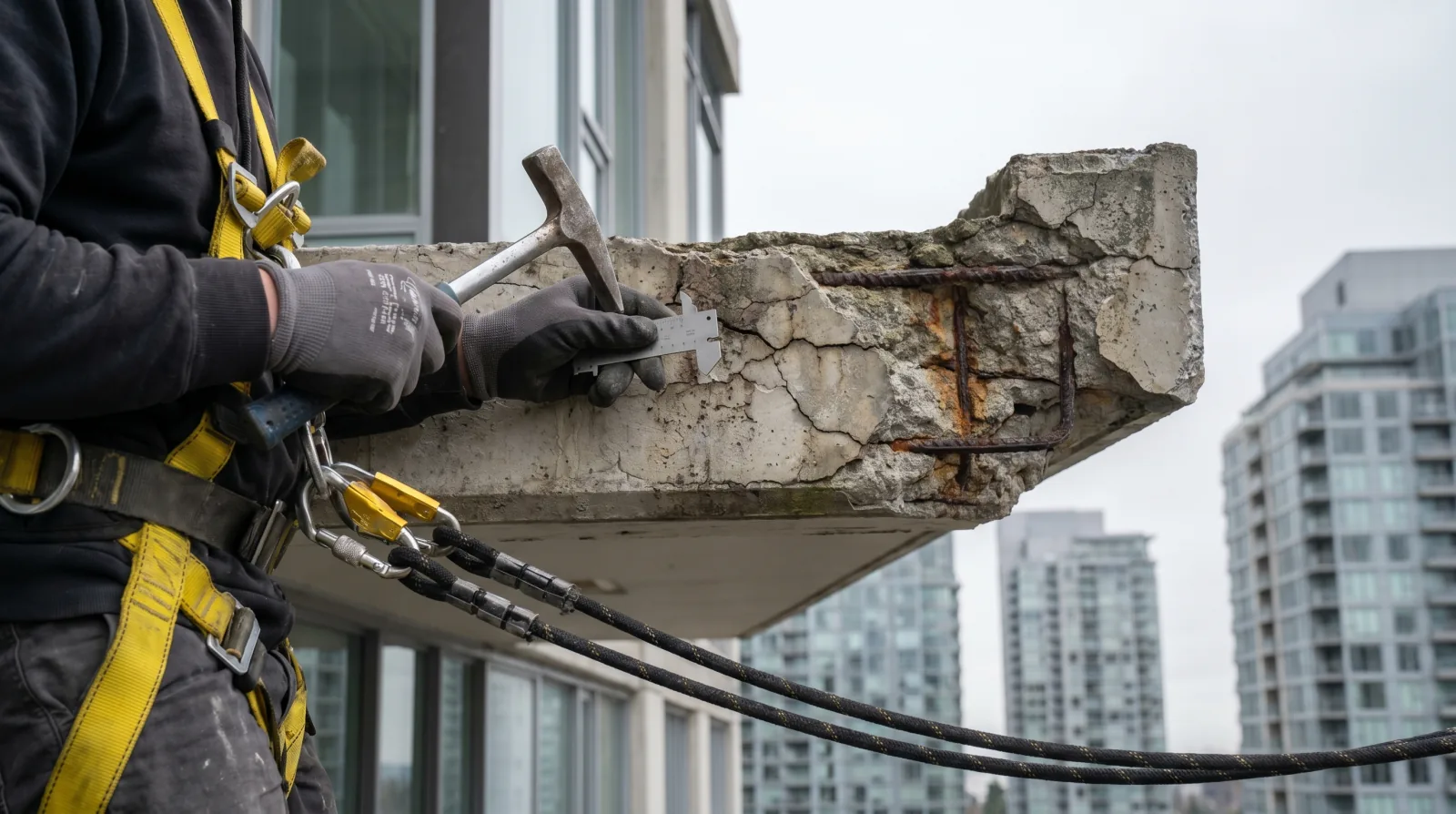
Two things break it on the BC coast. Carbonation: atmospheric carbon dioxide slowly reacts with the concrete and drops its pH, eating inward from the surface until it reaches the bar. And chloride: salt carried in off the Strait, plus de-icing salt tracked into parkades, migrates through the porous concrete to the steel. Once either front reaches the rebar, the steel starts to corrode. Rust occupies several times the volume of the original steel, and that expansion is what cracks the cover concrete off — the brown-stained, hollow-sounding damage strata owners call spalling.
So a real restoration removes the contaminated and delaminated concrete back to sound material, cleans or replaces the affected rebar, sometimes adds a corrosion inhibitor or sacrificial anode, and rebuilds the profile with a polymer-modified repair mortar engineered to bond and to resist the next round of chloride. Then the surface gets a protective coating or sealer so water and salt have a harder time getting back in. Skip the steel and you have painted over a problem that is still growing.
How coastal exposure walks a healthy slab to a spall: the corrosion front reaches the steel, the steel expands, the cover lets go.
Where it shows up first
On residential concrete towers it tends to start at balcony slab edges and undersides — the most exposed horizontal concrete on the building, and the place where membrane failure lets water sit. That overlap is why concrete restoration and balcony waterproofing are usually the same project caught at two stages: fix the failed membrane and the spalling edge together, or neither holds. On parkades it is the suspended slab soffit and the column bases, where road salt and standing water do the damage; the membranes, joints, and corrosion-control systems that protect that structure have their own parkade waterproofing guide. On older buildings from the leaky-condo decades, it follows wherever the envelope was leaking: window heads, parapets, and any detail that wasn't drained.
None of that is guesswork on a specific building. An engineer sounds the concrete, maps the delaminated areas, and tests for chloride and carbonation depth before anyone scopes a repair. The three guides below walk through the diagnosis, the repair-or-replace call, and how a strata gets the project run.
Quick answers
What is concrete restoration and how is it different from cosmetic repair?
Concrete restoration is the structural process of removing deteriorated concrete, treating or replacing corroded reinforcing steel, and rebuilding the section with engineered repair mortar so the element carries load again. Cosmetic repair only hides surface cracking. If rebar corrosion is driving the damage, a cosmetic patch traps the active corrosion underneath and the spall returns, usually worse, within a year or two.
Why does concrete spalling happen so often in Metro Vancouver buildings?
Coastal British Columbia combines three accelerators: wind-driven rain that saturates the envelope, sea-salt chloride in the air near the water, and a building stock — much of it from the late-1980s-to-early-2000s "leaky condo" era — built before rainscreen detailing became standard. Water and chloride reach the rebar, the steel rusts and expands, and the expansion cracks the concrete cover off. The Strait of Georgia storm exposure makes it faster here than in a dry inland climate.
What standard governs concrete repair in BC buildings and parkades?
Structural concrete repair in buildings and parking structures is carried out to CSA S448.1, "Repair of reinforced concrete in buildings and parking structures." It sets the minimum requirements for investigating the damage, designing the repair, and executing it so the element returns to a safe and serviceable state. A qualified structural or building-envelope engineer scopes the work against this standard.
From the resources library
Concrete Carbonation on Coastal BC Buildings
Not all rebar corrosion is salt. On older Victoria concrete buildings, carbonation quietly lowers the concrete's pH until the steel loses its protection.
Read article ArticleVapour Barrier Failure and Interstitial Condensation in BC Walls
The water staining a Coquitlam condo's interior wall isn't always a leak. Sometimes the wall makes its own water — warm air condensing inside the cavity.
Read article ArticleCorroding Balcony Guardrail Anchors on Vancouver Strata Towers
The rust staining at the base of a balcony railing post in Burnaby isn't cosmetic — it's a corroding anchor pushing the concrete apart, and a safety problem.
Read article ArticleBrick Masonry Repointing on Vancouver Heritage and Older Buildings
Use the wrong mortar to repoint a heritage brick building in New Westminster and you'll spall the brick faces within a few winters. Why hardness matters.
Read article ArticleEfflorescence on Vancouver Concrete Walls: Causes and Fixes
The white salt bloom on a North Vancouver concrete wall is a map of water moving through the structure. What it signals and how to fix the real cause.
Read article ArticleEngineered Stone and Composite Cladding Panel Failures on Vancouver Towers
Composite panel cladding — engineered stone, fibre cement, aluminum composite — has dominated Vancouver tower facades since 2005. The failure modes are now becoming visible as the first generation reaches 15-20 years in service. What property managers need to know about inspection, repair, and replacement.
Read article ArticleRebar Corrosion and Concrete Delamination in Coastal BC Buildings
Why concrete spalls on West Vancouver and waterfront towers — how chloride and carbonation corrode rebar, the warning signs, and how coastal concrete repair is done.
Read articleRestoration services this guide connects to
Concrete restoration questions
What is concrete restoration and how is it different from cosmetic repair?
Concrete restoration is the structural process of removing deteriorated concrete, treating or replacing corroded reinforcing steel, and rebuilding the section with engineered repair mortar so the element carries load again. Cosmetic repair only hides surface cracking. If rebar corrosion is driving the damage, a cosmetic patch traps the active corrosion underneath and the spall returns, usually worse, within a year or two.
Why does concrete spalling happen so often in Metro Vancouver buildings?
Coastal British Columbia combines three accelerators: wind-driven rain that saturates the envelope, sea-salt chloride in the air near the water, and a building stock — much of it from the late-1980s-to-early-2000s "leaky condo" era — built before rainscreen detailing became standard. Water and chloride reach the rebar, the steel rusts and expands, and the expansion cracks the concrete cover off. The Strait of Georgia storm exposure makes it faster here than in a dry inland climate.
What standard governs concrete repair in BC buildings and parkades?
Structural concrete repair in buildings and parking structures is carried out to CSA S448.1, "Repair of reinforced concrete in buildings and parking structures." It sets the minimum requirements for investigating the damage, designing the repair, and executing it so the element returns to a safe and serviceable state. A qualified structural or building-envelope engineer scopes the work against this standard.
Does a depreciation report cover concrete restoration?
A depreciation report identifies concrete and envelope components as future maintenance items and estimates their service life and reserve funding — it flags the problem but it is not a repair design. Under the Strata Property Act, BC strata corporations of five or more lots must obtain a depreciation report on a five-year cycle, with a July 1, 2026 deadline for Metro Vancouver stratas that do not have a current one. When the report flags concrete deterioration, the next step is an engineer-led condition assessment to scope the actual restoration.
How do crews reach concrete damage on a high-rise without scaffolding the whole building?
For spot repairs and facade work, IRATA or SPRAT certified rope-access technicians rig from engineered roof anchors and work the elevation on two independent lines under WorkSafeBC Part 11 fall-protection rules. Rope access removes the cost and footprint of full scaffold or swing-stage staging for localized work, and it keeps sidewalks and resident access open with smaller barricaded zones.
Can concrete restoration be done while the building stays occupied?
Yes — most strata and commercial concrete restoration runs on occupied buildings. The work is sequenced by elevation, residents get notice before crews are on their face or balcony, noisy chipping is scheduled into agreed windows, and ground barricades isolate the drop zone. Parkade slab repairs are phased so a portion of parking stays available while sections cure.
Spalling spreading on your building?
We assess concrete deterioration on strata and commercial buildings across Vancouver, North Vancouver, West Vancouver, and Burnaby — and scope the repair to CSA S448.1 with engineering oversight.