Parkade waterproofing and restoration for BC strata and commercial buildings
A parkade fails from a different direction than the rest of the building. The rain never touches it; the damage drives in on tires as road salt, dissolves in standing water, and works down through the slab to the reinforcing steel. This hub explains the systems that keep that from happening, how to read the warning signs on your own deck, and how to tell a maintenance job from a structural one before you approve either.
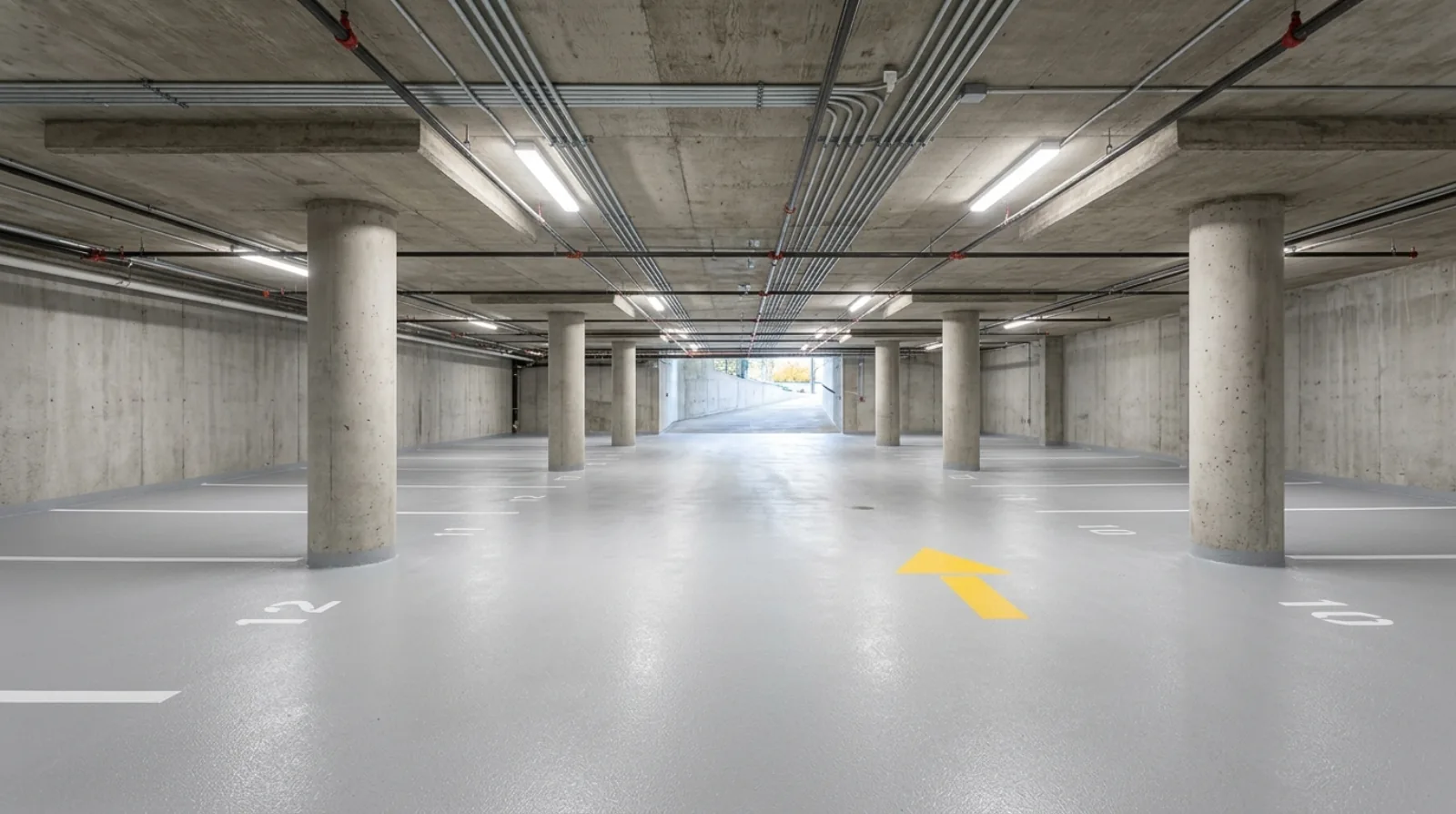
What matters most in a parkade
De-icing salt tracked in on tires is the enemy. Once its chloride reaches the reinforcing steel, corrosion starts, the steel expands, and the concrete cracks apart from within. Everything on this page exists to keep chloride away from the bar, or to stop what it started.
The gritty wearing layer you drive on is sacrificial. It is built to wear out so the waterproofing under it does not. Renewing it before it is gone is the entire discipline that keeps a parkade in the maintenance budget instead of the levy conversation.
Membranes protect sound concrete. They do not fix damaged concrete, and coating over a slab that is already delaminating traps the problem. Testing first, repair second, waterproofing last is the order that holds.
The five systems that keep a parkade dry
A parkade is not protected by one product. It is protected by a set of systems doing different jobs: membranes on the deck, seals at the joints, treatment on the below-grade walls, and, where chloride has already done damage, corrosion control inside the slab itself.
| System | What it does | Timing | Where it is strong | What to watch |
|---|---|---|---|---|
| Polyurethane traffic membrane | Waterproofs the driving surface of the deck | Each coat cures in roughly 24 to 48 hours; will not cure below 5°C | Economical, proven, and widely available. The workhorse system on Metro Vancouver parkade decks, applied as a flexible base coat under an aggregate wear course. | The long cure stretches the closure over several days, and the temperature window rules out much of the cold season in an unheated underground structure. |
| PMMA traffic membrane | Waterproofs the driving surface where speed or cold matters | Trafficable within one to three hours of application | Cures fast even in a cold parkade, so a section can be coated and reopened in a single day. Sits toward the upper end of the traffic membrane service range. | Costs more up front and cannot be brushed or rolled. It needs trained applicators, and the mixing ratio tolerance is tight enough that a bad mix can fail to cure. |
| Deck expansion joint systems | Seals the movement gaps between slab sections | Replaced when the elastomer hardens, tears, or loses contact | Compression seals and strip seals absorb the thermal and traffic movement a rigid slab cannot, while carrying vehicle loads across the gap. | Joints are the most common source of the leak that stains the cars below. De-icing salt attacks the steel edge rails, and an aged seal stops following the joint. |
| Crystalline waterproofing (negative side) | Seals below-grade walls from the inside | Applied when excavating the exterior is not practical | Grows crystals inside the concrete capillaries to block water, without digging up landscaping or a neighbouring property to reach the outside face. | It is a repair of last resort with real limits. Active leaks have to be controlled first, and the concrete itself has to be sound before it goes on. |
| Cathodic protection | Stops rebar corrosion in chloride-soaked slabs | Chosen from chloride testing, not from looking at the slab | Galvanic zinc anodes or an impressed-current system protect the reinforcing steel that patching alone leaves corroding, and interrupt the ring of new damage that forms around patches. | Not a waterproofing layer. It manages corrosion that has already started, and it still needs the deck sealed above it to cut off the chloride supply. |
Service life on any of these depends more on surface preparation, drainage, and inspection discipline than on the product name. A well-prepared economical system outlasts a premium one applied over a damp, poorly profiled slab.
The three decisions that come up most
Most parkade conversations with a strata council or building owner come down to one of these three calls. Each guide gives the building science and a decision framework rather than a recommendation to buy something.
 Compare
 Parkade crack repair: injection vs. surface sealing
Epoxy structural injection against polyurethane waterproofing injection against surface sealing, and when a crack is telling you the membrane above it has failed.
Read the guide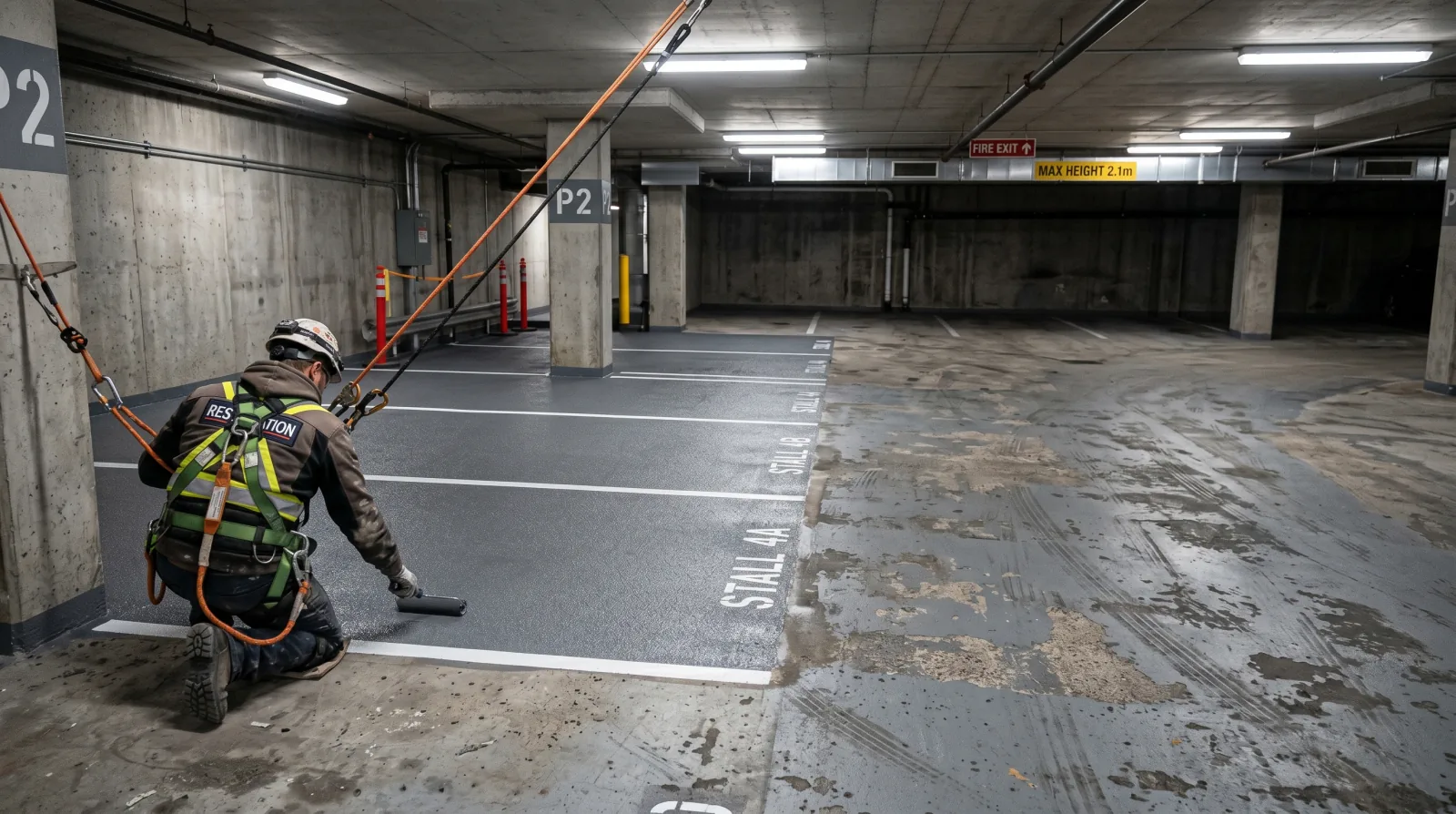 Compare
 Traffic membrane vs. penetrating sealer
A membrane waterproofs a suspended slab; a penetrating sealer only slows chloride into sound, at-grade concrete. Why the two are not interchangeable and where each belongs.
Read the guide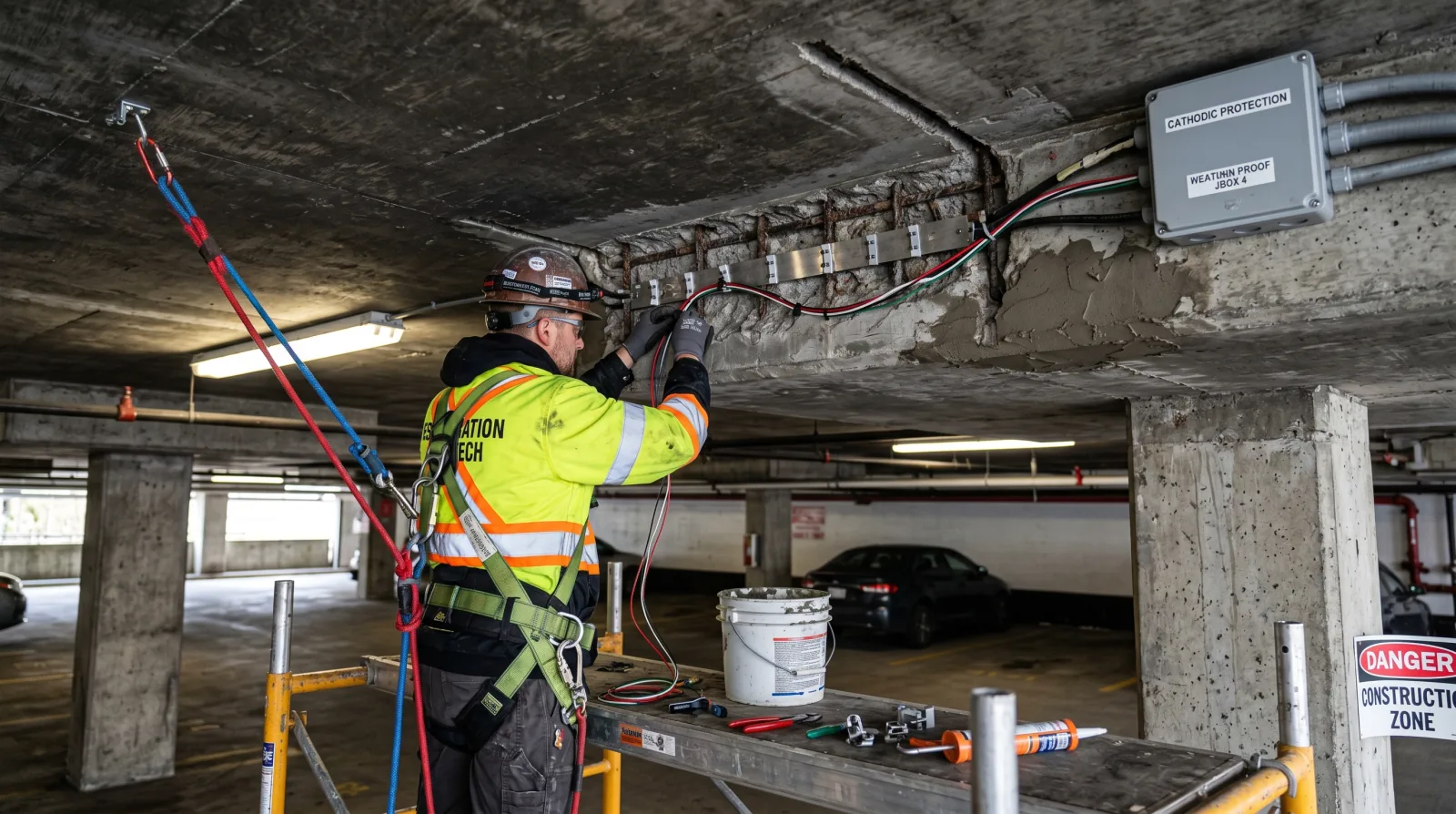 Compare
 Cathodic protection vs. patch repair
Why patches on a chloride-soaked slab spawn a ring of new damage around their own edges, and when anodes are the cheaper long-term call than chasing spalls.
Read the guideSix questions that change the answer
Work through these before comparing bids. They are the factors that genuinely move the recommendation, and a contractor who cannot answer them about your specific parkade has not looked at it closely enough.
-
Is the topcoat worn, or is the base coat gone?
The wearing topcoat is sacrificial. It exists to take tire abrasion so the waterproofing base coat underneath stays intact, and renewing it in the drive lanes every 5 to 10 years is normal maintenance. Once traffic is abrading the base coat itself, a cheap recoat is off the table and you are pricing a full system replacement. The difference between the two is usually one missed inspection cycle.
-
Has chloride already reached the reinforcing steel?
This is the question a coating cannot answer. If the steel is still protected, a new membrane stops chloride before corrosion starts and is exactly the right move. If chloride has already reached the bar, a membrane over top traps the problem while the slab keeps delaminating underneath. Chloride sampling at the depth of the steel, often paired with a half-cell potential survey, settles it before anyone quotes.
-
Is the damage showing on the soffit below?
Rust staining, hanging mineral deposits, or spalled concrete on the ceiling of the level below means the deterioration has gone through the slab. At that point the file moves from a coating contractor to a professional engineer, because repair of structural concrete in parking structures is scoped against CSA S448.1 and the reinforcing steel is carrying real load.
-
How long can residents lose their parking?
An occupied strata parkade rarely empties. That drives two choices: the membrane chemistry, because PMMA reopens a section in hours where polyurethane takes days, and the phasing, because the work is sequenced in zones so part of the parkade stays usable throughout. A bid that ignores the phasing question has not thought about your building.
-
Is the leak tracking along a straight line?
Water appearing along a clean line on the level below usually means a failed expansion joint above, not a failed membrane field. Joints are their own system with their own repair scope, and the joint and the membrane have to be treated as one waterproofing assembly where they meet, or the water simply moves to the seam between the two repairs.
-
Is the wet wall below grade?
A leaking foundation wall is a different problem from a leaking deck. If the outside face can be excavated, positive-side waterproofing is the durable fix. When the wall sits under a lane, a garden, or a neighbouring property, negative-side crystalline treatment from the inside is the practical option, with limits worth understanding before committing.
Why parkades fail from below
Most Vancouver parkade decks are suspended slabs: concrete supported on columns, with parked cars, people, and often another parking level underneath. Water and chloride enter from the driving surface on top, but the damage shows on the soffit below, where falling concrete and exposed corroded steel become a safety hazard and a structural question at the same time. By the time rust stains and hanging mineral deposits appear on the ceiling of P2, the chloride has usually been working for years.
The mechanism is the same one that attacks balconies and facades, fed by a heavier and more concentrated dose. Cars carry salt and slush in all winter, it dissolves in water pooling on the deck, and the resulting brine soaks down through the concrete to the reinforcing steel. The steel corrodes, expands, and cracks the concrete off the underside of the slab and off the column bases, where the brine pools. The chemistry is covered in our rebar corrosion and spalling guide, and the full repair sequence in the parkade slab restoration article.
The membrane is a discipline, not a purchase
A traffic-bearing membrane is a layered system. The waterproofing happens in the base coat against the concrete; on top sits a wearing topcoat with embedded aggregate that gives the gritty, non-slip surface you drive on. That topcoat is sacrificial by design. It takes the abrasion of tires so the waterproofing underneath stays intact, and the recoat cycle is simply the discipline of renewing it before it is gone. Drive lanes and the tire-turning zone at the ramp bottom wear first; stalls barely wear at all, which is why a sensible program treats the deck in zones rather than recoating everything on one cycle.
Skip that discipline and the chain is predictable: the topcoat wears through, traffic abrades the base coat, water and salt reach the slab, and the rebar starts to corrode. At that point the project has quietly changed category, from a recoat to structural concrete repair at many times the cost. Our guide to reading membrane wear before it is too late covers the indicators, and the membrane versus sealer comparison explains why a penetrating sealer is not a substitute on a suspended slab. Drainage belongs in the same conversation: standing water sits on a membrane and breaks it down faster than traffic alone, so ponding at low spots and blocked drains shortens every cycle on this page.
When it stops being a coating job
There is a line in every deteriorating parkade where waterproofing stops being the answer and engineering starts. It is crossed when chloride reaches the reinforcing steel. Contaminated concrete cannot be neutralized in place; it has to come out, the corroded bar has to be assessed and cleaned, sleeved, or replaced, and the section rebuilt with repair mortar before any protective coating goes back on. Structural repair in parking structures is scoped by a professional engineer against CSA S448.1, using sounding surveys, half-cell potential mapping, and chloride sampling at the depth of the bar.
Testing is what separates a patch case from a cathodic protection case. A slab with localized contamination gets patched. A slab with high chloride across large areas is where patches backfire: the clean patch drives faster corrosion in the contaminated concrete around its edges, the ring anode effect, and the repairs seed the next round of spalling around themselves. Galvanic anodes or an impressed-current system control that corrosion where patching alone cannot. The cathodic protection versus patch repair guide walks through the call, and the repair versus replace guide covers how an engineer decides when a slab element is past repairing.
Joints, drains, and the below-grade walls
The leak that stains the cars is very often not the membrane at all. Parkade decks are cast in sections, and the expansion joints between them move with temperature and traffic. The compression seals and strip seals in those joints age, harden, tear, and lose contact, and de-icing salt corrodes the steel edge rails a strip seal depends on. Water appearing in a straight line on the level below points at a joint above, and the joint and the deck membrane have to be restored as one assembly where they meet, or the water moves to the seam between the two repairs.
Below grade, the problem changes shape. Foundation walls sit against saturated soil, and where the water table is high the water arrives under pressure. The durable fix is positive-side waterproofing on the outside face, but when a lane, landscaping, or a neighbouring building makes excavation impractical, a crystalline treatment applied from the inside is the realistic option. It grows crystals in the concrete capillaries to block water, and it has limits: active leaks have to be controlled first and the concrete has to be sound. Where water ingress has already reached finished space, our leak repair service covers how the investigation is scoped.
Planning parkade work into a strata budget
On a BC strata, the parkade slab and its traffic membrane appear as funded components in the depreciation report, which estimates their remaining service life and is meant to flag this work years before it is urgent. Strata corporations of five or more lots must obtain a depreciation report on a five-year cycle under the Strata Property Act, with a July 1, 2026 deadline for Metro Vancouver stratas that did not have a current one. The report flags and helps fund the work; it is not a repair design, and the step between the two is a condition assessment of the actual deck.
The work itself is phased so the parkade never fully closes: sections are cordoned off, shored where concrete is removed, repaired, cured, and reopened before the crew moves on. Membrane chemistry feeds directly into that plan, since a PMMA section reopens the same day while polyurethane holds it closed for days. For how major envelope work gets funded, from reserve funds to special levies, see the BC strata guide, and the cost guides for calibration on envelope repair generally. Our parkade waterproofing service page covers how we scope and stage the membrane work itself.
Quick answers
How long does a parkade traffic membrane last?
Traffic deck membranes generally last roughly 10 to 25 years depending on the system, the quality of surface preparation, and the traffic volume, with polyurethane tending toward the lower end of that range and PMMA toward the upper end. The number that matters more day to day is the topcoat cycle: the sacrificial wearing layer in drive lanes and turning areas usually needs renewal every 5 to 10 years, while parking stalls, where a car mostly sits still, can go much longer. Wear is about traffic, not the calendar. The tire-turning zone at the bottom of the ramp always goes first, which is why a zoned recoat program renews the high-wear lanes on a shorter cycle instead of recoating the whole deck at once.
Why is water dripping onto cars in our parkade?
Water on the cars means water is moving through the structural deck above, and the white icicle-like deposits that often come with it are calcite: minerals the water dissolved out of the concrete on the way through. The entry point is usually one of three things. If the drips follow a straight line, suspect a deck expansion joint whose seal has hardened or torn. If they appear at scattered cracks, the traffic membrane above has likely worn through or debonded and water is finding the cracks in the slab. If they concentrate at drains or curbs, the detailing at those penetrations has failed. The staining itself is a warning worth taking seriously, because the same water path that carries minerals onto a windshield is carrying chloride to the reinforcing steel inside the slab.
Can we just seal the concrete instead of installing a membrane?
Not on a suspended slab. A penetrating sealer slows water and chloride absorption on sound concrete cast directly on the ground, with nothing structural below it, and in that setting it is a legitimate, economical treatment. A suspended parkade slab, or any deck with occupied space or another parking level underneath, needs a true waterproofing membrane that forms a continuous film and bridges cracks as the slab moves. A sealer cannot do either. Bids sometimes blur this line because a sealer application is far cheaper to quote, so it is worth being precise: sealers are for at-grade slabs, membranes are for suspended ones. Our traffic membrane versus sealer guide walks through the full comparison.
Parkade articles from the resources library
Cathodic Protection for Chloride-Contaminated Parkades in Vancouver
Road salt drives chloride deep into Surrey and Vancouver parkade slabs, and patch repair alone won't stop the corrosion it starts. When cathodic protection makes sense, how it works, and what it costs you to ignore it.
Read article ArticleWhen to Recoat a Parkade Traffic Membrane in Vancouver
Deferring a parkade traffic-coating recoat is how a Richmond strata turns a maintenance bill into a slab replacement. How to read wear before it's too late.
Read article ArticlePMMA vs Polyurethane Traffic Membranes for Vancouver Parkade Decks
Comparing PMMA and polyurethane traffic membranes for Metro Vancouver parkades and balconies — cure speed, service life, cold-weather use, and resident disruption.
Read article ArticleParkade Slab Restoration in Vancouver: What's Eating Your Concrete From Below
Underground parkades fail from a different direction than balconies — de-icing salt, standing water, and chloride driving corrosion through suspended slabs and columns. Here's how Vancouver parkade restoration actually works.
Read articleOther resource guides
Parkade questions from strata councils and property managers
How long does a parkade traffic membrane last?
Traffic deck membranes generally last roughly 10 to 25 years depending on the system, the quality of surface preparation, and the traffic volume, with polyurethane tending toward the lower end of that range and PMMA toward the upper end. The number that matters more day to day is the topcoat cycle: the sacrificial wearing layer in drive lanes and turning areas usually needs renewal every 5 to 10 years, while parking stalls, where a car mostly sits still, can go much longer. Wear is about traffic, not the calendar. The tire-turning zone at the bottom of the ramp always goes first, which is why a zoned recoat program renews the high-wear lanes on a shorter cycle instead of recoating the whole deck at once.
Why is water dripping onto cars in our parkade?
Water on the cars means water is moving through the structural deck above, and the white icicle-like deposits that often come with it are calcite: minerals the water dissolved out of the concrete on the way through. The entry point is usually one of three things. If the drips follow a straight line, suspect a deck expansion joint whose seal has hardened or torn. If they appear at scattered cracks, the traffic membrane above has likely worn through or debonded and water is finding the cracks in the slab. If they concentrate at drains or curbs, the detailing at those penetrations has failed. The staining itself is a warning worth taking seriously, because the same water path that carries minerals onto a windshield is carrying chloride to the reinforcing steel inside the slab.
Can we just seal the concrete instead of installing a membrane?
Not on a suspended slab. A penetrating sealer slows water and chloride absorption on sound concrete cast directly on the ground, with nothing structural below it, and in that setting it is a legitimate, economical treatment. A suspended parkade slab, or any deck with occupied space or another parking level underneath, needs a true waterproofing membrane that forms a continuous film and bridges cracks as the slab moves. A sealer cannot do either. Bids sometimes blur this line because a sealer application is far cheaper to quote, so it is worth being precise: sealers are for at-grade slabs, membranes are for suspended ones. Our traffic membrane versus sealer guide walks through the full comparison.
Should we choose PMMA or polyurethane for the recoat?
The honest answer is that you are choosing logistics as much as chemistry. Polyurethane is economical, proven, and widely available, but each coat needs roughly 24 to 48 hours to cure and it will not cure below 5°C, which stretches a deck over several days and rules out much of the cold season in an unheated underground parkade. PMMA is trafficable within one to three hours, cures in the cold, and lets a crew coat and reopen a section in a single day, which changes the project for an occupied building where residents need their stalls back. The trade is cost and skill: PMMA is a premium product that demands trained applicators and exact mixing. On a summer project where overnight closures are workable, polyurethane is a legitimate choice. On a tight schedule or a winter window, PMMA earns its price.
When does a parkade problem need an engineer instead of a coating contractor?
The moment the problem is structural rather than superficial. Damage showing on the soffit, the underside of the slab, means water and chloride have gone through the deck and the reinforcing steel is corroding where it carries load. Exposed or rust-stained rebar, drummy hollow-sounding concrete, and spalling at column bases belong in the same category. Repair of reinforced concrete in buildings and parking structures is carried out to CSA S448.1, and a qualified structural or building envelope engineer scopes that work, using sounding surveys, half-cell potential mapping, and chloride sampling at the depth of the bar. A coating contractor protects a deck; an engineer decides how a damaged one gets fixed. On a BC strata, the parkade slab and its membrane also appear as funded components in the depreciation report, which is what should be flagging this work before it becomes an emergency.
What is cathodic protection and when does a parkade need it?
Cathodic protection stops the electrochemical corrosion of reinforcing steel instead of just repairing its damage. Galvanic anodes are pieces of a more reactive metal, usually zinc, connected to the rebar so they corrode in place of the steel. Impressed-current systems drive a small controlled protective current through the slab from a power supply, which suits large or heavily contaminated structures but needs monitoring. The reason either exists is that patch repair alone keeps failing on a chloride-soaked slab: a fresh, clean patch can drive faster corrosion in the contaminated concrete right around its edges, sometimes called the ring anode or halo effect, so patch-only repairs spawn the next round of spalling around themselves. Whether a slab is a patch candidate or a cathodic protection candidate is decided by testing, not by eye: chloride analysis at several depths and locations, usually with a half-cell potential survey mapping where the steel is actively corroding.
Not sure whether your parkade needs a recoat or a repair?
We assess parkade decks, joints, and below-grade walls across Vancouver, North Vancouver, West Vancouver, and Burnaby. We check membrane wear, joint condition, drainage, and the soffit below, so your council knows whether it is buying maintenance or restoration before the bids come in.