Cathodic Protection for Chloride-Contaminated Parkades in Vancouver
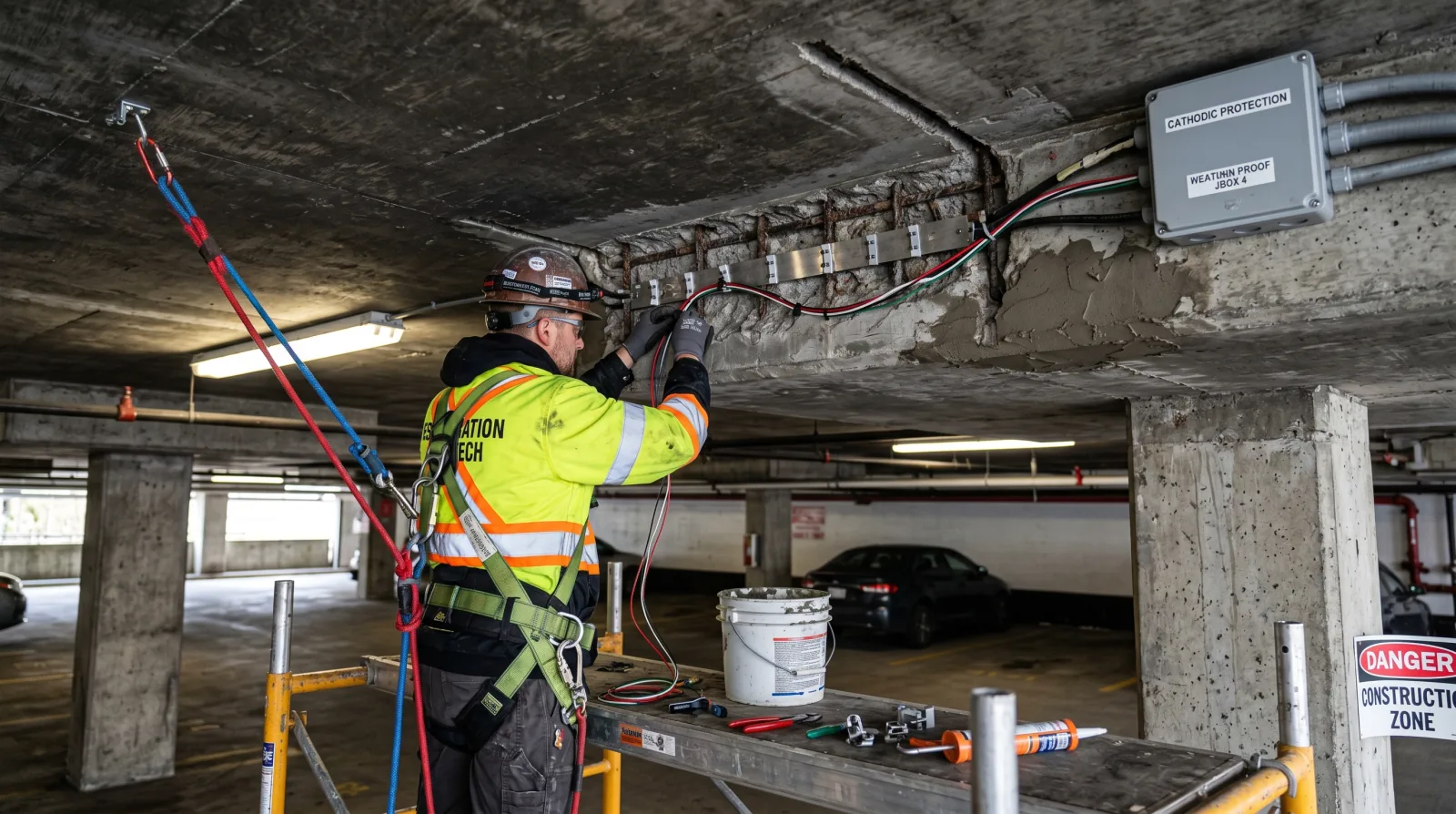
A strata council in Surrey repairs the spalling in their parkade. Three years later, fresh chunks of concrete are lifting off the slab — sometimes right beside the patches they just paid for. The contractor comes back, the council approves another repair, and the cycle resets. Nobody is doing bad work. They’re treating the symptom and leaving the disease in place.
The disease is chloride, and on a salt-contaminated slab, removing visible damage doesn’t stop it. To actually halt the decay, you have to change what’s happening to the steel inside the concrete.
How road salt destroys a parkade from the inside
Concrete normally protects the rebar inside it. The high alkalinity of the concrete forms a thin passive layer on the steel that keeps it from rusting. That protection holds for decades — until something breaks it down. In a Metro Vancouver parkade, that something is chloride.
Every winter, cars drive in off salted streets across Vancouver, Burnaby, and Surrey, dripping salty meltwater onto the slab. That water carries chloride from road salt and de-icing chemicals, and chloride is small enough to migrate down through the concrete to the rebar. Once enough of it accumulates at the steel, it destroys the passive layer, and the steel starts to corrode.
Corroding steel expands — it can occupy several times the volume of the original metal. That expansion cracks the concrete from the inside, lifting the surface off in sheets. That’s spalling and delamination, and it’s why a slab that looked fine starts shedding concrete. The visible damage is the last act. The corrosion that caused it has been running quietly underneath for years.
Why patch repair alone keeps failing
If the chloride is concentrated in a few spots, removing the bad concrete, cleaning the steel, and patching can work. But on a slab where chloride has soaked in broadly, patch-only repair runs into a problem that surprises a lot of councils.
When you cut out a damaged area and fill it with fresh, clean, chloride-free concrete, that new patch becomes a zone where the steel can’t corrode. The contaminated concrete around it still has chloride at the steel. The contrast between the clean patch and the dirty surroundings can actually drive the corrosion in the adjacent contaminated concrete faster — a ring of new damage forms right at the patch edges. This is sometimes called the halo or ring-anode effect, and it’s why patch-only repairs on heavily contaminated slabs often spawn the next round of spalling around themselves.
So the council pays to repair the slab, and the repair seeds the next failure. The underlying causes of spalling in concrete structures don’t go away just because the broken concrete did.
What cathodic protection does differently
Cathodic protection attacks the corrosion reaction itself, at the steel, across the whole protected area — not just where concrete has already broken. There are two main approaches.
Galvanic (sacrificial) anodes are pieces of a more reactive metal, usually zinc. Connected to the rebar, the zinc corrodes preferentially — it gives itself up so the steel doesn’t. These need no power source, are relatively simple to install, and are often embedded at the edges of patch repairs specifically to interrupt the ring-anode effect. They’re low maintenance and largely passive.
Impressed-current systems use an external power supply to drive a small, controlled protective current through the slab via installed anodes. This delivers more controllable and more powerful protection, suited to large or heavily contaminated structures. The trade-off is that it has equipment — a power supply, reference electrodes — and it needs monitoring and periodic adjustment to confirm the steel is staying protected.
Neither approach reverses damage that’s already done. Rebar that has lost cross-section stays lost, and existing spalls still need repair. What cathodic protection does is stop the process, so the slab you repair today doesn’t quietly corrode its way to the next repair.
Testing comes before any decision
You don’t choose between patch repair and cathodic protection by looking at the slab. You choose based on what the concrete and steel are actually doing, which means testing. An engineer takes concrete samples or powder drillings at several depths and locations and has them analyzed for chloride content. Often that’s paired with a half-cell potential survey that maps where the steel is actively corroding across the deck.
Those results tell you how deep the chloride has gone and how widespread it is. A slab with localized contamination is a patch-repair candidate. A slab with high chloride across large areas, where patches will just seed more damage, is where cathodic protection earns its place. Many real projects land in between and use both — patch repair for the damaged areas, galvanic anodes to control the corrosion that patching alone would trigger. The parkade slab restoration process starts with this assessment, not with the chipping hammer.
Stopping corrosion is only half the job
Cathodic protection deals with the steel. It does nothing about the water and salt still arriving on the slab. If you install corrosion control and leave the deck soaking up fresh chloride every winter, you’ve treated one half of the problem and left the source running.
That’s why corrosion control and waterproofing belong in the same project. A traffic-rated membrane and proper drainage keep the salty meltwater off the deck and out of the concrete, so new chloride isn’t continuously feeding the very reaction you just spent money to stop. The membrane protects the slab going forward; the cathodic protection deals with the contamination already in it. Skipping the waterproofing side is one of the recurring parkade waterproofing problems that lets a repaired slab deteriorate again.
Why Vancouver parkades get hit hard
The chloride problem in a Metro Vancouver parkade comes from one place: the road salt and de-icing brine that vehicles drag down the ramp every winter. It drips off bumpers and wheel wells, pools in the low spots and at the bottom of ramps, and soaks into any concrete that isn’t sealed. Over years, that salt builds up in the slab and works its way down to the rebar.
Parkades are also unforgiving environments for concrete. They see constant traffic abrasion on the surface, freeze-thaw cycling at the entrances where outside air reaches the deck, and limited drying because they’re enclosed and shaded. A suspended slab — one that forms the ceiling of the level below — is the worst case, because corrosion there doesn’t just spall the surface; it weakens a structural element overhead, with the falling-concrete risk that goes with it. That’s why a half-cell survey on a suspended parkade slab is worth doing before damage is even visible.
The buildings most exposed are older ones built before waterproofing parkade decks was standard practice, and any structure where the membrane has worn out and never been recoated. On those slabs, decades of winter salt have often already pushed chloride well past the threshold where steel starts to corrode — which is exactly the condition where cathodic protection moves from optional to the only approach that actually stops the cycle.
What this means for your building
If your parkade is on a repair-it-again cycle — spalls coming back, patches surrounded by fresh damage — that’s the signature of chloride contamination that patch repair can’t solve. The path forward is:
- Test the chloride. Get an engineer to sample the slab and map the corrosion. The test result, not the visible spalling, drives the strategy.
- Match the method to the contamination. Localized problem, patch it. Widespread chloride, look hard at cathodic protection — galvanic for simpler cases, impressed-current for large or severe ones.
- Stop the source. Pair any corrosion control with waterproofing and drainage so new salt isn’t refeeding the problem.
- Document the system. If cathodic protection goes in, record it in the building’s files so future councils know it’s there and, for impressed-current systems, keep up the monitoring.
A parkade is one of the most expensive structures a strata owns and one of the hardest to replace. On a chloride-contaminated slab, cathodic protection is the difference between preserving it and demolishing the same spalls every few years until the structure itself runs out of road.
Related guides
- Concrete Restoration Hub — how concrete repair and corrosion control work together
- Rebar Corrosion and Concrete Delamination on Coastal Buildings — the corrosion process in detail
- Parkade Slab Restoration in Vancouver — the full slab repair process
- Concrete Spalling Causes in Strata Towers — what drives spalling and how to stop it
Frequently Asked Questions
More from Parkade Waterproofing Guide
When to Recoat a Parkade Traffic Membrane in Vancouver
Deferring a parkade traffic-coating recoat is how a Richmond strata turns a maintenance bill into a slab replacement. How to read wear before it's too late.
Read article →PMMA vs Polyurethane Traffic Membranes for Vancouver Parkade Decks
Comparing PMMA and polyurethane traffic membranes for Metro Vancouver parkades and balconies — cure speed, service life, cold-weather use, and resident disruption.
Read article →Parkade Slab Restoration in Vancouver: What's Eating Your Concrete From Below
Underground parkades fail from a different direction than balconies — de-icing salt, standing water, and chloride driving corrosion through suspended slabs and columns. Here's how Vancouver parkade restoration actually works.
Read article →