Flat roof systems for BC strata and commercial buildings
A strata council asked to approve a roof replacement is usually handed three bids that name three different membranes and land at three different prices. This hub explains what those systems actually are, which conditions on your building point to which one, and which questions separate a careful roofing bid from a cheap one.
Where we fit, and where we do not
We are a building envelope restoration and waterproofing contractor, not a roofing company. We do not install or replace roofs, and nothing here is a pitch to do so. We work on these roofs constantly, because a roof is where a great many building leaks begin and because our crews access, inspect, and waterproof the surfaces around them. That gives us an informed view of which systems hold up on the BC coast and which bids leave out the parts that matter, without a re-roofing contract riding on the answer. When a roof replacement is the right call, the work belongs with a licensed roofing contractor, ideally one registered to provide an RCABC RoofStar guarantee.
What matters most on a low-slope roof
What the membrane sits on decides more than the membrane does. A combustible deck over occupied suites is the case where an open-flame torch is hardest to justify, and it settles much of the decision on its own.
A roof that holds water is a roof you will be back on early. Correcting slope and clearing drains does more for service life than any product choice, and a serious assessment flags it before recommending a membrane.
Roofs fail at laps, welds, and the flashings around drains, parapets, and penetrations, not in the middle of the field. That is where bids differ and where inspections should focus.
The systems you are likely to be quoted
Four assemblies cover most low-slope roofs on Metro Vancouver strata and commercial buildings. None of them is the best roof in the abstract. Each one is the right answer to a particular set of conditions.
| System | Layers | Typical service life | Where it is strong | What to watch |
|---|---|---|---|---|
| Torch-on SBS modified bitumen | Two plies | About 15 to 25 years | Puncture resistance and 2-ply redundancy. Handles foot traffic and rooftop equipment service better than a single sheet. | Hot work with an open flame. Needs a non-combustible deck or proper protection, plus a fire watch that stays after torching stops. |
| Single-ply TPO or PVC | One ply | About 15 to 25 years | No open flame during install. Reflective surface cuts summer heat gain, and PVC in particular sits in standing water without breaking down. | A single sheet punctures more easily, and the whole roof depends on weld quality. Welds should be probed, not assumed. |
| Spray polyurethane foam (SPF) | Monolithic, sprayed in place | Depends on maintaining the protective coating | Continuous across a complex roof, adds insulation value, and can follow an irregular shape without a joint at every change of plane. | The foam is only as good as the coating over it. Recoating is a scheduled obligation, not an option, and the application is weather-sensitive. |
| Green roof assembly | Membrane plus growing medium | Depends on the membrane beneath | Stormwater retention and a protected membrane that sits out of direct sunlight. | A leak is far harder to find and reach under a planted assembly. The waterproofing below has to be right the first time, and root resistance is not optional. |
Service-life ranges assume the roof is detailed properly and maintained. Where a roof actually lands in its range depends far more on drainage, flashing quality, and annual upkeep than on which membrane is named on the invoice.
The two decisions that come up most
Most roof conversations on a Metro Vancouver strata come down to these two questions. Each guide gives the building science and a decision framework rather than a recommendation to buy something.
Compare Torch-on vs. single-ply roof membranes
SBS modified bitumen against TPO and PVC on BC strata and commercial low-slope roofs. Seams, hot-work fire risk, service life, reflectivity, ponding, and where the cost actually comes from.
Read the guide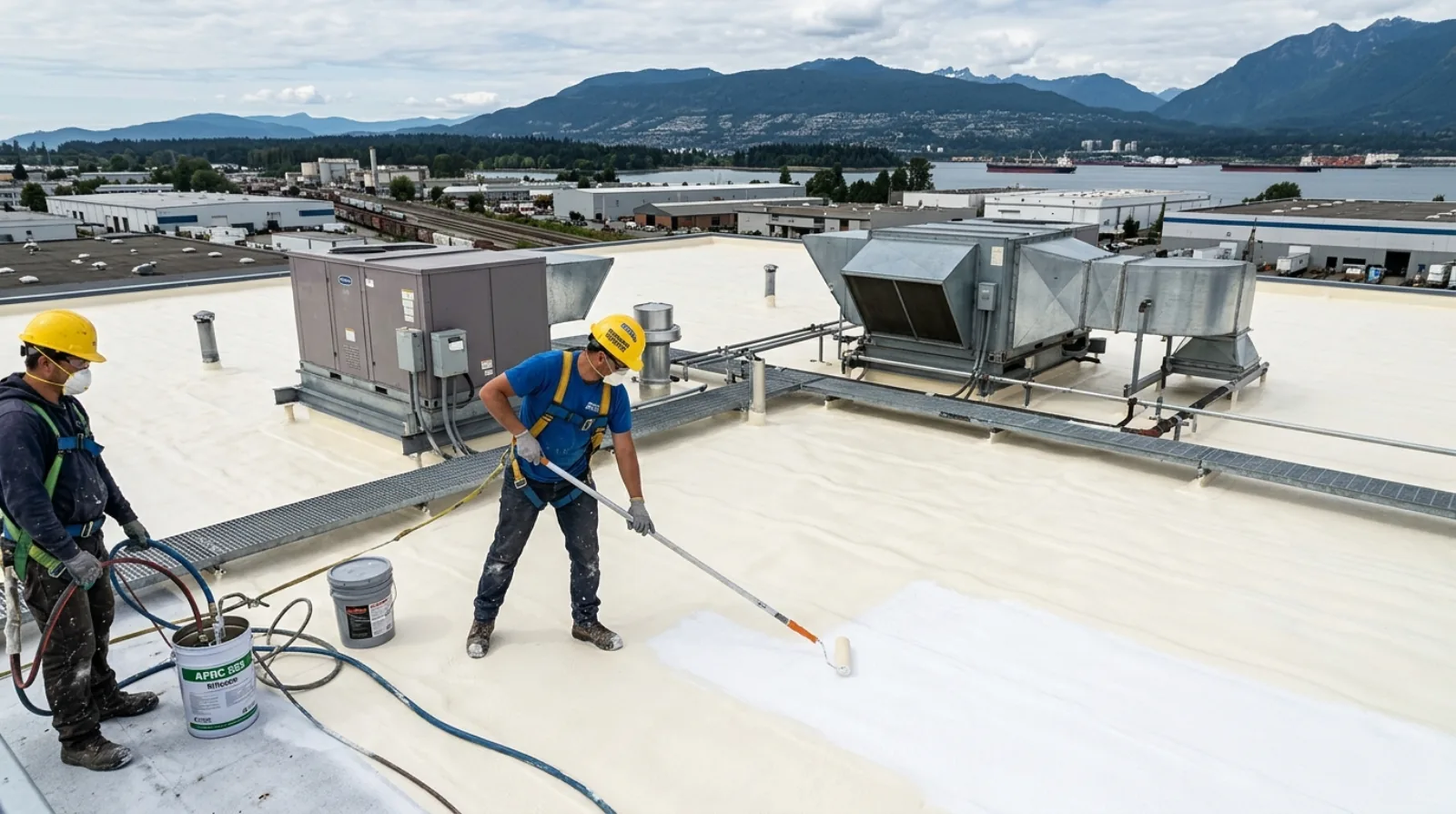 Compare
 Roof recover vs. full tear-off
Overlaying a new membrane on the old one against stripping back to the deck. Code limits on layers, hidden moisture, warranty conditions, and when a recover turns out to be false economy.
Read the guideSix questions that change the answer
Work through these before comparing bids. They are the factors that genuinely move the recommendation, and a contractor who cannot answer them about your specific roof has not looked at it closely enough.
-
What is the deck made of?
This is the first fork in the road. A combustible deck over occupied suites pushes hard away from open-flame torching and toward hot-air welded single-ply. A concrete deck keeps every option open, provided the hot work is properly managed.
-
Does the roof pond after heavy rain?
Standing water is common on Metro Vancouver low-slope roofs through the fall and winter. Single-ply, PVC especially, handles ponding better than multi-ply asphalt. The deeper fix is correcting the slope with tapered insulation so the roof actually drains, which matters more than the membrane name.
-
How much traffic does the roof take?
A roof that crews walk constantly to service mechanical equipment benefits from two thick asphalt plies. A roof nobody goes on rarely needs that armour.
-
How many roof coverings are already up there?
The general principle in Canadian building codes is a maximum of two total coverings on a low-slope roof. Once a roof carries two, a further recover is not permitted and it has to come off to the deck. Layer limits and how they are applied vary by building and jurisdiction, so confirm with your local building authority rather than a rule of thumb.
-
Is the insulation underneath dry?
Wet insulation left in place under a new membrane keeps the assembly damp, invites rot, and voids most warranties. A moisture survey settles this before anyone prices a recover.
-
Are top-floor suites overheating in summer?
A dark roof absorbs solar heat and pushes it into the units below. Reflective single-ply gives you a cool surface out of the box; torch-on needs a reflective cap sheet or coating to get there.
Why roof bids on the same building land so far apart
A strata that collects three roof quotes and sees a wide spread is usually not looking at a pricing error. It is looking at three different scopes. One bid prices a full tear-off, a deck repair allowance, tapered insulation to fix the low spots, and full detailing at every drain and parapet. Another assumes the assembly underneath is sound and prices a recover over top. Those are different pieces of work, and comparing the totals tells you almost nothing until you compare what is in them.
The membrane name is a small part of the number. The larger drivers are roof access, tear-off and disposal, what is found once the roof is opened, insulation and tapered systems to correct drainage, and the amount of detailing around penetrations and rooftop equipment. Torch-on adds hot-work costs that are real line items: protection sheets, extinguishers, and a fire watch that stays on site after the flame goes off. When two bids are far apart, ask each contractor to walk through what they included. A low bid that leaves out preparation, drainage correction, and a wet-insulation allowance is not a saving, it is a change order waiting to happen.
Drainage comes before the membrane
Metro Vancouver sees well over 1,100 mm of rain in a typical year, and low-slope roofs that do not drain cleanly hold standing water through the fall and winter. Ponding is where the systems genuinely diverge: PVC single-ply is built to sit in standing water, while multi-ply asphalt is more sensitive to it over the long term. At higher elevations on the North Shore, freeze-thaw adds another load, because water that ponds and then freezes pushes on any weak lap or weld.
But choosing a membrane that tolerates ponding is managing a symptom. The real fix is correcting the slope with tapered insulation and keeping the drains and scuppers clear so water leaves the roof. A new membrane laid over the same low spots is a roof you will be back on sooner than you should be. This is why an honest roof assessment looks at drainage before it names a product, and why drain and scupper maintenance belongs in the annual plan rather than in the emergency budget.
Where roofs actually fail
Neither torch-on nor single-ply usually fails in the middle of the field. They fail at the details. On torch-on, the classic failure is a lap that never fully bonded, often because the asphalt was too cold or the crew moved too quickly, and it opens years later as a slow leak. On single-ply, it is a weld run too fast or too cool that looked fine on the day and pulls apart later under thermal movement, which is exactly why probing every seam matters. On both, the flashings at parapets, drains, and penetrations are the weak points, because that is where the membrane has to turn corners and seal against other materials.
This is also why a leak rarely enters directly above the stain on someone's ceiling. Water travels along the deck, through insulation, and down a structural element before it appears inside. A repair aimed at the stain instead of the source tends to fail again. Our guide to how a building leak investigation actually works covers the diagnostic sequence, and where a roof leak has already reached the interior, our leak repair and water ingress service page explains how that work is scoped.
Planning the roof into the strata's budget
A roof is one of the largest single line items in a strata's depreciation report, and it is one of the easiest to underestimate, because the report's cost figures are typically based on industry-average pricing that can lag current Vancouver contractor rates. When the depreciation report flags the roof, the next step is a condition assessment that establishes the deck type, the layer count, the moisture condition, and the drainage, not a direct conversion of the report figure into a reserve draw.
That assessment also tells you whether you are budgeting for a recover or a tear-off, which is often a large difference. For how a major envelope expense gets funded under the Strata Property Act, our BC strata guide covers reserve funds, special levies, and strata loans, and the cost guides give calibration ranges for the envelope work around the roof. Budgeting the maintenance alongside the replacement is what lets a roof reach the service life you paid for.
Roof access and working safely up there
Anyone working at the roof edge, or over it, is subject to WorkSafeBC fall-protection requirements, and the anchors used for that work carry their own recertification schedule. On many Metro Vancouver towers the roof is also the staging point for facade work below it, which makes anchor condition a building-wide issue rather than a roofing one. Our rope access hub covers access methods and certification, including the comparison against swing stages and scaffolding.
The roof surface itself is also part of the envelope that our crews work around constantly. Where a roof meets a wall, a parapet, or a canopy, the transition detail is where water most often finds its way in, and those junctions sit squarely in the waterproofing and building envelope repair work we do. A roof assessment that stops at the roof edge misses the details that cause the most trouble.
Quick answers
Which flat roof membrane is best for a Vancouver strata building?
There is no single best membrane, and any contractor who names one before looking at your roof is selling rather than advising. The roof decides it. Start with the deck: a combustible deck over occupied suites pushes toward hot-air welded single-ply, because an open propane torch on that assembly carries a smouldering-fire risk that is hard to justify. Then look at use and drainage. A roof walked constantly for mechanical service benefits from the puncture resistance of two torch-on asphalt plies. A roof that ponds favours single-ply, PVC especially, which is built to sit in standing water. If summer heat into top-floor units is already a complaint, a reflective single-ply surface helps. Both torch-on and single-ply typically last about 15 to 25 years on a Metro Vancouver roof when detailed and maintained well, so service life alone rarely settles the question.
How long does a flat roof last in Metro Vancouver?
Torch-on SBS and single-ply TPO or PVC both typically reach about 15 to 25 years on a Metro Vancouver low-slope roof when they are detailed properly and maintained. Where a roof lands in that range depends far more on the details and the upkeep than on the membrane type. A roof that gets an annual inspection, has its drains cleared, and gets small repairs at the first sign of a lifted lap or a suspect weld will reach the top of the range. A roof left alone until a suite leaks will not, and by then the interior repair often costs more than years of maintenance would have. The coastal climate is a factor too: Metro Vancouver sees well over 1,100 mm of rain in a typical year, so drainage that works is doing a lot of the work of keeping the roof alive.
Can we put a new roof over the old one, or do we need a tear-off?
Sometimes a recover is fine, and sometimes it buries a problem you will pay for later. Two things decide it. First, how many coverings are already on the roof: the general principle across Canadian building codes is a maximum of two total coverings on a low-slope roof, so the original plus one overlay. Once a roof carries two, it has to come off to the deck. Layer limits and how they are applied vary by building and jurisdiction, so confirm the specific requirement with your local building authority rather than assuming. Second, whether the assembly underneath is dry. Wet insulation left under a new membrane keeps feeding water into the deck and voids most warranties, and the RCABC RoofStar Guarantee requires the existing roof to be demonstrably dry and free of wet material. A test cut and a moisture survey answer both questions before anyone prices the work.
Roof articles from the resources library
Metal Flashing Detail Failures in BC Rainscreen Walls
Good cladding doesn't keep a Burnaby wall dry — flashing does. Reverse laps, missing end dams, and bad transitions are why rainscreen buildings still leak, and why the metal almost nobody looks at deserves the attention.
Read article ArticleRoof Drain and Scupper Maintenance on Vancouver Strata Flat Roofs
A clogged roof drain is the cheapest leak you'll ever ignore — until ponding water destroys the membrane. How Burnaby strata roofs fail at the drains.
Read article ArticleEPDM vs TPO Flat Roof Membranes for BC Strata Buildings
Choosing between EPDM and TPO single-ply membranes on a Burnaby strata low-rise comes down to seams, reflectivity, and how each ages in Pacific NW rain.
Read article ArticleSpray Polyurethane Foam Roofing on BC Commercial Buildings: When It Makes Sense
Spray polyurethane foam (SPF) roofing is well established in colder North American climates but used sparingly in coastal BC. Where it works, where it fails, and how it compares to the membrane systems that dominate Metro Vancouver flat-roof installations.
Read articleOther resource guides
Flat roof questions from strata councils
Which flat roof membrane is best for a Vancouver strata building?
There is no single best membrane, and any contractor who names one before looking at your roof is selling rather than advising. The roof decides it. Start with the deck: a combustible deck over occupied suites pushes toward hot-air welded single-ply, because an open propane torch on that assembly carries a smouldering-fire risk that is hard to justify. Then look at use and drainage. A roof walked constantly for mechanical service benefits from the puncture resistance of two torch-on asphalt plies. A roof that ponds favours single-ply, PVC especially, which is built to sit in standing water. If summer heat into top-floor units is already a complaint, a reflective single-ply surface helps. Both torch-on and single-ply typically last about 15 to 25 years on a Metro Vancouver roof when detailed and maintained well, so service life alone rarely settles the question.
How long does a flat roof last in Metro Vancouver?
Torch-on SBS and single-ply TPO or PVC both typically reach about 15 to 25 years on a Metro Vancouver low-slope roof when they are detailed properly and maintained. Where a roof lands in that range depends far more on the details and the upkeep than on the membrane type. A roof that gets an annual inspection, has its drains cleared, and gets small repairs at the first sign of a lifted lap or a suspect weld will reach the top of the range. A roof left alone until a suite leaks will not, and by then the interior repair often costs more than years of maintenance would have. The coastal climate is a factor too: Metro Vancouver sees well over 1,100 mm of rain in a typical year, so drainage that works is doing a lot of the work of keeping the roof alive.
Can we put a new roof over the old one, or do we need a tear-off?
Sometimes a recover is fine, and sometimes it buries a problem you will pay for later. Two things decide it. First, how many coverings are already on the roof: the general principle across Canadian building codes is a maximum of two total coverings on a low-slope roof, so the original plus one overlay. Once a roof carries two, it has to come off to the deck. Layer limits and how they are applied vary by building and jurisdiction, so confirm the specific requirement with your local building authority rather than assuming. Second, whether the assembly underneath is dry. Wet insulation left under a new membrane keeps feeding water into the deck and voids most warranties, and the RCABC RoofStar Guarantee requires the existing roof to be demonstrably dry and free of wet material. A test cut and a moisture survey answer both questions before anyone prices the work.
Why does our flat roof keep leaking after it was repaired?
Because low-slope roofs almost never fail in the middle of the field. They fail at the details: laps and welds, and the flashings at parapets, drains, and penetrations, where the membrane has to turn a corner and seal against another material. A repair that patches the visible stain without tracing the actual entry point tends to fail again, because water rarely enters directly above where it shows up inside. It travels along the deck, through insulation, and down a structural element before appearing on a ceiling. Persistent leaks usually mean either the source was never found or the underlying problem is drainage rather than the membrane. If the roof ponds, laying new material over the same low spots does not fix anything. Our guide to how a building leak investigation works walks through the diagnostic sequence that finds the real source before a repair is scoped.
Is torch-on roofing safe on an occupied building?
It can be, on the right deck and with a disciplined crew, but it needs to be taken seriously. Torch-on is hot work: a propane torch with an open flame melts the underside of the membrane so it welds to the layer below. The specific danger is a fire that starts smouldering under the membrane, in a combustible deck or in trapped dust, and does not show itself right away. It can flare up hours after the crew has packed up. WorkSafeBC treats torching as hot work, and a legitimate crew protects combustible material, keeps charged extinguishers on the deck, and holds a fire watch on site after the flame goes off. On a concrete deck with that discipline in place, the risk drops a long way. On a wood-frame deck over occupied suites, many strata councils and their consultants take the flame off the table entirely and go single-ply, which welds with hot air instead. Some insurers also add conditions or higher premiums for torch work, so check your policy before a torch-on bid gets far.
What is an RCABC RoofStar guarantee and should we ask for one?
RCABC is the Roofing Contractors Association of British Columbia. It publishes roofing practice standards for the province and runs the RoofStar guarantee, which is backed by the association rather than by the individual roofing company. When a RoofStar-registered contractor installs an accepted assembly to the standard, the guarantee covers the roof even if that contractor later goes out of business, which a plain workmanship warranty cannot promise. For a strata that is real protection, because it does not depend on one firm still being around in fifteen years. RoofStar accepts SBS torch-on, TPO, and PVC assemblies, so it is available whichever path you take. Ask any bidder whether the job will carry a RoofStar guarantee, and confirm they are actually registered to provide the one they are quoting rather than taking it on trust.
Not sure whether your roof needs replacing or repairing?
We assess low-slope roofs and the envelope details around them across Vancouver, North Vancouver, West Vancouver, and Burnaby. We check deck type, drainage, ponding, and the flashings at drains and parapets, so your strata knows what it is actually buying before the bids come in.