Rope Access for High-Rise Buildings in Vancouver
Rope access is the practical default for distributed high-rise maintenance work in Metro Vancouver — window cleaning, sealant replacement, localized concrete repairs, condition surveys. It mobilizes in under an hour, leaves no sidewalk footprint, and costs 30–60% less than scaffolding for the scopes it's suited to. This is the working reference for strata councils and property managers deciding which access method fits which project.

Why rope access dominates Metro Vancouver high-rise maintenance
Typical mobilization time — a rope access crew rigs from certified roof anchors and starts work the same morning, versus 2–5 days for a swing stage and 1–3 weeks for full scaffolding.
Typical cost saving versus ground-up scaffolding for maintenance, cleaning, sealant, coatings, and localized repairs — when the scope is distributed across the facade rather than concentrated.
Sidewalk closures, lane permits, and ground footprint on most rope access deployments. A small drop zone is barricaded; everything else stays open.
Rope access vs. swing stage vs. scaffolding
The right access method depends on the scope, payload, height, and building geometry — not on habit or which vendor calls first. Use this guide to make the comparison objectively before you sign a contract.
 Compare
 Rope access vs. swing stage vs. scaffolding
Side-by-side comparison of setup time, mobilization cost, ground disruption, payload capacity, and WorkSafeBC certification requirements — so strata councils and property managers can make an evidence-based access decision for their project.
Read the guide Compare
 Rope access vs. mast climber
When a full-facade recladding or rainscreen retrofit outgrows rope access. Payload limits, setup and anchor requirements, ground footprint, and how cost per square foot flips toward a mast climbing work platform on large continuous scopes.
Read the guide Compare
 IRATA vs. SPRAT certification
How the two rope access certification schemes compare on levels, upgrade hours, and global versus North American recognition, why WorkSafeBC accepts both under Part 34, and exactly what a Vancouver strata or property manager should ask a contractor to verify.
Read the guide FAQ
FAQ Rope access window cleaning: how it works and what it costs
The two-rope WorkSafeBC process, the typical per-pane cost range for strata high-rises, and how to schedule around bylaw notice periods and resident privacy.
Read the guideWhat rope access actually is — and what it's not
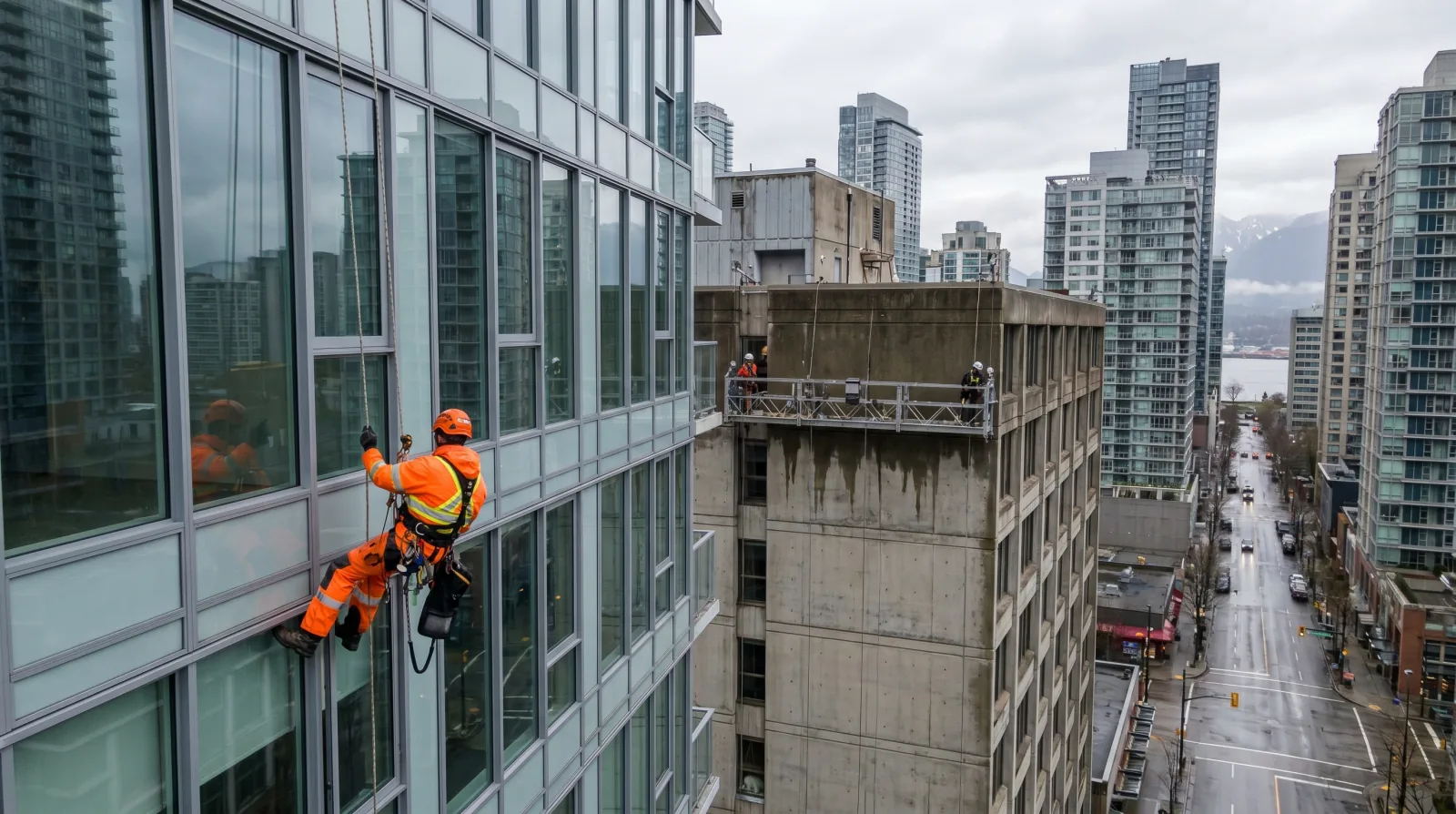
Rope access is a work-positioning system. Two independent ropes are rigged from certified anchors on the roof — one the technician works from, one the safety line — and the technician descends or traverses the facade under full WorkSafeBC Part 11 two-rope redundancy. The key phrase is "two independent ropes": if one system fails, the second holds the load. That's the standard that separates rope access from informal abseiling or window-cleaning bosun's chairs.
In Metro Vancouver, anchors used for recurring access — like the roof anchor systems on most commercial and strata high-rises built in the last 30 years — must be certified by a professional engineer on a five-year load-test cycle. On sites without existing certified anchors, a temporary anchor system is engineered for the project. That certification step is often skipped by non-specialist contractors and is one of the first things a WorkSafeBC inspection will flag.
What rope access cannot do is carry bulk material payload. A technician carries hand tools and materials under roughly 25 kg. When a repair requires large quantities of mortar, a structural glazing unit, or masonry units, the scope needs a swing stage or localized scaffolding for that segment. A capable building envelope contractor will specify the right combination — rope access for survey and distributed work, mechanical access for payload-intensive tasks — rather than forcing every scope into one access method.
WorkSafeBC certification requirements on a BC high-rise
BC's WorkSafeBC Part 11 governs fall protection, and rope access falls under it as a work-positioning system. The specific requirements: two independently anchored ropes, anchors rated and engineered, and technicians trained and competent in the system. In practice, most Vancouver building envelope contractors use IRATA or SPRAT certification as the demonstrated competency standard — IRATA Level 1 through 3 maps to the technician, supervisor, and assessor tiers, and most commercial strata contracts specify IRATA Level 2 supervision as a minimum.
Roof anchors are a separate compliance item. Under WorkSafeBC and the BC Building Code, anchors on high-rises built under post-1990 codes are typically engineered into the roof structure, but certification must be current. A strata asking for proof of anchor certification before authorizing access is following correct procedure — that documentation protects both the building owner and the contractor.
Quick answers
What is rope access for building maintenance?
Rope access is a work-positioning technique where technicians descend and move across a building facade using two independent rope systems rigged from certified anchors on the roof. In British Columbia, the technique follows WorkSafeBC Part 11 fall-protection rules, and technicians are certified by IRATA (Industrial Rope Access Trade Association) or SPRAT (Society of Professional Rope Access Technicians). It allows crews to reach any point on a high-rise facade without scaffolding or a suspended platform.
When is rope access the right choice for a high-rise project in Vancouver?
Rope access is best suited to scopes where the work is distributed across the facade rather than concentrated in one spot — window cleaning, sealant replacement, localized concrete spall repairs, elastomeric coating touch-ups, annual condition surveys, and post-storm damage assessments. It is the practical choice for buildings where ground disruption, sidewalk closures, and resident privacy are concerns, and where speed of mobilization matters. It is not the right tool when bulk material payload, structural glazing replacement, or simultaneous multi-trade access is required.
What WorkSafeBC certifications are required for rope access on a BC high-rise?
WorkSafeBC Part 11 requires all technicians working from rope access systems to use two independent ropes — a working line and a separately anchored safety line. The anchor systems must be engineered, typically certified by a professional engineer, and inspected on a schedule. In practice, most Vancouver contractors use IRATA or SPRAT certification to demonstrate the competency standard. Roof anchors used for recurring access must also be load-tested and certified by a P.Eng. on a five-year cycle.
From the resources library
Swing Stage and Street Use Permits for Downtown Vancouver Facade Work
Before a swing stage touches a downtown Vancouver tower, the City wants a street use permit and a pedestrian protection plan. Here's what that involves, why it delays projects, and how rope access sidesteps most of it.
Read article ArticleWhy Gutter and Scupper Cleaning Belongs in Your Rope Access Maintenance Visit
Blocked gutters, scuppers, and roof drains send water where it was never meant to go — usually into the parapet or down the face of the building. Why this belongs in the same rope access visit as window cleaning and sealant inspection, not a separate call.
Read article ArticleRoof Anchor Recertification: WorkSafeBC Rules for Vancouver High-Rises
BC roof anchors for rope access must be engineer-certified and inspected yearly. Here is what building owners in Metro Vancouver must keep on file to stay compliant.
Read articleServices this guide connects to
Overhead glass at ground level has its own access and safety questions, since the work sits directly above a doorway the public uses. The glass canopies and awnings hub covers cleaning method, staining, and leaks on entrance canopies.
Rope access questions
What is rope access for building maintenance?
Rope access is a work-positioning technique where technicians descend and move across a building facade using two independent rope systems rigged from certified anchors on the roof. In British Columbia, the technique follows WorkSafeBC Part 11 fall-protection rules, and technicians are certified by IRATA (Industrial Rope Access Trade Association) or SPRAT (Society of Professional Rope Access Technicians). It allows crews to reach any point on a high-rise facade without scaffolding or a suspended platform.
When is rope access the right choice for a high-rise project in Vancouver?
Rope access is best suited to scopes where the work is distributed across the facade rather than concentrated in one spot — window cleaning, sealant replacement, localized concrete spall repairs, elastomeric coating touch-ups, annual condition surveys, and post-storm damage assessments. It is the practical choice for buildings where ground disruption, sidewalk closures, and resident privacy are concerns, and where speed of mobilization matters. It is not the right tool when bulk material payload, structural glazing replacement, or simultaneous multi-trade access is required.
What WorkSafeBC certifications are required for rope access on a BC high-rise?
WorkSafeBC Part 11 requires all technicians working from rope access systems to use two independent ropes — a working line and a separately anchored safety line. The anchor systems must be engineered, typically certified by a professional engineer, and inspected on a schedule. In practice, most Vancouver contractors use IRATA or SPRAT certification to demonstrate the competency standard. Roof anchors used for recurring access must also be load-tested and certified by a P.Eng. on a five-year cycle.
Is rope access safe for occupied strata buildings?
Yes — rope access has an excellent safety record compared to other suspended access methods. A 2006 study across the IRATA membership found a fatal-accident rate of 0.009 per 1,000 hours worked, lower than many construction activities. On occupied buildings, the main resident impact is a small barricaded zone at the base of the drop while work is in progress. Because ropes are rigged and removed daily, there is no long-term obstruction of views, lighting, or balcony access as with a swing stage.
How much cheaper is rope access than scaffolding?
For distributed-scope maintenance work — window cleaning, sealant replacement, localized repairs — rope access typically costs 30–60% less than ground-up scaffolding when mobilization, labour, and rental time are totalled. The savings are largest on complex facades and phased projects where scaffolding would have to be moved repeatedly. For comparison, a single-facade swing stage is typically 15–30% less than scaffolding.
Do rope access technicians clean windows or do structural repairs?
Both. On a Metro Vancouver high-rise, rope access crews routinely handle window cleaning, sealant and caulking replacement, elastomeric coating applications, localized concrete spall chipping and patching, leak investigation from the exterior, and inspection surveys. The limiting factor is payload — technicians carry hand tools and materials, not bulk material quantities. When a repair requires large volumes of mortar, structural glazing units, or masonry, a swing stage or scaffolding is added for that scope.
Need rope access work on a Metro Vancouver high-rise?
Our IRATA-certified technicians work on strata and commercial buildings across Vancouver, North Vancouver, West Vancouver, and Burnaby — window cleaning, sealant replacement, concrete repairs, and building envelope surveys.