Why Gutter and Scupper Cleaning Belongs in Your Rope Access Maintenance Visit
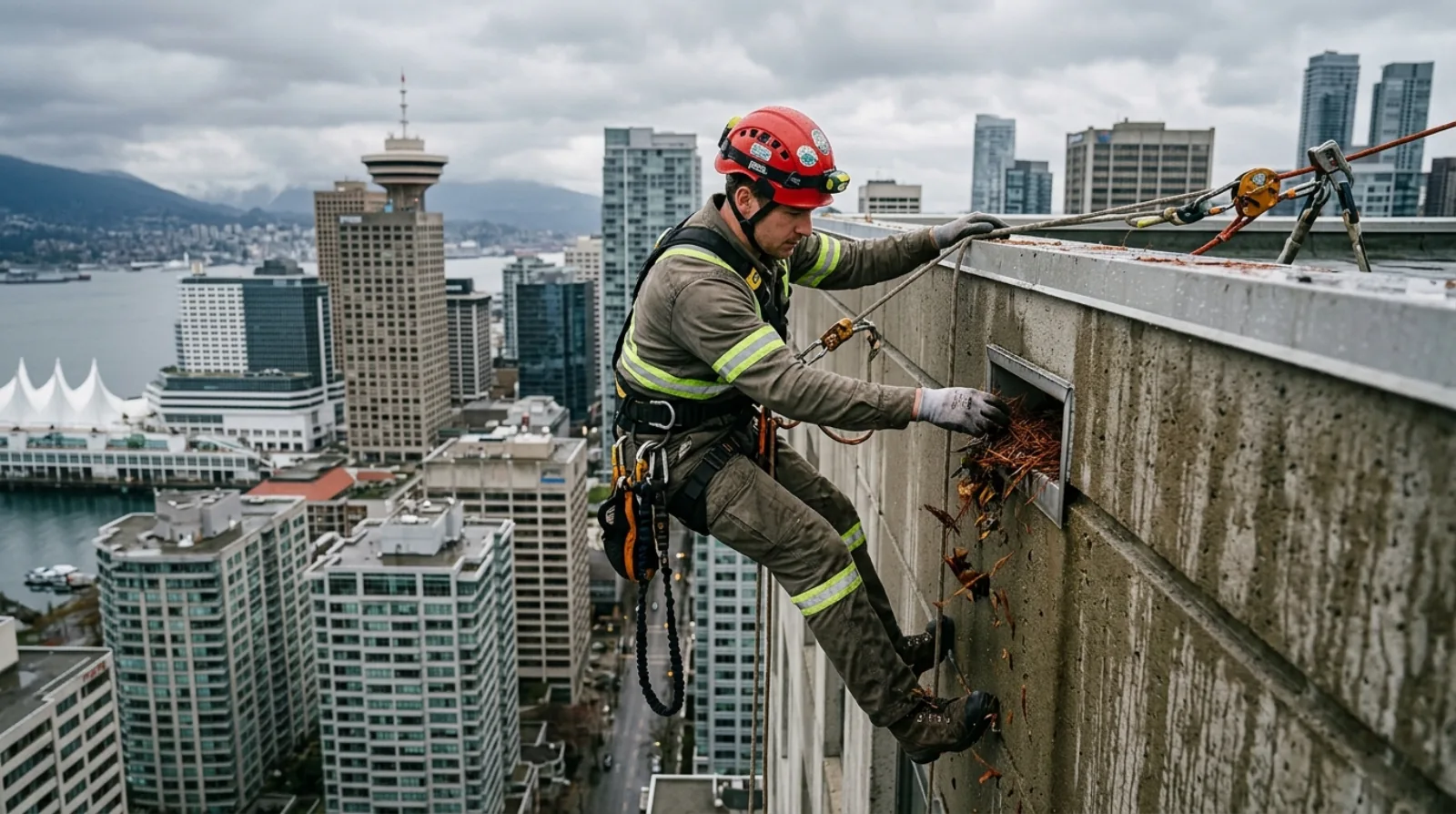
A North Vancouver strata spent the better part of a wet season chasing a leak on the top floor. The sealant around the nearest window got replaced. A section of exterior coating got redone below the stain. The leak kept coming back after every heavy rain, and nobody could explain why the repairs weren’t holding.
The actual source was forty feet above the stain: a parapet scupper packed with cedar needles from a tree overhanging the roofline. Every storm heavy enough to test the drainage system backed water up against the parapet instead of letting it drain, and the water went over the top and down the face of the building, well away from where anyone was looking. The wall was never the problem. The blocked drain was.
Why this gets missed
Roof drains, gutters, and parapet scuppers are the first thing water hits on a high-rise, and they’re also the part of the building nobody looks at unless something has already gone wrong. Window cleaning contracts cover the glass. Sealant inspections cover the joints. Coating work covers the wall face. Drainage clearing rarely has an obvious line item, so it becomes the gap between scopes.
That gap matters more here than in a drier climate. Metro Vancouver’s wind-driven rain tests every drainage path on a building repeatedly through the wet season, not just during the occasional storm. A drain that runs clear in July can be packed solid by October if nobody has checked it since spring, and by the time an overflow shows up as a stain on a lower floor, the actual cause is sitting undisturbed on the roof.
What actually blocks a drain up there
The usual culprits on a Vancouver building: leaf litter and conifer needles from nearby trees (cedar and fir needles are a particular problem because they mat together instead of blowing clear), grit and roofing granules that wash off an aging membrane, moss growing in low-flow areas that never fully dry, and leftover construction debris from past roof work that was never swept up. A scupper is especially vulnerable because it’s a narrow through-wall opening by design — it doesn’t take much packed debris to choke one off completely.
Where the water goes instead
Water always finds a path. When the intended one is blocked, the alternate paths are rarely good ones:
- Ponding on a flat or low-slope roof. Standing water adds dead load the roof structure wasn’t necessarily designed to carry long-term, and it accelerates membrane wear right at the pond’s edge, where the material cycles between wet and dry.
- Backup over a parapet. At a blocked scupper, water backs up against the coping cap and, once it’s deep enough, goes over the parapet edge and runs down the exterior wall — staining the facade, testing wall coatings and sealant joints that were never meant to handle that volume, and sometimes finding a marginal joint to get behind the cladding.
- A leak that looks like it’s coming from somewhere else entirely. Because water travels before it shows up as damage, an overflow at the roofline can present as a leak two or three floors down, in a location that has nothing to do with the actual cause. That’s exactly the pattern that sends a strata council chasing sealant and coating repairs that were never going to fix the problem — the same diagnostic trap covered in our guide on how a building leak investigation actually works.
Why this belongs in the same visit, not a separate call
A rope access crew rigged from roof anchors for window cleaning or a facade inspection is already at the roofline with the access set up. Clearing accessible gutters, scuppers, and drain strainers while that access is in place costs very little on top of the existing scope, because the expensive part — getting a certified technician safely to that height — has already been paid for.
Scheduling drainage clearing as a separate visit means a second mobilization: a different crew, a new access setup, a new site notice to residents. For most strata buildings, that’s a harder cost to justify than simply expanding the scope of a visit that’s already happening. This is the same logic behind bundling sealant inspection into a routine window cleaning drop, covered in our spring and fall maintenance checklist.
What a proper check covers
Clearing a drain isn’t just pulling out the visible debris. A thorough pass includes:
- Removing debris from gutters, roof drains, and scuppers, and checking that the strainer or dome cover (where fitted) is intact and correctly seated
- Confirming water actually flows through the cleared path, not just that the visible blockage is gone
- Checking the parapet coping cap and joint condition while access is already in place at that elevation
- Noting any standing water, membrane wear at drain locations, or scupper corrosion for the building’s maintenance record
That last point is worth being deliberate about. A drain that’s clear today but shows wear at its edges is a maintenance item worth flagging before it becomes next season’s overflow, and it’s the kind of detail that only gets caught when someone is physically up there looking, not inferred from a leak two floors down.
Rope access, not a ladder at the roofline
Clearing gutters and scuppers on a high-rise from rope access, under SPRAT or IRATA certification and WorkSafeBC OHS Regulation Part 11 fall protection, avoids the awkward and often more exposed alternative: a ladder or temporary platform right at the roof edge. It’s the same access method and the same safety standard already governing window cleaning and facade inspection on these buildings — see our guide on rope access for high-rise buildings for how that access method compares to scaffolding and swing stages.
If your building’s maintenance contract covers window cleaning but has never mentioned drainage, that’s worth a direct question to whoever holds the scope. The answer tells you whether anyone has actually been checking the part of the building that decides where all that Vancouver rain ends up.
Every drainage path on the building, from roof drains to site grading, is covered in our building drainage hub, including a seasonal maintenance calendar for Metro Vancouver.
Frequently Asked Questions
More from Rope Access Guide
Swing Stage and Street Use Permits for Downtown Vancouver Facade Work
Before a swing stage touches a downtown Vancouver tower, the City wants a street use permit and a pedestrian protection plan. Here's what that involves, why it delays projects, and how rope access sidesteps most of it.
Read article →Roof Anchor Recertification: WorkSafeBC Rules for Vancouver High-Rises
BC roof anchors for rope access must be engineer-certified and inspected yearly. Here is what building owners in Metro Vancouver must keep on file to stay compliant.
Read article →