Roof Access Planning: The Hatch, the Anchors, and the Route in Between
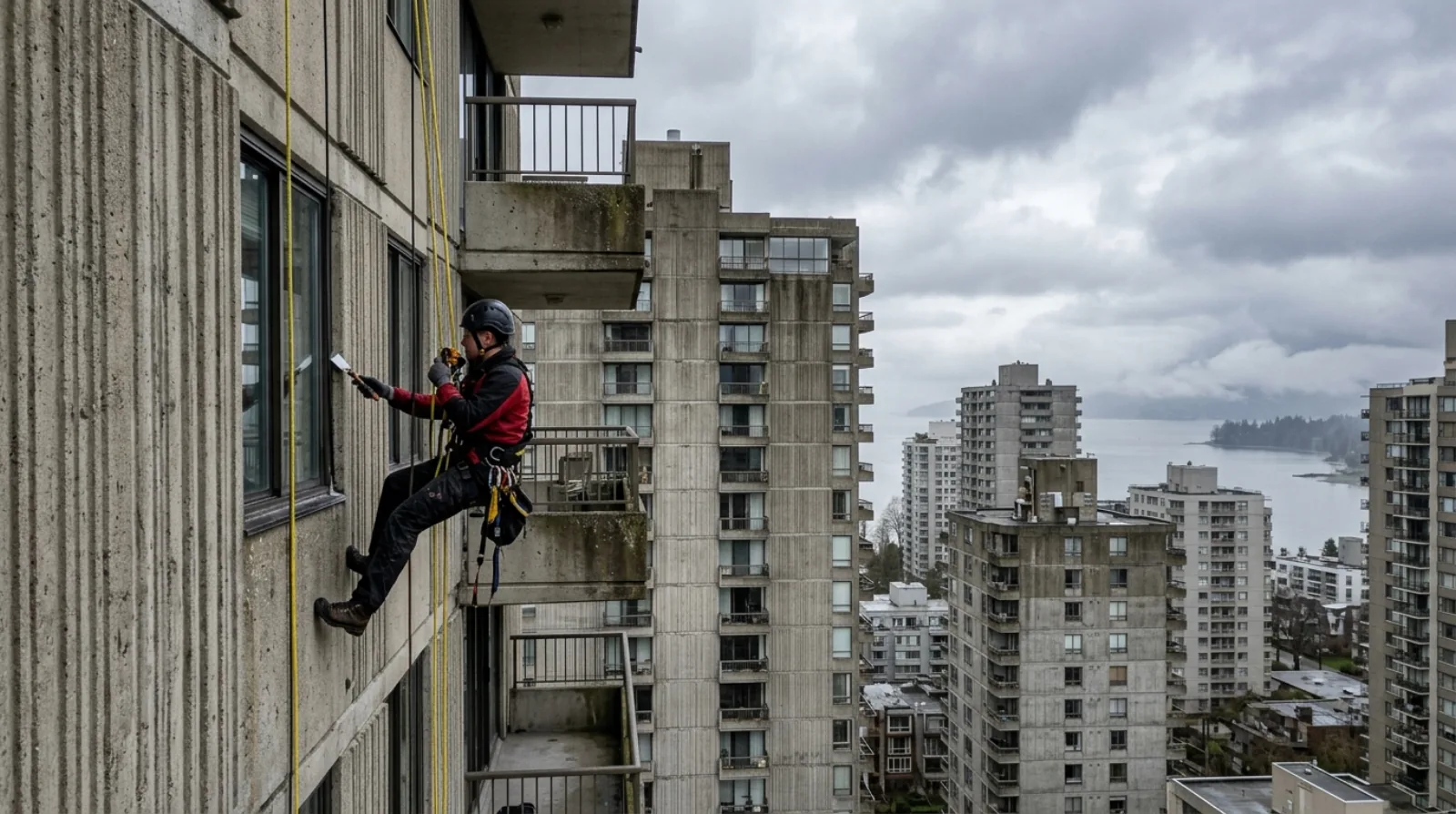
A rope access crew arrives on a Monday morning to start a restoration project. By mid-morning they have packed up and left without doing any work, and the strata receives an invoice for the mobilization anyway.
The reason, in a scenario that plays out more often than it should: the roof anchor certification expired more than a year ago, and nobody checked.
Every piece of exterior work on a mid-rise or high-rise depends on a technician being able to get to the roof and connect to something rated to hold them. That route and those anchors belong to the building, which makes them the strata’s responsibility rather than the contractor’s. They are also the part of a project that is easiest to overlook, because nobody goes up there between projects.
Why anchors are the strata’s problem
A roof anchor is an engineered attachment point fixed to the building structure. Ropes and fall protection connect to it, and it transfers the load of a suspended worker into the building. It is a permanent part of the building in the same way the roof membrane is.
That means the strata is responsible for having anchors installed, maintained, and certified. The contractor’s responsibility is different: they must inspect anchors before use, work within the rated capacity, and refuse to use anything that is uncertified or appears damaged.
Neither party can hand their obligation to the other. A strata cannot ask a contractor to accept an uncertified anchor, and a contractor cannot be held responsible for a building’s failure to maintain one. This split catches councils out, because the anchors sit on the roof looking permanent and maintenance-free, and the certification requirement is invisible until it stops a job. The recertification requirement is set out in the post on WorkSafeBC roof anchor recertification.
The route to the roof
Before anyone reaches an anchor, they have to get to the roof, and that route is worth walking before a contractor does.
Start at the building entrance and follow the path a technician would take. Stairs, locked doors, service corridors, and the final ladder or stair to the hatch. Note who holds keys for each door and whether any part of the route runs through a unit or a space requiring a resident’s cooperation, because that becomes a scheduling constraint.
At the hatch itself, several things matter that nobody thinks about until they are a problem.
Size. Rope access equipment, sealant, coating materials, and tools have to come up through the opening. A hatch sized for a person to inspect a roof may not take a full equipment load, which means more trips or a different route.
Operation. The hatch has to open fully and stay open. Hatches with failed gas struts or seized hinges that need to be propped are a hazard for someone climbing through with equipment.
The ladder or stair. A fixed ladder that has loosened at its anchors, corroded, or lost rungs is a fall hazard on the way to a fall protection job. This gets missed because it is inside a service space nobody visits.
The landing. At the top there needs to be a safe place to stand and stage equipment, with guarding where the hatch opens near a roof edge or a level change.
This route is also the path a rescue would take, which is what turns it from a convenience issue into a safety one.
Anchor layout versus the work you need done
An anchor system that is certified and in good condition can still be inadequate for a given project, and this is the second most common planning surprise.
Many anchor layouts on residential towers were designed around window cleaning. Window cleaning drops follow predictable lines down the main faces of the building at regular intervals, and an anchor layout serving that need can be perfectly adequate for it while leaving significant areas unreachable.
Restoration work has different requirements. It needs to reach specific joints, specific concrete repairs, and specific coating areas, which may sit in recessed corners, on setback elevations, at re-entrant angles, under overhangs, or on faces the window cleaning route never covers. A technician can only work where they can rig safely, and rigging is constrained by where the anchors are.
The way to catch this is to map anchors against work areas during planning. Take a roof plan, mark every anchor with its identification and certification date, then overlay the elevations and areas the project needs to reach. Gaps show up immediately.
Where gaps exist, the answer is usually additional anchors, engineered for the specific locations and loads and installed into suitable structure. That takes time: design, installation, then certification. Arranged in advance it is a modest line item. Discovered on the first morning of work it becomes a delay and a change order, in the environment described in the post on envelope tender scope of work where the building has the least negotiating leverage.
Certification, and what an expired one means
Anchors require periodic inspection and recertification by a qualified engineer, plus a pre-use inspection by the technician connecting to them each time.
The recertification produces documentation: a report identifying each anchor, its condition, its rated capacity, and confirmation that the system meets requirements. The strata should hold that report and know its date. If nobody on the council knows where it is or when it was issued, that is worth resolving before it becomes urgent.
An expired certification stops work. There is no negotiating around it, because a contractor connecting to an uncertified anchor is exposing their technicians and their own compliance standing. Buildings sometimes push back on this, having watched crews use the same anchors for years, but the requirement is not about whether the anchor looks fine.
Anchors can also fail inspection. Corrosion at the base plate, a compromised structural connection, damaged hardware, or deterioration of the roof assembly around the penetration all show up in inspections. A failed anchor needs repair or replacement, which is a bigger and slower job than recertification, and one more reason to review certification well ahead of a project rather than alongside it.
The rescue plan has to be real
Rope access work requires a written rescue plan before it begins. This is not paperwork. It describes how a technician suspended on rope who cannot self-rescue will be reached and brought to safety, and it has to be achievable on the specific building.
A rescue plan depends on the anchor positions, because a rescuer needs to be able to get to the casualty. It depends on the access route, because equipment has to reach the roof. It depends on the equipment on site and the crew’s training.
Which is why a plan written generically and filed in a binder is worse than useless: it creates the appearance of preparation without the substance. When a council is reviewing a contractor’s safety documentation, the question worth asking is whether the plan describes their building, with their anchors, in their configuration. The professional standards that underpin this are covered in the guide on IRATA versus SPRAT certification.
Why rope access makes access planning simpler, not harder
There is a common assumption that rope access is the demanding option because it requires anchors. In practice the alternatives have their own, often larger, access requirements.
A swing stage needs roof structure capable of supporting outrigger beams and counterweights, plus staging space on the roof and a rigging plan for each drop position. A boom lift needs ground space, adequate ground bearing capacity, and a clear approach, and on a downtown site it frequently needs street occupancy permits, as described in the post on swing stage street use permits in downtown Vancouver. Scaffolding needs ground space, a longer erection and dismantling schedule, and a large footprint that affects residents for the duration.
The relative merits are set out in the guide on rope access versus scaffolding and swing stage. The relevant point here is that every access method has building-side requirements that need to be verified in advance. Rope access concentrates those requirements in the anchor system, which has the advantage of being a single, well-defined thing a strata can inspect, certify, and budget for.
What to review, and when
Do this while preparing the tender documents, not after awarding the contract.
Walk the route from entrance to roof and note anything that would obstruct a person carrying equipment. Confirm the hatch operates properly and the ladder is sound. Find every anchor, record its position on a roof plan, and note its identification tag and certification date. Obtain the current certification report and check it is in date. Overlay the anchor positions against the areas the project needs to reach and identify anything unreachable. Confirm that a rescue is achievable from the available anchor positions.
Each of these takes an hour or two. Together they prevent the two most common access failures on a strata project: a crew that cannot start because the certification lapsed, and a crew that cannot finish because the anchors do not reach the work.
Both cost real money when they surface on site. Both cost almost nothing when they surface during planning.
Sources and further reading
- WorkSafeBC, Occupational Health and Safety Regulation Part 11 (Fall Protection) and Part 34 (Rope Access), referenced 2026
- CSA Z91, Health and Safety Code for Suspended Equipment Operations, referenced 2026
- CSA Z271, Safety Code for Suspended Platforms, referenced 2026
- SPRAT and IRATA published certification standards, referenced 2026
- Allweathercoating access planning records, Metro Vancouver, 2026
Frequently Asked Questions
More from Rope Access Guide
Rope Access vs Boom Lift for High-Rise Facade Work in BC
A boom lift can reach the lower floors of a Richmond mid-rise from the street. It can't reach the 30th floor of a downtown Vancouver tower. Where each tool wins, and why.
Read article →Swing Stage and Street Use Permits for Downtown Vancouver Facade Work
Before a swing stage touches a downtown Vancouver tower, the City wants a street use permit and a pedestrian protection plan. Here's what that involves, why it delays projects, and how rope access sidesteps most of it.
Read article →Why Gutter and Scupper Cleaning Belongs in Your Rope Access Maintenance Visit
Blocked gutters, scuppers, and roof drains send water where it was never meant to go — usually into the parapet or down the face of the building. Why this belongs in the same rope access visit as window cleaning and sealant inspection, not a separate call.
Read article →