Swing Stage and Street Use Permits for Downtown Vancouver Facade Work
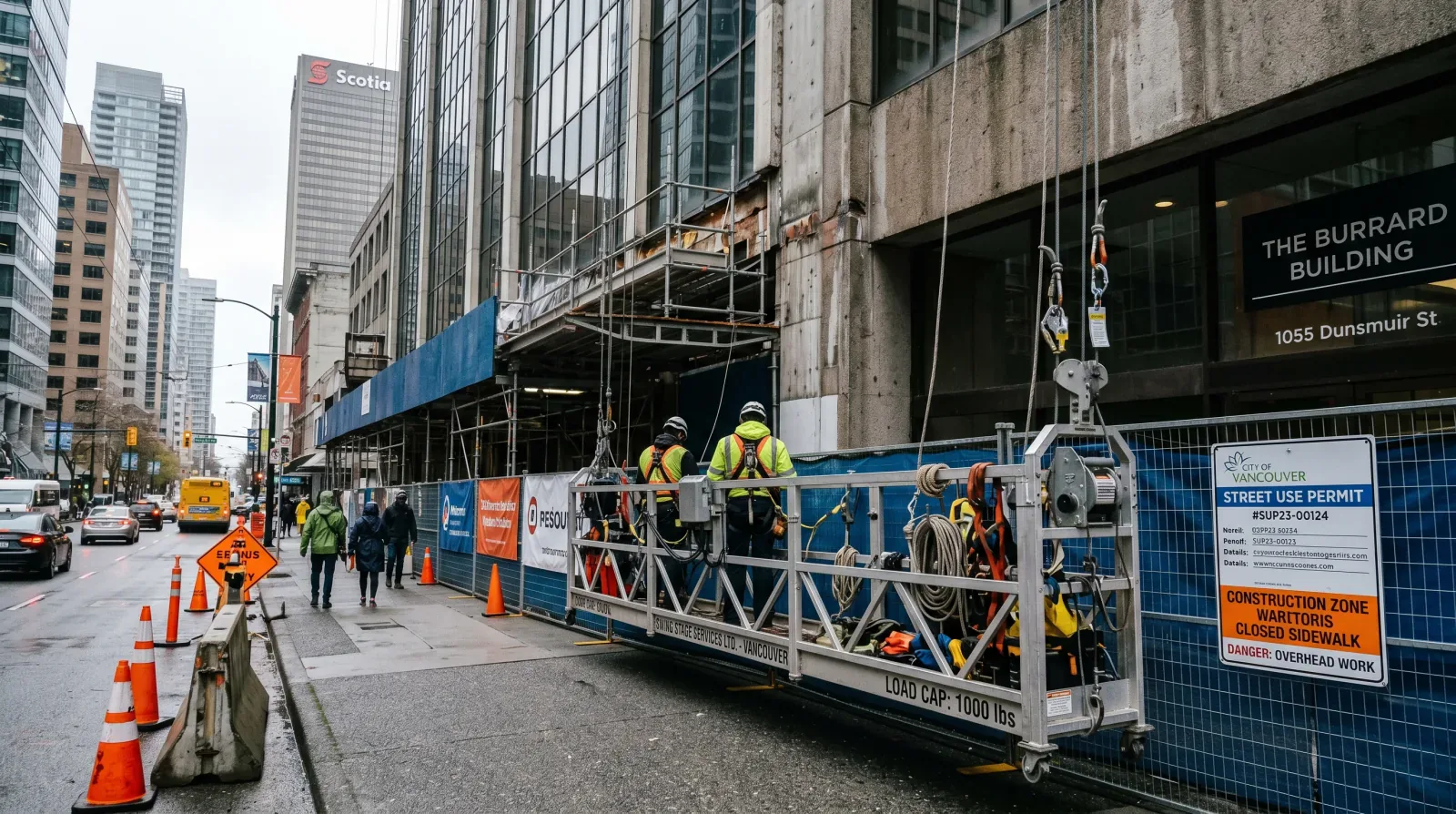
A facade restoration on a downtown Vancouver office tower can sit idle for weeks before anyone touches the wall. The sealant is failing, the contractor is booked, the strata has approved the budget — and nothing happens, because the swing stage can’t go up until the City signs off on occupying the sidewalk below it. That sidewalk is public space, and using it for construction is its own approval process.
Property managers tend to budget for the work on the wall and overlook the work it takes to legally stand below it. On a street-fronting tower, that second part often drives the schedule more than the repair does.
What a street use permit actually covers
The City of Vancouver issues street and sidewalk use permits for any temporary use of public space during construction — the sidewalk, a traffic lane, or the airspace above them. A swing stage on a downtown tower touches all three. The davits and counterweights sit somewhere, the platform swings through the airspace over the sidewalk, and there’s a drop zone below where tools or debris could fall.
That permit is separate from your building permit. It carries its own fees, its own conditions, and a defined time window. It’s reviewed against how you plan to keep pedestrians and traffic safe, which means the City wants a protection plan before it grants anything. On a high-traffic downtown block, expect more scrutiny than on a quiet side street.
Pedestrian protection is the slow part
The permit isn’t just paperwork — it’s a commitment to physically protect the people walking below. In practice that means:
- An overhead protected walkway or canopy so pedestrians can pass under the work without exposure to falling objects
- Hoarding or fencing around the rigging and the drop zone
- Signage and wayfinding to redirect foot traffic
- A flag person or traffic management where a lane is affected
Building that protection takes time and trades of its own, and dismantling it at the end takes more. None of it is the facade repair. It’s the cost of getting a platform onto a public sidewalk and keeping the public safe while it’s there.
Why staging delays the whole project
Here’s the sequence that catches people out. The work on the wall can’t start until the swing stage is rigged. The swing stage can’t be rigged until the pedestrian protection is built and the street use permit is in hand. The permit takes lead time. So the real timeline looks like this:
permit lead time → rigging and counterweighting → pedestrian protection setup → then the actual sealant, coating, or repair work.
On a tight downtown site, that front-end staging can take longer than the facade work itself. A strata that approved a “two-week sealant job” can find itself a month in before a technician reaches the first joint. The work didn’t grow — the access did.
This is also why rushing a swing stage project rarely speeds it up. The bottleneck is usually the permit and the protection, not the crew.
How rope access changes the math
Rope access doesn’t put a platform on the sidewalk. IRATA or SPRAT certified technicians descend the building on two independent ropes — a working line and a backup — anchored at the roof. There’s no swing stage to rig, no davits and counterweights to stage at street level, and no platform swinging through the airspace over pedestrians.
That removes most of what the street use permit is built to manage. There’s still a drop zone below the work that has to be controlled, so some street-level management may apply, and the work still runs under WorkSafeBC Part 11 fall protection standards. But you skip the davits, the platform footprint, and most of the permitted ground staging that drives swing stage lead time. On the right job, that’s the difference between a multi-week setup and a same-week start.
The trade-off matters too. A swing stage gives you a stable working deck and real load capacity — necessary for heavy material handling, large cladding panels, or trades that need somewhere to set out tools and stock. Rope access is built for touch-every-joint work: sealant restoration, coating, inspection, and minor concrete repair. For a sealant program spread across a whole elevation, that’s exactly the kind of work it does well, and the access method usually drives the cost more than the materials do.
Roof anchors come into it too
If you’re choosing rope access, the building’s roof anchors matter, because that’s what the technicians tie into. Anchors have to be in place, rated, and current on their certification before work starts. A lapsed or missing anchor can stall a rope access project the same way a missing permit stalls a swing stage one. It’s worth confirming the roof anchor recertification status early, so the access method you chose to save time doesn’t get held up by something you could have checked in advance.
For downtown buildings without adequate roof anchors, that’s a planning item — sometimes anchors can be installed as part of the project, sometimes a swing stage becomes the more practical choice. A contractor who works both methods will tell you straight.
The hidden costs people miss with swing stage staging
Beyond the permit fee itself, a street-fronting swing stage carries a string of costs that don’t show up in a quick estimate. The pedestrian protection has to be designed, built, maintained for the duration, and then taken down — that’s labour and materials on both ends. A high-traffic downtown block may need a flag person on site whenever the work is overhead. If the permitted window expires before the work finishes, you’re renewing the permit and possibly re-staging. And every day the sidewalk is occupied is a day a neighbouring business is looking at hoarding in front of their storefront, which is its own source of friction and complaint.
None of these are reasons to avoid a swing stage when the job genuinely needs one. They’re reasons to count the full cost of the access method — not just the platform rental — when you compare it against rope access. On a touch-every-joint facade job, the platform’s load capacity is sitting idle most of the time anyway, so you’re paying for staging and street occupation you don’t really use. That’s the comparison that often tips a sealant or coating program toward rope access on a downtown tower.
Plan the street, not just the wall
The other thing worth doing early is talking to whoever manages the building’s relationship with the street — the property manager, and on a strata, the council. A sidewalk closure or lane occupation affects more than the building. It affects deliveries, accessibility, neighbouring tenants, and pedestrian flow on the block. Getting ahead of that, rather than surprising everyone the morning the hoarding goes up, smooths the project and reduces the complaints that can stall a job mid-stream.
What to do before you scope the project
Treat access as a first-order decision, not a line item you sort out later. When you plan a facade project on a downtown tower:
- Decide the access method early — it drives the schedule and a large part of the cost. Get a contractor to assess rope access against swing stage for your specific scope and elevation.
- Confirm who pulls the permit — usually the contractor, but put it in writing so there’s no gap in who arranges and pays for the street use permit and the pedestrian protection.
- Check the roof anchors — if you’re leaning toward rope access, verify the anchors are present, rated, and certified before you commit.
- Build in lead time — a street use permit that lands late pushes everything behind it. The same is true for anchor recertification on a rope access job.
The work on the wall is rarely the hard part to schedule. Reaching the wall is. Getting the access method right — and lined up early — is what keeps a facade project on time.
Related guides
- Rope Access Hub — how rope access works for facade and envelope work
- Rope Access vs Swing Stage — choosing the right method for the job
- Rope Access vs Scaffolding and Swing Stage — a deeper comparison of access options
- WorkSafeBC Roof Anchor Recertification for High-Rise Buildings — keeping anchors current for rope access
Frequently Asked Questions
More from Rope Access Guide
Why Gutter and Scupper Cleaning Belongs in Your Rope Access Maintenance Visit
Blocked gutters, scuppers, and roof drains send water where it was never meant to go — usually into the parapet or down the face of the building. Why this belongs in the same rope access visit as window cleaning and sealant inspection, not a separate call.
Read article →Roof Anchor Recertification: WorkSafeBC Rules for Vancouver High-Rises
BC roof anchors for rope access must be engineer-certified and inspected yearly. Here is what building owners in Metro Vancouver must keep on file to stay compliant.
Read article →