Rope Access vs Boom Lift for High-Rise Facade Work in BC
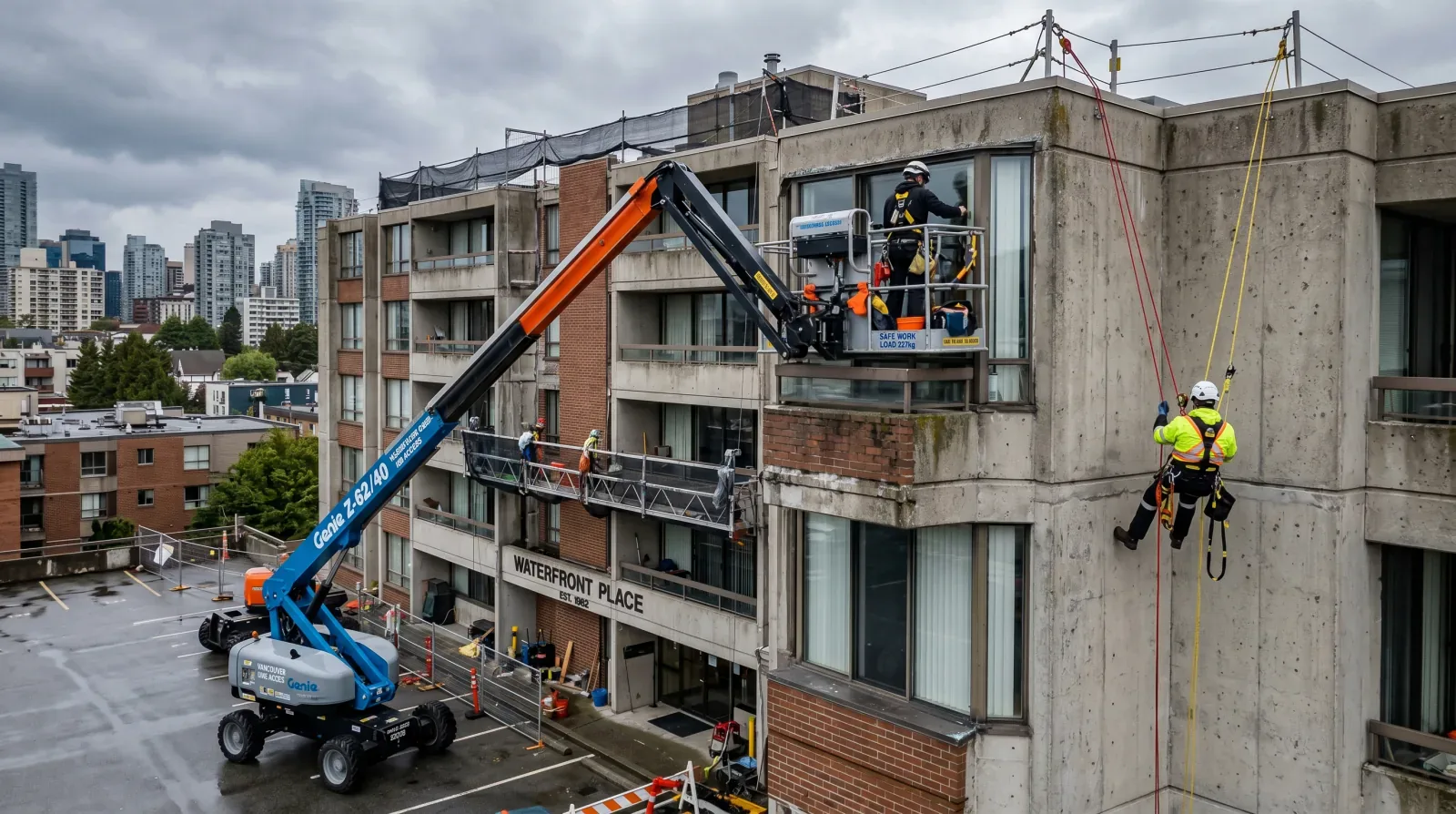
A property manager once asked me, reasonably enough, why we weren’t just bringing a boom lift for a facade job in downtown Vancouver. No ropes, no rigging, a machine does the lifting — it sounded simpler and cheaper to him. The building was 28 storeys. A big boom lift tops out somewhere around a mid-rise. It would have reached maybe the eighth floor.
That is the short version of the whole comparison. But the choice between a boom lift and rope access comes up constantly, and it deserves more than “the building’s too tall.” The two methods solve the access problem from opposite directions, and each is genuinely the right tool in the right place.
Two opposite approaches to height
A boom lift — one type of MEWP, or mobile elevating work platform — reaches up from the ground. A worker stands on a powered platform at the end of an articulating or telescopic arm, and the machine lifts them to the work. Everything about a boom is governed by two things: how far the arm extends, and the ground the machine sits on.
Rope access works the other way. Certified technicians descend down the facade on dual rope lines anchored at the roof. There is no arm reaching up, so there is no boom-length limit and no machine on the ground. The access comes from above.
That difference decides almost everything else.
Where the boom lift runs out
In downtown Vancouver, a boom hits its limits fast, and usually more than one at once.
Height. Even large self-propelled and truck-mounted booms top out in mid-rise territory. A tower is out of reach by definition. Past the boom’s safe working height the arm cannot extend, and that is the end of the conversation for the upper floors.
Ground. A boom needs firm, level ground rated to carry the machine plus its load at full extension, with room to set up and swing the arm. Downtown, that ground is scarce. The machine might sit over an underground parkade slab that cannot take the concentrated point loads. There may be landscaping, a slope, or simply no clear space close enough to the wall. Finding legal, strong, level ground near the facade is often the constraint that kills the idea before height even comes up.
Setbacks and podiums. Plenty of Vancouver towers rise from a podium or step back partway up. The upper facade then sits out over a roof the boom cannot drive onto, and reaching over that obstruction burns up the boom’s working envelope. Stepped buildings are a classic reason a tower defaults to rope access — the geometry just does not suit a ground-based machine.
Permits. A machine occupying a street, sidewalk, or lane needs municipal street-use permits, traffic management, and sometimes a lane closure. In dense downtown Vancouver those are slow and involved to arrange.
Where the boom lift wins
None of this makes the boom the wrong tool everywhere. For the right job it is the better choice.
A boom wins on lower-level work where you need to bring weight and stay put — a heavier concrete repair, bulky materials, two workers and their tools at one spot for a sustained stretch. Standing on a platform is more comfortable and productive for that kind of concentrated work than hanging on rope. If the height is within reach and there is firm, level ground with room to set up, a boom can be faster than rope access for work that lives in one location.
It also wins where ropes are genuinely hard to rig — some podium roofs, some setback geometries, certain canopy or overhang details — where a machine positioned on a solid surface gets to the work more directly than a descent from above would.
The trade-off against scaffolding and swing stage is a separate question; here the comparison is specifically against a ground-based lift, and the deciding factors are height, ground, and how concentrated the work is.
Why rope access wins on towers
On a tall building, rope access wins for the same reason the boom loses: it does not care about height or ground.
Technicians descend from roof anchors, so they reach any point on the facade — the 30th floor as easily as the 3rd. There is no boom envelope to run out of and no ground-bearing problem to solve. A single rigging setup can cover an entire elevation, and the crew moves down the face working as they go. For a job that touches the whole facade — a sealant program, a coating application, a close-up inspection — that “reach everything from above” quality is exactly what you want, which is why rope access is the standard for high-rise facade work in Metro Vancouver.
Mobilization is faster too. On a building with sound, certified anchors, a rope access crew can rig and start the same day. A boom needs delivery, positioning, ground verification, and often permits and traffic management before anyone reaches the wall. For work spread across a facade, rope access gets crews working sooner and moves between locations without repositioning a machine.
Safety is not optional for either
Both methods sit squarely under WorkSafeBC’s fall protection rules in Part 11 of the Occupational Health and Safety Regulation. There is no method that lets a contractor skip the requirements.
Rope access has specific rules for anchors, dual rope systems, and technician certification — IRATA or SPRAT training is the industry standard. MEWPs have their own operator training, machine inspection, and fall-protection requirements. Whichever is used, the contractor must have a written safe work procedure and meet WorkSafeBC standards. If a contractor is vague about which rules apply to the method they are proposing, that is the warning sign.
For rope access specifically, the roof anchors matter as much as the ropes. Anchors must be inspected and recertified on a schedule, and a building with current certification is ready to go immediately. A building with expired or missing anchor certification needs that handled first — confirming roof anchor recertification status is one of the first planning steps for any rope-access job on a BC high-rise.
Matching the tool to the building
The decision is not about which method is better in the abstract. It is about the specific building and the specific scope.
Heavy, concentrated work on lower floors, with good firm ground and no setback in the way? A boom lift is a strong choice. Work that is tall, scattered across the facade, over a podium, or on a downtown block with no room for a machine? Rope access wins, and on a real high-rise it is usually the only method that can reach the work at all.
The right answer comes from looking at the height, the ground, the geometry, and how the work is distributed across the building. That is a site assessment, not a guess — and getting it right up front avoids paying to mobilize the wrong method.
Related guides
- Rope Access Hub — how rope access works and where it fits
- Rope Access vs Swing Stage — the other access comparison that comes up on towers
- Rope Access vs Scaffolding and Swing Stage — choosing among the suspended-access options
- WorkSafeBC Roof Anchor Recertification for High-Rises — keeping the anchors that make rope access possible compliant
Frequently Asked Questions
More from Rope Access Guide
Swing Stage and Street Use Permits for Downtown Vancouver Facade Work
Before a swing stage touches a downtown Vancouver tower, the City wants a street use permit and a pedestrian protection plan. Here's what that involves, why it delays projects, and how rope access sidesteps most of it.
Read article →Why Gutter and Scupper Cleaning Belongs in Your Rope Access Maintenance Visit
Blocked gutters, scuppers, and roof drains send water where it was never meant to go — usually into the parapet or down the face of the building. Why this belongs in the same rope access visit as window cleaning and sealant inspection, not a separate call.
Read article →Roof Anchor Recertification: WorkSafeBC Rules for Vancouver High-Rises
BC roof anchors for rope access must be engineer-certified and inspected yearly. Here is what building owners in Metro Vancouver must keep on file to stay compliant.
Read article →