Building Envelope Sealants & Caulking
Every window perimeter, panel joint, expansion joint, balcony threshold, and utility penetration on a Metro Vancouver high-rise relies on sealant to keep the rain out. When that sealant degrades — and all sealants eventually do — water finds the joint. In BC's coastal climate, the window between "sealant is past service life" and "active leak in a suite" is often one wet winter season. This guide is for strata councils and property managers who want to understand the sealant system before they're dealing with the water damage claim.

Sealant facts for Metro Vancouver strata
Typical service life of a correctly specified and installed commercial-grade sealant on a Metro Vancouver high-rise — polyurethane at panel joints, silicone at curtain wall and glazing, both significantly shorter when the wrong product or spec is used.
Typical time between "sealant visibly failed" and "active water entry in suites" on a wind-exposed Metro Vancouver high-rise — the gap between a maintenance issue and a water damage claim.
New sealant reliably bonds to degraded old sealant. Patching is a visual fix, not a repair. Full strip-out and replacement is the professional standard — always.
Which sealant goes where — and why it matters
Polyurethane and silicone are the two workhorse sealants in building envelope work, and they are not interchangeable. The guide below walks through the critical differences in UV stability, paintability, adhesion, and movement accommodation that determine which product goes at which joint on your building.
 Compare
 Polyurethane vs. silicone sealant for building envelopes
Polyurethane and silicone sealants perform differently at window frames, concrete panel joints, and curtain wall assemblies. How a Vancouver envelope contractor decides which goes where — and why using the wrong one fails in BC's coastal climate.
Read the guide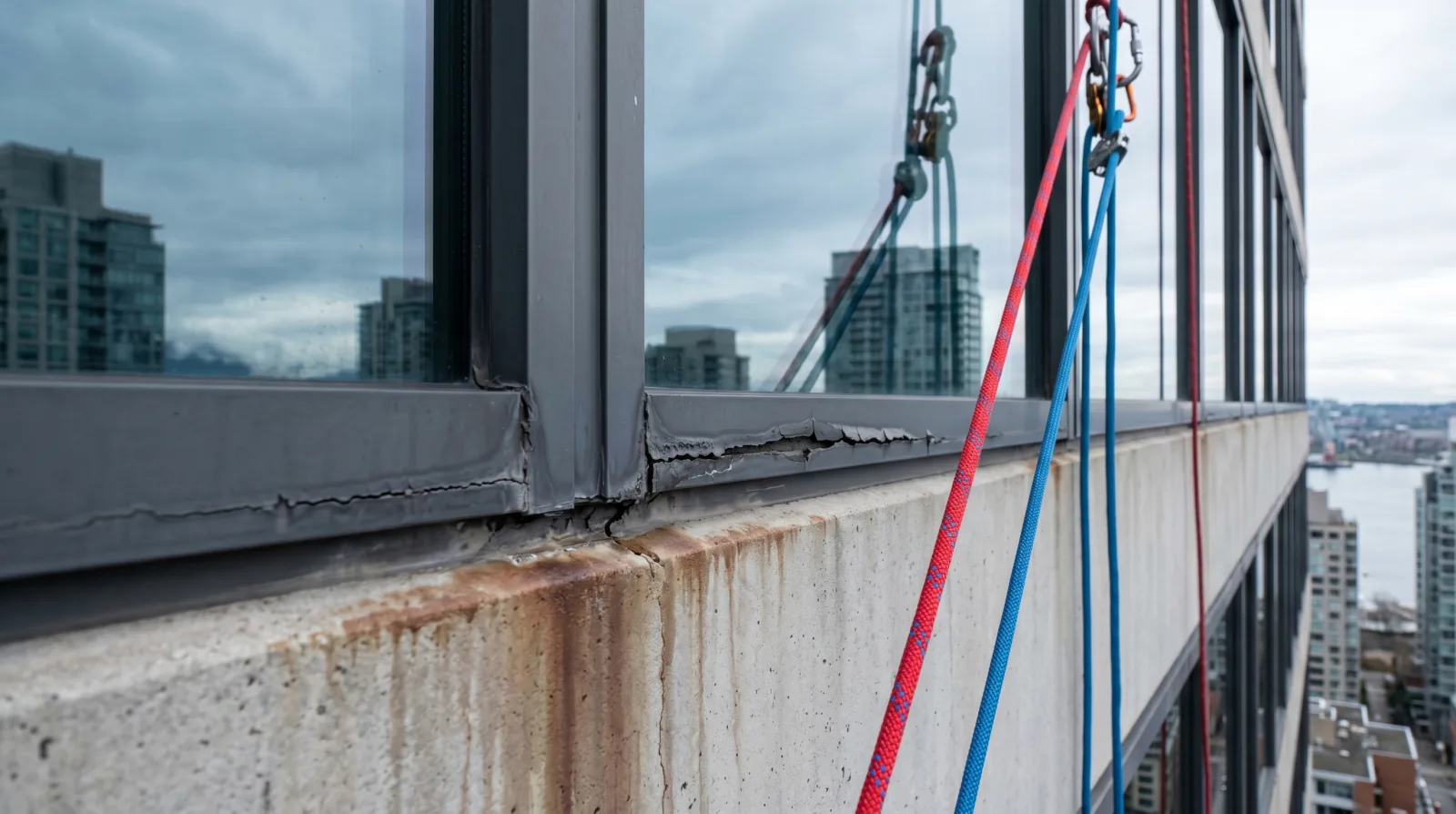 Compare
 Polyurethane vs. hybrid MS (STPE) sealant
On a joint that gets painted or coated over, polyurethane is fine. On an exposed joint in the sun it chalks, and that is where hybrid MS earns its premium: UV-stable and paintable at once. How to match the chemistry to sun exposure on a Metro Vancouver facade.
Read the guide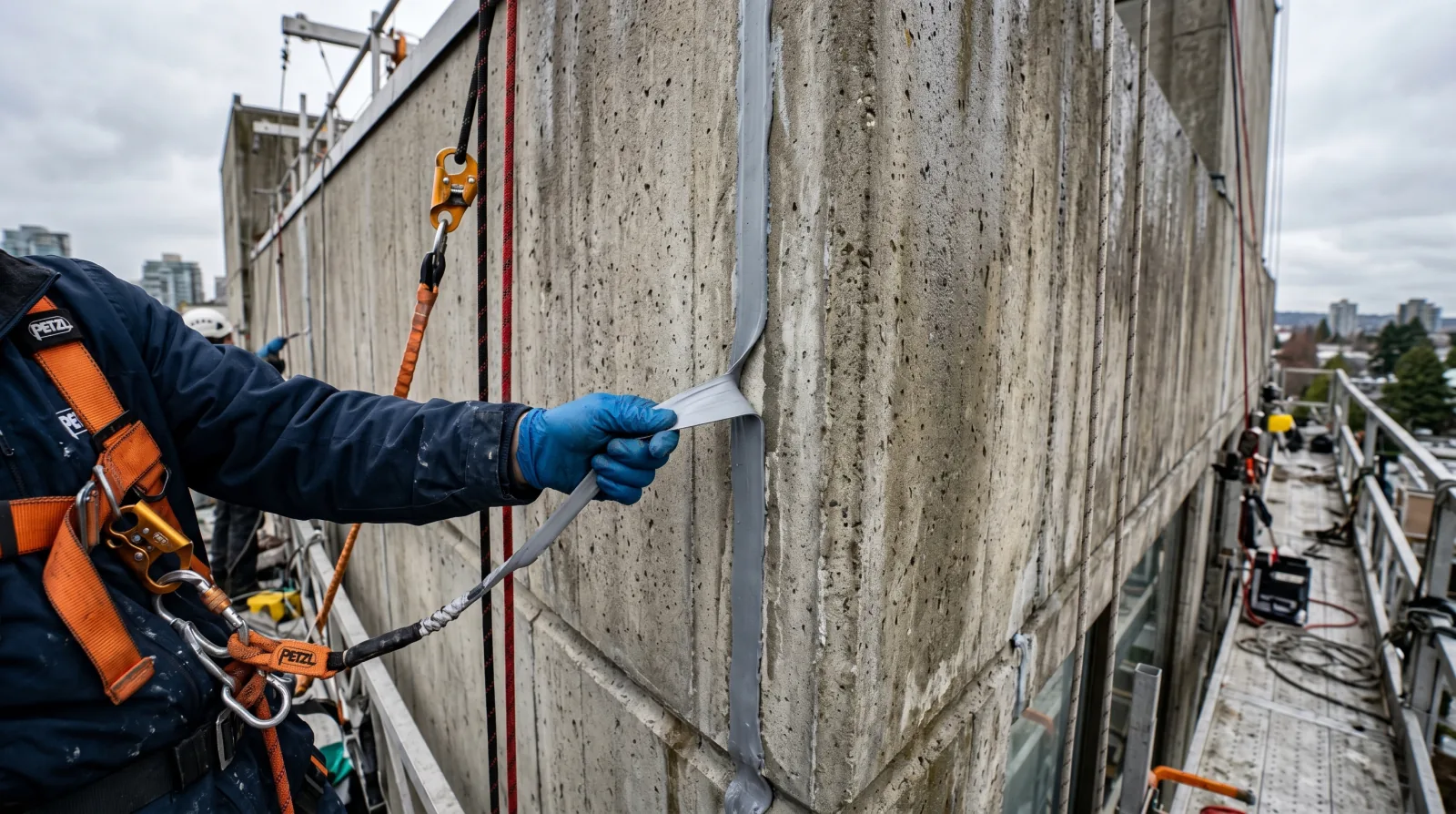 Compare
 One-part vs. two-part polyurethane sealant
One-part polyurethane cures from the surface in and stalls in deep joints; two-part cures full-depth in any weather. Which fits a standard joint, a deep expansion joint, and cold-season work on the wet BC coast.
Read the guide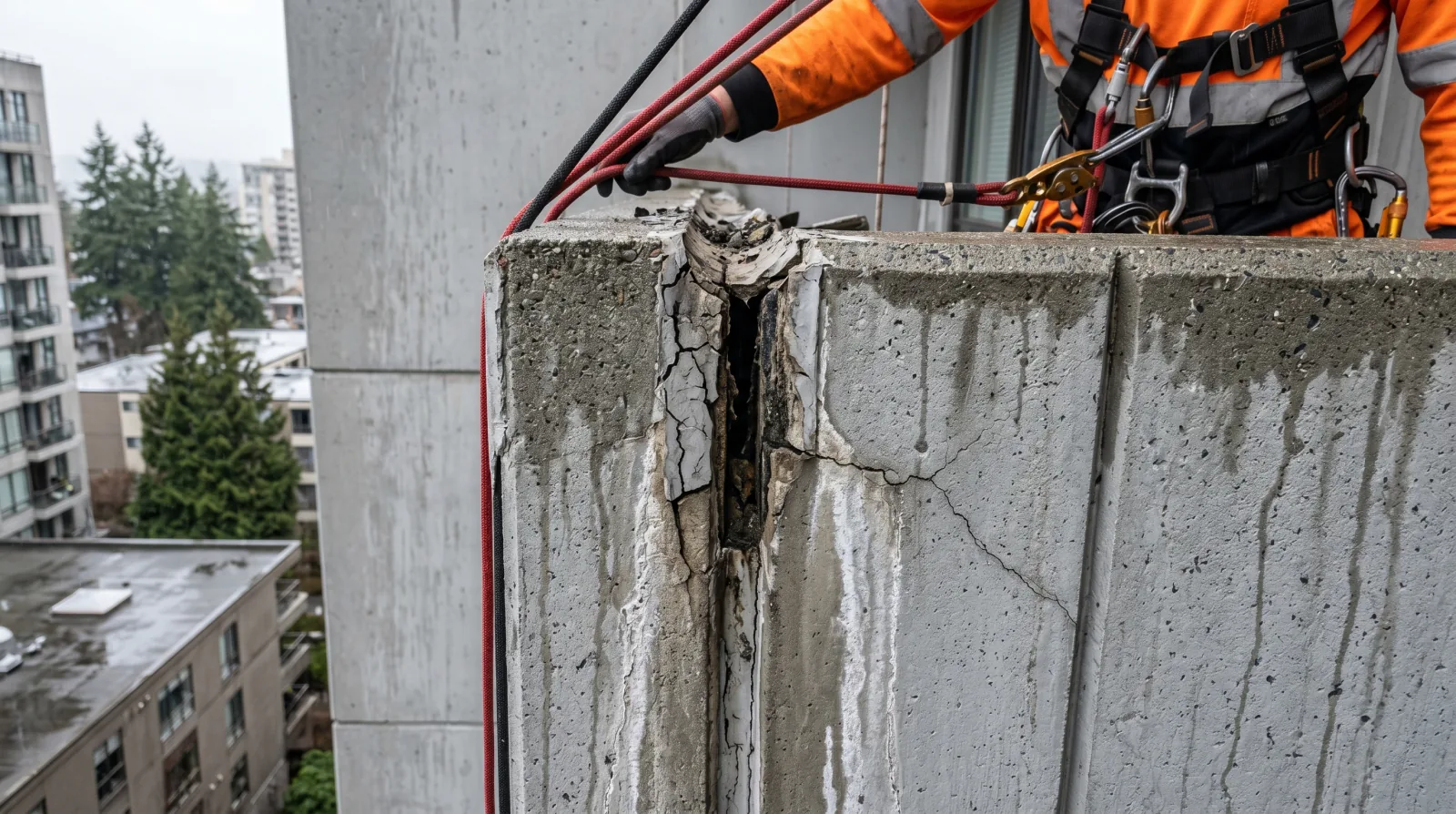 Compare
 Wet glazing vs. dry glazing for window seals
Wet glazing seals glass with gunned silicone; dry glazing holds it with rubber gaskets that dry and shrink over decades. Why older Vancouver towers leak at the gaskets and when a UV-stable silicone reseal is the durable fix.
Read the guide Compare
 Full recaulk vs. spot sealant repair
Spot repair looks cheap but leaves same-age joints open and repeats the access cost each time. When a whole-building recaulk is the rational call for a strata, and how the depreciation report and rope-access economics factor in.
Read the guideWhy sealant failure is usually the start — not the whole problem
When a strata gets a leak complaint, the instinct is to look for where the water is entering from the outside. But by the time water shows up inside a suite — staining drywall, pooling on the floor, rusting the balcony door threshold — it has already been traveling through the wall assembly for some time. Sealant failure at a window perimeter creates an entry point, but the water then wicks into the stucco, the insulation, the framing or concrete behind it, and may travel laterally before it shows up somewhere else entirely.
That means a sealant replacement program isn't just a maintenance task — it's a leak prevention program. And it connects directly to the other systems in the building envelope: the exterior coatings that protect the cladding face, the balcony membranes that handle the deck, and the concrete restoration work that gets triggered when water reaches the rebar behind a failed sealant joint. Sealant is the first line of defence at every joint — and the line most likely to reach end of service life first.
What a full sealant replacement program looks like on a Metro Vancouver high-rise
A properly scoped sealant program starts with a condition survey — either from rope access or a visual assessment from the ground with binoculars for a preliminary scope — that identifies every failed or at-risk joint on the building. The survey maps which joints are in adhesion failure, which are in cohesive failure, and which are degraded to a point where failure is a season away. That gives the strata a real picture of scope and priority, not a guess.
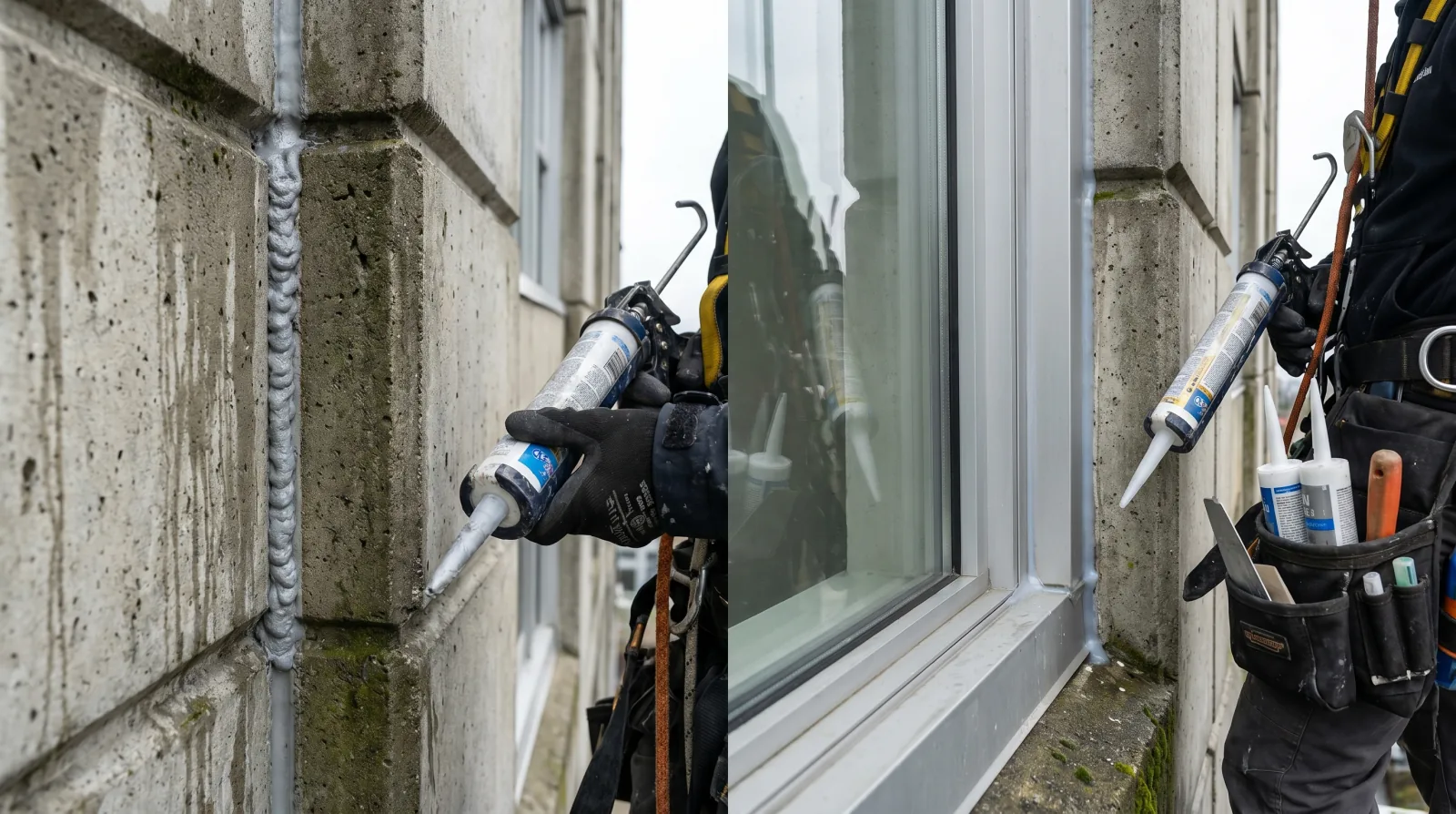
The replacement work itself: strip the failed sealant from each joint back to the substrate, clean the joint faces of residue, install new backer rod at the correct depth to control the sealant profile, prime where the product requires it, and apply the new sealant in one continuous bead tooled to a concave profile. On a high-rise, that work is done by rope access for window perimeters and panel joints, with swing stage or scaffolding added where bulk movement or payload requires it. A properly run program does all joints on a face in one mobilization — not a floor at a time across multiple mobilizations, which wastes access cost.
Quick answers
What is building envelope sealant and why does it fail?
Building envelope sealant is a flexible, adhesive compound installed at every joint, penetration, and transition in a building's exterior cladding — window perimeters, panel-to-panel joints, expansion joints, balcony thresholds, and utility penetrations. Sealant bridges the gap between materials that move at different rates through thermal cycling, structural settlement, and wind loading. It fails because all sealants have a finite service life: the polymer degrades, adhesion to the substrate is lost, and the joint opens to water entry. On the BC coast, UV exposure and wind-driven rain accelerate the failure timeline for lower-quality or wrong-specification sealants.
How long does building sealant last on a Vancouver high-rise?
A properly specified and installed commercial-grade silicone or polyurethane sealant on a Metro Vancouver high-rise typically performs for 10–20 years depending on the exposure, joint movement, and sealant type. Silicone at high-movement curtain wall joints often reaches 20 years. Polyurethane at more protected locations can also reach 15+ years with correct application. Low-quality products, joints that weren't prepared correctly, or the wrong sealant for the joint movement can fail in 3–5 years. A strata's depreciation report should track the sealant cycle as a funded component.
What are the signs that building sealant needs replacement?
Visual signs that sealant replacement is warranted: cracking along the centreline of the joint (cohesive failure — the sealant split through itself); pulling away from the substrate at one or both edges (adhesion failure); hardening and shrinking away from the joint faces; surface chalking and UV degradation; visible gaps or voids in the sealant bead; discolouration from mold or algae growth indicating moisture penetration. Any of these on window perimeters and panel joints on a stucco or curtain wall building warrant a full sealant assessment, not just spot repairs.
From the resources library
Field Sealant Adhesion Testing on BC Restoration Projects
A sealant that won't stick is a leak waiting to happen. Why a hand pull test on a Surrey restoration project catches the failure before it ever ships.
Read article ArticleExpansion Joint Failure Between Precast Concrete Panels in Vancouver
The joints between precast panels on a Vancouver high-rise move constantly, and sealant is the only thing keeping rain out. Why they fail and how to fix them.
Read article ArticleWindow Perimeter Sealant Failure on Vancouver Curtain Wall Towers
The sealant around window and curtain wall joints is the first line of defence against wind-driven rain on a Vancouver tower — and the first thing to fail. How to spot it, why it happens, and what restoration actually involves.
Read article ArticleSealant Removal vs Cap-Bead Repair: When to Use Each on BC Buildings
Cap-bead sealant repair is faster and cheaper than full removal and replacement — but it's also the most common reason re-caulking work fails within two years. When each approach makes sense, what the actual labour difference is, and how to specify the right approach in your tender.
Read article ArticleSilicone vs Polyurethane Sealant for Expansion Joints in BC Buildings
Which sealant belongs in your building's expansion joints? We compare silicone and polyurethane for movement, UV resistance, and coating over on Metro Vancouver towers.
Read article ArticleSigns Your Building Needs Sealant Replacement
Don’t wait for suites to leak. Learn how to spot failing window perimeter caulking and expansion joints from the ground, what cracks to watch for, and why polyurethane sealant needs replacement every 8 to 10 years.
Read articleServices this guide connects to
The same joint failures show up at a smaller scale where a glass canopy meets a wall above an entrance. Our canopy leak guide covers how to tell a failed wall joint from a glazing gasket or a blocked drain, and the glass canopies hub links the rest.
Sealant and caulking questions
What is building envelope sealant and why does it fail?
Building envelope sealant is a flexible, adhesive compound installed at every joint, penetration, and transition in a building's exterior cladding — window perimeters, panel-to-panel joints, expansion joints, balcony thresholds, and utility penetrations. Sealant bridges the gap between materials that move at different rates through thermal cycling, structural settlement, and wind loading. It fails because all sealants have a finite service life: the polymer degrades, adhesion to the substrate is lost, and the joint opens to water entry. On the BC coast, UV exposure and wind-driven rain accelerate the failure timeline for lower-quality or wrong-specification sealants.
How long does building sealant last on a Vancouver high-rise?
A properly specified and installed commercial-grade silicone or polyurethane sealant on a Metro Vancouver high-rise typically performs for 10–20 years depending on the exposure, joint movement, and sealant type. Silicone at high-movement curtain wall joints often reaches 20 years. Polyurethane at more protected locations can also reach 15+ years with correct application. Low-quality products, joints that weren't prepared correctly, or the wrong sealant for the joint movement can fail in 3–5 years. A strata's depreciation report should track the sealant cycle as a funded component.
What are the signs that building sealant needs replacement?
Visual signs that sealant replacement is warranted: cracking along the centreline of the joint (cohesive failure — the sealant split through itself); pulling away from the substrate at one or both edges (adhesion failure); hardening and shrinking away from the joint faces; surface chalking and UV degradation; visible gaps or voids in the sealant bead; discolouration from mold or algae growth indicating moisture penetration. Any of these on window perimeters and panel joints on a stucco or curtain wall building warrant a full sealant assessment, not just spot repairs.
Can sealant be patched rather than fully replaced?
Patching — applying new sealant over old — almost never works at a professional standard. New sealant does not bond reliably to degraded old sealant, and the patch will fail at or before the old sealant's failure point. The correct method is full removal: strip the old sealant back to the substrate, clean the joint faces, install new backer rod at the correct depth, prime where required by the product specification, and apply new sealant in one continuous bead tooled to a concave profile. Patching is a short-term visual fix that delays the real work.
What is the correct joint design for sealant on a high-rise?
The joint must be designed to the sealant's movement accommodation factor (MAF) — typically ±25% for polyurethane and ±50% for silicone. For a sealant rated at ±25%, a joint that opens and closes 5 mm must be at least 10 mm wide so the sealant is never stretched beyond its rated movement. The depth-to-width ratio should be 1:2 to 1:1, controlled by a backer rod that sets the correct sealant depth. A bead that is too shallow fails in tension; one that is too deep develops three-point adhesion (a condition called three-point bonding or hourglass failure) that causes premature cohesive cracking.
How much does a full building sealant replacement cost in Vancouver?
Sealant replacement cost depends on linear meterage of joints on the building, the access method required (rope access vs. swing stage vs. scaffolding), and the sealant product specified. As a reference range from our 2026 pricing: a single floor of window perimeter sealant runs $3,000–$8,000 depending on lineal metres; a full 10–20 storey building runs $25,000–$80,000+ for the full window perimeter program. These ranges are from our cost guide — actual scope and pricing depends on a site assessment.
Sealant due for replacement on a Metro Vancouver high-rise?
We assess sealant condition and run replacement programs on strata and commercial buildings across Vancouver, North Vancouver, West Vancouver, and Burnaby — all via rope access, no ground disruption.