Polyurethane vs. silicone sealant: which does your building's envelope need?
The wrong sealant in the wrong joint doesn't fail after ten years — it fails after two. Polyurethane bonds aggressively to concrete and can be painted. Silicone handles high movement and UV exposure without degrading. The selection isn't a brand preference; it's chemistry matched to substrate, movement, and what happens to the joint surface afterward.
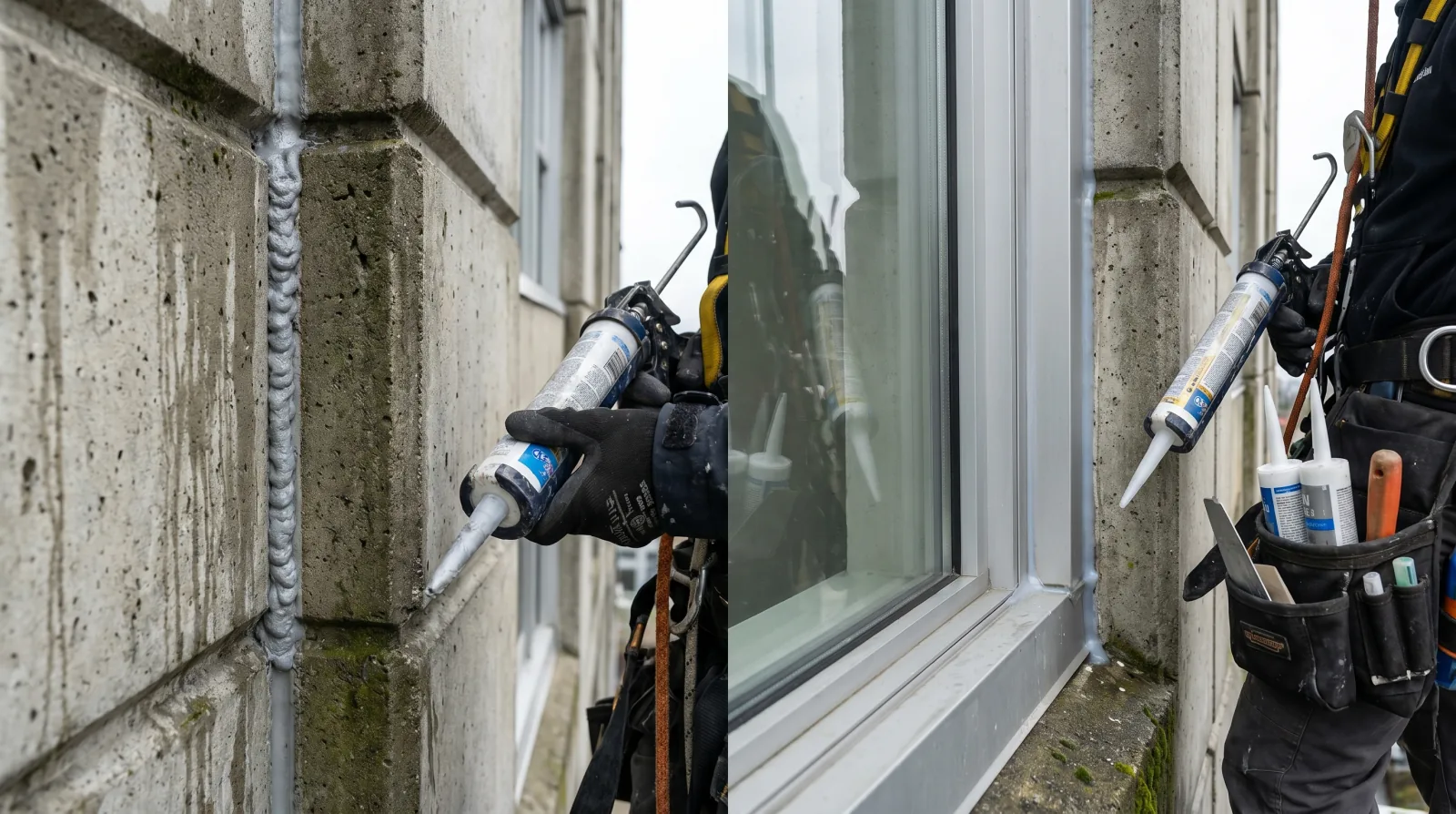
The key difference: what the sealant must do after cure
The fundamental selection question is not "which one lasts longer" — it's "what does the joint require." A concrete panel joint that will be painted over needs a paintable sealant; silicone won't accept paint, so it's out regardless of its other properties. A structural glazing joint that moves ±50% of its width thermally needs the elongation silicone delivers; polyurethane would split at that range. The chemistry is secondary to the application.
Chemistry and properties compared
Polyurethane (PU)
Single- or two-component system that cures by reacting with moisture in the air. Bonds by chemical adhesion to the substrate.
Silicone
Single-component system that cures by reacting with atmospheric moisture. Cross-links into a flexible elastomeric solid.
Sealant selection by application type
A single building envelope uses multiple sealant products in different locations. This is not over-engineering — it's the difference between a joint that lasts and one that fails before the contractor is out of warranty.
| Application | Recommended Sealant | Why |
|---|---|---|
| Window frame to concrete surround | Neutral-cure silicone | High thermal movement as the aluminum frame expands and contracts independently of the concrete. The joint is typically exposed and unpainted — silicone's UV stability and elongation are the right profile. A dedicated silicone primer is required for adhesion to the concrete side. |
| Concrete panel-to-panel joints | Single-component polyurethane | Medium-movement concrete panel joints on a strata tower, typically 15–25 mm wide. Polyurethane bonds to both concrete faces without a primer, accepts the architectural paint finish that ties the joint colour to the facade, and performs well in the movement range these joints see. |
| Curtain wall and structural glazing | Two-part structural silicone (neutral-cure) | Curtain wall sealant is a structural element — it holds glass and panels in position as well as sealing against water. The joint specification is engineered: two-part structural silicone with a defined hardness, adhesion, and movement rating. The contractor follows the engineer's spec here; this is not a field selection. |
| Balcony wall upturn and door sill | Polyurethane, followed by membrane upturn | The joint between a balcony wall and the floor waterproofing system typically uses a polyurethane sealant as a pre-formed backer before the membrane upturn is installed over it. It bonds to the concrete and is compatible with most liquid membrane systems. The membrane manufacturer's specification governs compatibility. |
| Stucco expansion joints | Paintable polyurethane | Stucco expansion joints need a paintable sealant so the joint disappears into the wall coating. Polyurethane bonds well to the sand-float stucco faces, accepts the elastomeric overcoat, and handles the moderate movement of a BC stucco panel. |
| Glazed tile or stone cladding joints | Neutral-cure silicone with tile-specific primer | Tile and stone faces are non-porous and smooth — silicone with the appropriate primer is the correct adhesive profile. Some acetoxy-cure silicones react with certain stones; neutral-cure is the safe default for all stone and ceramic tile. |
Why Vancouver's climate makes sealant selection matter more
Metro Vancouver averages over 1,100 mm of annual rainfall, much of it as persistent horizontal-driven rain against the building facade. That rainfall pressure-tests every joint continuously from October through April. On top of that, coastal thermal cycling — not as extreme as inland BC but present year-round — means building joints move with temperature daily, and cumulatively that movement adds up to thousands of cycles over a sealant's service life.
In this climate, UV degradation of polyurethane is less of an annual issue than in a sunny inland climate — cloudy winters slow UV damage — but joint movement and water pressure are unforgiving. A sealant that can't keep up with the movement, or that lost adhesion to its substrate because the wrong product was specified, will leak within a year. The coastal environment doesn't give a second chance on a poorly chosen or poorly installed joint.
The installation variable that matters more than the product
A premium sealant installed poorly outperforms nothing. The most common installation failures:
- Three-sided bond: Sealant bonded to both joint faces and the back of the joint cannot flex — it tears. A backer rod creates the two-sided bond that allows movement. Without it, the joint will fail regardless of the product.
- Dirty or wet substrate: Sealant applied over dust, laitance, oil, or residual moisture fails at the adhesion interface, not through the sealant body. Substrate preparation — grinding, priming, and confirming dryness — determines whether the product ever achieves its rated adhesion.
- Capping over old sealant: A new bead over old, failing caulk bonds to the old sealant, not the substrate. When the old sealant moves or loses adhesion, it takes the new cap with it. Remove, clean, prime, and replace — that is the only installation that earns a warranty.
- Applying in cold or wet conditions: Polyurethane cures by moisture reaction; applying over a frozen or wet joint changes the cure chemistry. Silicone is more tolerant of cold but still needs a substrate above 5°C for reliable adhesion. Good envelope work schedules sealant installation around the weather window.
Our sealant and caulking hub covers the full scope of building envelope sealant work, including inspection, lifespan, and what a strata replacement project actually involves.
Quick answers
Which sealant lasts longer — polyurethane or silicone?
In the right application, both last 15–20 years. Silicone wins on UV-exposed joints where it degrades far more slowly than polyurethane. Polyurethane wins on concrete and masonry joints where its adhesion profile outperforms silicone without a primer. The mistake is applying either one to a joint it was not designed for — UV-exposed polyurethane chalks and loses adhesion within a few years; silicone over porous concrete without a primer peels at the adhesion line regardless of the product's bulk performance. Longevity comes from matching the sealant to the substrate and movement, not from brand or price.
Can I use silicone over old polyurethane sealant, or polyurethane over old silicone?
No — and this is one of the most common field mistakes on strata recaulking projects. Silicone will not bond to cured polyurethane. Polyurethane will not bond reliably to a silicone-contaminated substrate. Before any reseal, the old sealant must be completely removed — cut and pulled out, with the joint faces cleaned of all residual material. Any silicone contamination on a concrete joint face will prevent polyurethane adhesion even if the contamination is invisible. A proper recaulking project removes, cleans, and primes before applying; a "cap bead over the old caulk" is wasted money.
Why do building envelope sealants fail so quickly in Vancouver?
Usually for one of four reasons. First, wrong product for the joint — polyurethane on a high-movement glazing joint exceeds its elongation limit and splits; silicone without primer on concrete loses adhesion. Second, wrong joint geometry — a sealant applied too thin (joint depth less than 6 mm) or with a three-sided bond instead of two-sided bond does not flex properly and tears. Third, dirty or wet substrate — sealant applied over a dusty, oily, wet, or poorly cured concrete face fails at the adhesion line, not through the body of the sealant. Fourth, capping over old sealant instead of removing it. The product gets blamed, but the installation is usually responsible.
Sealant selection questions
Which sealant lasts longer — polyurethane or silicone?
In the right application, both last 15–20 years. Silicone wins on UV-exposed joints where it degrades far more slowly than polyurethane. Polyurethane wins on concrete and masonry joints where its adhesion profile outperforms silicone without a primer. The mistake is applying either one to a joint it was not designed for — UV-exposed polyurethane chalks and loses adhesion within a few years; silicone over porous concrete without a primer peels at the adhesion line regardless of the product's bulk performance. Longevity comes from matching the sealant to the substrate and movement, not from brand or price.
Can I use silicone over old polyurethane sealant, or polyurethane over old silicone?
No — and this is one of the most common field mistakes on strata recaulking projects. Silicone will not bond to cured polyurethane. Polyurethane will not bond reliably to a silicone-contaminated substrate. Before any reseal, the old sealant must be completely removed — cut and pulled out, with the joint faces cleaned of all residual material. Any silicone contamination on a concrete joint face will prevent polyurethane adhesion even if the contamination is invisible. A proper recaulking project removes, cleans, and primes before applying; a "cap bead over the old caulk" is wasted money.
Why do building envelope sealants fail so quickly in Vancouver?
Usually for one of four reasons. First, wrong product for the joint — polyurethane on a high-movement glazing joint exceeds its elongation limit and splits; silicone without primer on concrete loses adhesion. Second, wrong joint geometry — a sealant applied too thin (joint depth less than 6 mm) or with a three-sided bond instead of two-sided bond does not flex properly and tears. Third, dirty or wet substrate — sealant applied over a dusty, oily, wet, or poorly cured concrete face fails at the adhesion line, not through the body of the sealant. Fourth, capping over old sealant instead of removing it. The product gets blamed, but the installation is usually responsible.
How do I know when my building's sealant needs replacement?
The signs visible from ground level are cracking, shrinkage away from the joint edges (adhesion loss), discolouration indicating water tracking behind the bead, and sealant pulled or torn out of the joint. Up close, a probe or fingertip compression test reveals hardening, loss of elasticity (the sealant stays compressed instead of springing back), and chalking surface degradation. On most Metro Vancouver buildings, sealant has a service life of 15–20 years, with exposure and joint movement rate shortening that depending on the facade. Our sealant-condition guide covers the full inspection protocol.
Is STPE (hybrid) sealant worth the premium over polyurethane or silicone?
For specific applications, yes. STPE (silyl-terminated polyether) and similar hybrid chemistries combine silicone's UV stability with polyurethane's paintability and porous-substrate adhesion — solving the two main weaknesses of each pure chemistry. The trade-off is higher material cost and less field experience than either established chemistry. On a high-visibility painted facade where an exposed UV-stable joint is also required to match the wall coating, an STPE hybrid is the technically correct product and its premium is justified. On a standard concrete panel joint that will be overcoated, standard paintable polyurethane is equally durable for lower cost.
What is a backer rod and why does it matter?
A backer rod is a closed-cell polyethylene foam cylinder installed in the joint before the sealant is applied. Its function is to control the depth of the sealant and create a two-sided bond: the sealant adheres to the two joint faces but not to the backer rod behind it. Without a backer rod, sealant fills the joint too deeply, bonds to three sides, cannot flex, and tears when the joint moves. Backer rod diameter should be 25% wider than the joint gap so it compresses slightly when installed, stays seated, and gives the sealant a consistent depth to work against. On any professional recaulking, backer rod installation is not optional.
Does a strata have to replace all sealant at once, or can it be phased?
Phased replacement is common and often necessary from a depreciation reserve standpoint. A condition assessment by a building-envelope consultant will typically classify sealant by condition zone and life remaining, allowing a strata to prioritise the worst-performing elevations or joint types first and budget the remainder over two or three years. The risk to manage is that open or failing joints on one elevation continue to admit water while the rest is deferred — so the phasing plan has to sequence by water-intrusion risk, not just budget convenience. We provide zone-based sealant assessments that give strata councils the information to make that phased plan rationally.
Get a sealant condition assessment before the water finds the next joint
We assess and replace building envelope sealant on high-rise strata and commercial buildings across Vancouver, North Vancouver, West Vancouver, and Burnaby — rope access, SPRAT and IRATA certified, with the right product specified for each joint type.