Glass Canopies and Entrance Awnings in Metro Vancouver
A glass canopy over a doorway is the one piece of a building that every customer walks under and looks up at. It is also the piece nobody maintains until it goes green, hazes over, or starts dripping on people at the door. This is the working reference for restaurant, retail, and strata owners: why canopy glass soils differently from windows, which stains come off and which never will, what the three causes of a canopy leak are, and how to buy a clean that does not wreck the seals.

What owners get wrong about canopy glass
A canopy has a top and an underside, and they soil for completely different reasons. On a restaurant entrance the underside is usually the dirtier one. Most quotes cover the top only.
Surface soiling washes off. Mineral deposit needs chemistry and dwell time. Etched glass never cleans up at all. Paying for the wrong one is the most common canopy complaint we hear.
Reaches the underside of a canopy. Whatever lands there from the doorway and the street (cooking aerosol, smoke, traffic film) stays until somebody wipes it off.
Six decisions, in the order they usually come up
Start with what you actually have and what is wrong with it. Most canopy money gets wasted at the diagnosis stage, not the repair stage: cleaning etched glass, sealing a joint that was not leaking, replacing a panel that could have been polished.
 Compare
 Glass canopy vs. fabric awning
What each one actually costs you in maintenance over a decade on the BC coast. Cleaning frequency, mould and mildew on fabric, mineral staining on glass, snow load, replacement cycle, and which one survives a Vancouver entrance better.
Read the guide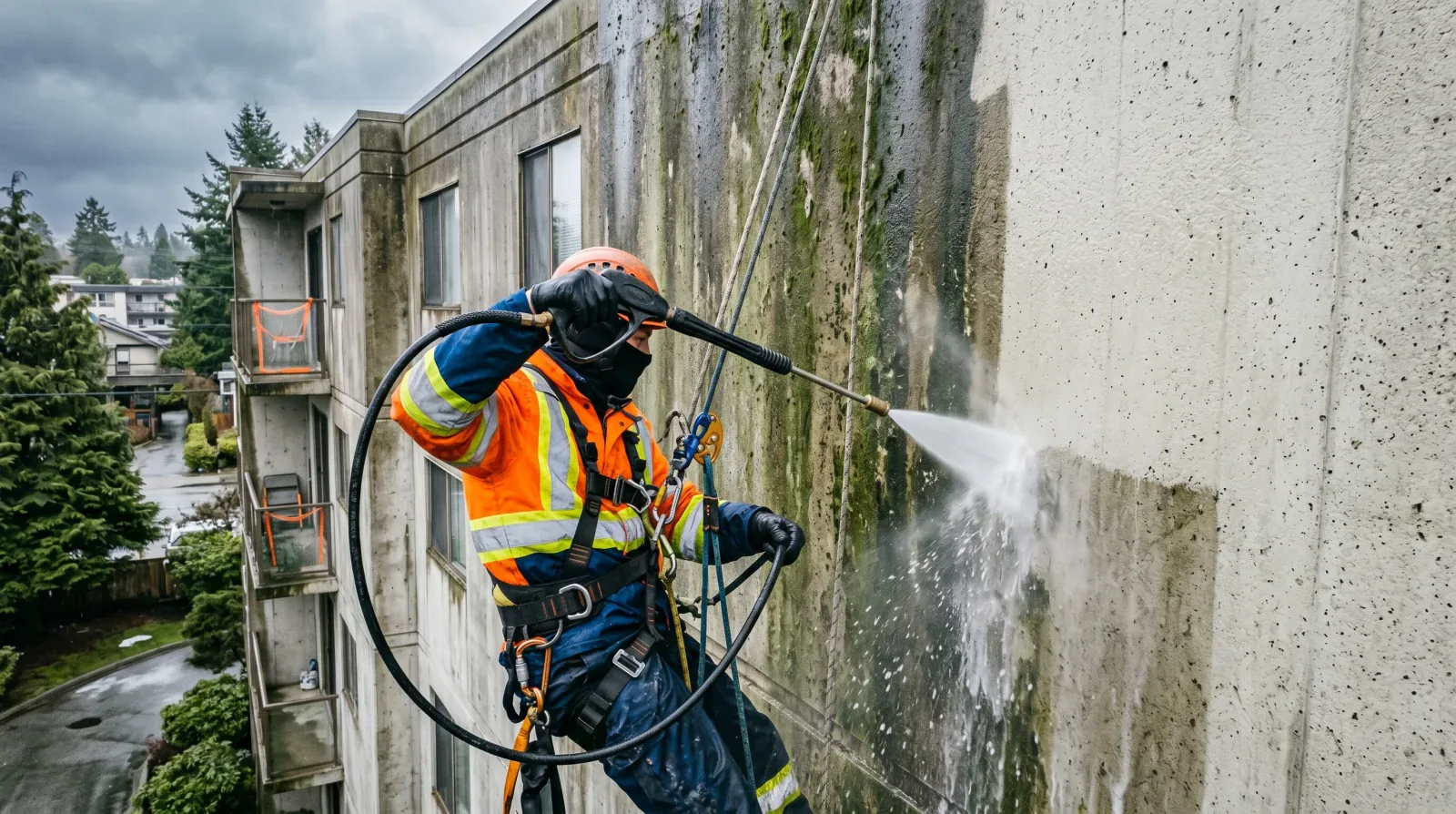 Compare
 Soft wash vs. pressure washing overhead glass
Why a pressure wand on a canopy drives water into the glazing gaskets and the wall joint, what the glass industry actually permits, and the low-pressure sequence that gets the same result without opening a leak path over your door.
Read the guide Diagnose
 Mineral staining vs. surface dirt vs. etched glass
The wet-glass test that tells you in thirty seconds whether your hazy canopy can be cleaned, needs a cerium oxide restoration, or is past saving. Stage 1 and stage 2 glass corrosion explained without the sales pitch.
Read the guide Diagnose
 Restaurant grease film on entrance glass
Why the underside of a restaurant canopy is dirtier than the top, how kitchen exhaust discharge puts it there, what NFPA 96 cleaning intervals have to do with your glass, and when cleaning more often is the wrong answer.
Read the guide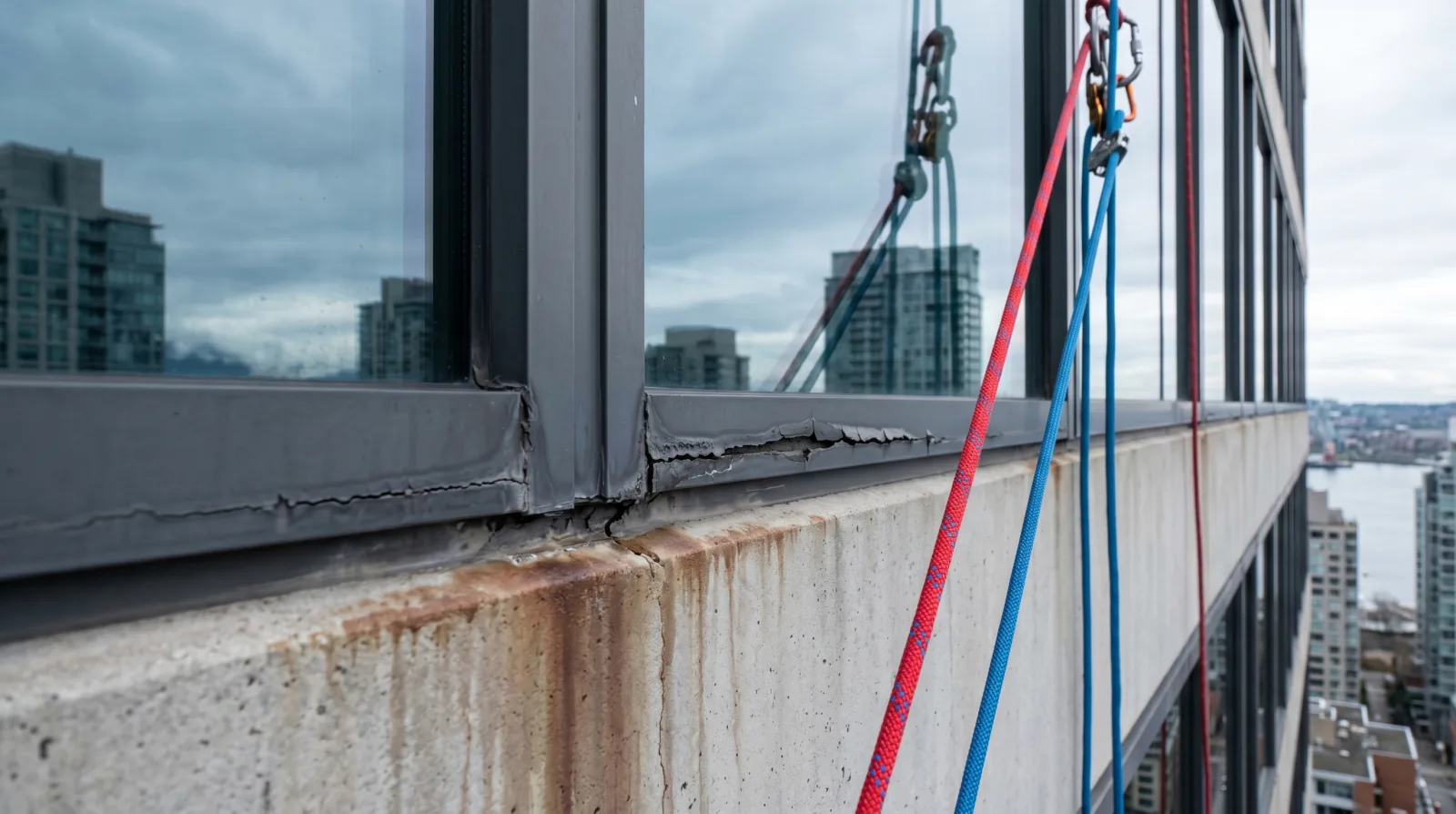 Repair
 Canopy leaks: wall joint vs. glazing gasket vs. drainage
Three causes of water dripping through a glass canopy onto your entrance, how to tell them apart from the ground, and why sealing the wrong one leaves the real leak open under fresh silicone.
Read the guide Decide
 Restore vs. replace a glass canopy
When polishing, resealing, and refitting is the right call, and when the glass or the structure has gone far enough that replacement is the cheaper decade. Delamination, corroded fittings, and the code questions a replacement triggers.
Read the guideA canopy is not a window lying down
The reason canopy glass behaves so differently comes down to slope. A vertical window sheds. Everything that lands on it slides off, and rain rinses the face every few days through a Metro Vancouver winter. A canopy sits at a shallow pitch, typically somewhere between two and fifteen degrees, which is enough to move water off the glass but nowhere near enough to move a wet leaf, a fir needle, or a handful of grit.
So the debris stays. It sits in the film of standing water that a shallow slope always leaves behind, and on a shaded or north-facing entrance it grows moss and algae inside a single wet season. Decaying leaf matter leaches tannins that stain the glass a rusty brown, and those stains sit under the moss where you cannot see them until the moss comes off.
The second source is above you. Whatever wall sits over the canopy (concrete, stucco, brick, painted masonry) drains onto it. That runoff carries dissolved minerals picked up off the wall surface, and when it evaporates on glass rather than running clear off the edge, the minerals are left behind. This is why the dirtiest band on most canopies is the strip closest to the building, not the exposed leading edge that gets the most weather.
And then there is the face nobody thinks about. Warm air rising off a doorway carries whatever is in it upward onto the underside of the glass: cooking oil aerosol from a kitchen, cigarette and vape residue where people stand at the door, diesel soot and brake dust off a busy street. Rain never reaches that surface. On an entrance on Robson, Main Street, or Commercial Drive, the underside is routinely the worse of the two faces, and it is the one most cleaning quotes quietly leave out.
Three stains, three outcomes
Owners tend to describe every canopy problem as "dirty," and contractors tend to quote every canopy as a wash. That mismatch is where the disappointment comes from. There are three distinct conditions and only the first one is actually dirt.
Loose soiling is organic debris, moss, algae, pollen, and traffic film. It comes off with a proper soft wash. Surface mineral deposit is what hard-water runoff leaves behind, and it needs an acidic treatment with real dwell time rather than more scrubbing. This is the stage where an ordinary window clean fails and the owner concludes the glass is ruined. Etched glass is the third, and it is not a deposit at all. Water in prolonged contact with glass leaches alkali ions out of the surface, leaving a roughened, silica-rich layer that scatters light. That is damage to the glass itself, and no cleaning process removes it.
Telling them apart takes thirty seconds and a hose. Wet the glass. Haze that vanishes while wet and returns as it dries is sitting on the surface, and it can be removed. Haze that stays visible while the glass is wet, on a surface that feels dry and rough to the fingertips, is etched. From there the choice is a controlled cerium oxide polish, which is a chemical-mechanical process that levels the roughened surface and typically recovers most of the clarity rather than all of it, or replacement of the panel. Either way, you now know that before you pay somebody to wash it twice.
The parts of a canopy that are not glass
We come at this as a building envelope contractor rather than a cleaning company, which changes what gets looked at. A glass canopy is an envelope element. It has a slope, a drainage path, a sealed joint to the building, and structural connections, and each of those fails in a predictable way on the BC coast.
The joint where the canopy meets the wall does the most work and gets the least attention. It moves every day with thermal cycling, and when the sealant debonds or splits, water runs behind the canopy and down the wall or straight through onto the entrance. Drainage is the next one: a channel or scupper at the leading edge packs with needles and moss, water backs up over the edge detail, and the pooling that follows accelerates the mineral staining on the glass. The fittings are third. Spider fittings, tension rods, brackets, and bolts live permanently in the weather, and on oceanfront exposure in West Vancouver or along the North Shore, salt spray attacks stainless fixings faster than owners expect. Rust bleeding down the glass from a bolt head is a corrosion report, not a stain.
Last, the glass. Overhead glazing is safety glass by requirement, not by choice. The BC Building Code sets the material standard at Division B, Article 9.6.1.2, requiring CAN/CGSB-12.1-M, "Tempered or Laminated Safety Glass," or CAN/CGSB-12.11-M for wired glass. Article 9.6.1.3 then requires the glass to be structurally designed to CAN/CGSB-12.20-M or ASTM E1300. On laminated units, a cloudy or milky band creeping in from the edge is delamination of the interlayer, and a chip at a bolt hole on a point-fixed panel is a crack waiting for a cold night. Both are worth reporting the moment anyone is close enough to see them.
How to buy a canopy clean without wrecking it
The Glass Association of North America publishes the working standard here, and its bulletin on proper procedures for cleaning architectural glass products is direct about the two mistakes that damage glass during cleaning. Blades are the first: GANA does not condone scraping glass with blades or scrapers for routine cleaning, and razor blades must never be used on coated glass, because a scraper lifts the coating in a stripe that stays visible for the life of the panel. Plenty of canopies carry a low-e or reflective coating on one face and nobody on site knows which face it is on. Sequence is the second: cleaning runs top down, so solution and dissolved dirt do not run across panels that have already been finished.
Add one more rule that is specific to canopies. Skip the pressure washer. A wand drives water sideways into the glazing gaskets and into the sealant joint at the wall, the exact detail holding water out of your entrance, and it drags grit across the glass on the way. Soft washing does the same job: dry debris off first, low-pressure application of a pH-appropriate biodegradable solution, real dwell time, soft agitation, then a deionized water rinse so the glass dries without spotting. When a contractor's answer to a mossy canopy is a high-pressure wand, the moss comes off and something else starts leaking a season later.
Two questions sort most quotes. Ask which faces are included, in writing. And ask what happens if the haze does not come off. A contractor who has already identified the staining as etching and told you so is worth more than one who finds out on the day and bills you anyway.
Quick answers
What is a glass canopy on a commercial building?
A glass canopy is a shallow-sloped overhead glazed structure projecting from a building wall, most often above an entrance, a patio, or a storefront. It is built from safety glass held in an aluminum or steel frame, or suspended on stainless spider fittings and tension rods. In British Columbia the glass must meet the safety glass standards referenced in the BC Building Code: CAN/CGSB-12.1-M for tempered or laminated safety glass under Article 9.6.1.2, and it must be structurally designed to CAN/CGSB-12.20-M or ASTM E1300 under Article 9.6.1.3. Owners and cleaners often call them glass awnings, which is the same thing in everyday use even though a true awning is a fabric or metal cover.
Why does a glass canopy get dirty faster than the windows below it?
Because it does not shed. A vertical window drops everything that lands on it; a canopy sloped between roughly two and fifteen degrees moves water but holds leaves, needles, seeds, and grit. That debris sits in standing water, grows moss and algae in a Metro Vancouver wet season, and releases tannins that stain the glass brown. On top of that, the wall above drains onto the canopy, and mineral-laden runoff evaporating on the glass leaves deposits behind. The underside collects a separate load (kitchen exhaust film, door-level smoke, and street soot) that no rain ever reaches.
How often should a glass canopy or awning be cleaned in Vancouver?
Twice a year covers most retail and office entrances here, timed after the autumn leaf drop and again in late spring once the pollen has finished. A restaurant entrance near a kitchen exhaust discharge needs it quarterly, because the grease film on the underside rebuilds within weeks. A canopy shaded by trees or facing north needs the autumn clean regardless of what else is on the schedule, since that is when the organic debris that feeds moss growth lands on it.
From the resources library
Pressure Washing vs Soft Washing Building Exteriors in Metro Vancouver
High-pressure water strips algae off a Coquitlam wall fast — and can blast the coating, sealant, and concrete off with it. When soft washing is the right call, and why surface prep before coating decides everything.
Read article ArticleWindow Perimeter Sealant Failure on Vancouver Curtain Wall Towers
The sealant around window and curtain wall joints is the first line of defence against wind-driven rain on a Vancouver tower — and the first thing to fail. How to spot it, why it happens, and what restoration actually involves.
Read article ArticleHow Often Should High-Rise Windows Be Cleaned in Vancouver? (2026 Guide)
A guide to scheduling window washes for strata towers and commercial buildings. Learn how marine salt, traffic smog, and forest fire smoke affect glass lifespan, and why bi-annual cleanings prevent permanent mineral etching.
Read article ArticleRoof Drain and Scupper Maintenance on Vancouver Strata Flat Roofs
A clogged roof drain is the cheapest leak you'll ever ignore — until ponding water destroys the membrane. How Burnaby strata roofs fail at the drains.
Read article ArticleMetal Flashing Detail Failures in BC Rainscreen Walls
Good cladding doesn't keep a Burnaby wall dry — flashing does. Reverse laps, missing end dams, and bad transitions are why rainscreen buildings still leak, and why the metal almost nobody looks at deserves the attention.
Read articleServices this guide connects to
Related resource hubs
Glass canopy and awning questions
What is a glass canopy on a commercial building?
A glass canopy is a shallow-sloped overhead glazed structure projecting from a building wall, most often above an entrance, a patio, or a storefront. It is built from safety glass held in an aluminum or steel frame, or suspended on stainless spider fittings and tension rods. In British Columbia the glass must meet the safety glass standards referenced in the BC Building Code: CAN/CGSB-12.1-M for tempered or laminated safety glass under Article 9.6.1.2, and it must be structurally designed to CAN/CGSB-12.20-M or ASTM E1300 under Article 9.6.1.3. Owners and cleaners often call them glass awnings, which is the same thing in everyday use even though a true awning is a fabric or metal cover.
Why does a glass canopy get dirty faster than the windows below it?
Because it does not shed. A vertical window drops everything that lands on it; a canopy sloped between roughly two and fifteen degrees moves water but holds leaves, needles, seeds, and grit. That debris sits in standing water, grows moss and algae in a Metro Vancouver wet season, and releases tannins that stain the glass brown. On top of that, the wall above drains onto the canopy, and mineral-laden runoff evaporating on the glass leaves deposits behind. The underside collects a separate load (kitchen exhaust film, door-level smoke, and street soot) that no rain ever reaches.
How often should a glass canopy or awning be cleaned in Vancouver?
Twice a year covers most retail and office entrances here, timed after the autumn leaf drop and again in late spring once the pollen has finished. A restaurant entrance near a kitchen exhaust discharge needs it quarterly, because the grease film on the underside rebuilds within weeks. A canopy shaded by trees or facing north needs the autumn clean regardless of what else is on the schedule, since that is when the organic debris that feeds moss growth lands on it.
Can a hazy glass canopy always be cleaned back to clear?
No, and this is the single most useful thing for an owner to understand before paying for a clean. Wet the glass and watch it. If the haze disappears while wet and comes back as it dries, the deposit is sitting on the surface and a restorative clean will remove it. If it stays hazy while wet and the surface feels rough and dry under your fingertips, water has leached alkali out of the glass and left an etched, silica-rich layer. That damage is in the glass. It can be polished back toward clarity with a controlled cerium oxide process, typically recovering most but not all of the original clarity, or the panel is replaced.
Is pressure washing safe on a glass canopy?
It is the wrong tool. High pressure drives water sideways into the glazing gaskets and into the sealant joint where the canopy meets the wall, which is exactly the detail you do not want opened above an entrance. It also drags grit across the glass. Soft washing achieves the same result: dry debris is removed first, then a pH-appropriate biodegradable solution is applied at low pressure and given dwell time, agitated with soft tools, and rinsed with deionized water so it dries spot-free.
Why is water dripping through my glass canopy?
Three usual causes, and cleaning fixes none of them. The most common is a split or debonded sealant joint where the canopy meets the building wall, which moves with thermal cycling and eventually tears. Second is a failed or displaced gasket at a glazing bar between panels. Third is a drainage channel or scupper at the leading edge packed with needles and moss, so water backs up behind the edge detail and finds a way through. The three look similar from the ground and need different repairs, so the leak path gets traced before anything is sealed.
Do canopy cleaners clean the underside of the glass?
Many do not, and it is worth confirming in writing before you accept a quote. On a restaurant or bar entrance the underside is normally the dirtier face, because warm air off the doorway carries cooking aerosol, vape and cigarette residue, and traffic film up onto a surface rain never washes. A canopy cleaned only on top looks clean from across the street and still looks filmed and yellowed to a guest standing under it at the door.
What safety rules apply to cleaning a canopy above an occupied entrance?
The work is overhead work above the public, so the area beneath is controlled with barriers and drop protection while a technician is up there. Where the work is done from ropes it falls under WorkSafeBC OHS Regulation Part 11 fall protection; ladders and elevating work platforms bring Part 13 into play. If a boom lift needs the curb lane or the sidewalk, a municipal street use permit is arranged before the truck arrives. On most restaurant and retail canopies the practical answer is early-morning work from a water-fed pole or a small lift, finished before opening.
Should the canopy structure be inspected during a cleaning visit?
Yes, because that visit is the only time anyone is close enough to see it. Four things are worth checking every time: the sealant joint at the wall, the drainage channel and any scupper at the leading edge, the spider fittings, tension rods, and bolts for corrosion, and the glass itself for chips, cracks, and edge delamination on laminated units. On oceanfront exposures in West Vancouver and along the North Shore, salt spray corrodes canopy fixings faster than owners expect, and rust bleeding down the glass from a bolt head is an early warning rather than a cosmetic stain.
Is a glass canopy better than a fabric awning for a Vancouver restaurant?
For a wet coastal climate, glass generally outlasts fabric by a wide margin and does not have to be replaced on a cycle. Fabric holds moisture, grows mildew on the underside, fades under UV, and eventually needs recovering. Glass does not rot, but it shows every mark, stains from mineral runoff, and needs both faces cleaned rather than a hose-down. The honest trade is that glass costs more to install and less to own, provided it is actually maintained, and it fails differently. A neglected fabric awning looks tired, while a neglected glass canopy leaks at the wall joint.
Glass canopy or awning that needs looking at?
We clean both faces, clear the drainage, and tell you what is failing at the wall joint and the fittings, for restaurants, retail storefronts, office lobbies, and strata entrances across Vancouver, North Vancouver, West Vancouver, and Burnaby.