Pressure Washing vs Soft Washing Building Exteriors in Metro Vancouver
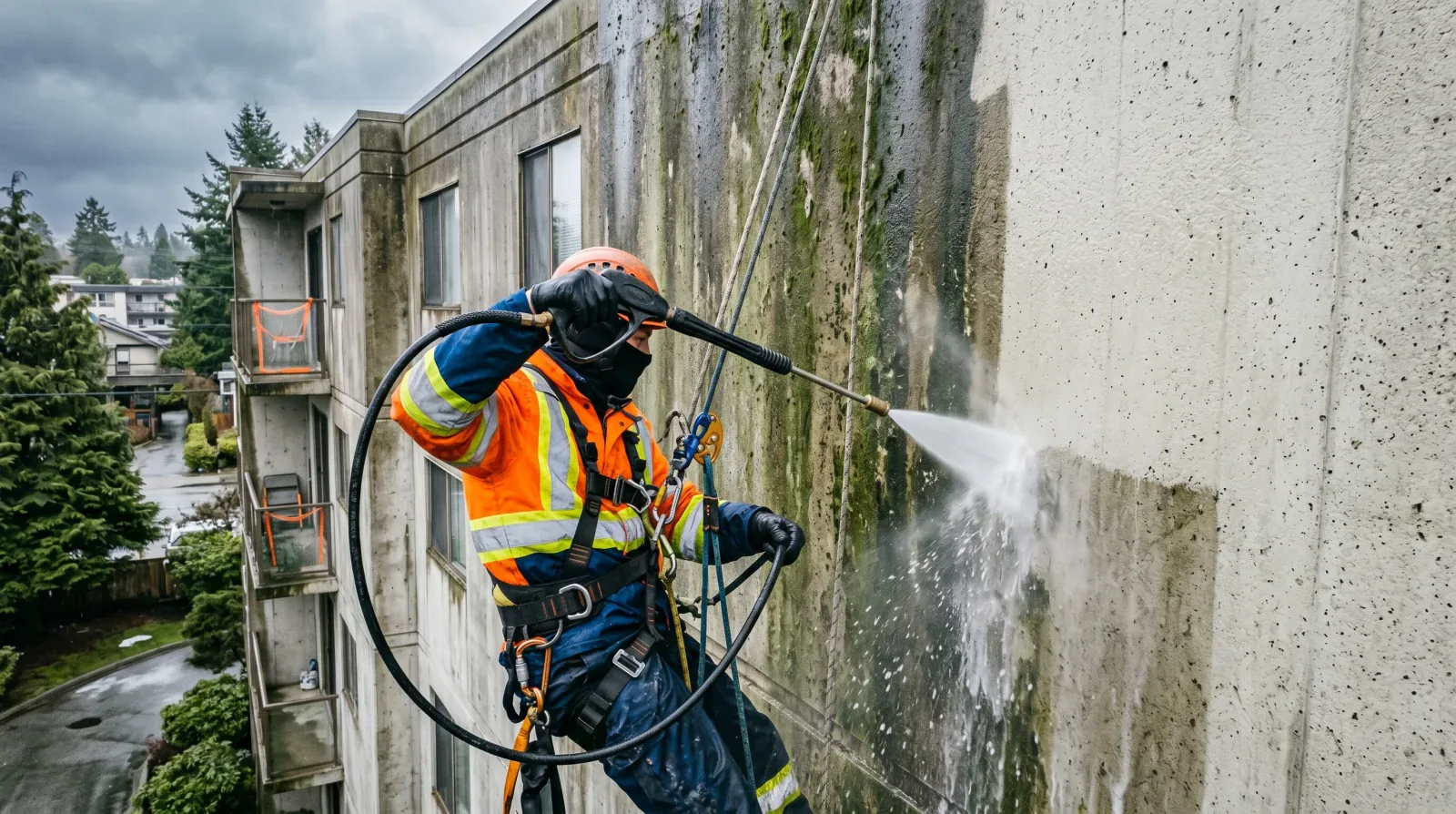
A Coquitlam strata books a pressure washing crew to clean the green off the north face of their building. The result looks great for a week. Then someone notices the green creeping back within a couple of months, a few sealant joints that used to be full are now empty, and a top-floor unit has a fresh water stain that wasn’t there before. The wall got clean. The building got hurt. And the algae came back anyway.
This is the recurring problem with treating building washing as a “more pressure is better” job. On the wet coast, where the real enemy is biological growth, high pressure often does the least good and the most damage at the same time.
What the two methods actually do
Pressure washing uses high-pressure water to physically blast dirt and growth off a surface. It’s force-based — the water hits hard enough to knock material loose.
Soft washing uses low pressure combined with cleaning solutions that break down and kill algae, moss, and mildew, followed by a gentle rinse. It’s chemistry-based — the solution does the work the pressure would otherwise try to do by brute force.
That difference is everything on a Metro Vancouver building. The damp climate grows algae, moss, and mildew on exteriors all year, heaviest on shaded north and east faces that never dry out. Those are living organisms with roots into the surface. Blast them with pressure and you remove the visible layer but leave the roots, so the growth returns fast — which is exactly why the pressure-washed wall is green again by mid-season. Soft washing’s solutions actually kill the organism, so it stays gone much longer.
The damage high pressure does
Pressure is a tool, and like any tool it does harm when it’s used on the wrong material. On a building exterior, too much pressure can:
- Erode concrete surfaces, wearing away the cement paste and exposing aggregate
- Blast sealant out of joints, stripping the very weather seals that keep water out
- Strip or gouge coatings, especially at edges and around existing defects, accelerating a coating’s failure
- Force water behind cladding and past window seals, driving it into the wall where it causes interior damage
That last one is the sneaky one. The damage from forcing water into the envelope doesn’t show up while the crew is there. It shows up weeks or months later as a stain inside a suite, far from where the wand was pointed — and nobody connects it to the wash. On a building with aging sealant or imperfect detailing, the direction and pressure of the water matters as much as getting the surface clean. This is the same vulnerability that drives so many water ingress problems: water finding its way past the weather barrier, except here you’re the one pushing it in.
Coatings and the prep that protects them
If your building has an elastomeric or acrylic coating, high-pressure washing is a particular risk. The coating is a film bonded to the wall, and aggressive pressure can strip, gouge, or prematurely wear it — worst at the edges and around any existing damage. On an aging coating, a hard wash can push it from “weathered” to “failing.” Where the goal is to clean a coated wall, soft washing protects the very finish you paid to apply. Removing a coating for recoating is a different, controlled process — not something general cleaning should be doing by accident.
When cleaning is the prep step before a new coating goes on, the stakes change again. A coating is only as good as what it’s bonded to. Coat over dirt, algae, chalking, or a loose existing finish and the new coating grips the contamination instead of the substrate — then peels, blisters, or delaminates well before its time. Poor surface preparation is one of the most common reasons exterior coatings fail early, and it’s entirely avoidable. The cleaning method has to leave a sound, properly prepared surface, which is a different goal than just making the wall look good for the photos.
The choice of coating system interacts with all of this too. Different products tolerate different prep and have different cleaning needs over their life — the elastomeric versus acrylic comparison gets into how those systems behave, including how they should be maintained once they’re on.
When pressure washing is the right call
None of this means pressure washing is always wrong. For the right surface and purpose, it’s the correct tool: durable hard surfaces like some concrete flatwork, removing certain stubborn contaminants, or controlled surface preparation by a trained operator who deliberately matches the pressure to what the substrate can take. The problem is never pressure itself — it’s high pressure applied indiscriminately to surfaces and materials that can’t handle it.
That’s the real skill: matching method to substrate. A concrete drive aisle and a coated stucco wall and a sealed-joint curtain wall are not the same cleaning problem, and treating them as one with a single high-pressure setting is how buildings get damaged. A crew that asks what the surface is and what’s growing on it before they pick a pressure is a crew that won’t hurt your building.
Windows are their own consideration
Cleaning around windows deserves care. Aggressive high pressure can drive water past window perimeter seals and stress aging sealant, and direct high pressure isn’t ideal near sealed glass units. Window cleaning and exterior washing are related but separate tasks. On a high-rise, both are typically done from rope access or suspended access, and how often the glass gets cleaned is its own maintenance question — covered in the guide on how often high-rise windows are cleaned. Using appropriate pressure and technique around the openings protects the seals and the glass while still getting them clean.
How to think about it for your building
The goal isn’t a satisfying blast. It’s a clean building that stays clean and isn’t damaged in the process. For a Metro Vancouver property:
- Treat growth as a chemistry problem, not a force problem. Algae and moss come back fast if you only knock off the surface. Soft washing kills it, so it stays gone.
- Match the method to the substrate. Concrete flatwork, coated walls, sealed joints, and windows are different problems. One pressure setting for all of them damages something.
- Protect the coating. If the wall is coated and you want to keep the coating, soft wash it. Don’t let a cleaning crew strip your finish by accident.
- Get the prep right before coating. If you’re cleaning to recoat, the cleaning has to leave a sound, bondable surface — that decides whether the new coating lasts its full life or peels early.
- Clean regularly and gently. Periodic soft washing as part of a maintenance program is easier on the building than occasional aggressive blasting once growth is heavy.
A clean exterior protects the building and the people who own it. But the cleaning itself shouldn’t be the thing that drives water into the wall or strips the seals and coatings keeping it out. On the wet coast, gentle and consistent beats hard and occasional almost every time.
Related guides
- Exterior Coatings Hub — protecting buildings with coatings
- How Exterior Coatings Protect Buildings — what coatings do and how they fail
- Elastomeric Wall Coatings for Concrete Towers in Vancouver — coating systems for high-rises
- How Often Should High-Rise Windows Be Cleaned — window cleaning frequency and access
Frequently Asked Questions
More from Exterior Coatings Guide
Cold-Weather Exterior Restoration in Coastal BC: What Works in Winter
Winter restoration on a West Vancouver building is possible, but coatings, sealants, and concrete have temperature and dew-point limits. How crews manage it.
Read article →EIFS vs Traditional Stucco for BC Multifamily Buildings
Exterior Insulation and Finish Systems (EIFS) and traditional three-coat stucco look similar from the street but fail in completely different ways. What BC strata councils and developers need to know before specifying, repairing, or buying a building with either system.
Read article →Stucco Crack Repair on Vancouver Low-Rise Buildings Before the Wet Season
Hairline cracks in stucco on a Lower Mainland low-rise turn into wet-season leaks if they're not sealed in late summer. What cracks matter, what to ignore, and how the repair is actually done before October.
Read article →