Why Exterior Coatings Blister and Peel on BC Buildings
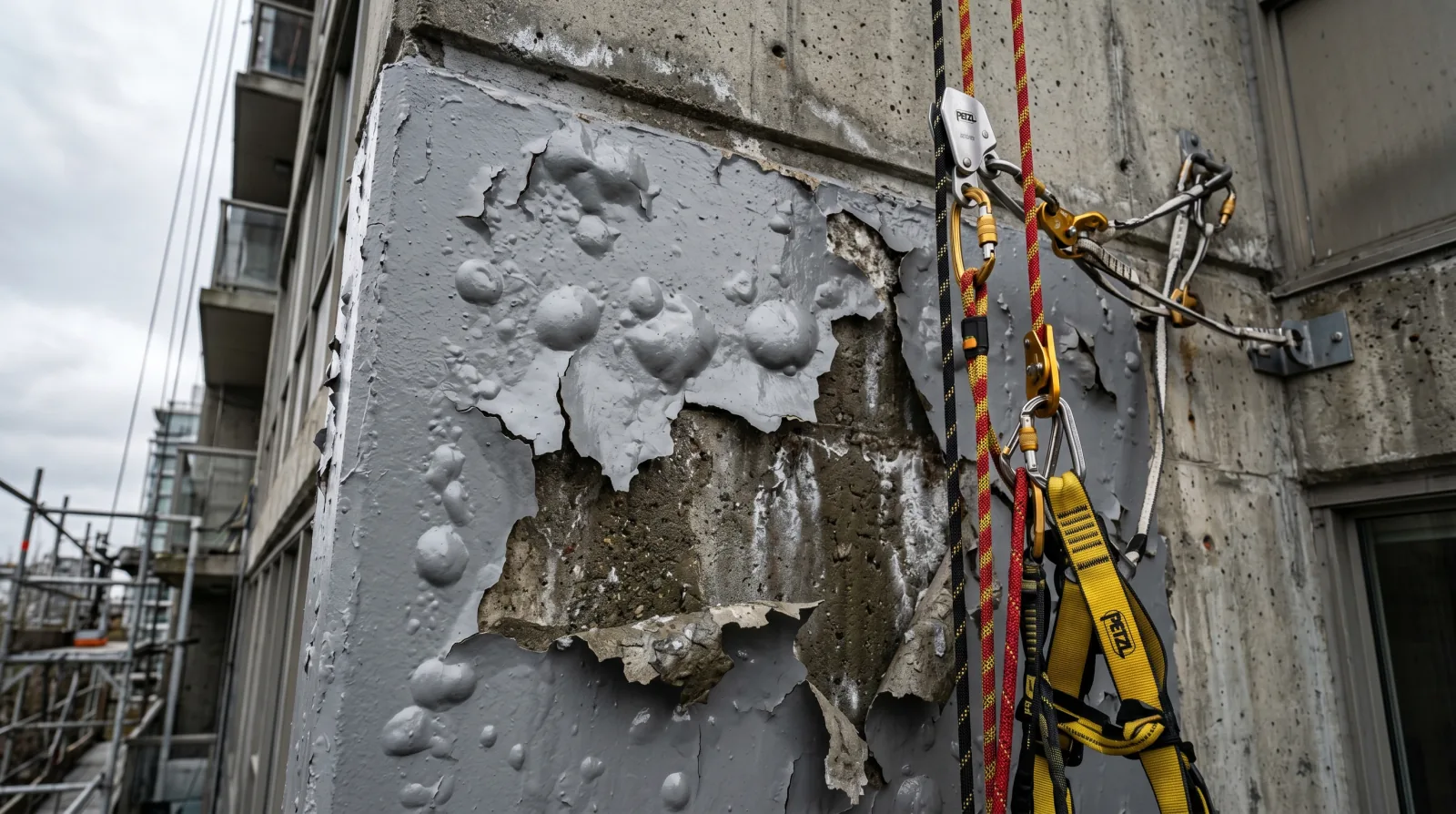
A Surrey strata recoated their mid-rise in the spring and felt good about it. Fresh elastomeric, sharp new colour, the building looked ten years younger. By the following winter the south elevation was covered in blisters — fat bubbles you could push in with a thumb, sheets of coating lifting off the concrete.
The contractor blamed the product. The manufacturer’s rep showed up, peeled back a blister, and found the answer in about thirty seconds. The wall had been damp when they coated it. The coating never had a chance.
Coating failures look dramatic and feel like a mystery, but they almost always come down to a short list of causes. Most of them are preventable, and the most common one is moisture.
The blister is a symptom, not the disease
A blister forms when something pushes the coating off the wall from behind. The film itself rarely fails on its own — it gets lifted. And the thing doing the lifting is almost always moisture or vapour pressure.
Picture damp concrete with a fresh coating sealed over it. The water in that concrete wants to leave. When the sun hits the wall and heats it, the trapped moisture turns to vapour and expands, and the only direction it can go is outward against the back of the coating. The coating, which never bonded well to a damp surface in the first place, lifts into a bubble. On a dark colour in direct Pacific sun, the wall gets hotter, the moisture expands harder, and the blistering is worse.
So when you see blisters, the question is not “why did the coating fail” — it is “where did the moisture come from.” Either it was in the wall before you coated, or it found a way in afterward.
The 5% rule
Most exterior coating manufacturers set a substrate moisture limit, and for concrete and masonry it commonly lands around 5% moisture content, or an equivalent relative-humidity reading inside the concrete. Below that threshold, the coating can bond and the wall is dry enough that you are not sealing water inside. Above it, you are coating a wet wall, and you are building a blister farm.
The exact number is whatever the product data sheet says — it varies by coating chemistry. But the principle does not change. You do not coat a wet wall and expect it to hold. On a BC building coming out of a wet season, this is the rule that gets ignored most and punishes you hardest.
The trap is that a wall can look dry. The surface dries fast in a sunny week, but concrete holds moisture deep in the slab or block for far longer. A wall that reads dry to the touch can still be well over the limit a centimetre in.
You test it, you don’t eyeball it
Because the surface lies, you measure. There are a few honest ways to know whether a substrate is dry enough to coat.
- A calibrated moisture meter gives a quick reading, useful for surveying a wall and finding wet zones, though surface meters only read shallow.
- In-situ relative humidity probes drilled into the concrete read moisture deeper in the slab, which is where the trouble hides.
- The plastic-sheet test is the cheapest check there is: tape a square of clear plastic tightly to the wall, leave it a day, and look for condensation or darkening underneath. If moisture collects, the wall is still giving off water and is not ready.
None of this is exotic. It is the step that separates a coating that lasts fifteen years from one that fails in twelve months, and it is the step most often skipped because it costs a day. On a Pacific Northwest job, building in the time to verify moisture — and to wait for the wall to dry if it fails — is part of doing the work right.
Vapour drive: when the moisture comes from inside
Not all coating moisture comes from a damp substrate. Some of it comes from inside the building.
Warm, humid interior air pushes water vapour outward through the wall toward the cooler exterior — that is vapour drive. If the exterior coating is too vapour-tight, the moisture reaches the back of the film, cannot escape, and builds pressure that blisters the coating from behind. The wall needed to breathe outward, and the coating sealed it shut.
This is why coating selection is not just about colour and warranty. A wall that has to release vapour outward needs a coating with enough permeability to let it pass, while still shedding liquid water from outside. Get that balance wrong and you get blistering that has nothing to do with substrate prep — it is the building exhaling against a sealed surface. Choosing between systems with different permeability is part of why the elastomeric versus acrylic decision matters beyond price, and why elastomeric wall coatings on concrete towers are specified the way they are.
Prep and compatibility: the installation failures
Moisture is the leading cause, but two installation problems run close behind.
Surface prep decides whether the coating bonds to the wall or to the dirt on the wall. A coating grips whatever is directly beneath it. If that is chalk, dust, oil, or a loose layer of failed old coating, the new coat bonds to the contamination and peels off with it. Proper prep means cleaning, removing failed coating, repairing the substrate, and profiling the surface so the coating keys in. Rushed prep is the most common installation reason a coating peels early.
Compatibility is the other one. Not every coating bonds to every surface. An elastomeric over a glossy old alkyd, or a waterborne system over a chalky aged coating, can release cleanly at the interface and peel in sheets. Before any recoat, you identify the existing coating, test adhesion, and pick a compatible system — or strip back to sound substrate. Guessing what the old coating is, and hoping the new one sticks, is how recoats fail on the first winter.
Diagnosing a failure
When a coating has already failed, the diagnosis starts at the failure itself. Peel back a blister and read what is underneath.
A clean, dry release at the coating-to-substrate interface points to a prep or compatibility problem — the coating never bonded. Moisture or condensation on the back of the film points to trapped water or vapour drive. White salt deposits point to moisture carrying minerals out of the concrete. Each tells a different story, and each has a different fix.
Then check the rest: test substrate moisture across the wall, look for incompatible layers underneath, and review the conditions when it was applied — temperature, dampness, dew point. Diagnosis matters because the repair for a moisture problem (dry the wall, fix the vapour path) is nothing like the repair for a prep problem (strip and recoat properly). Get the diagnosis wrong and the recoat fails the same way.
Whether a failure can be patched or has to come off entirely depends on how widespread it is. Isolated blisters over otherwise sound coating can sometimes be cut out, dried, prepped, and patched. Widespread blistering from substrate moisture or incompatibility usually means coming back to sound material across the whole elevation, because the condition that caused it is everywhere — not just where the first blisters showed.
Getting it right the first time
A coating that lasts does so because the boring steps were done. The substrate moisture was tested and verified below the manufacturer’s limit. The surface was cleaned, repaired, and profiled. The coating was chosen for the wall’s vapour behaviour and the existing surface, not just the colour card. It went on within the temperature and dew-point window the data sheet requires, in a dry enough season. That is the whole list, and it is the reason a good exterior coating actually protects the building for its full service life instead of failing the first winter.
On a coastal BC building, the moisture verification is the step that gets skipped and the step that causes the most failures. Test the wall before anyone opens a pail. A plastic-sheet test costs nothing. A failed recoat on a tower costs a special levy.
Related guides
- Exterior Coatings Hub — coating types, selection, and BC climate considerations
- Elastomeric vs Acrylic Coatings — matching the coating to the wall’s needs
- Elastomeric Wall Coatings on Concrete Towers — how high-build coatings perform on tall buildings
- How Exterior Coatings Protect Buildings — what a sound coating system actually does
Frequently Asked Questions
More from Exterior Coatings Guide
Pressure Washing vs Soft Washing Building Exteriors in Metro Vancouver
High-pressure water strips algae off a Coquitlam wall fast — and can blast the coating, sealant, and concrete off with it. When soft washing is the right call, and why surface prep before coating decides everything.
Read article →Cold-Weather Exterior Restoration in Coastal BC: What Works in Winter
Winter restoration on a West Vancouver building is possible, but coatings, sealants, and concrete have temperature and dew-point limits. How crews manage it.
Read article →EIFS vs Traditional Stucco for BC Multifamily Buildings
Exterior Insulation and Finish Systems (EIFS) and traditional three-coat stucco look similar from the street but fail in completely different ways. What BC strata councils and developers need to know before specifying, repairing, or buying a building with either system.
Read article →