Elastomeric coating vs. acrylic paint for stucco and concrete: what actually lasts in Metro Vancouver
Standard exterior acrylic paint cracks with the substrate, lasts 5–7 years on a BC coastal facade, and needs to be reapplied two or three times over the life of an elastomeric coating. Elastomeric bridges hairline cracks, resists wind-driven rain, and lasts 15–20+ years when applied correctly over a properly prepared surface. The right call depends on what your building's walls actually need — here's how to read that.
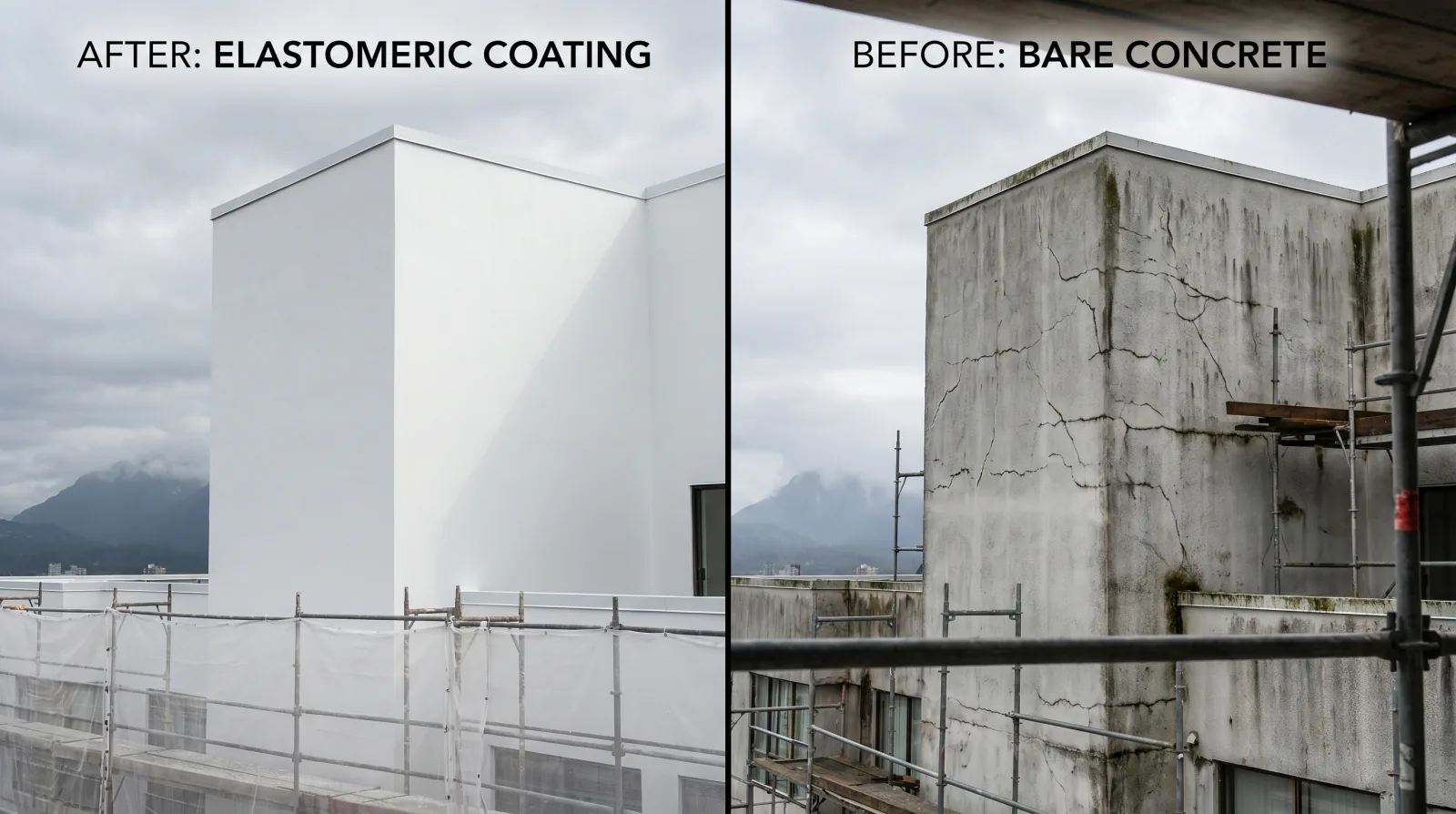
Why standard paint fails on Vancouver high-rises
A concrete or stucco wall in Metro Vancouver is not a stable substrate. Thermal cycling — even the mild coastal range — causes daily expansion and contraction. Seasonal moisture absorption and drying adds more movement. The result is a wall that constantly shifts at a micro scale, and hairline cracks form and widen over years. Standard exterior paint at 2–4 mils dry film is not thick enough to move with the wall. It follows the substrate, which means it cracks, allows water behind it, and begins peeling from the edges of the crack outward. By year five or six, the wall looks streaked, cracked, and dated. That's not the paint's fault — it's just the wrong product for an actively-moving concrete facade.
What elastomeric coating does differently
Elastomeric coating is applied at 10–20 times the film thickness of standard paint — 20–30 dry mils per coat, in two coats, for a finished system approaching 50–60 mils. At that thickness, it can stretch with the substrate across hairline cracks up to approximately 2 mm wide, then return to its original length when the movement reverses. That elastomeric behaviour bridges the thermal and shrinkage cracking that destroys standard paint films, and it does it across thousands of cycles over a 15-year service life.
The waterproofing performance follows from the thickness. A properly applied elastomeric coating at full film build creates a low-permeance continuous barrier that resists sustained wind-driven rain — tested to ASTM E331 conditions. It does not replace failed sealant joints or cracked flashing, but it significantly slows surface water infiltration through the wall face itself.
Coatings compared
Elastomeric coating
A thick, rubber-like coating — typically applied at 10–20 times the film build of standard paint — formulated from 100% acrylic or modified acrylic resins with high elastomer content.
Standard exterior acrylic paint
A conventional water-based exterior latex paint at typical architectural film thickness. Good colour and sheen options, widely available.
Decision framework: six questions that point to the right coating
| Question | Recommendation | Reason |
|---|---|---|
| Hairline cracking present? | Yes — elastomeric | Standard acrylic follows the crack and shows it within one season. Elastomeric bridges it for the life of the coating. |
| Water infiltration history? | Yes — elastomeric | If staining or damp is tracking through the wall, the coating needs to act as a moisture barrier, not just a decorative film. Elastomeric's low permeance slows infiltration significantly. |
| Building is occupied strata or commercial? | Yes — elastomeric | Recoating disruption every 5–7 years costs the strata in both levy and resident inconvenience. One elastomeric application that lasts 15–20 years is the rational life-cycle choice. |
| Substrate is wet or has active cracks > 2 mm? | No — repair first | Elastomeric applied over a wet wall seals moisture in and causes blistering. Active structural cracks wider than 2 mm exceed its bridge capacity and must be repaired before coating. |
| Colour change flexibility needed soon? | Consider acrylic | Elastomeric, once down, is the colour it is. Repainting over elastomeric is possible but requires the surface to be sound. If the owner expects a colour change within 5 years, acrylic is a lower-stakes choice. |
| Surface is horizontal or ponding likely? | Elastomeric — but assess drainage | Elastomeric is not a substitute for a proper waterproofing membrane on horizontal surfaces that pond. On a vertical facade, excellent. On a horizontal surface with standing water, a proper membrane system is needed. |
The life-cycle cost argument
Standard exterior paint on a high-rise strata tower requires recoating every 5–7 years. That means three separate coating campaigns over a 15-year period: three mobilizations, three scaffold or rope access crews, three sets of tenant notices, three strata levies. A single elastomeric application covers the same 15 years. Even at 2–3× the per-application cost, the elastomeric option typically wins over the building's life — and with significantly less cumulative disruption to residents.
The calculation depends on your building's specific square footage and existing coating condition, and we model both scenarios on request. The outcome is almost always the same: the elastomeric option costs less per protected square foot per year. The reason stratas still sometimes choose standard repaint is the upfront cost is lower — which makes sense when the reserve fund doesn't support the full elastomeric campaign. In that case, a phased approach — elastomeric on the worst-performing elevation first, remaining faces in the next funding cycle — captures most of the benefit without requiring a full immediate outlay.
What the coating cannot fix
Elastomeric is a coating, not a waterproofing system. It does not replace failed sealant at window frames and panel joints — those still need to be cut out and replaced as part of the same campaign. It does not fix cracks wider than approximately 2 mm — those require crack filler or concrete repair before coating. It does not perform on a wet or damp wall — moisture trapped under an elastomeric film causes blistering and delamination. And it does not substitute for a proper membrane on horizontal or near-horizontal surfaces that pond.
A full envelope coating campaign should include a sealant inspection and replacement alongside the coating application. Coating a wall and leaving the sealant joints open defeats much of the purpose — water will still enter at the joints and track behind the new coating. Our team scopes both the coating and the sealant in a single assessment, so nothing falls through the cracks between trades.
For the application process in detail — prep, priming, film-thickness monitoring, and what good installation actually looks like — see our exterior coatings service page.
Quick answers
Does elastomeric coating prevent water infiltration on a stucco high-rise?
It significantly slows it. Elastomeric coatings rated to ASTM D7088 provide a low-permeance continuous film that resists wind-driven rain and moisture vapour transmission far better than standard paint. The important qualification is that it slows infiltration through the coating film — it does not fix failed sealant joints, cracked flashing, or open construction gaps that are already allowing bulk water into the wall assembly. An elastomeric coating campaign should always run alongside a sealant assessment; the coating is not a substitute for fixing the joints.
Can elastomeric coating be applied in Vancouver's rainy season?
With care. Elastomeric coatings are water-based and require the substrate to be dry at application — typically above 5°C air and surface temperature, with no rain forecast for 6–8 hours minimum. In practice, the coating window on a Vancouver October or February day is often a few hours in the late morning before the next rain cell arrives. Experienced applicators working from rope access can stage the work to follow the weather — coating a south-facing elevation on a dry day, protecting the work, and moving to the sheltered east face the next day. It extends the campaign, but it's manageable. Application in active rain is not acceptable and any legitimate contractor will halt and cover the work.
How thick should elastomeric coating be applied?
Manufacturer specifications vary, but a correctly applied elastomeric system typically delivers a dry film thickness of 20–30 mils per coat, in two coats, for a finished dry film of 40–60 mils. Applied too thin, it loses its crack-bridging and waterproofing properties — the film is just expensive paint at that point. This is why wet-film thickness gauges and coverage-rate tracking matter during application: the spec calls for a specific volume of material per square foot, and shortcutting that to reduce cost eliminates the performance advantage. Ask your contractor how wet-film thickness will be monitored and documented during application.
Exterior coating questions
Does elastomeric coating prevent water infiltration on a stucco high-rise?
It significantly slows it. Elastomeric coatings rated to ASTM D7088 provide a low-permeance continuous film that resists wind-driven rain and moisture vapour transmission far better than standard paint. The important qualification is that it slows infiltration through the coating film — it does not fix failed sealant joints, cracked flashing, or open construction gaps that are already allowing bulk water into the wall assembly. An elastomeric coating campaign should always run alongside a sealant assessment; the coating is not a substitute for fixing the joints.
Can elastomeric coating be applied in Vancouver's rainy season?
With care. Elastomeric coatings are water-based and require the substrate to be dry at application — typically above 5°C air and surface temperature, with no rain forecast for 6–8 hours minimum. In practice, the coating window on a Vancouver October or February day is often a few hours in the late morning before the next rain cell arrives. Experienced applicators working from rope access can stage the work to follow the weather — coating a south-facing elevation on a dry day, protecting the work, and moving to the sheltered east face the next day. It extends the campaign, but it's manageable. Application in active rain is not acceptable and any legitimate contractor will halt and cover the work.
How thick should elastomeric coating be applied?
Manufacturer specifications vary, but a correctly applied elastomeric system typically delivers a dry film thickness of 20–30 mils per coat, in two coats, for a finished dry film of 40–60 mils. Applied too thin, it loses its crack-bridging and waterproofing properties — the film is just expensive paint at that point. This is why wet-film thickness gauges and coverage-rate tracking matter during application: the spec calls for a specific volume of material per square foot, and shortcutting that to reduce cost eliminates the performance advantage. Ask your contractor how wet-film thickness will be monitored and documented during application.
What surface preparation does elastomeric coating require?
More than standard paint — and more than many quotes account for. The sequence is: (1) high-pressure wash to remove all dirt, algae, chalk, and loose existing coating; (2) chip and repair any delaminated stucco, loose concrete, or open cracks with a compatible patching compound; (3) treat active cracks with a crack filler rated for the expected movement; (4) apply a dedicated elastomeric primer — not a standard paint primer — to the bare and patched areas; (5) confirm substrate is dry before topcoat application. Skipping or rushing any of these steps produces a coating that peels or blisters within a year. On a high-rise facade, that means another rope access mobilization to re-apply — at full cost. Prep is where the job is won or lost.
Is elastomeric paint the same as waterproof paint?
The terms overlap loosely in the market but they describe different performance levels. A true elastomeric coating is a thick-film, high-elongation system tested to ASTM D522 for crack bridging and ASTM D7088 for wind-driven rain resistance. "Waterproof paint" is a marketing term with no standardised performance requirement — it can describe anything from a genuine elastomeric to a standard exterior paint with a minor water-repellent additive. When evaluating products for a high-rise facade in Vancouver, ask for the specific ASTM performance test results, not the label claim.
Can you apply elastomeric coating over existing paint on a concrete or stucco building?
Yes, if the existing paint is well-bonded, sound, and compatible. The prep requirement is to remove any peeling, blistering, or chalking areas back to a sound substrate, clean the surface thoroughly, and prime bare areas. Applying elastomeric over a poorly bonded existing paint system will bond the elastomeric to a failing substrate — and when that substrate eventually peels, it takes the elastomeric with it. On buildings with multiple layers of existing paint or unknown coating history, an adhesion test patch confirms whether direct overcoat is viable before committing the full facade.
What is the cost difference between elastomeric coating and acrylic paint on a Metro Vancouver high-rise?
Per-application, elastomeric runs roughly 2 to 3 times the material and labour cost of a standard acrylic repaint. For a mid-rise strata tower, the difference might be $30,000 to $60,000 more for the elastomeric application than for a standard repaint. However, the standard repaint needs to be repeated every 5 to 7 years. As a simplified illustration only: if one elastomeric application costs about the same as a single high-end repaint, but a standard repaint has to be redone two or three times over the same 15-year period, the elastomeric usually wins on life-cycle cost before you even account for the strata disruption and levy cost of the extra recoating campaigns. The actual numbers depend entirely on your building. We can model both scenarios specifically for your facade on request.
Find out whether your facade needs elastomeric coating or acrylic repaint
We assess stucco and concrete facades across Vancouver, North Vancouver, West Vancouver, and Burnaby — checking crack patterns, moisture condition, existing coating adhesion, and sealant status — so you have the data to make the right coating decision and budget it accurately.