Concrete High-Rise Sealant & Envelope Repair in the West End
Allweathercoating maintains the West End's dense concentration of 1960s and 1970s concrete apartment towers with sealant replacement, concrete spall repair, balcony waterproofing, and certified rope-access window cleaning for strata councils, rental building owners, and property managers between English Bay and Coal Harbour.
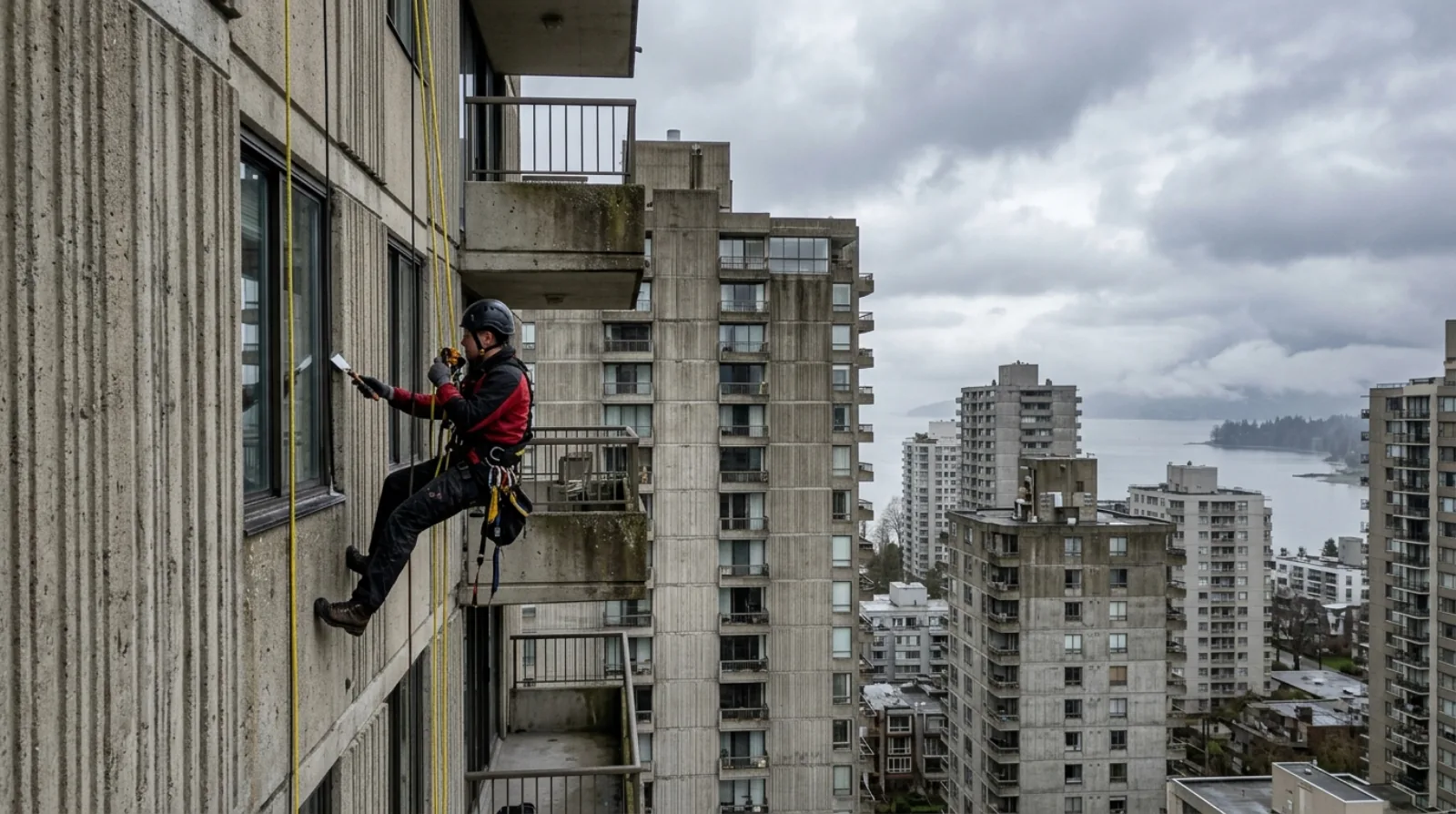
Property Types We Serve in West End
The West End is Vancouver's highest-density neighbourhood, built out almost entirely between 1957 and the late 1970s after the City lifted the eight-storey height limit that had constrained the area. In roughly two decades, more than 300 mid- and high-rise concrete apartment buildings went up along the streets between Georgia and English Bay, and the neighbourhood still holds close to a third of Vancouver's purpose-built rental housing stock. This gives the West End a building profile unlike anywhere else Allweathercoating serves: an unusually dense cluster of face-sealed concrete towers, most 15 to 25 storeys, built to the construction standards of a single 20-year window rather than the mixed-era stock found in Kitsilano or the newer curtain-wall towers of Yaletown and Coal Harbour.
Because these buildings predate rainscreen requirements, their exterior walls rely on surface-applied coatings and perimeter sealant joints as the sole barrier against wind-driven rain — there is no secondary drainage plane behind the cladding to catch water that gets past a failed joint. Original polyurethane caulking on West End towers is now 50 to 65 years old in many buildings, decades past its functional service life, and concrete balcony edges on the earliest towers are showing the carbonation-driven spalling typical of reinforced concrete built before modern cover requirements. We see a consistent pattern across the neighbourhood: exposed rebar at balcony slab edges, hairline cracking radiating from window corners, and staining below failed control joints on the concrete facade panels.
A mix of ownership structures adds complexity that is distinct from the strata-only buildings we service elsewhere. Many West End towers are purpose-built rental buildings under single ownership rather than strata corporations, which changes how maintenance decisions get made — a single building owner or asset manager, rather than a strata council vote, authorizes the work. We work with both ownership types, adapting our reporting and scheduling to whichever decision-making structure applies, while some West End buildings have since converted to strata or leasehold co-op tenure and require the depreciation-report-driven planning process common to BC strata corporations.
The neighbourhood's narrow lot widths and tight setbacks mean many buildings sit close to their neighbours, with limited ground-level staging space for scaffolding. Rope access is frequently the only practical method for exterior work on these towers, since a swing stage or scaffold erection would block the narrow lane access that many West End buildings depend on for parking and refuse collection. Our technicians rig from roof anchors and work each elevation independently, keeping ground footprint to a folding barricade and a spotter rather than the days-long scaffold assembly that denser lot conditions would otherwise require.
Local Coastal Climate Demands
The West End's waterfront exposure along English Bay places it directly in the path of wind-driven rain from Pacific storm systems tracking in across the Strait of Georgia. Towers on the bay-facing blocks between Denman and Beach Avenue take the most direct exposure, with salt-laden air accelerating corrosion of exposed steel components — balcony railing brackets, drainage scuppers, window frame fixings — at a faster rate than buildings set back further from the water. We apply corrosion-inhibiting primers to exposed steel during balcony repair work in the waterfront blocks specifically because standard coatings underperform against the chloride load these buildings absorb.
Because the majority of West End concrete towers were built to a similar design era, the neighbourhood has a correspondingly concentrated need for sealant replacement work happening at roughly the same time across many buildings. Strata councils and rental building owners who delay joint replacement past the 20-year mark on original 1960s and 1970s caulking are seeing water tracking into wall cavities during winter storm events, a problem that only worsens as sealant continues to harden and pull away from the concrete substrate. Under BC Strata Property Act depreciation report requirements for strata-tenure buildings, envelope sealant condition is a standard line item that owners are required to plan and budget for.
Rope access work in the West End requires coordination with the City of Vancouver for street use permits on the neighbourhood's narrow residential streets, many of which have limited daytime parking that our ground crews must account for when setting up exclusion zones. We secure City of Vancouver street use permits for every drop that passes over a public sidewalk, and our technicians hold current IRATA or SPRAT certification with fall protection rigged exclusively to anchors that meet WorkSafeBC Part 11 structural requirements.
Stanley Park's tree canopy and the neighbourhood's mature street trees create pockets of shaded, slow-drying facade on the park-facing and interior-block sides of many towers, encouraging moss and algae growth on concrete surfaces that stay damp longer after rain events. We schedule soft-wash cleaning on these shaded elevations more frequently than sun-exposed facades, since organic growth left untreated retains moisture against the concrete surface and accelerates the carbonation process that leads to rebar corrosion over time.
"Our building is a 1968 rental tower with the original face-sealed concrete envelope. Allweathercoating documented every failed joint on all four elevations during one rope-access visit and gave us a phased sealant replacement plan we could actually afford to spread across two budget years."
Services Available in West End
High-Rise Window Cleaning
Allweathercoating provides safe, efficient high-rise window cleaning for strata towers, commercial buildings, office towers, and mixed-use properties across Vancouver, North Vancouver, West Vancouver, and Burnaby.
Local DetailsCommercial Window Cleaning
Allweathercoating provides professional commercial window cleaning for office plazas, retail complexes, institutional buildings, and low-to-mid rise properties in Vancouver, Burnaby, and the North Shore.
Local DetailsGlass Canopy and Awning Cleaning
Allweathercoating cleans and maintains glass entrance canopies, awnings, and overhead glazing for restaurants, retail storefronts, office lobbies, and strata entrances across Vancouver, Burnaby, and the North Shore.
Local DetailsWaterproofing Contractor
Allweathercoating provides specialized commercial and strata waterproofing services designed to protect properties from the challenging Pacific Northwest climate.
Local DetailsBuilding Envelope Repair
Allweathercoating provides targeted, localized building envelope repairs — rope-access concrete spall patching, sealant replacement, and stucco repair — for high-rise and commercial buildings across Vancouver, North Vancouver, West Vancouver, and Burnaby.
Local DetailsRope Access Building Maintenance
Allweathercoating uses certified industrial rope access (SPRAT/IRATA) to perform repairs, washing, and envelope maintenance on tall towers, reducing cost and tenant disruption.
Local DetailsExterior Coatings
Allweathercoating applies advanced exterior wall coatings and elastomeric painting to seal building facades against wind-driven coastal moisture.
Local DetailsSealant & Caulking
Allweathercoating replaces failed joints, window perimeter caulking, and structural expansion sealants to keep coastal rainwater out of strata and commercial properties.
Local DetailsBalcony Waterproofing
Allweathercoating installs high-durability balcony waterproofing membranes and liquid deck coatings to protect concrete decks and underlying framing from water ingress.
Local DetailsParkade Waterproofing
Allweathercoating applies heavy-duty vehicular traffic deck coatings and waterproofing membranes to protect parkade concrete structures from water ingress and salt corrosion.
Local DetailsStucco Repair
Allweathercoating repairs cracked, water-damaged, and deteriorating stucco on strata and multifamily buildings across Vancouver, North Vancouver, West Vancouver, and Burnaby, with texture-matched patching and a moisture assessment before any crack gets sealed over.
Local DetailsRainscreen Installation & Repair
Allweathercoating installs and repairs rainscreen wall assemblies for Vancouver, North Vancouver, West Vancouver, and Burnaby strata and multifamily buildings, converting older face-sealed walls into drained, vented systems that manage wind-driven rain the way the BC Building Code now requires.
Local DetailsConcrete Sealing
Allweathercoating seals structural concrete on Vancouver strata and commercial buildings: parkade slabs, balconies, and exterior concrete walls exposed to wind-driven rain and de-icing salt.
Local DetailsLeak Repair & Water Ingress
Allweathercoating diagnoses, traces, and repairs complex water ingress issues and building envelope leaks in Vancouver, Burnaby, and the North Shore.
Local DetailsBuilding Restoration
Allweathercoating delivers engineer-coordinated, full-scope building restoration for strata and commercial properties — structural concrete repair, brick masonry repointing, cladding renewal, and multi-system envelope rehabilitation across Vancouver, North Vancouver, West Vancouver, and Burnaby.
Local DetailsFrequently Asked Questions
Why do West End buildings need sealant replacement more urgently than newer Vancouver towers?
Most West End concrete towers were built between 1957 and the late 1970s, before BC Building Code rainscreen requirements existed. These buildings are face-sealed, meaning the original perimeter caulking and surface coatings are the only barrier against water entry — there is no secondary drainage cavity behind the cladding to catch water that gets past a failed joint. With original sealants now 50 to 65 years old, well beyond the 10-to-20-year functional lifespan of polyurethane caulking, many West End buildings are relying on joints that have already failed structurally even if they have not yet caused a visible leak. We recommend a rope-access condition survey to document joint status across all elevations before scheduling replacement.
Do you work with purpose-built rental building owners as well as strata councils in the West End?
Yes. The West End has an unusually high proportion of purpose-built rental buildings under single ownership rather than strata corporations, reflecting the neighbourhood's development history. We adapt our process to whichever ownership structure applies — providing condition reports and budget proposals directly to a building owner or asset manager for rental buildings, or working through the standard depreciation-report and AGM approval process for strata corporations. Both ownership types receive the same documented inspection reports and photographic evidence needed to plan and justify maintenance spending.
Is rope access the only option for exterior work on West End towers, or can scaffolding be used?
Rope access is typically the more practical option in the West End because of the neighbourhood's tight lot spacing and narrow lane access. Many buildings sit close to their neighbours with minimal ground clearance, and scaffold erection would block lane access that residents depend on for parking and garbage collection. Rope access requires only a small ground footprint — a folding barricade and a ground spotter — and our technicians can move between elevations without the days-long assembly and disassembly that scaffolding requires. We do use boom lifts or scaffolding on lower-rise West End buildings where ground access and street width allow it.
What causes the rust staining below balcony edges on older West End concrete towers?
Rust staining below balcony slab edges is a visible sign of rebar corrosion inside the concrete. As atmospheric carbon dioxide penetrates aging concrete over decades — a process called carbonation — it neutralizes the alkaline environment that normally protects embedded steel reinforcement from corrosion. Once carbonation reaches the rebar depth, the steel begins to rust, and rust occupies significantly more volume than the original steel, creating internal pressure that cracks and eventually spalls the surrounding concrete. The staining is oxidized iron leaching out through hairline cracks before visible spalling occurs. We assess corrosion extent with cover meter surveys and chip back to sound concrete during repair, treating the exposed rebar with a corrosion-inhibiting primer before patching.
How does marine salt exposure differ for West End buildings compared to inland Vancouver neighbourhoods?
West End buildings on the blocks closest to English Bay, particularly along Beach Avenue and the streets nearest Denman, receive direct salt-laden air off the water that accelerates corrosion of exposed steel components at a measurably faster rate than buildings set back several blocks inland. This affects balcony railing brackets, drainage scupper hardware, and window frame fixings in particular. We use corrosion-inhibiting primers on exposed steel repairs in the waterfront blocks and recommend more frequent window and facade washing for buildings in direct bay exposure to remove the salt film before it can chemically bond with glass and concrete surfaces.
Can Allweathercoating help a West End strata prepare for its next depreciation report?
Yes. Under the BC Strata Property Act, strata corporations are required to maintain a depreciation report that documents the condition and expected remaining service life of major building components, including the envelope, sealants, and balcony membranes. We provide rope-access condition surveys with dated photographic documentation of joint condition, concrete spalling extent, and balcony membrane status across every elevation, giving the strata's depreciation report preparer accurate current-state information rather than relying on estimates. This documentation also supports special levy budget proposals when major envelope restoration work needs council and ownership approval.
Protect Your Strata or Commercial Building Today
Contact Vancouver’s commercial exterior maintenance specialists. Get fully insured high-rise window cleaning, waterproofing, and building envelope repair.