Rainscreen Installation & Repair in Vancouver
· Serving Vancouver, BC
Allweathercoating installs and repairs rainscreen wall assemblies for Vancouver, North Vancouver, West Vancouver, and Burnaby strata and multifamily buildings, converting older face-sealed walls into drained, vented systems that manage wind-driven rain the way the BC Building Code now requires.
- IRATA Certified
- SPRAT Certified
- WorkSafeBC Compliant
- WCB & Liability Insured
- Building Envelope Renovation Experience
"Our building was one of the pre-1996 face-sealed towers with recurring interior staining every winter. Allweathercoating's assessment confirmed there was no drainage cavity behind the cladding at all. The rainscreen conversion on the worst elevation stopped the staining completely."
Common Problems Solved
- Face-sealed walls from before the rainscreen requirement, relying on a single watertight outer plane with no drainage cavity behind it.
- Recurring interior staining or dampness at wall corners despite repeated sealant repairs.
- Sealant joints that keep failing and getting re-caulked without the underlying leak actually stopping.
- A depreciation report flagging an envelope re-clad, without a plan for whether to upgrade to rainscreen while the wall is already open.
Benefits for Property Managers
- Converts the wall to the drained, vented assembly the BC Building Code has required in coastal zones since 2006.
- Addresses the root cause of recurring leaks rather than repeatedly re-caulking a face-sealed wall.
- Can be phased by elevation, prioritizing the wettest-facing wall first while spreading cost across funding cycles.
- Rope access reduces cost and disruption on assessment and localized repair work ahead of a full re-clad.
Our Execution Process
Assembly Assessment
Determine whether the existing wall is rainscreen or face-sealed, and where moisture readings or interior symptoms indicate active problems.
Cladding Removal
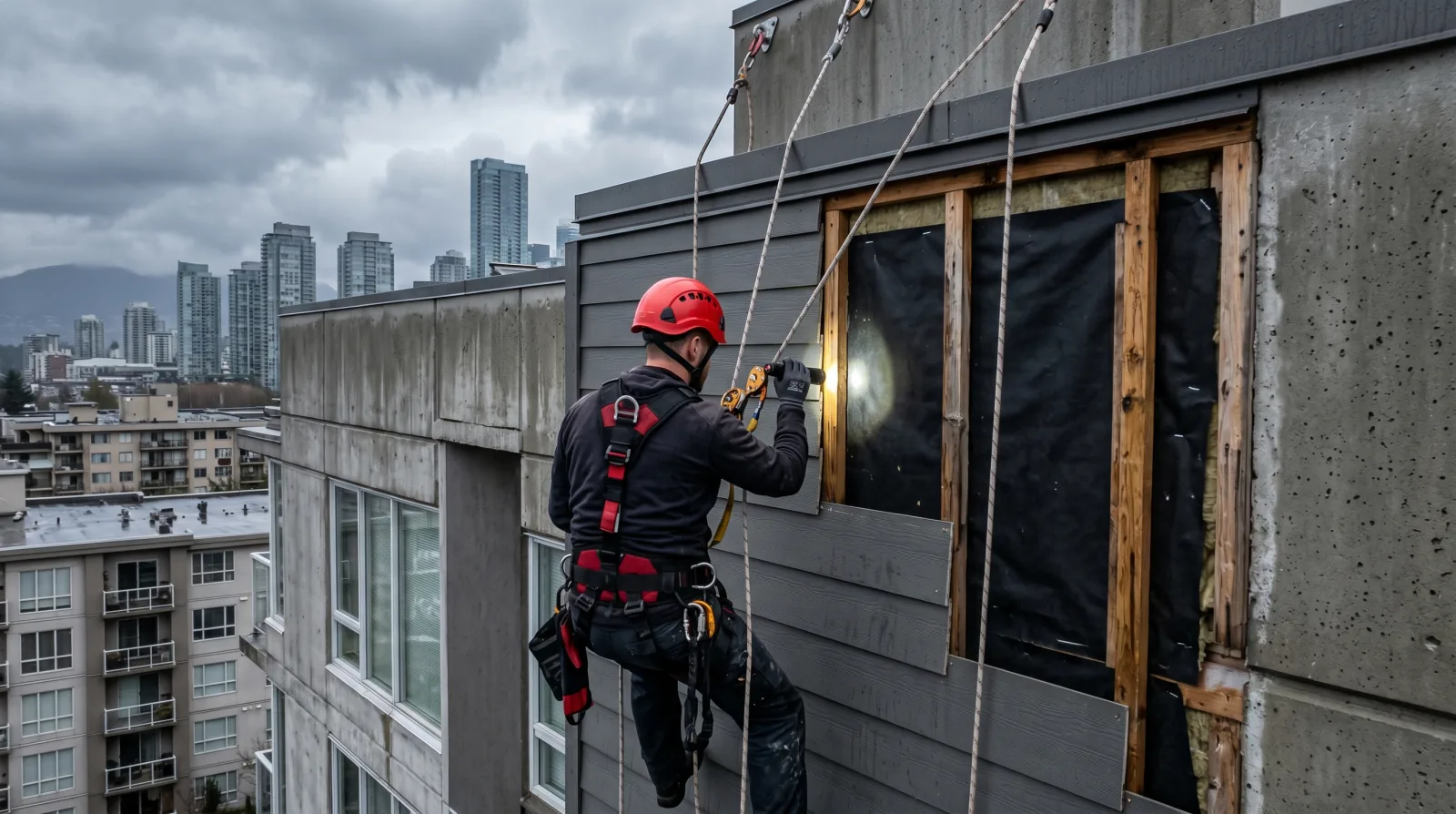
Strip the existing cladding on the affected elevation back to the sheathing.
Drainage Cavity Installation
Add strapping or a drainage layer to create the vented air gap that lets incidental water drain and the wall dry.
Barrier and Flashing Renewal
Install a new water-resistive barrier and renew flashings at every window, door, and penetration.
Re-Cladding
Install new cladding over the completed rainscreen assembly, phased by elevation to manage cost and resident disruption.
Rainscreen Wall Installation and Repair for Metro Vancouver Buildings
A rainscreen wall assembly holds the cladding off the structure, leaving a drained and vented air cavity behind it. That cavity is the entire point: it assumes some water will always get past the outer cladding, and gives that water a controlled path to drain out and dry, rather than trapping it against the sheathing. This is the design response to the BC leaky condo crisis, when thousands of face-sealed buildings built through the 1980s and 1990s had no such cavity, relied entirely on a perfect outer seal, and failed when that seal inevitably cracked or aged.
Face-Sealed vs. Rainscreen: Why the Difference Matters
A face-sealed wall puts the entire weather-resistance burden on the cladding and its joints, with no backup drainage plane. When water gets past a caulked joint or a hairline crack, it has nowhere to go and sits against the sheathing, which is how rot and mould start, often invisibly, for years before an interior stain appears. A rainscreen wall gives that same incidental water a drained, vented path out. Vancouver's building by-law required rainscreen construction starting in the late 1990s, and the BC Building Code adopted the requirement province-wide for coastal exposure zones in 2006. Buildings built before those dates, and never since renovated, are very likely still relying on the original face-sealed assembly.
How a Rainscreen Retrofit Actually Works
Converting an existing face-sealed wall to rainscreen means removing the cladding, adding strapping or a proprietary drainage layer to create the air gap, installing a new water-resistive barrier, and renewing every flashing detail at windows, doors, and penetrations before the cladding goes back on. This is a genuinely bigger scope than a simple re-clad, but if the cladding is already coming off as part of a depreciation-report-driven project, the incremental cost of adding the drainage assembly is a fraction of the total project and corrects the underlying problem permanently rather than repeating it.
Phasing a Rainscreen Conversion by Elevation
Wind-driven rain does not load every face of a building equally. South and west elevations on the BC coast typically take the worst exposure. Where budget or timing does not allow converting the whole building at once, a phased approach that addresses the worst-exposed elevation first, confirmed against an engineer's assessment of the sound walls, lets a strata council stage the cost across multiple funding cycles rather than requiring one large special levy.
Is a Rainscreen Renovation Regulated in BC?
Yes. Qualifying building envelope renovations in BC fall under the Building Envelope Renovation Regulation, and must be carried out by a licensed Building Envelope Renovator with home warranty insurance in place. This applies to larger re-cladding projects across Metro Vancouver, not minor sealant or coating repairs, and is a compliance point a strata council should confirm with any contractor bidding a rainscreen conversion.
Sealant Maintenance on a True Rainscreen Wall
A properly functioning rainscreen wall still depends on maintenance. If the drainage path at the base of the cavity or the weep vents get blocked by debris, mortar droppings, or a poorly detailed later renovation, the cavity stops draining and venting, and moisture can accumulate the same way it does in a face-sealed wall. Keeping the cavity, flashings, and sealant joints in good order is what makes the assembly deliver its intended service life.
Common Questions About Rainscreen Installation & Repair in Vancouver
How do I know if my building has a rainscreen wall or a face-sealed wall?
The original construction drawings and any prior building envelope renovation records held by the strata are the fastest way to confirm it. As a general rule, buildings constructed before the City of Vancouver's rainscreen requirement took effect in the late 1990s, or before 2006 for the rest of coastal BC, are more likely to be face-sealed unless they have since had an envelope renovation. A building envelope assessment can confirm it directly by opening a test section of wall.
What is the difference between rainscreen and face-sealed walls?
A rainscreen wall holds the cladding off the sheathing with a drained, vented air cavity behind it, so any water that gets past the cladding can drain out and the wall can dry. A face-sealed wall has no cavity: it relies entirely on the outer cladding and its joints staying perfectly watertight, and when that seal fails, water has nowhere to go and gets trapped against the structure. See our <a href="/resources/building-envelope/rainscreen-vs-face-sealed/">rainscreen vs. face-sealed comparison guide</a> for the full breakdown.
Can an existing face-sealed building be converted to rainscreen?
Yes. A rainscreen retrofit removes the existing cladding, adds strapping or a drainage layer to create the air cavity, renews the water-resistive barrier and all flashings, and re-clads over the new assembly. It is a bigger scope than a simple re-clad, but it corrects the underlying cause of recurring leaks rather than continuing to patch a wall design that cannot stay watertight long-term.
Safety & Access Considerations
Performing rainscreen installation & repair in vancouver requires meticulous planning under WorkSafeBC regulations. Our operations are governed by qualified SPRAT/IRATA technicians who conduct risk assessments, verify structural roof anchors, and set up secondary backup systems. We coordinate ground barricades to isolate work areas, keeping residents, shoppers, and pedestrians safe on the ground.
View Our Safety StandardsRelated Guides & Resources
- Rainscreen vs. Face-Sealed Walls — The core comparison and decision framework for a retrofit
- Rainscreen Walls and the Leaky Condo Legacy — Why rainscreen construction became required in BC
Frequently Asked Questions
How do I know if my building has a rainscreen wall or a face-sealed wall?
The original construction drawings and any prior building envelope renovation records held by the strata are the fastest way to confirm it. As a general rule, buildings constructed before the City of Vancouver's rainscreen requirement took effect in the late 1990s, or before 2006 for the rest of coastal BC, are more likely to be face-sealed unless they have since had an envelope renovation. A building envelope assessment can confirm it directly by opening a test section of wall.
What is the difference between rainscreen and face-sealed walls?
A rainscreen wall holds the cladding off the sheathing with a drained, vented air cavity behind it, so any water that gets past the cladding can drain out and the wall can dry. A face-sealed wall has no cavity: it relies entirely on the outer cladding and its joints staying perfectly watertight, and when that seal fails, water has nowhere to go and gets trapped against the structure. See our <a href="/resources/building-envelope/rainscreen-vs-face-sealed/">rainscreen vs. face-sealed comparison guide</a> for the full breakdown.
Can an existing face-sealed building be converted to rainscreen?
Yes. A rainscreen retrofit removes the existing cladding, adds strapping or a drainage layer to create the air cavity, renews the water-resistive barrier and all flashings, and re-clads over the new assembly. It is a bigger scope than a simple re-clad, but it corrects the underlying cause of recurring leaks rather than continuing to patch a wall design that cannot stay watertight long-term.
How much does a rainscreen conversion cost in Vancouver?
Cost is driven by the scope: how much of the building is being converted, the condition of the sheathing and framing once the old cladding comes off, and the cladding material chosen for the re-clad. A single elevation conversion costs considerably less than a full-building retrofit, and phasing by elevation is a common way to manage the total project cost across multiple funding cycles. We provide detailed quotes after a site assessment rather than a flat per-square-foot estimate, since sheathing condition varies significantly once the old cladding is removed.
Do I need a licensed Building Envelope Renovator for a rainscreen project in BC?
Yes, for qualifying renovations. Under the BC Building Envelope Renovation Regulation, envelope renovations of this scope must be carried out by a licensed Building Envelope Renovator with home warranty insurance in place. This applies to larger re-cladding and rainscreen conversion projects, not minor sealant or coating repairs.
Can a rainscreen conversion be done on just one elevation at a time?
Yes, and this is a common approach for strata buildings managing cost across funding cycles. Wind-driven rain typically loads south and west elevations harder than north and east faces, so converting the worst-exposed wall first, with an engineer confirming the remaining walls can wait, lets a strata phase the project rather than funding a full-building conversion in one special levy.
What maintenance does a rainscreen wall need after installation?
Less than a face-sealed wall, but it is not maintenance-free. Base vents and weep paths at the bottom of the cavity need to stay clear of debris, and sealant at windows and penetrations still needs periodic inspection and replacement. If a later renovation breaches the wall without properly reconnecting the drainage cavity, that section can lose its rainscreen function even though the rest of the wall is intact.
Protect Your Strata or Commercial Building Today
Contact Vancouver’s commercial exterior maintenance specialists. Get fully insured high-rise window cleaning, waterproofing, and building envelope repair.