Coating a Damp Substrate Is How You Buy the Same Job Twice
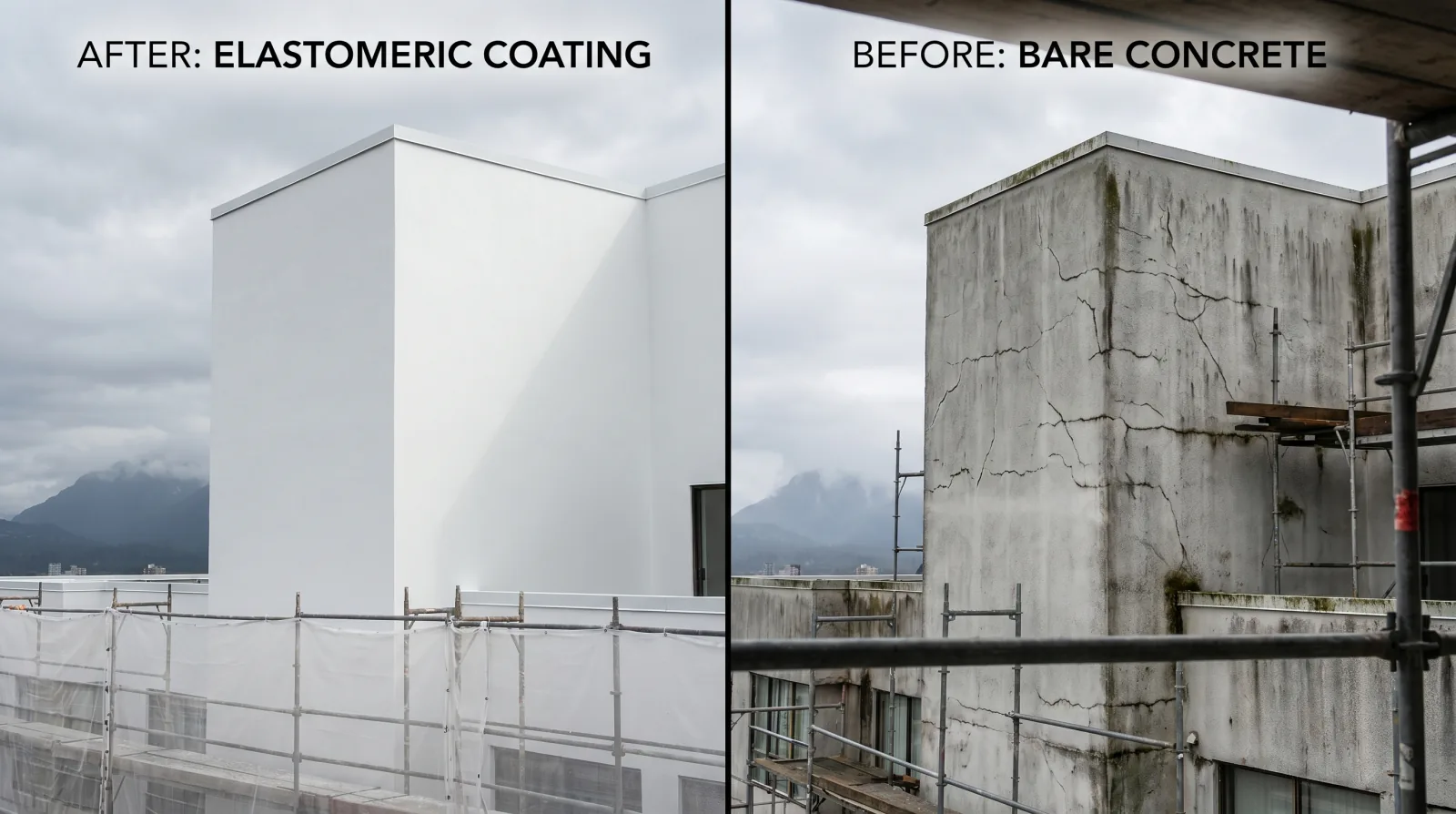
A coating project on a concrete building finishes in September. The work looks excellent, the consultant signs off, and the holdback is released.
The following April, blisters appear across an entire elevation.
The strata concludes it received a defective product or poor workmanship. Usually it received neither. The concrete was still wet when it was coated, and nobody measured it.
Why the failure waits until spring
Moisture in a concrete substrate continues to move outward toward the surface. A coating with low vapour permeability stops it at the interface, and the moisture accumulates there as pressure.
That pressure needs a driving force to become significant, and the driving force is heat. A wall in sustained sunlight warms, the vapour pressure behind the coating rises, and the coating lifts.
In Metro Vancouver that means the failure appears with the first extended sunny period on that elevation, which is typically the spring after an autumn application. By then the project is closed, the contract is complete, and nobody links April’s blisters to September’s application.
The mechanism and its variants are covered more broadly in the post on coating adhesion failure and blistering, and substrate moisture is the most common single cause.
What the tests measure
Each method answers a different question, and the specification should name the method the coating manufacturer requires.
Electrical impedance and resistance meters give rapid readings across an area. They are relative rather than absolute for concrete, and they are genuinely useful for comparing locations and finding the wet parts of a wall that otherwise looks uniform.
Relative humidity probes placed in drilled holes measure the condition within the material at depth. This matters because the moisture that causes coating failure comes from inside, and a surface that reads dry after a sunny afternoon can sit over material that is still saturated.
The plastic sheet test is the cheapest useful check available. A sheet of plastic taped down over the substrate and left in place for a period, then lifted: condensation on the underside or darkening of the concrete indicates moisture is still moving out. It is qualitative and it reliably catches conditions that are obviously unsuitable.
Surface pH testing is a related check on new or recently repaired concrete, because alkalinity affects the adhesion of some coating systems.
Surface readings are not enough on their own
The distinction between surface condition and internal condition is what makes this worth doing properly.
After a dry, breezy day, the outer few millimetres of a concrete wall can be genuinely dry while the material behind it holds substantial moisture. A surface reading taken at that moment gives a comfortable number and no useful information about what will happen once a coating traps everything behind it.
Where the decision matters, and on a full-elevation coating application it does, in-depth measurement is the reliable answer. Where a project is relying on surface readings, the readings should at least be taken at a consistent time of day and after a consistent period without rain, so the comparison between locations means something.
Drying takes longer here
The regional constraint is ambient humidity. Material dries by giving moisture to the surrounding air, and air that is already near saturation accepts very little.
Through the Metro Vancouver wet season, drying rates are slow, and a schedule that allocates a fixed number of days for a substrate to dry before coating is a schedule that will be wrong. Two weeks of dry weather in July and two weeks in November are not comparable.
The practical approach is to test and wait for the reading rather than working to a calendar date. That has schedule and cost consequences, which is exactly why it needs to be understood at planning stage rather than argued about on site. The seasonal constraints are set out in the guide on scheduling envelope work in a wet climate.
Where the schedule genuinely cannot accommodate the drying time, the honest options are temporary enclosure and heat, as described in the post on temporary weather protection, or a vapour-permeable coating system.
Permeable coatings are a strategy, not an exemption
Vapour-permeable coatings allow moisture to pass through rather than trapping it, and they tolerate a damper substrate than impermeable systems.
That is a legitimate design response on a wall that will not stay dry, and it is a product selection decision made deliberately in the specification. It is not a reason to skip testing, because permeable products still have limits and still require the substrate to be within them.
The trade-offs between coating types are set out in the comparison of elastomeric versus acrylic coatings, and permeability belongs in that comparison alongside crack bridging and durability.
A wall that will not dry has a source
If a substrate repeatedly fails to reach an acceptable reading, the coating is not the first problem.
Something is supplying water to that wall. A drainage failure above it, a leak into the assembly, rising damp at the base, or a condensation problem within the wall. Coating over it addresses the appearance and leaves the source running, and the coating will fail regardless of how well it was applied.
That situation calls for the investigation described in the guide on moisture testing methods before any coating decision is made.
Newly repaired concrete is the highest-risk case
The substrate most likely to be too wet is the one that was placed most recently, and on a restoration project that means the repair patches.
Cementitious repair material contains water by design and releases it over an extended period. A patch completed two weeks before the coating goes on is almost certainly still releasing moisture, and it is doing so in a discrete area surrounded by older, drier concrete.
The result is a coating that performs across most of an elevation and blisters in a pattern that maps the repair locations exactly. Because the patches were the newest and most carefully done work, the failure looks inexplicable.
The controls are sequencing and testing. Repairs need to be completed early enough in the programme that they can dry before coating, and the moisture readings should be taken at the patch locations specifically rather than at a general sample across the wall. The material selection also matters, and the compatibility considerations in the post on concrete repair mortar selection include how quickly a product releases its water.
Ambient conditions at application
Substrate moisture is one of several conditions that have to be within limits, and the others are easier to get wrong because they change through the day.
Air temperature and substrate temperature both have specified ranges, and they are not the same figure. A wall in shade on a cool morning can be well below the air temperature, and a wall in afternoon sun can be well above it.
Relative humidity affects cure, and the dew point matters most of all. Where the substrate temperature is at or near the dew point, moisture is condensing on the surface, and applying a coating onto that surface bonds it to a film of water.
The rule that applicators use is to keep the substrate a defined margin above the dew point, and it requires measuring both rather than judging by feel. On an autumn morning in Metro Vancouver, a wall can be below the dew point at eight and comfortably above it by eleven, which is a schedule constraint rather than a reason not to work.
Record it
Every test should be recorded with the date, the location, the method, and the reading, and the record should form part of the closeout package described in the post on as-built documentation.
That record is what settles the question in April. Without it, a blistered elevation is an argument between a contractor who says the substrate was fine and a strata that has no evidence either way, and those arguments are resolved by whoever has more patience rather than by what happened.
With it, either the readings were within limits and the cause is something else, or they were not and everybody knows where they stand. Both outcomes are better than the argument.
Sources and further reading
- ASTM International, ASTM F2170 Standard Test Method for Determining Relative Humidity in Concrete Floor Slabs Using in situ Probes, referenced 2026
- ASTM International, ASTM D4263 Standard Test Method for Indicating Moisture in Concrete by the Plastic Sheet Method, referenced 2026
- BC Housing, Building Enclosure Design Guide, coating application and substrate preparation, referenced 2026
- Allweathercoating coating application records, Metro Vancouver, 2026
Frequently Asked Questions
More from Exterior Coatings Guide
Moss on a Building Is a Drainage Report You Can Read From the Street
Organic growth does not appear randomly. It grows where surfaces stay wet, which makes it the cheapest diagnostic tool available on a Metro Vancouver building.
Read article →Why Exterior Coatings Blister and Peel on BC Buildings
A fresh coating on a Surrey tower blistering within a year almost always traces back to one thing: moisture in the substrate. Why it happens, how to diagnose it, and the 5% rule.
Read article →Pressure Washing vs Soft Washing Building Exteriors in Metro Vancouver
High-pressure water strips algae off a Coquitlam wall fast — and can blast the coating, sealant, and concrete off with it. When soft washing is the right call, and why surface prep before coating decides everything.
Read article →