Moisture testing methods compared
No single tool finds a leak. Meters find where water is, imaging finds where to point the meter, spray testing proves where water gets in, and an opening shows what it has done. Each method answers one question and stays silent on the others, which is why the order they run in matters as much as the tools themselves.
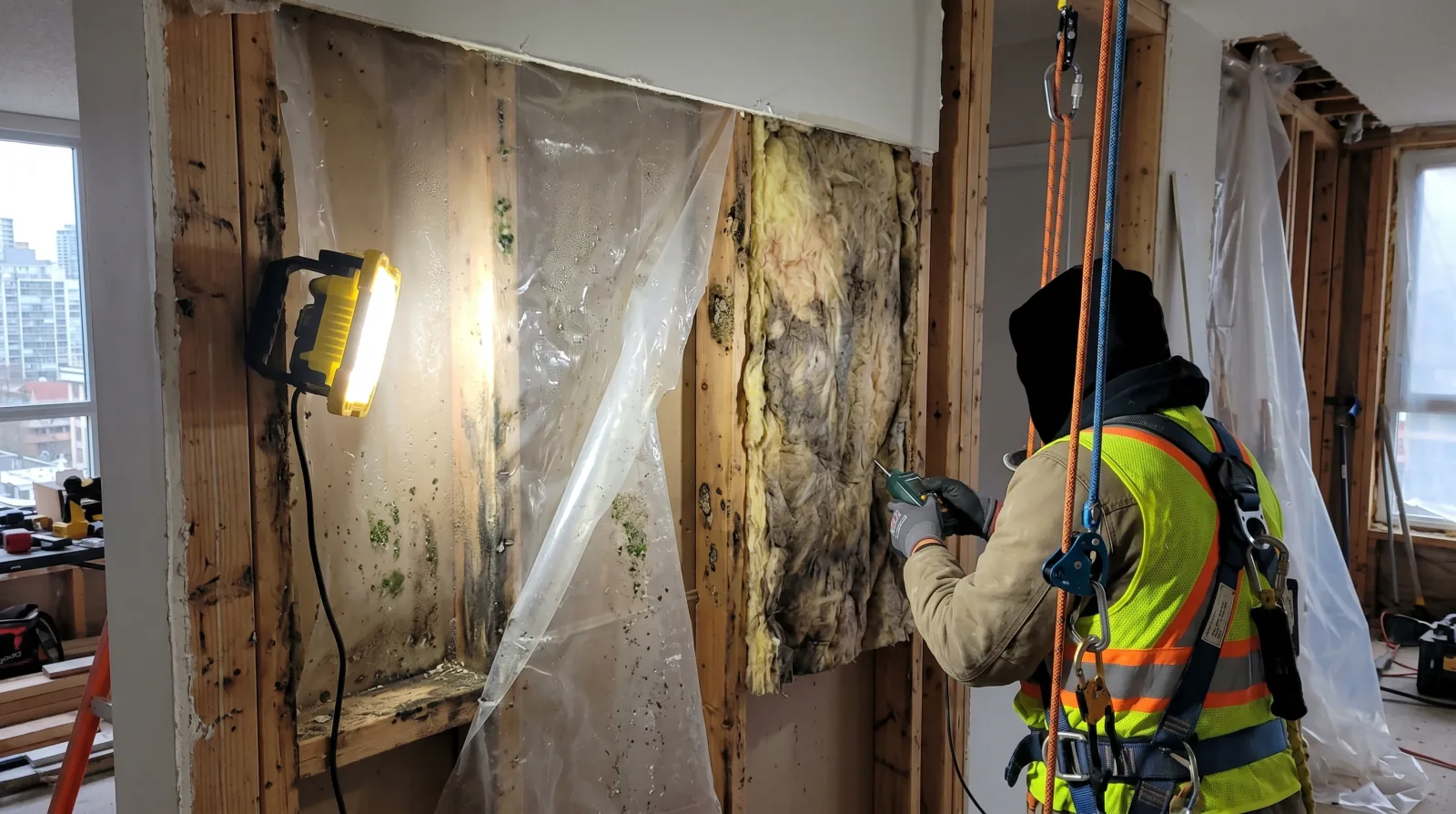
The four methods, honestly compared
Every method below earns its place in Metro Vancouver leak investigations, and every one gets oversold somewhere. The useful comparison is what each can and cannot tell you.
Moisture meters (pin and pinless)
What it can tell you: Read moisture levels at specific points and, swept across a wall or ceiling, map the footprint of a wet area. Pin meters measure electrical resistance between two probes pushed into the material; pinless meters scan through the surface without holes. Repeat visits show whether an assembly is wetting further or drying.
What it cannot: Say where the water came from, or read deep into an assembly from the surface. Pinless meters read shallow and get fooled by foil backings, metal lath, and dense materials. A dry surface reading over a wet stud bay is a routine false comfort.
Thermal imaging (infrared camera)
What it can tell you: Show temperature patterns across large areas fast. Wet materials cool by evaporation and change temperature more slowly than dry ones, so moisture often appears as a distinct cool pattern. Excellent for scanning whole elevations or ceilings to decide where to put the meter next.
What it cannot: See moisture directly; it sees temperature, and insulation gaps, thermal bridges, and air leaks make similar patterns. Every thermal anomaly needs meter confirmation before it counts as a wet finding. Conditions matter too: the method needs a workable temperature differential across the assembly.
Water spray testing
What it can tell you: Reproduce the leak on demand, which is the strongest evidence an investigation can produce. Details get wetted one at a time, working upward, while someone watches inside; when the leak appears, the active detail is confirmed. The calibrated version, ASTM E1105, adds interior negative pressure to simulate wind-driven rain for disputed or stubborn leaks.
What it cannot: Find anything by itself; it confirms or eliminates the suspects that inspection and mapping nominated. Run out of sequence (bottom-up discipline broken, several details wetted at once) it produces confusion rather than proof. It also needs access to the details, which on a tower means rope access rigging.
Exploratory openings
What it can tell you: Show the assembly itself: the actual wetting path, the condition of sheathing and framing, and how the concealed layers were built. A well-placed opening converts every prior finding from inference to fact, and grades the damage so the repair scope covers what is actually there.
What it cannot: Be undone. Openings cost patching and finishes, so they come last, placed where the meters, imaging, and spray tests say the path runs, sized to confirm rather than to hunt. Exploratory demolition in place of investigation is how buildings end up with six holes and no diagnosis.
Sequence is the real method
The tools are ordinary; the discipline is the value. A sound investigation runs from cheap and non-invasive toward expensive and physical, letting each step nominate targets for the next: pattern review narrows the elevations, inspection narrows the details, thermal scanning narrows the interior area, meters confirm and bound it, spray testing convicts a specific detail, and an opening verifies the path. Our walkthrough of how a professional leak investigation runs covers that sequence end to end, from records review to a scoped repair, and what the closing report should hand a strata council.
Skipped steps show up later as costs. Spray testing without an inspection shortlist wets half an elevation and proves nothing. Openings cut at the stain, before any mapping, find wet drywall and no source, for reasons the guide on why leaks show far from the source makes plain: the stain is the exit, and the evidence trail runs upward from it.
Where the testing happens: at the details, at height
On a low-rise walk-up in Burnaby, most suspect details sit within ladder reach. On a Vancouver tower, they run twenty storeys up a curtain wall, and the practical difference between a real investigation and a lobby-level opinion is access. IRATA and SPRAT certified rope access technicians rigging on two independent lines under WorkSafeBC Part 11 bring inspection and spray testing to each detail in turn, without scaffolding the elevation. One of our high-rise cases, written up in the post on causes of water ingress in high-rises, traced a 9th-floor leak to a 12th-floor expansion joint exactly this way: an ASTM E1105 spray test reproduced the leak within the test window, three floors from where the water showed.
Reading results without fooling yourself
Two habits keep testing honest. First, respect the weather: readings taken during or just after rain describe the leak, readings taken after a dry fortnight describe the drying, and the two must not be compared as if equivalent. On this coast the wet season supplies test conditions generously; the storm versus chronic leaks guide covers how timing itself diagnoses. Second, respect the false negative. A dry surface reading over a wet cavity, a thermal scan on a day with no temperature differential, a spray test that never reached the true entry detail: each produces a comforting nothing. Findings should converge across methods before anyone declares an assembly dry, and results this equivocal usually mean testing again in weather.
When the testing does converge, the output is a confirmed entry point and a graded damage picture, which turns the repair from exploratory work into a fixed scope, whether that is a targeted leak repair or a larger envelope project. The rest of the diagnostic series, from first signs to emergency response, lives in the water ingress hub.
Quick answers
What does a moisture meter actually measure?
A pin moisture meter measures electrical resistance between two probes, which drops as moisture content rises; a pinless meter reads capacitance changes through the surface. Both express the result as moisture content or a relative scale. The readings are point data: useful for mapping a wet footprint and tracking drying over repeat visits, and silent about where the water entered. Meters find where water is; tracing where it came from takes the rest of the sequence.
What is the difference between pin and pinless moisture meters?
Pin meters push two small probes into the material and read resistance between them, giving a localized reading at probe depth and leaving pinholes. Pinless meters scan a sensing plate across the surface and read a shallow zone without damage, which makes them fast for sweeping walls and ceilings. Investigations use both: pinless to sweep and find the footprint, pins to confirm and quantify at the spots that matter.
Can thermal imaging find a leak?
Thermal imaging finds candidates rather than leaks. The camera sees surface temperature, and wet areas often read cooler because of evaporation, so an infrared scan locates suspicious patterns across large areas quickly. But insulation voids, thermal bridges, and air leakage paint similar pictures, so every thermal anomaly needs moisture meter confirmation. Used that way, scan wide, confirm narrow, it is one of the most efficient tools in the sequence.
Moisture testing questions
What does a moisture meter actually measure?
A pin moisture meter measures electrical resistance between two probes, which drops as moisture content rises; a pinless meter reads capacitance changes through the surface. Both express the result as moisture content or a relative scale. The readings are point data: useful for mapping a wet footprint and tracking drying over repeat visits, and silent about where the water entered. Meters find where water is; tracing where it came from takes the rest of the sequence.
What is the difference between pin and pinless moisture meters?
Pin meters push two small probes into the material and read resistance between them, giving a localized reading at probe depth and leaving pinholes. Pinless meters scan a sensing plate across the surface and read a shallow zone without damage, which makes them fast for sweeping walls and ceilings. Investigations use both: pinless to sweep and find the footprint, pins to confirm and quantify at the spots that matter.
Can thermal imaging find a leak?
Thermal imaging finds candidates rather than leaks. The camera sees surface temperature, and wet areas often read cooler because of evaporation, so an infrared scan locates suspicious patterns across large areas quickly. But insulation voids, thermal bridges, and air leakage paint similar pictures, so every thermal anomaly needs moisture meter confirmation. Used that way, scan wide, confirm narrow, it is one of the most efficient tools in the sequence.
What is an ASTM E1105 water spray test?
ASTM E1105 is the field standard for testing installed windows, curtain walls, and doors for water penetration. A calibrated spray rack applies water to the exterior at a controlled rate while a pressure differential, usually a fan creating negative pressure inside, simulates wind-driven rain. The combination reproduces storm conditions on demand, so an intermittent leak can be made to perform while investigators watch. It is the standard tool for disputed or repair-resistant leaks.
Why not just cut the wall open to find a leak?
Because an opening only answers questions about the square metre it exposes, and the entry point is usually somewhere else. Water travels inside assemblies, so a hole cut at the stain shows wet material and no source, and each unproductive hole costs patching and finishes. Openings are the confirmation step: after mapping and testing have traced the path, one or two well-placed cuts verify it and grade the damage for the repair scope.
What order should moisture testing methods run in?
Cheapest and least invasive first, each step narrowing the next: records and pattern review, close visual inspection of the suspect details, thermal scanning to find candidate areas, moisture meter mapping to confirm and bound them, water spray testing to reproduce the leak at a specific detail, and exploratory openings last to verify the path and grade damage. Skipping ahead, spraying before inspecting, cutting before mapping, spends more and proves less.
Can moisture testing be done from ropes on a high-rise?
Yes, and on towers it is standard practice. IRATA or SPRAT certified technicians rigged on two lines from engineered anchors carry out close inspection, run spray testing detail by detail down an elevation, and take exterior meter readings, under WorkSafeBC Part 11 fall protection rules. Rope access reaches every detail on the facade without scaffolding, which is what makes methodical detail-by-detail testing affordable on a Vancouver or Burnaby high-rise.
How reliable are moisture meter readings on concrete?
Useful with care. Concrete's density, embedded rebar, and surface salts all skew readings, and pinless meters in particular respond to metal near the surface. On concrete, investigators lean on comparative readings, the same meter, same settings, wet-suspect area against a known-dry control area, rather than absolute numbers, and confirm anything important with pin probes, drilled-in sensors, or an opening. A single uncalibrated number on concrete proves little.
Does a dry moisture reading mean there is no leak?
No. It means the material at that point, at that depth, was dry at that moment. Intermittent leaks dry between storms, surface readings miss wet layers deeper in the assembly, and the path may simply run beside the tested spot. A dry reading after two dry weeks says little; the informative reading is taken during or just after weather, mapped across the area. Timing the testing to the rain is part of the method.
What should a moisture testing report give a strata council?
Four things: the mapped extent of wet materials, the confirmed or most probable entry point with the evidence behind it, the condition of what the water has reached, and a scoped recommendation for repair. Readings should come with locations, dates, and the weather context so they can be re-taken and compared later. A report that lists numbers without a traced path is data, and a council cannot scope a repair from data alone.
Need a leak traced to its source?
We run structured moisture testing and spray testing on strata and commercial buildings across Vancouver, North Vancouver, West Vancouver, and Burnaby, including rope access testing on high-rise elevations.