Emergency leak response: the first 48 hours
Water is coming in right now, somewhere in the building, and the storm has hours left to run. What a council or property manager does in the next two days decides three things: how much damage this event causes, how easy the source will be to find, and how the insurance and warranty conversations go. The good news: the right moves are simple, and none of them require knowing where the leak is yet.
The first 48 hours, in order
Make the area safe
Water near light fixtures, outlets, or panels comes first: keep people away and have an electrician or the building operator isolate affected circuits before anyone works under the drip. Then check overhead surfaces; a sagging, water-heavy ceiling can drop. Cordon rather than poke.
Contain and capture
Buckets and poly sheeting under the drips, towels at the spread edge, furniture and stored goods moved or lifted onto blocks. If a ceiling is bellying with trapped water, a small controlled drain hole through the drywall at the low point, with a bucket ready, beats waiting for the ceiling to choose its own moment.
Check the cheap causes while it rains
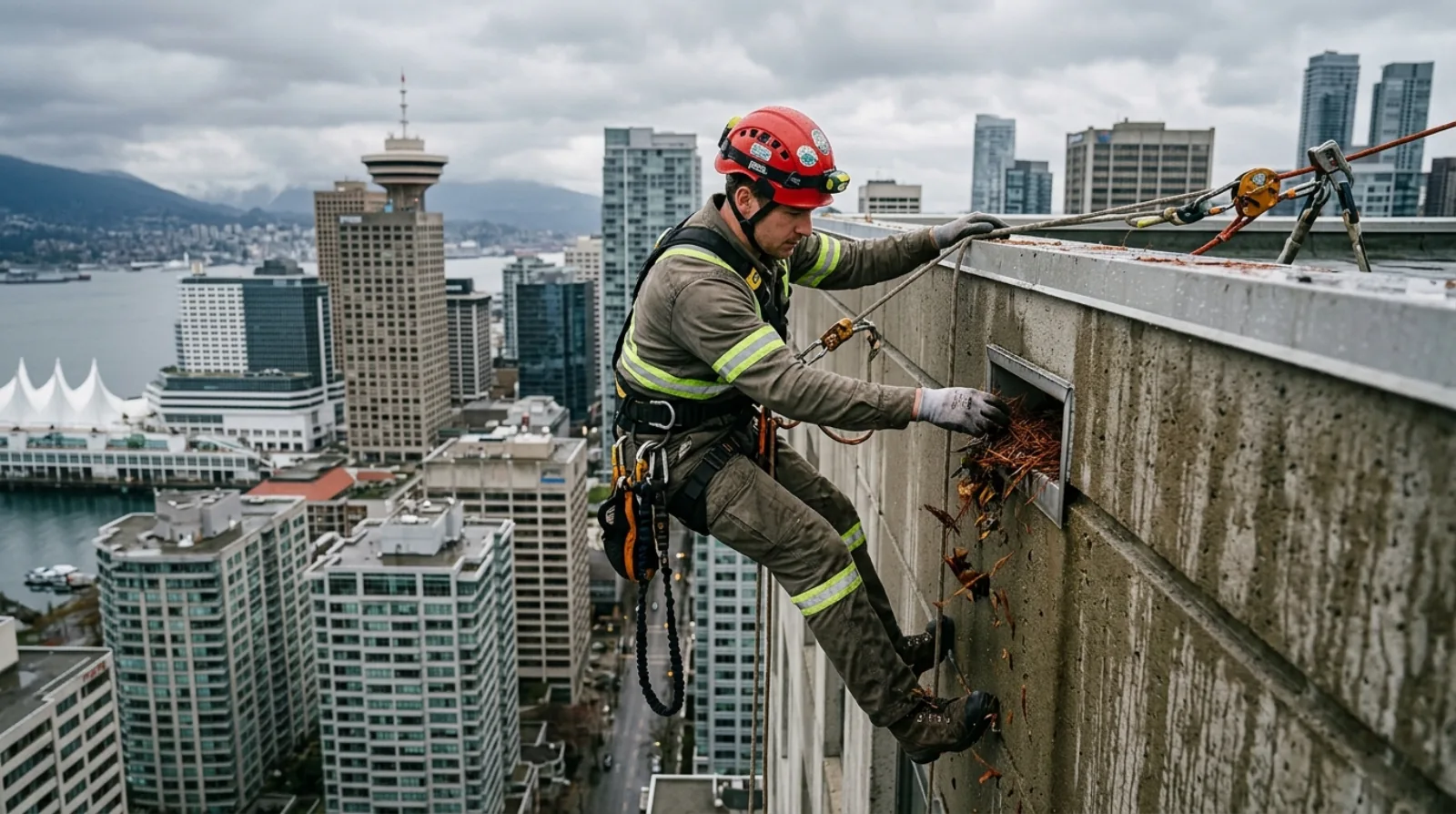
A surprising share of "envelope failures" are drainage blockages. If safe roof or deck access exists, check that drains, scuppers, and downspout inlets are not buried in leaves or debris. Clearing a blocked drain can stop an active leak in minutes and is often the single most valuable act of the first hour. Height work stays with people rigged and certified for it.
Document everything, in real time
Photographs and video of the water while it runs: where it enters the visible space, how fast, what the weather and wind direction are doing, timestamps on all of it. Note which suites report water and when. This record is the raw material for diagnosis, and for any insurance or warranty conversation that follows. Water that has stopped cannot be photographed.
Protect finishes and start drying
Once inflow is contained, get air moving: fans, opened cavities where finishes are already ruined, dehumidification for enclosed areas. Wet drywall and insulation that stay wet grow mould; the drying clock runs in days. Restoration contractors handle large-scale drying, and their moisture logs feed the envelope diagnosis later.
Call for envelope triage, and hold the repairs
An envelope specialist should see the building while the evidence is fresh: active water, wet paths, weather data. Triage identifies the likely entry, makes temporary protection weather-tight (taped poly, temporary sealant, counterflashing clamps), and scopes the permanent repair for proper diagnosis. What it should not do is guess-repair the nearest joint; that erases evidence and rarely lands on the true entry.
Why documentation outranks repair in hour one
Running water is evidence that destroys itself. While it flows, it shows its entry behaviour, its path, and its relationship to the weather; an hour after the storm passes, all of that has soaked invisibly into assemblies. The photographs and videos taken during the event are frequently the highest-value diagnostic material an investigation ever gets, and they cost nothing but presence of mind. They also anchor the paper trail: BC's 2-5-10 home warranty gives newer buildings five years of envelope coverage including water penetration, and a dated record of the event is what turns "we think it leaks in storms" into a claim.
The same discipline applies to reading the event. Water arriving only in a wind-driven blow tells a different story from water that keeps seeping after the sky clears; the storm versus chronic leaks guide unpacks what each pattern points to. And where the water shows is the exit; the entry sits somewhere upstream of it, which is why guess-repairs made mid-event so often miss: the mechanics are covered in why leaks show far from the source.
The storm-season reality on this coast
Metro Vancouver's leak emergencies cluster in the atmospheric river season, when storms stack up back to back and the next weather system arrives before the building has dried from the last one. Our post on atmospheric rivers and the building envelope covers what those events do to envelope details. The operational consequence for an active leak: temporary protection has to be genuinely weather-tight, because it will be tested within days, and the diagnosis window between storms is short. Buildings in Vancouver, Burnaby, and the North Shore that pre-clean their drainage before the season, and log every event when one slips through, ride these weeks far better than buildings that meet each storm fresh.
Who goes on the roof, and who stays off it
The strongest urge in an active leak event is to send someone up to look, and it is where events grow second casualties. A wet roof in a wind storm is a fall hazard by definition, and parapet edges, skylights, and slick membranes do not forgive improvisation. Building staff belong on guarded roof walks and dry interior checks; anything at an edge, on a sloped surface, or over the side belongs to technicians rigged for it, on two lines from engineered anchors, under WorkSafeBC Part 11 fall protection rules. No leak is worth a fall, and the leak will still be diagnosable tomorrow.
Triage now, diagnose properly, repair once
The emergency phase ends when water stops moving and the building is stabilized under temporary protection. What follows should be sequential: a structured investigation traces the entry, then a scoped repair fixes it. The investigation sequence, records review through testing to scope, is laid out in how a professional leak investigation runs, and the eventual fix lands with a leak repair crew working from a confirmed entry point rather than a hunch. The rest of the diagnostic library, from reading the signs to testing methods, lives in the water ingress hub.
One habit separates buildings that handle leak events well from buildings that relive them: the leak log. Every event, every photo, every temporary measure, every repair, dated and kept in one place. It costs minutes per event and it is the document every future investigator, adjuster, and warranty reviewer will ask for first.
Quick answers
What should a strata do first when water is actively coming in?
Safety first: keep people away from water near electrical fixtures and from sagging ceilings, and isolate affected circuits. Then contain with buckets and sheeting, move contents, and document the event with photos and video while it runs. Report to council in writing the same day. Containment and documentation in the first hours protect both the building and the strata's position; diagnosis and permanent repair come after the water stops.
Should you drill a hole in a ceiling that is bulging with water?
A controlled drain beats an uncontrolled collapse. A bulging ceiling is holding water above the drywall, and drywall fails suddenly when saturated. A small hole at the low point of the bulge, made with a bucket positioned and someone steadying the area, releases the water on your terms. The drywall there is already ruined; the hole changes nothing about the repair. Keep clear of light fixtures and confirm circuits are safe before anyone reaches up.
Can clearing a roof drain stop an active leak?
Frequently, yes, and it is the first thing worth checking in a storm event. A drain or scupper blocked by leaf debris backs water up above membrane upturns and flashing heights, and details that were never designed to be submerged start admitting water. Clear the blockage and the ponding drains within minutes. Roof access in a storm has real fall risks though: anything beyond a safe, guarded roof walk belongs to technicians rigged for the conditions.
Emergency response questions
What should a strata do first when water is actively coming in?
Safety first: keep people away from water near electrical fixtures and from sagging ceilings, and isolate affected circuits. Then contain with buckets and sheeting, move contents, and document the event with photos and video while it runs. Report to council in writing the same day. Containment and documentation in the first hours protect both the building and the strata's position; diagnosis and permanent repair come after the water stops.
Should you drill a hole in a ceiling that is bulging with water?
A controlled drain beats an uncontrolled collapse. A bulging ceiling is holding water above the drywall, and drywall fails suddenly when saturated. A small hole at the low point of the bulge, made with a bucket positioned and someone steadying the area, releases the water on your terms. The drywall there is already ruined; the hole changes nothing about the repair. Keep clear of light fixtures and confirm circuits are safe before anyone reaches up.
Can clearing a roof drain stop an active leak?
Frequently, yes, and it is the first thing worth checking in a storm event. A drain or scupper blocked by leaf debris backs water up above membrane upturns and flashing heights, and details that were never designed to be submerged start admitting water. Clear the blockage and the ponding drains within minutes. Roof access in a storm has real fall risks though: anything beyond a safe, guarded roof walk belongs to technicians rigged for the conditions.
What should be documented during an active leak?
The water itself: video of where it enters the visible space and how fast, timestamped photos of every affected area, the weather and wind direction at the time, and a list of which suites reported water and when. Add the containment steps taken and when drying started. This record feeds three later processes: the envelope diagnosis, the insurance file, and any warranty claim. None of them can be reconstructed once surfaces dry and get repainted.
When does an active leak justify calling an envelope contractor immediately?
Call during the event when water is entering fast, spreading across multiple suites, running near electrical systems, or returning with every storm despite previous repairs. An envelope specialist seeing active water learns in one visit what dry-weather investigation takes days to reconstruct: the live path, the weather dependence, the entry behaviour. For a slow, contained drip, same-week is reasonable; for moving water, same-day matters.
What is envelope triage on a building?
Triage is the rapid assessment done while a leak is active or just contained: identify the probable entry area, judge whether the situation will worsen with the next weather system, install temporary weather protection over the suspect details, and define what investigation and repair should follow. It deliberately separates stabilization from diagnosis, because permanent repairs scoped in the middle of an emergency tend to treat the nearest symptom rather than the source.
Should the strata notify residents during an active leak event?
Yes, promptly and in writing. Residents below and beside the affected area need to check their own ceilings and walls, and reports from them refine the picture of the water path, which helps diagnosis. Notification also starts the paper trail the Strata Property Act framework expects: leaks that later become insurance claims, warranty claims, or repair levies all go smoother when the event was communicated and logged from day one.
Is temporary sealant an acceptable emergency repair?
As a stabilization measure over a suspected entry, applied knowingly and logged, yes. As a permanent repair, no. Temporary sealant and taped poly buy weather-tightness until proper diagnosis, and everyone involved should record what was covered and where, because the temporary work changes how the building behaves in the next storm and can mask the entry during later testing. The log entry matters as much as the sealant bead.
How fast does mould become a concern after a leak event?
The working assumption in the restoration trade is that mould growth can establish on wet organic materials within days, which is why drying starts immediately rather than after the repair is scoped. Wet drywall, insulation, and carpet in enclosed spaces are the priority materials. Fast drying, dehumidification, and removal of what cannot be dried keep a water event from becoming an air quality project on top of an envelope project.
What happens after the water stops and the building is dry?
The diagnosis begins. The event documentation, weather records, and moisture logs define the search area; investigation then traces the path back to the entry point through inspection and testing; and the permanent repair gets scoped against the confirmed entry rather than the stain. Skipping from "dry again" straight to "repaint and close the file" is how the same suite floods again next fall, with the damage further advanced each time.
Water coming in right now?
We provide envelope triage and leak repair for strata and commercial buildings across Vancouver, North Vancouver, West Vancouver, and Burnaby: stabilize first, diagnose properly, repair once.