Storm leaks vs chronic leaks
Before any tool comes out of a bag, a leak has already told you half its story through its schedule. Water that arrives only when the wind blows names one family of suspects; water that seeps steadily regardless of the forecast names a different family entirely. Reading that pattern correctly is the cheapest diagnostic step there is, and skipping it is how elevations get recaulked while a planter keeps leaking.
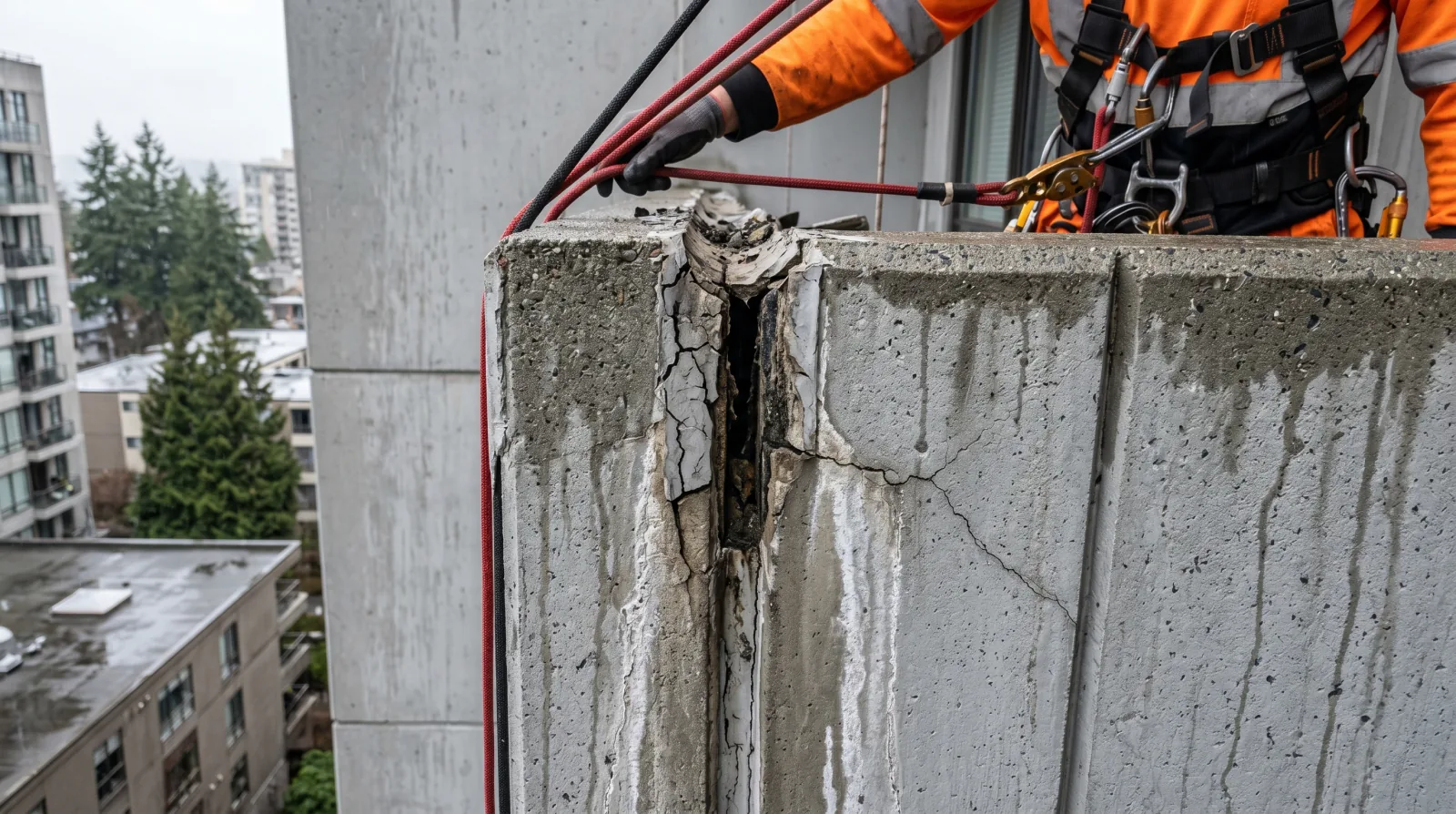
Two leak families, side by side
| Storm-driven leak | Chronic leak | |
|---|---|---|
| When it runs | During or right after wind-driven rain, especially southeasterly storms; dry the rest of the time | Steadily or on its own rhythm; indifferent to individual storms and sometimes to the forecast entirely |
| What drives it | Wind pressure forcing water through an opening that gravity alone cannot exploit | A constant supply: saturated ground, ponded water, irrigated planters, or a plumbing line |
| Typical entries | Sealant joints, window perimeters, parapet caps, junction flashings, expansion joints on the weather elevation | Below-grade walls and slabs, planter membranes, blocked drainage ponding on roofs and decks, pipe leaks |
| Elevation bias | Strong: the exposed elevations take it, sheltered sides stay dry | Weak or none: driven by what sits above or below the stain, regardless of wind direction |
| Dry-season behaviour | Disappears completely all summer, returns with the first fall blow | Continues, or keeps running wherever irrigation, ground water, or plumbing supplies it |
| First diagnostic move | Inspect and spray-test the exposed-elevation details, top down | Check drainage, planters, below-grade walls, and rule plumbing in or out early |
Why storm leaks need wind as well as rain
Plenty of rain falls straight down and never troubles a marginal joint. What breaches an aging sealant bead or an open parapet cap is pressure: wind loading the wall face, driving water sideways into joints and, in gusts, upward past drip edges and laps. That is why a building can shrug off a wet week and then leak in an afternoon squall, and why the failed detail is nearly always on the exposed elevation. Expansion joints on precast towers, window perimeters, and junction flashings all fail this way, silently in fair weather. The post on signs a building needs sealant replacement covers what those joints look like in the year before they let go.
The regional weather does the rest. Vancouver International Airport's climate normals record 1,189 mm of average annual precipitation (1991 to 2020), concentrated in a fall-to-spring storm season, and the heaviest events, the atmospheric rivers, add duration to the pressure. Our post on atmospheric rivers and the building envelope covers why leak reports spike during those systems: hours of sustained wind-driven wetting test every marginal detail at once.
Chronic leaks have a reservoir
A leak that runs without weather has a stored supply. The candidates are few and specific: saturated ground pressing on below-grade concrete, an irrigated planter over occupied space, water ponded on a roof or deck by blocked drainage, and plumbing. Each behaves distinctively. Ground-fed leaks track wet weeks and the seasonal water table, planter leaks run through August on irrigation, ponding leaks follow blocked drains, and plumbing ignores everything except fixture use. The below-grade family is covered in depth in the below-grade and planter leaks guide; the practical point here is that chronic timing should pull the investigation away from elevations and toward what sits above and below the stain, with a plumbing rule-out early.
The in-between cases
Two patterns sit between the families and trip up leak logs. The first is the saturation leak: it needs rain, but long rain rather than windy rain. A face-sealed stucco wall can absorb for days before enough moisture crosses the assembly to show inside, so the leak appears late in a wet week, with no storm attached, and reads as chronic in the log. The tell is the lag: interior evidence arriving days after the wetting began, on a wall elevation rather than below a roof or planter.
The second impostor is condensation, which produces water with no envelope breach at all. Indoor moisture hitting cold surfaces tracks cold snaps and indoor humidity rather than rain, shows on window glass and cold corners first, and often appears across many suites at once. It mimics a chronic leak convincingly through a damp winter. Distinguishing the two matters because the fixes share nothing: condensation is a ventilation and insulation conversation, and every dollar spent on exterior sealant against it is wasted. When the log cannot separate them, moisture mapping timed against weather and indoor conditions settles it.
Using the pattern before opening anything
The pattern assigns the first move. Storm-driven timing sends inspection to the pressure-exposed details of the weather elevations, top down, followed by isolated spray testing to convict a specific joint or flashing, the sequence described in the moisture testing methods guide. Chronic timing sends it to drainage, planters, and below-grade surfaces, with flood testing and isolation in place of spray racks. Either way, remember that the stain sits at the end of a travel path rather than under the entry; why leaks show far from the source explains how far the two can sit apart.
A leak log with dates, locations, weather, and wind direction is what makes all of this work, and it costs a strata nothing but consistency. Six months of entries usually classifies every recurring leak in the building before a single test is booked. From there, the storm-driven ones typically end at a sealant and caulking repair on the guilty detail, the chronic ones at a drainage or membrane fix, and both paths, along with everything in between, are mapped from the water ingress hub.
Quick answers
Why does my building only leak during storms?
A storm-only leak needs wind, which means the defect only admits water under pressure: an open sealant joint, a debonded window perimeter, a parapet cap gap, or a displaced flashing on the exposed elevation. Ordinary vertical rain runs past these openings; a southeasterly blow drives water into them sideways and upward. That dependence is diagnostic gold, because it points the investigation at pressure-exposed details on the weather-facing elevations and nowhere else.
What is wind-driven rain, exactly?
Wind-driven rain is rain travelling with a horizontal component, so it strikes walls, joints, and window perimeters instead of only roofs. Wind also pressurizes the wall face, pushing water through openings and, in gusts, upward against gravity into laps and drip edges. Coastal BC storms arrive mostly on south and southeast winds off the Strait of Georgia, which is why those elevations on Vancouver buildings fail first and get tested first.
What does a leak that ignores the weather point to?
A supply that does not depend on the sky: saturated ground pushing through below-grade concrete, an irrigated planter feeding a buried membrane, water ponded on a roof or deck by blocked drainage, or a plumbing line. Weather-indifferent leaks deserve an early plumbing check, since a pressurized line drips around the clock. Once plumbing is ruled out, the below-grade and drainage suspects take over, and the investigation shifts from elevations to what sits above and below the stain.
Leak pattern questions
Why does my building only leak during storms?
A storm-only leak needs wind, which means the defect only admits water under pressure: an open sealant joint, a debonded window perimeter, a parapet cap gap, or a displaced flashing on the exposed elevation. Ordinary vertical rain runs past these openings; a southeasterly blow drives water into them sideways and upward. That dependence is diagnostic gold, because it points the investigation at pressure-exposed details on the weather-facing elevations and nowhere else.
What is wind-driven rain, exactly?
Wind-driven rain is rain travelling with a horizontal component, so it strikes walls, joints, and window perimeters instead of only roofs. Wind also pressurizes the wall face, pushing water through openings and, in gusts, upward against gravity into laps and drip edges. Coastal BC storms arrive mostly on south and southeast winds off the Strait of Georgia, which is why those elevations on Vancouver buildings fail first and get tested first.
What does a leak that ignores the weather point to?
A supply that does not depend on the sky: saturated ground pushing through below-grade concrete, an irrigated planter feeding a buried membrane, water ponded on a roof or deck by blocked drainage, or a plumbing line. Weather-indifferent leaks deserve an early plumbing check, since a pressurized line drips around the clock. Once plumbing is ruled out, the below-grade and drainage suspects take over, and the investigation shifts from elevations to what sits above and below the stain.
Can one building have storm leaks and chronic leaks at the same time?
Routinely, and mixed patterns confuse leak logs until someone separates them. An aging building can carry a storm-driven joint failure on the southeast elevation and a chronic planter leak over the parkade at the same time, and if both get reported as "the building leaks," repairs chase a phantom. Splitting the log by location and timing usually untangles it: each leak keeps its own schedule, and each schedule points at its own family of sources.
Why did the leak stop all summer and return in October?
Because its driver went away and came back. Metro Vancouver summers carry long dry stretches, so storm-driven entries get no wind-driven water and the assembly partially dries. The first sustained fall storms reload the exposure, and the leak resumes at the same detail. A leak with that annual rhythm is announcing that it is weather-driven and elevation-specific. The mistake is closing the file in July; the file was only dormant.
What is an atmospheric river and why do leaks cluster during them?
An atmospheric river is a long, narrow corridor of concentrated moisture that delivers sustained heavy rain, often with strong wind, over a day or more. For an envelope, it is a duration test: hours of wind-driven wetting that finds marginal details a shower never loads, while drainage systems run at capacity and any blockage causes ponding. Leak reports cluster during these events because both failure families, storm-driven and drainage-driven, get stressed at once.
Which elevation of a Vancouver building leaks first?
Statistically, the south and southeast exposures, because the region's major rain arrives on winds from those directions. Those elevations take the most wind-driven water and the most UV on their sealants, an aging combination. Local geography modifies the rule: North Shore slopes, waterfront exposure in West Vancouver, and tower-channelled winds downtown all shift the load. The leak log tells you which elevation your building's weather actually hits.
Do chronic leaks turn out to be plumbing more often than envelope?
Often enough that ruling plumbing in or out belongs at the start of any weather-indifferent investigation. A pressurized supply line weeps constantly, a drain line leaks when fixtures above are used, and neither cares about the forecast. The checks are simple: meter movement with fixtures off, isolation tests, and dye tests on suspect drains. Envelope investigation proceeds once plumbing is excluded, with the below-grade and drainage suspects first in line.
How should a strata leak log record events to make diagnosis possible?
Four fields per event, kept consistently: date and time water was seen, exact location (suite, room, surface), what the weather was doing including wind direction, and a photo. Add what changed recently nearby: renovations, sealant work, landscaping. Six months of that log lets an investigator classify each leak as storm-driven or chronic before mobilizing, which shortens the on-site work considerably. Memory versions of the same information ("it leaks sometimes in winter") barely help at all.
Does a storm leak mean the whole elevation needs recaulking?
Not by default. A storm leak means at least one pressure-exposed detail on that elevation has opened, and testing usually convicts one joint, one flashing, or one window perimeter. Whether the rest of the elevation follows depends on the age and condition of its sealant generally: if the failed joint is the first of a generation reaching end of life, a broader program may be economical. That is a condition-survey decision, made from evidence rather than as a reflex.
Storm leak or something steadier?
We read leak patterns and trace them to the source on strata and commercial buildings across Vancouver, North Vancouver, West Vancouver, and Burnaby, before storm season makes the question urgent.