Below-grade and planter leaks
Everything above grade sheds water; everything below grade holds it back. That single difference changes how leaks start, how they behave, and how they get fixed. A parkade wall is not waiting for a storm to hit it sideways. It is standing in wet ground for half the year, under pressure, while a planter two levels up quietly irrigates a membrane nobody has seen since the building was poured.
Pressure changes everything
Above grade, water needs wind or gravity to enter, and it stops when the weather does. Below grade, saturated soil applies hydrostatic pressure to the structure continuously, and the pressure rises with every metre of depth. Water under pressure does not need an open joint; it exploits form tie holes, shrinkage cracks, honeycombed pours, and the cove joint where wall meets slab. And it keeps coming as long as the ground stays wet, which on this coast means most of the season: Vancouver International Airport's normals record 1,189 mm of average annual precipitation (1991 to 2020), and the ground banks a large share of it.
This is why below-grade leaks confuse leak logs built for weather. They ignore single storms, build over wet weeks, run for days after skies clear, and in the case of planters, keep going through August on irrigation alone. The timing pattern is so distinctive that the storm versus chronic leaks guide treats "ignores the forecast" as a below-grade fingerprint.
Where the water gets in
Foundation walls
Damp patches, efflorescence, or running water low on parkade perimeter walls, often tracking cracks, form tie holes, or the cove joint where wall meets slab. Activity follows ground saturation rather than individual storms: it builds over wet weeks and lingers for days after rain ends.
Planters over occupied space
Staining or drips on the slab soffit directly below a landscaped area, frequently ringed with efflorescence. Planters hold irrigated, saturated soil against a buried membrane year-round, and their drains clog with roots and fines. The leak often runs in summer too, because irrigation waters it when the sky does not.
Suspended slab joints and penetrations
Drips from cracks, construction joints, or around pipe penetrations in the parkade ceiling under plazas and driveways. Ponding above and traffic wear on the plaza membrane concentrate the entries; the drip line below rarely sits directly under the breach.
The cove joint and under-slab water
Water appearing at the wall-slab junction or up through floor cracks when the water table rises. This is hydrostatic pressure at work: the ground pushes water through the path of least resistance, and no surface coating on the inside face will hold it back for long.
Planters: the leak that waters itself
Planters over occupied space deserve their own paragraph in every depreciation report. The membrane under a planter carries the hardest duty on the building: permanently saturated soil, root pressure, fertilizer chemistry, and zero inspectability without excavation. Its drains clog gradually, so the soil column holds more water each season. When it fails, the evidence appears on the parkade or amenity ceiling below, usually offset from the breach, and often first as the efflorescence rings covered in the signs of water ingress guide and in our post on efflorescence causes and fixes.
Diagnosis leans on isolation: match the stain to the planter footprint, compare leak activity against irrigation schedules, then flood-test the planter in stages. It is methodical work, and it beats the alternative, which is excavating landscape until something looks wet.
What sustained wetting does to buried concrete
Concrete tolerates water; reinforcing steel does not. A below-grade wall or suspended slab that stays wet for years carries moisture, oxygen, and dissolved salts to the rebar, and in a parkade the salts include road de-icer carried in on tires all winter. Corroding steel expands, the expansion cracks the concrete cover, and the cracks admit more water: a feedback loop that runs quietly behind a damp patch everyone has learned to ignore. The end state is delamination and spalling, at which point the project has changed trades, from waterproofing to concrete restoration, and changed budgets with it.
The soffit drip line under a planter deserves the same respect. Water dripping through a suspended slab has crossed the full depth of structural concrete to get there, through cracks or joints that pass right by the reinforcing. A drip that has run for five years has been feeding steel for five years. This is the quiet argument for treating below-grade leaks early even though they rarely feel urgent: the structure absorbs the cost of the waiting, invisibly, and presents the bill all at once.
Fix from outside, or manage from inside
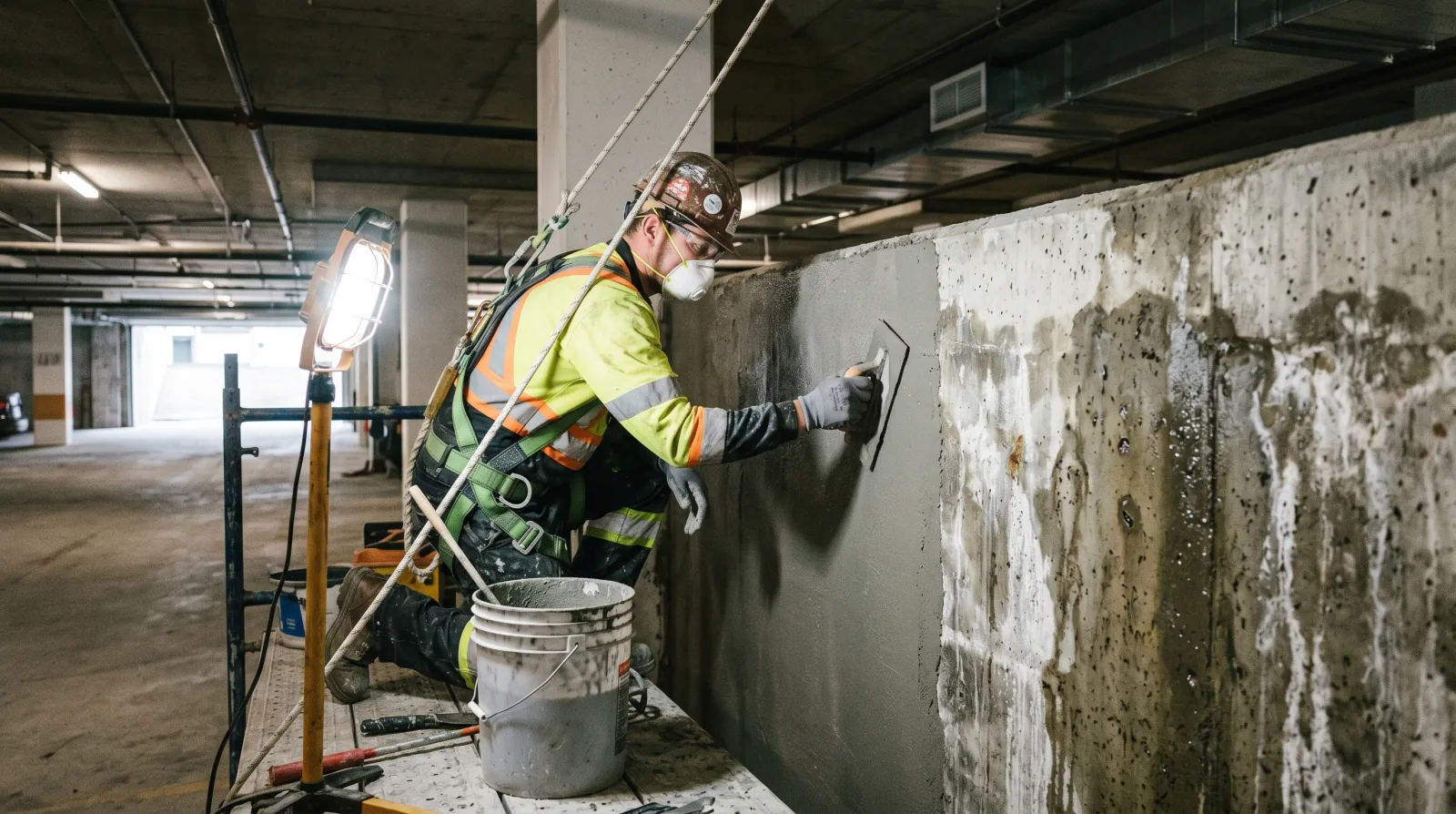
Positive-side repair, excavating to the wall or lifting the planter and re-waterproofing the buried face, removes the problem where it starts and is the more complete fix. It is also disruptive and sometimes impossible under driveways, property lines, or mature landscaping. The alternatives work from the dry side: polyurethane or epoxy crack injection for discrete cracks, and negative-side cementitious waterproofing where a whole wall face needs treatment. Each has a place, and matching method to condition is most of the value a waterproofing contractor brings to the decision.
Whichever route a strata takes, tie it into planning. BC stratas already run depreciation reports on a five-year cycle, and below-grade membranes belong on that list precisely because they fail on decade timescales with years of quiet warning. A leak caught at the efflorescence stage is a maintenance line item. The same leak feeding rebar corrosion for a decade becomes a concrete restoration project, and the diagnostic path back through the whole building is mapped in the water ingress hub.
Quick answers
Why does my parkade wall leak?
A leaking parkade perimeter wall means the ground outside is wetter than the wall's waterproofing can resist, and water is finding cracks, form tie holes, or the cove joint at the slab. In Metro Vancouver's wet season, soils stay saturated for months, so the wall sits under sustained hydrostatic pressure rather than storm-by-storm wetting. That is why parkade leaks track wet weeks and keep running days after the rain stops.
What is hydrostatic pressure in simple terms?
Hydrostatic pressure is the push that standing water in the ground exerts on anything below its level, and it grows with depth. A foundation wall two levels down carries real, continuous pressure whenever the surrounding soil is saturated. The pressure forces water into any crack, joint, or porous patch, which is why below-grade leaks are persistent: gravity drains a wall leak, but pressure feeds a below-grade leak for as long as the ground stays wet.
Why do planters over parkades leak so often?
A planter over occupied space is a box of permanently wet, irrigated soil sitting on a buried membrane. The membrane cannot be inspected without excavation, planter drains clog with roots and fines, and irrigation keeps the soil saturated even in dry months. Add root penetration and a membrane that may be decades old, and planters earn their reputation as one of the most common chronic leak sources on Vancouver strata and commercial buildings.
Below-grade leak questions
Why does my parkade wall leak?
A leaking parkade perimeter wall means the ground outside is wetter than the wall's waterproofing can resist, and water is finding cracks, form tie holes, or the cove joint at the slab. In Metro Vancouver's wet season, soils stay saturated for months, so the wall sits under sustained hydrostatic pressure rather than storm-by-storm wetting. That is why parkade leaks track wet weeks and keep running days after the rain stops.
What is hydrostatic pressure in simple terms?
Hydrostatic pressure is the push that standing water in the ground exerts on anything below its level, and it grows with depth. A foundation wall two levels down carries real, continuous pressure whenever the surrounding soil is saturated. The pressure forces water into any crack, joint, or porous patch, which is why below-grade leaks are persistent: gravity drains a wall leak, but pressure feeds a below-grade leak for as long as the ground stays wet.
Why do planters over parkades leak so often?
A planter over occupied space is a box of permanently wet, irrigated soil sitting on a buried membrane. The membrane cannot be inspected without excavation, planter drains clog with roots and fines, and irrigation keeps the soil saturated even in dry months. Add root penetration and a membrane that may be decades old, and planters earn their reputation as one of the most common chronic leak sources on Vancouver strata and commercial buildings.
Can below-grade leaks be fixed from the inside?
Often, yes. Cracks and joints can be injected, and negative-side cementitious systems can seal walls where excavation is impractical. Interior fixes manage the water at the wall rather than removing the source, so material choice matters: it must tolerate pressure from behind. Excavating and re-waterproofing the positive side is the more complete repair where access allows. Which approach fits is an engineering and access question, decided case by case.
What is crack injection in a parkade?
Crack injection fills a leaking concrete crack from the inside by pumping resin into it under pressure through surface ports. Flexible polyurethane resins react with water and expand, which suits actively leaking cracks; rigid epoxies restore structural bond, which suits dormant ones. Done well, injection seals the full depth of the crack. It fixes that crack only, so widespread cracking or joint failures still call for a broader waterproofing review.
Does a leaking parkade mean the foundation is failing?
Usually not. Water through a crack or joint is a waterproofing failure, and concrete tolerates occasional wetting without structural harm. The structural concern develops over time: sustained water reaching reinforcing steel drives corrosion, and corroding rebar expands and spalls the concrete. So a parkade leak is rarely an emergency for the structure today, and exactly the kind of item that becomes one if it runs untreated for years.
Why is there still water in the parkade days after the rain stopped?
Because the ground is the reservoir, and it drains slowly. Rain that fell over a wet week percolates down and holds the soil around the foundation saturated long after skies clear, and hydrostatic pressure keeps feeding the same cracks and joints from that stored water. This lag is a diagnostic gift: a leak that ignores individual storms but tracks wet weeks and the seasonal water table is below-grade by behaviour, before anyone lifts a meter.
Are parkade leaks a strata or owner responsibility in BC?
Parkade structures, foundation walls, and the waterproofing membranes over them are almost always common property in a BC strata plan, which places their repair with the strata corporation. Storage lockers and parking stalls affected by the water may be limited common property, which complicates the finishes question but rarely the source question. As with any leak, the strata plan and bylaws for the specific building govern, and written reports to council start the clock.
How is a planter leak confirmed without digging up the planter?
By elimination and pattern first: soffit staining mapped against the planter footprint above, activity compared against irrigation schedules versus rainfall, and planter drains inspected and flow-tested. Flood testing an isolated planter, plugging its drain and filling it in stages while watching below, confirms both the source and often the zone of the breach. Excavation comes last, targeted at the confirmed area, rather than as exploratory digging through the whole landscape.
Should efflorescence in a parkade be cleaned off or investigated?
Both, in that order of importance: investigate first, clean after. The deposit marks active water paths through the concrete, so photograph and map it before any cleanup erases the evidence. Then find and treat the source feeding those paths. Cleaning alone is cosmetic; the salts return with the next wet cycle as long as water keeps migrating. Mapped efflorescence lines are among the most useful free diagnostics a below-grade investigation gets.
Water in the parkade, or stains under a planter?
We diagnose and repair below-grade and planter leaks on strata and commercial buildings across Vancouver, Burnaby, North Vancouver, and New Westminster, from crack injection to full membrane replacement.