Signs of water ingress, ranked by urgency
Buildings announce water ingress long before anything drips. The announcements are quiet: a stain that fades and returns, a smell that lives in one corner, white crystals on a parkade wall. This guide ranks the common signs the way we triage them on Vancouver and Burnaby assessments, so a strata council can tell which observation goes in the log and which one goes in a phone call.
Two families of evidence: interior and exterior
Interior signs (stains, smells, swollen trim) tell you water has crossed the whole envelope and reached the finishes. Exterior signs (efflorescence, rust bleed, blistered coatings, staining below details) tell you where water is moving through the outer layers, sometimes years before anything shows inside. A building that only gets looked at from the lobby misses half the evidence, which is one reason rope access inspection earns its keep on towers in Vancouver and Burnaby: the exterior signs live at the details, and the details live at height.
Neither family locates the source on its own. Water that enters at a parapet can stain a ceiling two suites over, which is why the water ingress hub keeps a whole guide on why leaks show far from the source. Read the signs below as triggers for diagnosis; the place to open a wall comes later, from the traced path.
The signs, ranked by urgency
Ordered the way we triage them on site. Urgent means water is moving now or structure is involved. Act soon means the evidence points to an active path that has not yet done structural harm. Monitor means log it, photograph it, and watch how it behaves through the next storm cycle.
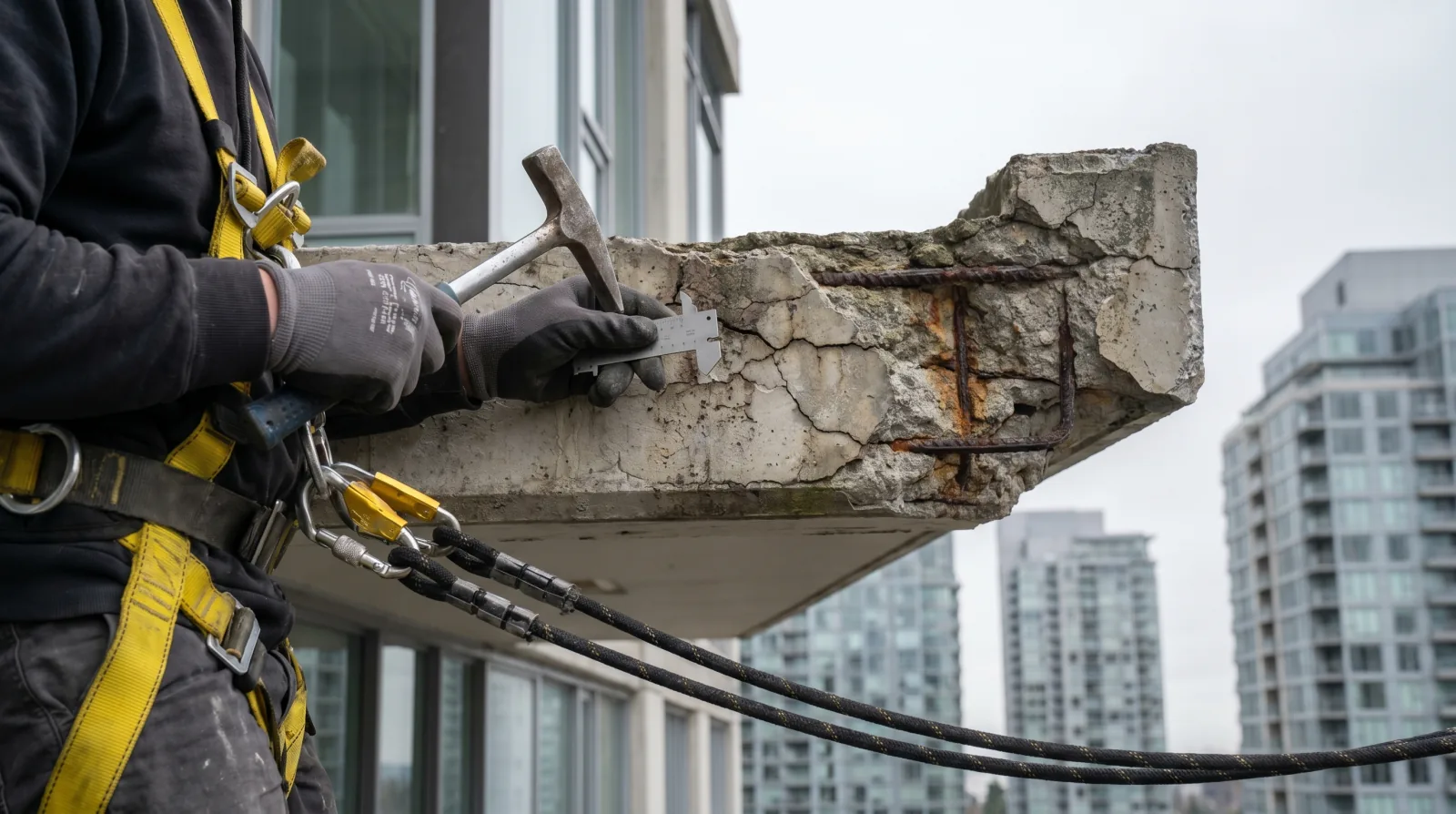
Rust stains bleeding down concrete
Brown streaks running from a slab edge, a crack, or an anchor mean water has reached embedded steel and the steel is corroding. Corroding rebar expands and cracks the concrete cover off, so this sign says the water has moved past finishes and into structure. Get the area sounded and assessed promptly; a spall falling from height over a sidewalk is a safety matter, and WorkSafeBC expects overhead hazards to be controlled.
Ceiling stain with a dark ring, or an active drip
A defined brown ring means the stain has wetted, dried, and wetted again: the leak is recurring, and the drywall above it has been wet more than once. An active drip during rain removes all doubt. Photograph it, note the weather, and start the diagnostic trail while the pattern is fresh. The entry point is rarely straight above; water travels before it drops.
Persistent musty smell
A musty odour that lingers in a suite, a corridor, or a stairwell is the smell of damp organic material, usually wet framing, insulation, or drywall paper inside an assembly. It often arrives before any visible stain. On wood-frame buildings from the pre-rainscreen era, a musty corner suite on the weather elevation deserves moisture testing even when the paint looks clean.
Paint blistering or bubbling on walls or soffits
Blisters form when moisture behind the paint film pushes it off the substrate. On an exterior elevation this points to a wall that is taking on water and trying to dry through the coating; on an interior ceiling it usually means water is sitting on the back of the drywall. Either way the coating failed because of water, so repainting without diagnosis just resets the clock.
Efflorescence: white crystalline deposits on concrete or masonry
Efflorescence is dissolved mineral salts left behind where water migrated through concrete or masonry and evaporated at the surface. The deposit itself is harmless; the message is that water has a through-path. New, spreading, or recurring efflorescence on a parkade wall, a slab soffit, or a masonry facade earns a source investigation, especially where it pairs with damp patches.
Swollen baseboards, casings, or window trim
MDF and finger-jointed trim swell visibly when they absorb water, and they hold the evidence long after the surface dries. Swollen trim at a window tells you water is getting past the window assembly; at a baseboard it can mean a wall leak draining to the floor plate. Track whether it worsens after storms, and pair it with the leak log before opening anything.
Reading the pattern behind the sign
A sign on its own is a data point. A sign with timing attached is a diagnosis half done. A ceiling stain that darkens during southeasterly storms and fades in dry weeks points at a wind-driven entry on the weather elevation; the same stain growing steadily regardless of forecast points at ponded water, a below-grade path, or plumbing. We keep a separate guide on storm leaks versus chronic leaks because that one distinction eliminates more suspects than any tool.
Location patterns matter just as much. Efflorescence concentrated low on a parkade wall behaves differently from efflorescence high on a facade, and the causes differ too; our post on efflorescence on concrete walls works through the variations. Signs clustered around windows push the investigation toward the window perimeter and sill pan. Signs at the top floor push it toward the roof edge. Signs on a balcony slab edge belong to the balcony membrane failure guide, which ranks that family of evidence on its own scale.
What to do with what you see
Photograph every sign with something for scale, date the photo, and record the weather. Metro Vancouver strata corporations already maintain depreciation reports on a five-year cycle under BC's requirements, and a dated photo log of envelope signs is exactly the kind of record that makes the next report, and any warranty or insurance conversation, easier. On buildings still inside the envelope coverage of BC's 2-5-10 home warranty, documented signs can be the difference between a claim and a levy.
Then get the source found before anyone repairs the symptom. Painting over stains, regrouting tile, or patching drywall while the entry point stays open buys a clean look for one season. A diagnosed entry point, fixed once through a targeted leak repair, ends the cycle. If several signs are appearing across one elevation, that is worth saying plainly to your council: it suggests a detail failing systematically, and the assessment should cover the whole elevation.
Quick answers
What are the first signs of water ingress in a building?
The earliest signs of water ingress are usually small and easy to dismiss: a faint ceiling or wall stain that returns after rain, a musty smell in one corner of a suite, hairline blistering in paint, or white efflorescence on concrete. Exterior signs often come first: staining below a window sill, rust bleed at a slab edge, or damp patches on cladding that outlast the weather. Any sign that recurs with rain deserves investigation.
What does a brown ceiling stain with a dark ring mean?
A brown ring around a ceiling stain means the spot has been wet, dried, and been wetted again, so the leak above it is recurring rather than a one-time spill. Each wetting carries dissolved material to the stain edge, which is what draws the ring. Rings within rings mean multiple cycles. Treat a ringed stain as an active leak that happens to be dry today, and start diagnosis rather than repainting.
Is efflorescence on concrete a sign of water ingress?
Efflorescence is direct evidence that water is moving through the concrete or masonry, dissolving salts inside it, and evaporating at the surface where the deposit forms. One faint bloom on a new pour can be construction moisture leaving. Recurring, spreading, or crusty deposits on a parkade wall, slab soffit, or facade mean an ongoing water path that needs a source investigation, particularly below grade or below planters.
Water ingress warning sign questions
What are the first signs of water ingress in a building?
The earliest signs of water ingress are usually small and easy to dismiss: a faint ceiling or wall stain that returns after rain, a musty smell in one corner of a suite, hairline blistering in paint, or white efflorescence on concrete. Exterior signs often come first: staining below a window sill, rust bleed at a slab edge, or damp patches on cladding that outlast the weather. Any sign that recurs with rain deserves investigation.
What does a brown ceiling stain with a dark ring mean?
A brown ring around a ceiling stain means the spot has been wet, dried, and been wetted again, so the leak above it is recurring rather than a one-time spill. Each wetting carries dissolved material to the stain edge, which is what draws the ring. Rings within rings mean multiple cycles. Treat a ringed stain as an active leak that happens to be dry today, and start diagnosis rather than repainting.
Is efflorescence on concrete a sign of water ingress?
Efflorescence is direct evidence that water is moving through the concrete or masonry, dissolving salts inside it, and evaporating at the surface where the deposit forms. One faint bloom on a new pour can be construction moisture leaving. Recurring, spreading, or crusty deposits on a parkade wall, slab soffit, or facade mean an ongoing water path that needs a source investigation, particularly below grade or below planters.
What causes rust stains running down a concrete facade?
Rust stains on concrete come from corroding steel: reinforcing bar, embedded anchors, or fasteners that water has reached. The water dissolves corrosion products and carries them out through cracks or pores, leaving brown streaks. Because corroding rebar expands and eventually spalls the concrete cover off, rust bleed is one of the more serious ingress signs on Metro Vancouver towers and should trigger a concrete condition assessment, promptly.
Does a musty smell mean there is a hidden leak?
A persistent musty smell usually means damp organic material somewhere out of sight: wet framing, insulation, or the paper face of drywall inside a wall or ceiling assembly. It frequently shows up before any stain does, because assemblies hold a lot of water before finishes discolour. If the smell strengthens in wet weather or concentrates in one area, moisture testing of the nearby assemblies is the sensible next step.
Why is paint blistering on my building walls?
Paint blisters when moisture behind the film builds enough vapour pressure to push the coating off its substrate. On exterior concrete or stucco, that moisture is usually water the wall absorbed through cracks, joints, or failed details, now trying to escape through the coating. Blistering that follows a pattern, one elevation, below a joint, around a window, maps the water path. Repainting without fixing the source produces the same blisters again.
What does swollen window trim or baseboard indicate?
Swollen trim means the material absorbed liquid water at some point, and composite trim like MDF holds that swelling permanently, so it acts as a recorder. At a window, swelling points to water getting past the frame, perimeter seal, or sill pan. At a baseboard, it can mean a wall leak draining down to the floor plate, or in a ground-floor suite, moisture rising from below grade. Match the location against rain events before opening anything.
Which signs of water ingress need immediate action?
Act immediately on active drips, spreading stains during rain, water near electrical fixtures, and rust bleed or spalling concrete overhead. Those signs mean water is moving now or structure is already affected. Musty smells, new efflorescence, and paint blistering justify an assessment within weeks. Slow-moving signs like swollen trim can be logged and monitored, but every sign on this page should end up in the strata leak log either way.
Can water ingress be happening with no visible signs at all?
Yes, and the leaky condo era proved it at scale. Wall assemblies can hold water for years while interior finishes stay clean, because the water wets sheathing and framing without reaching drywall. That is why moisture testing and inspection openings exist, and why depreciation report inspections and envelope condition assessments look at the assemblies rather than just the paint. Absence of stains is comfort, but it is thin evidence.
Should I just paint over a water stain?
Paint over a stain only after the leak that made it has been found and fixed, and the assembly has been confirmed dry. A stain blocker hides the evidence without touching the cause, and on the next storm the water returns behind fresh paint, which delays diagnosis and lets damage compound. If the stain has a ring or came back once already, treat repainting as the final step of a repair that started at the source.
Seeing one of these signs on your building?
We assess water ingress on strata and commercial buildings across Vancouver, North Vancouver, West Vancouver, and Burnaby, and we trace each sign back to the detail that produced it before writing any repair scope.