How to tell a balcony membrane is failing
A balcony membrane rarely fails all at once. It tells you, in order — first at the surface, then at the edge details, and finally as stains and rust on the structure below. Knowing which signs mean "monitor this" and which mean "get it assessed now" is the difference between a maintenance recoat and a concrete repair bill.
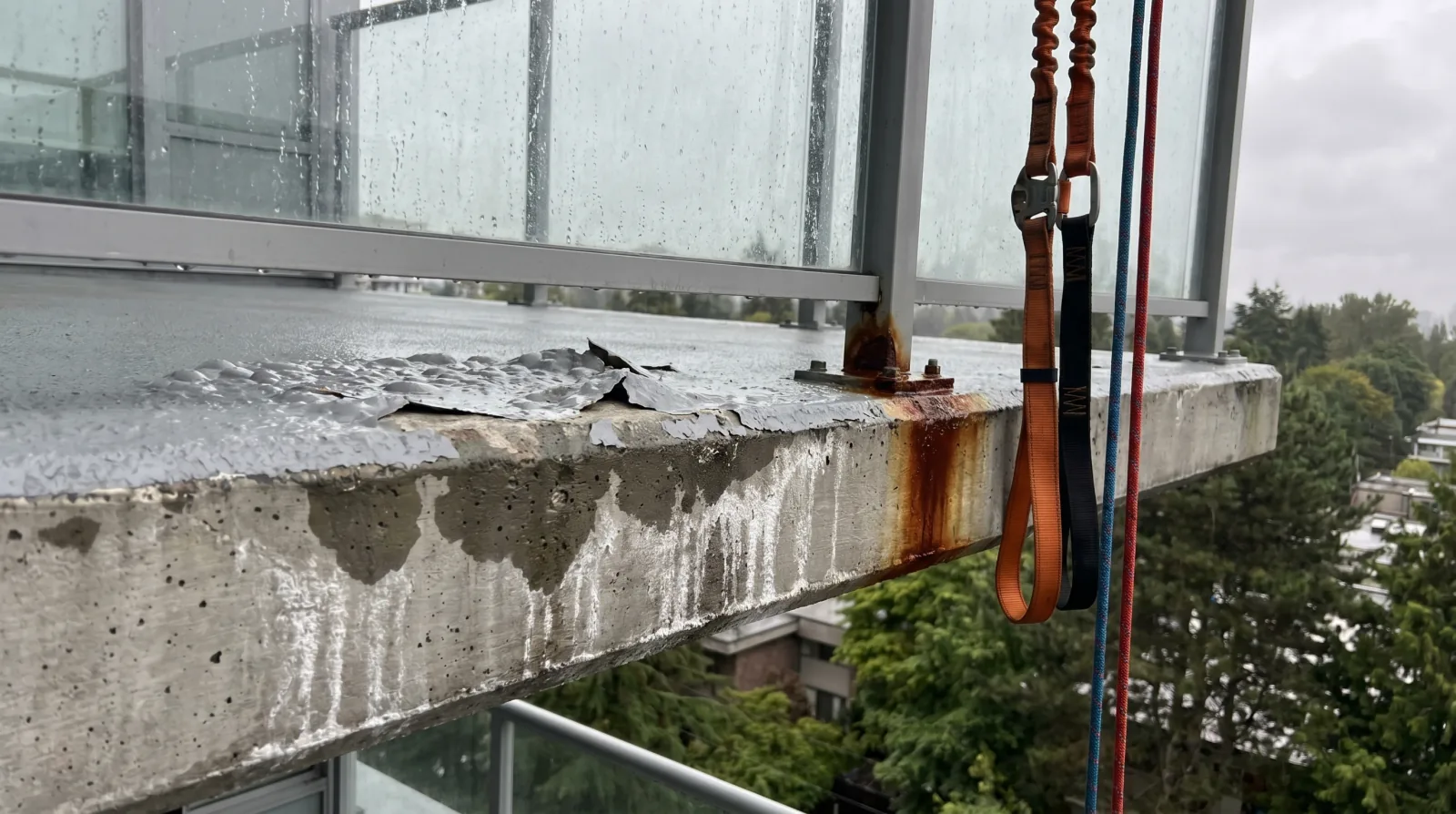
Read the deck top-down, then look below
The fastest way to read a balcony is to start at the surface and work outward. Check the open field for blisters and worn spots, then the wall upturn where most leaks start, then whether water ponds after rain. Then — and this is the step owners skip — look at the underside of the deck and the ceiling of the suite below, and at the concrete slab edge. The surface tells you the membrane is aging; the soffit and the slab edge tell you it has already failed and water is in the structure.
The signs, ranked by urgency
Not every sign means the same thing. These are ordered the way we triage them on an assessment — what needs action now versus what to keep an eye on.
Rust staining bleeding from the slab edge
Brown streaks running down the concrete edge or soffit mean water has already reached the reinforcing steel and it is corroding. The membrane failed some time ago; this is the structural stage. Get the concrete sounded and assessed — a falling spall over a walkway is a safety hazard, not just a maintenance item.
Water staining or drips on the soffit / ceiling below
Water showing on the underside of the deck or in the suite below means the membrane is breached and the structure is wetting through. On a wood-framed balcony this is the precursor to joist rot. Barricade nothing, but get it assessed quickly — by the time it shows below, it has been getting in above for a while.
Blistering or bubbling in the membrane surface
Raised blisters mean water or vapour is trapped under the membrane and breaking the bond to the deck. Once the bond is gone the membrane no longer protects that area even if it has not split yet. Common where a liquid coating went down over a damp or poorly prepared substrate.
Lifted, curling, or split edges at the wall upturn
The wall-to-floor upturn is the single most common entry point. When the membrane lifts off the wall or the termination sealant cracks, wind-driven rain runs straight behind it. Easy to miss from standing height because it hides at the base of the wall.
Ponding water that sits long after the rain stops
A deck that holds standing water has either a drainage problem or a slope problem, and standing water finds every weak seam and accelerates membrane breakdown. Often the drain is partly blocked or the original deck was never sloped to it properly. Ponding is a cause of failure as much as a symptom.
Cracks, tears, or worn-through traffic surface
Foot traffic, furniture, and UV wear the walking surface over time. A worn or cracked top coat is the early warning that the system is reaching the end of its service life — addressed early with a maintenance recoat, it can extend the membrane; ignored, the crack becomes the breach.
Why "monitor" doesn't mean "ignore"
Ponding water and a worn traffic surface sit in the monitor band because they aren't structural yet — but they're exactly the signs that, caught early, can be handled with a maintenance recoat or a drain clearing instead of a full membrane replacement. The strata that recoats a worn deck on schedule spends a fraction of what the strata that waits for the soffit to stain ends up paying. The cheapest balcony work is the work done before the water gets into the structure. The next guide walks through that repair, overlay, or replace decision.
When the slab edge is already going
Rust bleeding from the slab edge is at the top of the list for a reason: it means the failure has crossed from the membrane into the concrete, and a new membrane alone will trap an active corrosion problem underneath. The mechanism — chloride and water reaching the rebar, the steel expanding, the cover cracking off — is the same one covered in our rebar corrosion and spalling guide. When you see the rust, the scope is concrete repair first, membrane second.
Quick answers
How do I know if my balcony membrane is failing?
Walk the deck and look at three places. The wall-to-floor upturn — is the membrane lifting, curling, or is the sealant cracked? The surface — any blisters, bubbles, cracks, or worn-through spots? And the deck after rain — does water pond and sit instead of draining? Then look at the underside and the suite below for staining or drips, and at the slab edge for rust bleeding through. Any one of those is reason for an assessment; staining below or rust from the edge means act quickly.
Is water staining on the ceiling below a balcony serious?
Yes. By the time water shows on the soffit or in the suite below, the membrane has been breached for a while and the structure has been wetting through. On a concrete deck that means water is reaching the rebar; on a wood-framed deck it is the lead-up to joist rot. It is not usually an emergency in the sense of evacuating, but it needs a prompt assessment because the damage compounds every wet season.
What does ponding water on a balcony mean?
Ponding — water that sits on the deck long after the rain stops — means the deck is not draining, either because the drain is partly blocked or the slope to it was never right. Standing water is both a symptom and a cause: it finds every weak seam and it accelerates the breakdown of the membrane surface. Clearing the drain may be a quick fix; a slope problem built into the deck is a bigger conversation about re-profiling during the next membrane job.
Membrane failure questions
How do I know if my balcony membrane is failing?
Walk the deck and look at three places. The wall-to-floor upturn — is the membrane lifting, curling, or is the sealant cracked? The surface — any blisters, bubbles, cracks, or worn-through spots? And the deck after rain — does water pond and sit instead of draining? Then look at the underside and the suite below for staining or drips, and at the slab edge for rust bleeding through. Any one of those is reason for an assessment; staining below or rust from the edge means act quickly.
Is water staining on the ceiling below a balcony serious?
Yes. By the time water shows on the soffit or in the suite below, the membrane has been breached for a while and the structure has been wetting through. On a concrete deck that means water is reaching the rebar; on a wood-framed deck it is the lead-up to joist rot. It is not usually an emergency in the sense of evacuating, but it needs a prompt assessment because the damage compounds every wet season.
What does ponding water on a balcony mean?
Ponding — water that sits on the deck long after the rain stops — means the deck is not draining, either because the drain is partly blocked or the slope to it was never right. Standing water is both a symptom and a cause: it finds every weak seam and it accelerates the breakdown of the membrane surface. Clearing the drain may be a quick fix; a slope problem built into the deck is a bigger conversation about re-profiling during the next membrane job.
Why is my balcony membrane blistering or bubbling?
Blisters mean water or vapour is trapped under the membrane and pushing it off the deck, breaking the bond. It most often happens when a liquid coating was applied over a substrate that was damp or not properly prepared, so moisture later drives the coating off from underneath. Where the membrane has lifted it is no longer protecting that area, even if the surface has not split, which is why blistering is treated as an early failure, not a cosmetic issue.
Can rust stains on a balcony edge come from the membrane failing?
Directly. The membrane is what keeps water and coastal chloride out of the concrete slab. When it fails, water reaches the reinforcing steel in the slab edge, the steel corrodes, and the rust bleeds down the concrete as a brown stain — often the first visible sign that the failure has moved from the membrane into the structure. At that point the fix is concrete repair first, then a new membrane, not a membrane alone.
Seeing one of these signs on your deck?
We assess balcony membranes and slab edges on strata and commercial buildings across Vancouver, North Vancouver, West Vancouver, and Burnaby — and tell you straight whether it's a recoat, a repair, or a replacement.