Balcony waterproofing: repair, overlay, or replace
Unlike most building repairs, a balcony has three honest answers, not two: fix the spot, lay a new system over the old one, or strip it back to the slab and start over. Picking the right one is mostly about what's happening under the membrane — bond, trapped moisture, drainage, and on wood decks, rot. Here's the reasoning.
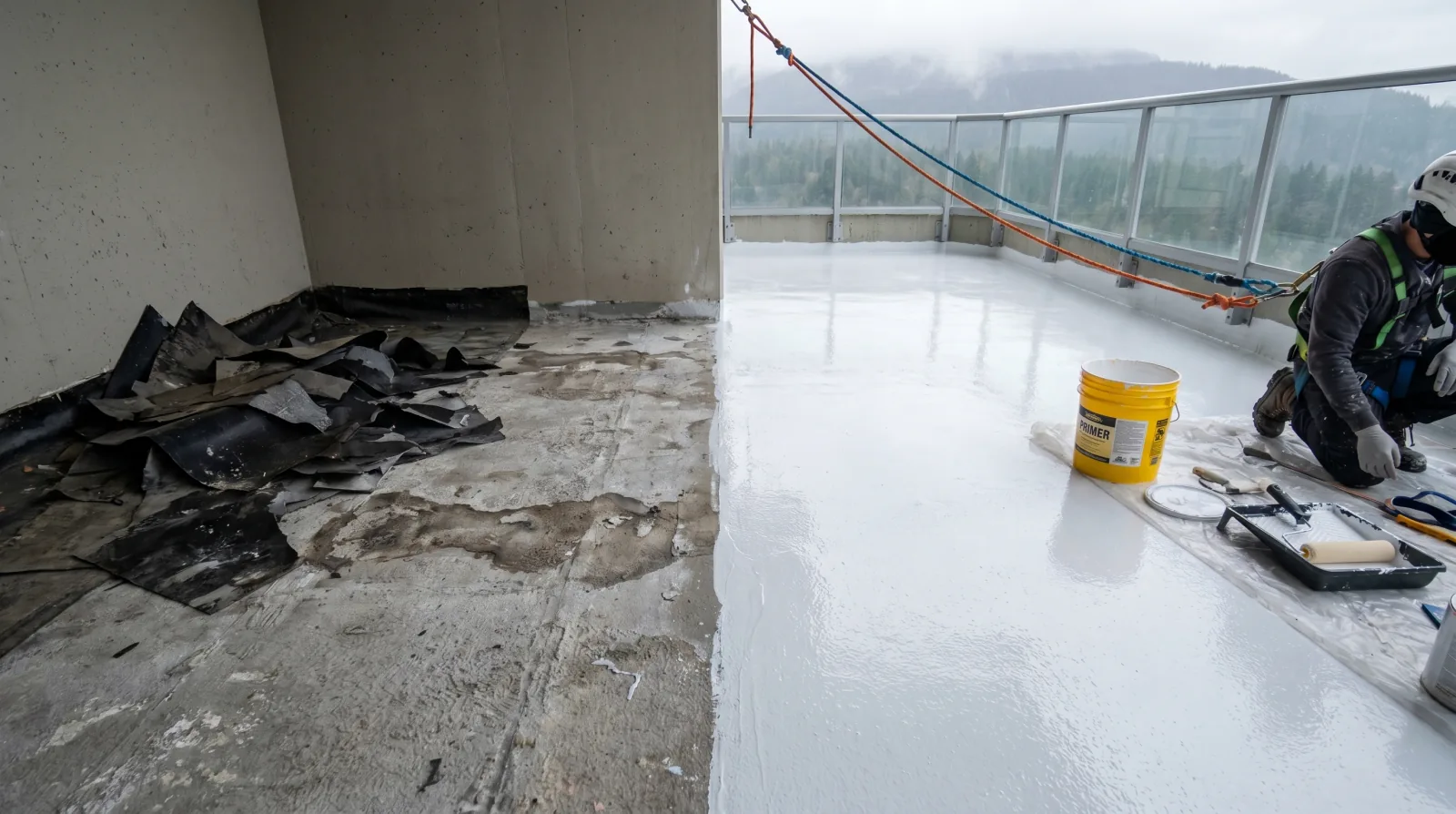
The trap: deciding by what you can see
The instinct is to judge a balcony by its surface — the membrane looks tired, so recoat it; it looks fine apart from one split, so patch it. That logic fails because the decisive facts are underneath. A membrane that looks worn but is firmly bonded over a dry, well-draining deck is an overlay candidate. A membrane that looks similar but is hiding trapped moisture, a ponding problem, or rotten framing needs a full tear-off. You cannot tell those two apart from standing height, which is why the decision starts with testing, not looking.
What gets checked before the call
These are the checks that actually drive the repair-overlay-replace decision. Most can be done in a single assessment visit.
Adhesion / bond check
Probing and pull testing the existing membrane to see whether it is still bonded to the deck — the single biggest factor in whether an overlay is even possible.
Moisture survey
Checking for water trapped under or within the existing system. Sealing trapped moisture under an overlay is a classic way to cause blistering within a year.
Drainage & slope check
Watching where water goes after a hose-down or a rain. A deck that ponds has a slope or drain problem that a new membrane alone will not fix.
Slab edge sounding
Tapping the concrete edge for the hollow note that signals delamination, and looking for rust staining that means the rebar is already corroding underneath.
Framing probe (wood decks)
On wood-framed balconies, probing the joists and ledger for soft, rotten material. Rot found here turns a membrane job into a structural repair.
If you're not yet sure your membrane has failed, the signs-of-failure guide covers what to look for first.
When a localized repair is honest
- The failure is localized — a split seam, a lifted upturn, a damaged spot — and the rest of the membrane is still sound and well bonded.
- The system is well within its service life and the surrounding membrane has plenty of life left in it.
- There is no staining on the soffit or suite below, meaning water has not yet been getting into the structure for long.
- The slab edge is sound — no rust, no hollow-sounding concrete — so there is nothing structural hiding under the repair.
A spot repair is the right answer more often than the industry likes to admit — a split seam or a lifted upturn on an otherwise-sound deck doesn't need a special levy. The discipline is being honest about "otherwise sound": if the surrounding membrane is bonded and the structure is dry, repair it and move on.
When an overlay buys real time
- The existing membrane is aging and worn across the field but still bonded — not blistered or lifting — so a new system can key into it.
- The deck drains properly and the substrate underneath is dry and stable.
- A compatible system exists that the manufacturer warrants over the existing membrane (compatibility is not a given — it has to be confirmed, not assumed).
- There is no trapped moisture under the old membrane that an overlay would seal in.
An overlay — a new compatible system keyed into a sound existing one — is the middle path, and it's a good one when the conditions line up. The make-or-break is bond and moisture: if the old membrane is lifting or there's water trapped underneath, an overlay seals the problem in and you pay twice. Compatibility has to be confirmed with the manufacturer, not assumed because two products are both "polyurethane."
When only a full replacement is defensible
- The membrane is widely blistered, lifting, or split — patching becomes a losing game of chasing the next breach.
- Water has been getting into the structure: soffit staining, drips below, or rust from the slab edge.
- A wood-framed deck shows soft framing or rot, which has to be opened up and replaced — you cannot overlay over rot.
- The deck never drained properly and needs re-profiling, which means stripping back to the slab anyway.
- Previous patches or overlays have already failed because the underlying cause was never addressed.
The tipping point is usually water in the structure or a deck that never drained. On a wood-framed balcony, rot ends the conversation: you cannot coat over soft framing, so the deck gets opened up, the bad material replaced, and a new system installed over a sound substrate. On a concrete deck, rust from the slab edge means concrete repair comes first — the same repair-or-replace logic our concrete guide walks through — and only then does the new membrane go down.
The framing-rot check most owners skip
Here's the mistake that turns a manageable project into an expensive one: approving a membrane overlay on a wood-framed balcony without anyone probing the framing first. The new membrane goes on, looks great, and the rot underneath keeps spreading because the water that caused it was never removed — it was sealed in. By the time the deck sags or the soffit stains again, you're paying for structural framing repair plus a second membrane. On any wood-framed deck showing soft spots or staining below, the framing gets opened and checked before a single decision about the membrane is made.
The cost of deferring balcony waterproofing
Strata councils sometimes defer balcony replacements to avoid special levies. This is an expensive strategy. In Vancouver's coastal climate, wood-decay fungi active in damp plywood thrive at temperatures between 10°C and 30°C — which describes most of our year. Once wood moisture content exceeds 20%, decay fungi secrete enzymes that dissolve cellulose, reducing structural plywood and support beams to crumbly pulp.
While replacing a balcony membrane is a straightforward exterior project, repairing structural support joists requires shoring the building structure, opening interior ceilings and stucco cladding to access joist connections, and substantial engineering fees and municipal permit approvals. Scheduling biennial inspections and executing localized repairs immediately — instead of deferring — is almost always the lower-cost path over a 10-year horizon.
Quick answers
Should I repair or replace my balcony waterproofing?
Repair makes sense when the failure is localized — a split seam or a lifted edge — the rest of the membrane is still sound and bonded, and there is no sign water has reached the structure. Replacement wins once the membrane is widely blistered or lifting, water has been getting into the deck (soffit stains, drips below, rust from the edge), or a wood-framed deck shows rot. Between those sits the overlay option. The honest answer for a specific deck comes from an assessment that checks bond, moisture, drainage, and the slab edge — not from how the surface looks from standing height.
Can you put a new balcony membrane over the old one?
Sometimes — that is an overlay, and it can buy real time when the existing membrane is worn but still well bonded, the deck drains properly, there is no trapped moisture, and a compatible warranted system exists for the overlay. The risks are sealing in moisture and bonding to a membrane that is itself failing. Compatibility and bond have to be confirmed by assessment, not assumed; an overlay over a lifting or blistered membrane just fails twice as expensively.
How do I know if there is rot under my balcony membrane?
On a wood-framed balcony, rot under the membrane shows as soft, spongy areas underfoot, sagging, staining or drips on the soffit and ceiling below, and soft material when the joists or ledger are probed. It is not always visible from the surface, which is why a proper assessment opens up suspect areas. Rot cannot be overlaid or coated over — the affected framing has to be replaced before any new waterproofing goes down, which is why it pushes the decision firmly toward full replacement.
Repair vs. replacement questions
Should I repair or replace my balcony waterproofing?
Repair makes sense when the failure is localized — a split seam or a lifted edge — the rest of the membrane is still sound and bonded, and there is no sign water has reached the structure. Replacement wins once the membrane is widely blistered or lifting, water has been getting into the deck (soffit stains, drips below, rust from the edge), or a wood-framed deck shows rot. Between those sits the overlay option. The honest answer for a specific deck comes from an assessment that checks bond, moisture, drainage, and the slab edge — not from how the surface looks from standing height.
Can you put a new balcony membrane over the old one?
Sometimes — that is an overlay, and it can buy real time when the existing membrane is worn but still well bonded, the deck drains properly, there is no trapped moisture, and a compatible warranted system exists for the overlay. The risks are sealing in moisture and bonding to a membrane that is itself failing. Compatibility and bond have to be confirmed by assessment, not assumed; an overlay over a lifting or blistered membrane just fails twice as expensively.
How do I know if there is rot under my balcony membrane?
On a wood-framed balcony, rot under the membrane shows as soft, spongy areas underfoot, sagging, staining or drips on the soffit and ceiling below, and soft material when the joists or ledger are probed. It is not always visible from the surface, which is why a proper assessment opens up suspect areas. Rot cannot be overlaid or coated over — the affected framing has to be replaced before any new waterproofing goes down, which is why it pushes the decision firmly toward full replacement.
Is a balcony overlay cheaper than a full replacement?
An overlay is less disruptive and lower cost than a full tear-off when the conditions are right — bonded existing membrane, dry substrate, good drainage, confirmed compatible system. It stops being cheaper the moment any of those is missing, because an overlay over trapped moisture, a failing membrane, or a deck that ponds simply fails and then you pay for the tear-off you avoided plus the overlay you wasted. We do not quote balcony pricing without an assessment, because the right scope — and therefore the cost — is set by what the deck actually needs.
Who decides whether a balcony gets repaired or replaced?
On a strata or commercial building the call is made from a condition assessment, and for larger projects a building-envelope consultant or engineer scopes it and the strata council funds the approved scope. A reputable contractor will not talk a council into the cheapest option to win the job when the deck needs more — and will tell you plainly when a localized repair is genuinely all that is required. The assessment, not a sales quote, is what should drive the decision.
Are strata balconies considered common property under BC law?
Yes. Under the BC Strata Property Act Section 72, structural elements and waterproofing membranes are typically classified as common property or limited common property, making the strata corporation responsible for their maintenance, repair, and replacement. Individual owners are generally responsible for surface-level cleaning only. This means the funding decision — repair, overlay, or replace — is a strata matter, not an individual owner's call.
Can you repair a split seam on a vinyl balcony deck?
A split seam on a PVC sheet vinyl deck (like Duradek) can be repaired by hot-air welding a new vinyl patch over the damaged area — but only if the vinyl is still flexible enough to accept the weld. Vinyl that is older than roughly 10 years has usually lost enough plasticizer that it is too dry and brittle to weld properly; the iron burns the material rather than fusing it. If the vinyl has reached that stage, attempting a seam repair gives a false sense of security — the patch fails and the rest of the membrane is signalling that full replacement is the honest answer.
How often should strata balcony railings be inspected for waterproofing issues?
Railings should be audited during your strata's biennial building envelope inspection. Anchors bolted through the top of the balcony membrane are common leak spots. Look for cracked sealants, rust staining, and loose posts, which indicate water is bypassing the seal around the post penetration.
Can I lay wood tiles or outdoor mats over my vinyl balcony deck?
Placing heavy tiles or rubber-backed mats directly over vinyl membranes can trap dirt, pollen, and moisture. This creates a dark, damp environment that breeds mold and accelerates vinyl degradation. If using pavers or tiles, ensure they are raised on pedestals to allow proper drainage and airflow underneath.
What happens if a leaking balcony membrane is left unrepaired?
Neglecting a leaking membrane allows water to saturate plywood decking or porous concrete slabs. In wood-frame structures, this leads to dry rot and structural failure of support beams. In concrete high-rises, it causes rebar corrosion, concrete spalling, and costly structural repairs. The cost of delayed action almost always exceeds the cost of the repair that was deferred.
Get the repair-or-replace call made properly
We assess balcony decks — membrane bond, moisture, drainage, slab edge, and framing — across Vancouver, North Vancouver, West Vancouver, and Burnaby, so the decision rests on what the deck needs, not a guess.