Window leaks: perimeter, glazing, or sill pan
"The window is leaking" is where most reports start and where most misdiagnoses start too. Three different failures produce water at a window, and only one of them involves the window assembly itself. Telling them apart before anyone quotes a repair is the whole game, because the fixes range from a day of recaulking to pulling the unit out of the wall.
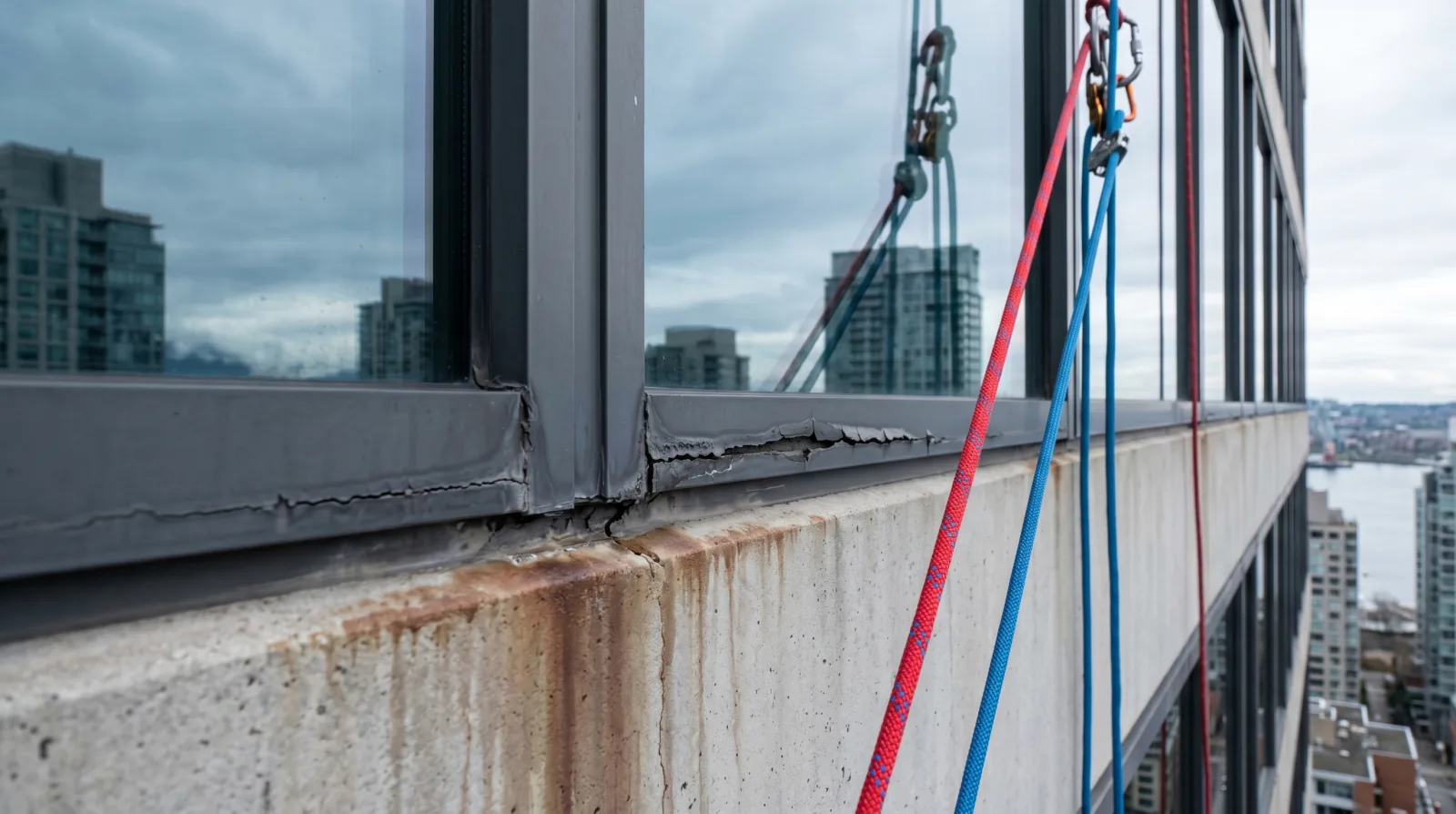
The window is a system, and the frame is its strongest part
A modern window on a Vancouver tower or Burnaby mid-rise is really four things: the glass unit, the frame that drains it, the sealant joint that ties the frame to the wall, and the sill pan hidden underneath as the last line of defence. The extruded frame is the component least likely to fail; it is factory-made, tested, and designed to collect and shed water through its weep holes. The site-built parts around it, the joint and the pan, carry decades of UV, movement, and the sideways rain this coast is known for. They fail first, and they fail quietly.
That distribution of failure matters for scope. When the perimeter joint is the problem, the repair belongs to a sealant and caulking program, and the window never moves. Our sealant and caulking hub covers how those joints are built and why they age out. When the sill pan is the problem, the conversation gets bigger, and confirming the diagnosis first becomes worth every hour it takes.
Three failures, three signatures
Perimeter seal failure
Where it fails: The sealant joint between the window frame and the surrounding cladding or concrete.
What you see: Leak tracks rain events and wind direction. Water shows at the head or jamb inside, or stains the wall beside the window rather than the sill. Outside, the bead is cracked, debonded, or pulled away from one side of the joint.
What the fix looks like: Cut out and replace the joint with the right sealant and backer rod. The window stays. This is the most common and most repairable of the three.
Glazing unit failure
Where it fails: The sealed insulating glass unit itself, or the glazing seal holding it in the frame.
What you see: Fogging or condensation between the panes means the unit seal has failed, but that is a comfort and energy problem, and it rarely leaks liquid water. Water weeping from the glazing stop or frame corners during rain points at the glazing seal or gaskets.
What the fix looks like: Reseal the glazing (wet seal) or replace the sealed unit. The frame stays in the wall either way.
Sill pan failure
Where it fails: The waterproof pan under the window that catches water passing the frame and drains it back out.
What you see: Water shows below the window, at the sill inside, or in the suite underneath, often only in sustained wind-driven rain. The window and its perimeter can look perfect, because the pan does its work out of sight and fails out of sight.
What the fix looks like: The hardest of the three: the pan sits under the window, so the repair usually means removing the unit or rebuilding the sill detail. Confirming the pan is the culprit with water testing first matters, precisely because the repair is invasive.
How the diagnosis actually runs
The evidence starts inside: where exactly does water show, and when? Head and jamb point up and sideways, toward the perimeter joint or the head flashing. Sill and below point down, toward the pan. Then the exterior gets inspected up close, which on a high-rise means rope access, because a debonded joint edge or a hairline split in a sealant bead is invisible from the ground. On curtain wall towers downtown, the failure patterns have their own history, which we cover in the post on window sealant failure on Vancouver curtain wall towers.
When inspection alone cannot settle it, controlled water testing isolates one component at a time: mask the joint and spray the glazing, then reverse it. For disputed or stubborn leaks, the calibrated version of that test is ASTM E1105, which adds negative air pressure inside the suite to reproduce wind-driven rain. The full toolkit, and the order it runs in, is covered in the moisture testing methods guide.
One caution that saves stratas money: water at a window does not prove a window failure at all. Water entering at a roof-to-wall junction or a cladding joint above can travel down the wall and exit at the window head, framing the innocent. The water ingress hub exists because these paths cross constantly, and the stain is a poor witness.
Questions worth asking before approving any window repair
For a council or manager weighing a quote, three questions separate a diagnosis from a guess. Which of the three components failed, and what test showed it? If the answer is "we will recaulk and see," the scope is a hope. Does the repair address the water path or the water evidence? Replacing interior drywall without touching the exterior detail treats the symptom. And if the sill pan is named, what confirmed it? Pan repairs are the invasive end of the range, and nobody should open a wall or pull a unit on an unverified suspicion. A contractor who welcomes these questions is describing work they can stand behind.
Why this matters more here than most places
Metro Vancouver's exposure is unforgiving to window details. Vancouver International Airport records an average of 1,189 mm of precipitation a year (1991 to 2020 normals), and a meaningful share of it arrives in wind-driven storms that load the south and southeast elevations hardest. A perimeter joint that would last decades in a dry climate gets tested here every autumn. West Vancouver and North Vancouver buildings add salt air and mountain freeze-thaw on top.
The pattern we see across strata portfolios is consistent: windows get blamed, sealant joints and sill pans are guilty. Getting that diagnosis right, once, is cheaper than every alternative.
Quick answers
Why is my window leaking when it rains?
A window that leaks in rain usually has a failed detail around it rather than a failed window. The usual suspects, in order: the perimeter sealant joint between frame and cladding, the sill pan under the unit, and the glazing seals holding the glass. Wind-driven rain finds whichever one has opened. Diagnosis means working out which path the water takes, because the three repairs differ enormously in scope.
How can I tell if a window leak is the perimeter sealant?
Perimeter sealant leaks track storms and show at the head or jamb, or stain the wall beside the window. Up close, the bead is cracked, chalky, or debonded from one side of the joint. A controlled water test on the joint alone, with the glazing masked off, confirms it. On Vancouver towers we run those tests from rope access so each joint can be isolated and sprayed in sequence.
What is a sill pan and how does it fail?
A sill pan is a waterproof tray under the window, formed from membrane or metal, that catches any water getting past the frame and drains it back outside. It fails when the membrane was lapped wrong, the end dams were left off, a fastener punctured it, or it was simply never installed. A failed pan sends water into the wall below the window, which is why sill pan leaks so often appear in the suite underneath.
Window leak questions
Why is my window leaking when it rains?
A window that leaks in rain usually has a failed detail around it rather than a failed window. The usual suspects, in order: the perimeter sealant joint between frame and cladding, the sill pan under the unit, and the glazing seals holding the glass. Wind-driven rain finds whichever one has opened. Diagnosis means working out which path the water takes, because the three repairs differ enormously in scope.
How can I tell if a window leak is the perimeter sealant?
Perimeter sealant leaks track storms and show at the head or jamb, or stain the wall beside the window. Up close, the bead is cracked, chalky, or debonded from one side of the joint. A controlled water test on the joint alone, with the glazing masked off, confirms it. On Vancouver towers we run those tests from rope access so each joint can be isolated and sprayed in sequence.
What is a sill pan and how does it fail?
A sill pan is a waterproof tray under the window, formed from membrane or metal, that catches any water getting past the frame and drains it back outside. It fails when the membrane was lapped wrong, the end dams were left off, a fastener punctured it, or it was simply never installed. A failed pan sends water into the wall below the window, which is why sill pan leaks so often appear in the suite underneath.
What does fogging between window panes mean?
Fog or condensation between the panes means the edge seal of the insulating glass unit has failed and moist air is getting into the cavity. It ruins visibility and the unit's insulating value, but it is a sealed-unit failure rather than a water leak: fogged units rarely let liquid water into the suite. The fix is replacing the glass unit, and it can usually be scheduled as maintenance rather than treated as an active leak.
Is the window itself usually the cause of a window leak?
Rarely. Aluminum and vinyl frames are factory-made drainage systems, and the frame extrusions themselves almost never let water through. What fails is everything built around the window on site: the perimeter sealant, the sill pan, the head flashing, and the tie-in to the weather barrier. That is good news for stratas, because it means most "window leaks" are repairable details, and wholesale window replacement is often the wrong scope.
Do leaking windows need to be replaced?
Most leaking windows stay right where they are. A failed perimeter joint gets recaulked, failed glazing gets resealed or the glass unit swapped, and a failed head flashing gets rebuilt, all without removing the frame. Replacement enters the conversation when the sill pan has failed and the sill must be rebuilt anyway, or when the units are at end of life for other reasons. Diagnose first; the repair scope follows the diagnosis.
Why does a window only leak in wind-driven rain?
Wind does two things vertical rain cannot: it pushes water sideways and upward into joints that gravity normally protects, and it pressurizes the wall face so water gets driven through small openings. A window that leaks only in a southeasterly blow has a defect that needs that pressure, typically an open perimeter joint or a breached sill pan on the exposed elevation. That timing detail alone narrows the search considerably.
What are window weep holes and should they be sealed?
Weep holes are the small drainage slots in the bottom of a window frame that let water collected in the frame drain back outside. They are supposed to be there, and sealing them is one of the classic well-intentioned mistakes: blocked weeps trap water inside the frame until it finds a path inward. If water dribbles from a weep during rain, the frame drainage is working. Keep weeps clear, never caulk them shut.
How are window leaks tested on a high-rise?
The reliable method is controlled water testing from the exterior, isolating one detail at a time: glazing first, then perimeter joints, then the sill zone, while someone watches inside. On towers, technicians rig on ropes to reach each window in the stack. Where a leak is disputed or has survived previous repairs, a calibrated spray test to the ASTM E1105 standard adds interior negative pressure to reproduce wind-driven rain conditions.
Are windows common property in a BC strata?
In most BC strata plans, windows on the building exterior are common property, which puts their repair with the strata corporation rather than the owner, but the strata plan and bylaws govern each building and there are exceptions. The practical takeaway for an owner with a leaking window: report it to council in writing and let the source be diagnosed, because responsibility follows where the water enters, and that is exactly what the diagnosis establishes.
Water showing at a window?
We diagnose and repair window leaks on strata and commercial buildings across Vancouver, North Vancouver, West Vancouver, and Burnaby, and we test which component failed before anyone talks about replacement.