Wall leaks through stucco and cladding
A wall leak is the hardest kind to picture, because the wall looks fine. Stucco, EIFS, and panel systems each let water through in their own characteristic places, and what happens next depends less on the cladding than on what sits behind it: a drained cavity that forgives, or a face-sealed assembly that accumulates every storm.
Every cladding leaks somewhere specific
Water rarely defeats the middle of a wall. It defeats the working details: cracks, joints, terminations, and the lines where one material hands off to another. Knowing where each system concentrates its risk tells you where to look first.
Traditional stucco
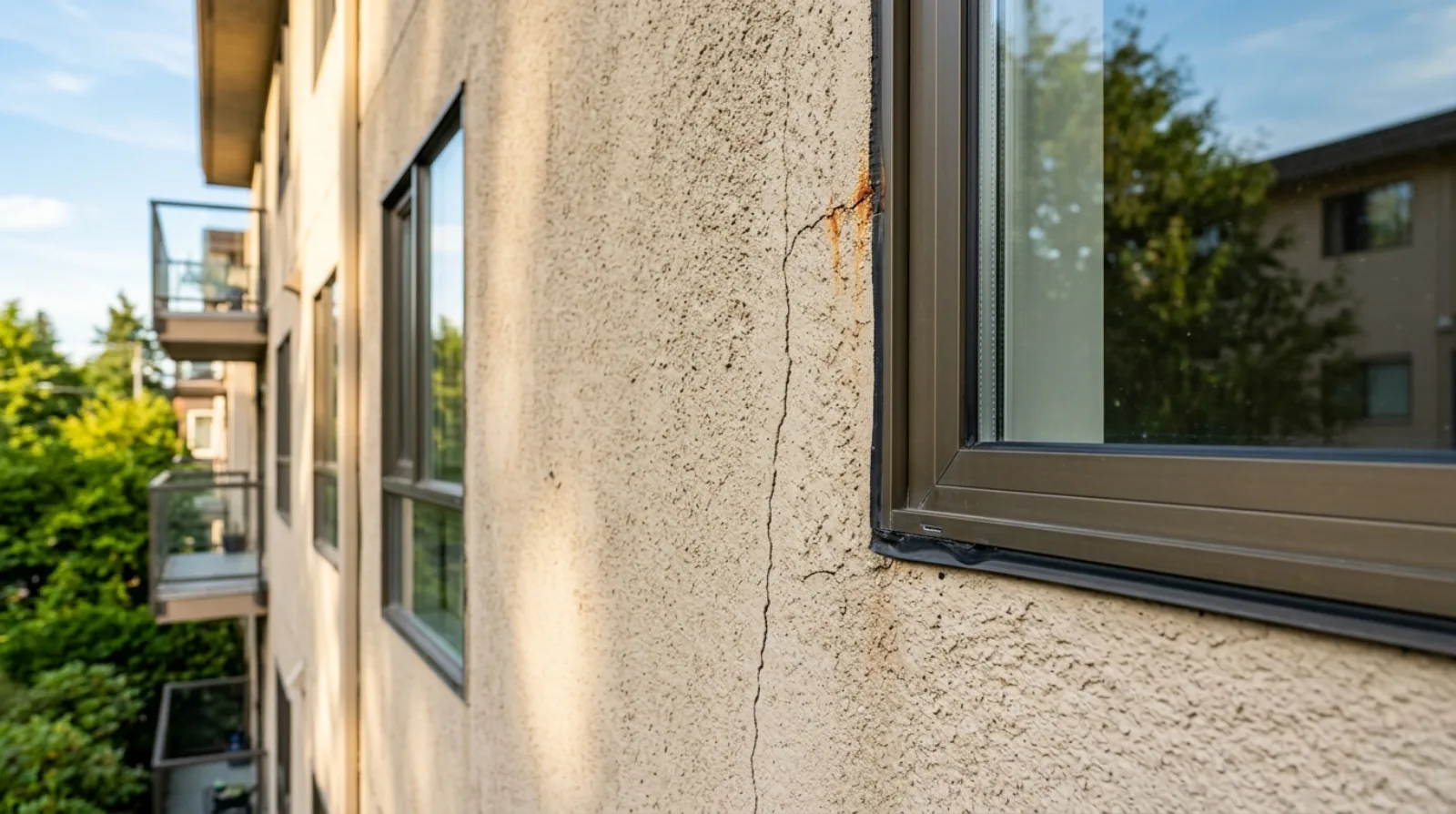
Cement stucco absorbs water; that is its nature, and a properly built wall plans for it. Water gets into trouble through cracks (shrinkage, movement, or impact), through failed sealant where stucco meets windows and penetrations, and through the wall body itself when the paper or membrane behind the stucco is damaged or was lapped wrong. On pre-rainscreen walls, whatever gets past the face has nowhere to drain.
EIFS (acrylic stucco over foam)
EIFS puts a thin acrylic lamina over insulation board. The lamina itself sheds water well, so nearly all EIFS leaks enter at terminations: window perimeters, penetrations, kickout locations, and the base of the wall. Once inside, water is trapped between foam and sheathing, and face-sealed EIFS from the 1980s and 1990s earned its reputation exactly there. Modern drainage EIFS adds a cavity for this reason.
Panel systems (metal, fibre cement, composite)
Panel cladding lives and dies by its joints. The panels shed water; the sealant or gasket joints between them, and the flashings at every opening and edge, are the working parts. A split sealant bead in a panel joint feeds water straight into the cavity. Rainscreen panel walls tolerate this for a while because the cavity drains; the leak shows once volume beats the drainage or reaches a tie-in.
Face-sealed versus rainscreen: the wall behind the wall
The same crack behaves completely differently on two different assemblies. A rainscreen wall keeps a drained, ventilated cavity between cladding and structure, so incidental water runs down the cavity and exits at flashings. A face-sealed wall has no cavity: the cladding face is the only defence, and water that passes it sits on the sheathing membrane and the framing. Our guide on rainscreen versus face-sealed assemblies works through the two designs in detail.
BC learned this distinction expensively. The leaky condo crisis put roughly $4 billion of damage across 900+ Lower Mainland buildings, most of them face-sealed wood-frame construction from the 1980s and 1990s. The history, and what it means for buildings of that era still standing across Vancouver, Burnaby, and New Westminster, is covered in our post on the leaky condo legacy and rainscreen retrofits. If your building predates the rainscreen requirement, a wall leak carries more urgency, because the assembly has no second chance built in.
Saturation is a process, and it hides well
A face-sealed stucco wall on a weather elevation does not fail in one storm. It absorbs a little more each wetting than it can dry between storms, and through a Vancouver winter the balance runs one way. Vancouver International Airport's climate normals put average precipitation at 1,189 mm a year (1991 to 2020), and the wall carries that load with whatever cracks and open joints it has. The interior stays clean while sheathing moisture climbs, which is why the first visible sign is often a musty smell or a stain at a floor line, both covered in the signs of water ingress guide.
By the time water shows inside, it has usually travelled: down studs, along the sheathing membrane, and out at an interruption well below or beside the entry. Chasing the stain leads crews to recaulk the nearest window, which is frequently innocent; the window leaks guide covers how that misdiagnosis happens in the other direction too.
What a wall tells you from the ground, and what it hides
A ground-level walk catches the loud evidence: crack networks, staining below joints, blistered coatings, vegetation growing out of a joint (always a bad sign, always worth photographing). What it cannot judge is the condition of the working details. A sealant joint reads as one dark line from ten metres away whether it is sound or split its full length, and the difference is invisible below arm's reach. On anything above a low walk-up, that means close access: rope access drops on towers, ladders and lifts where they make sense. The exterior inspection earns its cost by shortening everything that follows, because a shortlist of three suspect details tests in a day, while "somewhere on the south elevation" tests in a week.
Elevations also age as populations. Joints installed the same season fail around the same season, so one split joint on a twenty-year elevation is rarely alone. An inspection that finds the leaking joint should also grade its neighbours, which is how a strata turns an emergency repair into a planned program instead of a series of surprises.
Getting from suspicion to scope
The sequence that works: map when and where water shows, inspect the elevation up close (rope access on anything tall), meter and image the interior, then spray-test the suspect details one at a time. Small exploratory openings come last, to confirm the path and grade the sheathing. From there the repair is either surgical, a crack repair program like the one in our post on pre-storm stucco crack repair, plus joint replacement and flashing corrections, or, when openings show systemic saturation, a bigger envelope conversation. Both paths run through a proper building envelope repair scope, and both start at the same place: the water ingress hub's first rule, diagnose before repairing.
Quick answers
How does water get through a stucco wall?
Water enters stucco three ways: through cracks in the stucco itself, through failed sealant joints where the stucco meets windows, doors, and penetrations, and by absorption through the cement, which is porous by nature. On a wall with a drained cavity behind it, most of that water is managed. On a face-sealed wall, whatever gets past the surface sits against the sheathing, and repeated storms keep topping it up.
What is a face-sealed wall?
A face-sealed wall relies entirely on its outer surface, the stucco, coating, and sealant joints, to keep water out, with no drainage cavity behind the cladding. Every crack and joint becomes critical, because there is no second line of defence. Much of Metro Vancouver's 1980s and 1990s wood-frame stock was built this way, which is what made the leaky condo era possible. Rainscreen walls added the drainage gap specifically to end that dependence.
Do hairline stucco cracks let water in?
Yes, more than intuition suggests. Wind-driven rain is pushed against the wall under pressure, and capillary action pulls water into openings far narrower than a millimetre. One hairline crack is a small dose; a network of them across a weather elevation is a steady intake every storm. Whether that matters depends on the wall behind: a drained cavity forgives it, a face-sealed assembly accumulates it. Crack repair before storm season is cheap insurance either way.
Wall leak questions
How does water get through a stucco wall?
Water enters stucco three ways: through cracks in the stucco itself, through failed sealant joints where the stucco meets windows, doors, and penetrations, and by absorption through the cement, which is porous by nature. On a wall with a drained cavity behind it, most of that water is managed. On a face-sealed wall, whatever gets past the surface sits against the sheathing, and repeated storms keep topping it up.
What is a face-sealed wall?
A face-sealed wall relies entirely on its outer surface, the stucco, coating, and sealant joints, to keep water out, with no drainage cavity behind the cladding. Every crack and joint becomes critical, because there is no second line of defence. Much of Metro Vancouver's 1980s and 1990s wood-frame stock was built this way, which is what made the leaky condo era possible. Rainscreen walls added the drainage gap specifically to end that dependence.
Do hairline stucco cracks let water in?
Yes, more than intuition suggests. Wind-driven rain is pushed against the wall under pressure, and capillary action pulls water into openings far narrower than a millimetre. One hairline crack is a small dose; a network of them across a weather elevation is a steady intake every storm. Whether that matters depends on the wall behind: a drained cavity forgives it, a face-sealed assembly accumulates it. Crack repair before storm season is cheap insurance either way.
How do EIFS walls leak?
EIFS leaks concentrate at terminations rather than the field of the wall: window and door perimeters, penetrations for vents and fixtures, the base of the wall, and junctions where a roof meets the EIFS. The acrylic lamina sheds rain, so the water finds the edges where the lamina ends and sealant or flashing takes over. Face-sealed EIFS traps that water against the sheathing, which is why termination detailing decides the fate of the whole wall.
How do panel cladding joints leak?
Panel systems concentrate all their waterproofing into joints and flashings. Sealant joints split or debond with age and movement; gaskets shrink and lose compression; flashings at openings get displaced or were never lapped correctly. Any of these feeds water into the cavity behind the panels. Because the panels hide the cavity, joint failures can run for years before enough water accumulates to show inside, usually at a floor line or an opening below.
What happens inside a wall that stays wet?
In a wood-frame wall, sustained moisture feeds decay fungi in the sheathing and studs, corrodes fasteners, flattens insulation, and eventually supports mould on the paper faces of drywall. In a concrete or steel-stud wall, it corrodes steel and breaks down gypsum sheathing. The process runs hidden, because assemblies wet from the cladding side stain interior finishes late. The leaky condo crisis showed the end state: structural rot on a provincial scale.
Why do wall leaks show at floor lines?
Water inside a wall cavity runs downward until something horizontal interrupts it: a floor plate, fire blocking, or a shelf angle. Those interruptions collect the water and hold it against the assembly until it finds a way inward, which is why wall leaks so often stain the ceiling edge of the suite below the entry point rather than the wall where the water came in. The floor line is the collection point, and the entry sits somewhere above it.
Which walls leak first on a Metro Vancouver building?
The elevations that face the weather. Vancouver's big rain arrives mostly on south and southeast winds, so those walls take the driving rain, the most sealant UV exposure on top of it, and the most wetting cycles. On the North Shore, exposure shifts with terrain and buildings pick up freeze-thaw stress as well. When several suites report leaks on one elevation and the others stay dry, the wall system on that exposure is the suspect.
How is a wall leak located without stripping the cladding?
Investigation works from least invasive to most: pattern analysis of when and where water shows, close exterior inspection of cracks, joints, and terminations (on ropes for anything above reach), moisture meter mapping inside, thermal imaging to find wet zones, then controlled water spray testing to reproduce the leak one detail at a time. Only after the path is established does anyone cut an exploratory opening, sized to confirm rather than to hunt.
When does wall leak repair become recladding?
A wall crosses that line when the failures stop being local. One split joint or a cracked patch of stucco is a repair. Systemic sealant failure across an elevation, saturated sheathing in multiple test openings, or a face-sealed assembly showing rot at every opening points toward reclad territory, because patching each symptom individually costs more over a decade and leaves the underlying design in place. A condition assessment across the elevation settles it with data.
Does elastomeric coating stop wall leaks?
Elastomeric wall coating bridges hairline cracking and cuts absorption through the stucco or concrete face, so it genuinely helps walls whose problem is distributed fine cracking. It does nothing for failed sealant joints, flashings, or terminations, which cause most serious wall leaks, and coating over a wet, face-sealed assembly can slow its drying. The honest sequence: diagnose and repair the entry details first, then coat to protect the repaired field.
Suspect water is getting through a wall?
We investigate stucco, EIFS, and panel wall leaks on strata and commercial buildings across Vancouver, Burnaby, North Vancouver, and West Vancouver, and we find the entry detail before anyone strips cladding.