Roof-to-wall junction and parapet leaks
Where a roof meets a wall, two different waterproofing systems have to hand water off to each other in mid-air, in the wind, at the most exposed line on the building. The details that manage that handoff, kickouts, caps, counterflashing, scuppers, are small, cheap, and invisible from everywhere people normally stand. Which is exactly why they leak for years before anyone connects the interior stain to the roof edge.
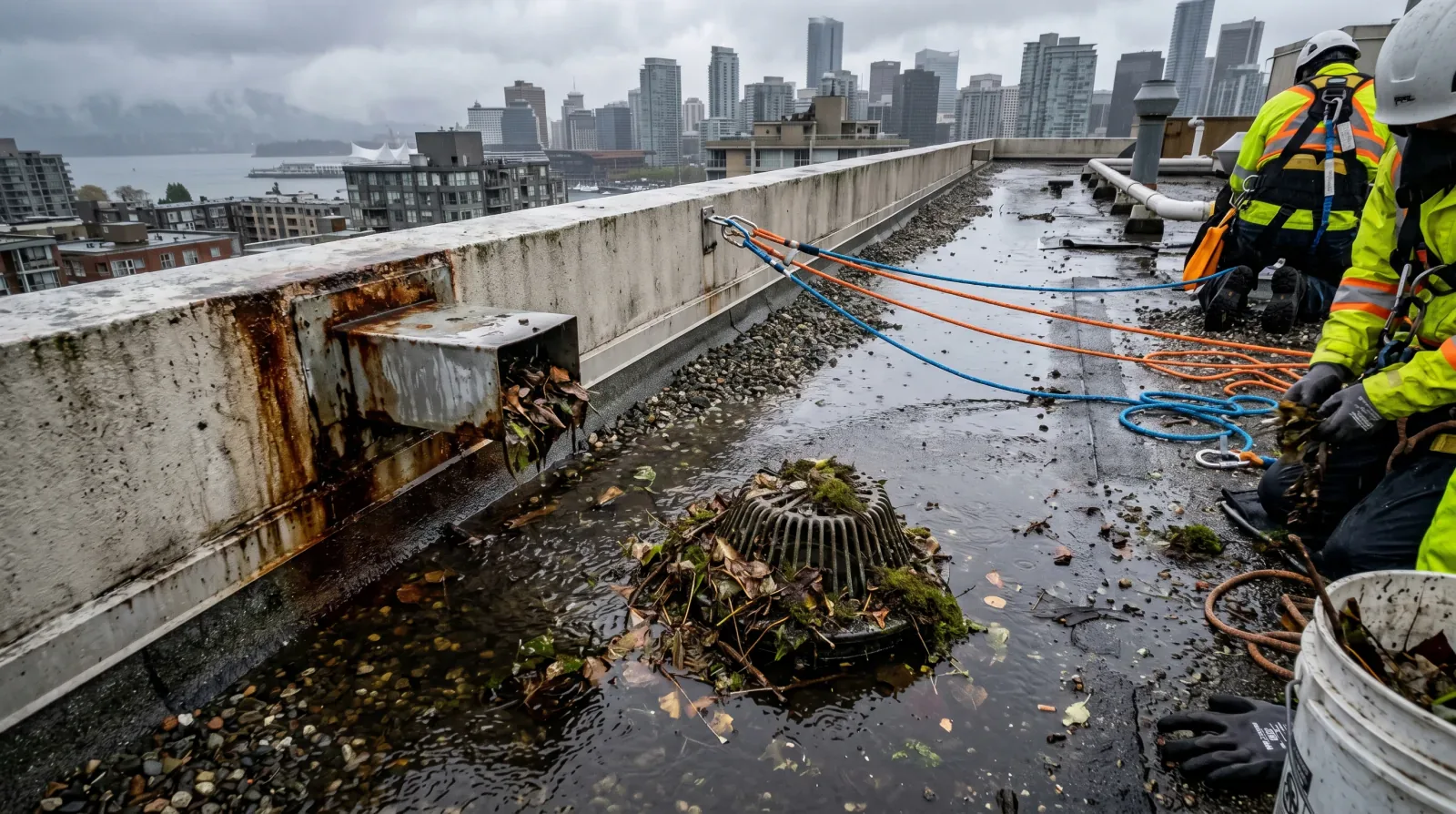
Why the junction is the hardest line on the building
A roof sheds water by slope and membrane; a wall sheds it by gravity and cladding. At the junction, the roof's water arrives concentrated, the wall's water arrives from above, and wind pressure works on both. Every component at that line is a transition piece, made and fitted on site, often by different trades in different years. The membrane belongs to the roofer, the cladding to the envelope contractor, the cap to the sheet metal trade, and the junction to whoever noticed it last.
That split ownership shows up in our investigations across Vancouver, Burnaby, and the North Shore more often than any material defect. A reroof that reused tired counterflashing, a repaint that caulked over a reglet, a cladding repair that stopped short of the kickout: each trade did its scope, and the junction fell between them.
The five details that do the work, and how each one fails
Kickout flashing
Its job: Diverts water off the bottom end of a roof-wall intersection, kicking it away from the wall and into the gutter.
How it fails: It is simply missing on a remarkable share of buildings, or it was cut short, flattened, or sealed over during a reroof or repaint. Without it, every rainfall pours the roof edge's collected water directly into the wall assembly at one concentrated point.
Parapet cap
Its job: The metal or membrane cap on top of a parapet wall keeps rain out of the wall's open top, the most exposed joint on the building.
How it fails: Open or displaced cap joints, popped fasteners, and splits at corners let water into the parapet core. The parapet then feeds it down into the wall or the roof edge from above, on both faces at once.
Counterflashing
Its job: Covers and protects the top edge of the roof membrane where it turns up against a wall, so water running down the wall cannot get behind the membrane termination.
How it fails: It loosens out of its reglet, the sealant at its top edge fails, or a trade removes it for other work and reinstalls it badly. Water then runs down the wall face and straight in behind the roof membrane's upturn.
Scuppers and overflow drains
Its job: Let water leave the roof or deck through the parapet when it cannot reach, or overwhelms, the primary drains.
How it fails: Debris blocks them, their liners split, or the membrane tie-in around the scupper opening cracks. A blocked scupper turns a parapet roof into a bathtub, and ponded water finds every weakness in the field and the edges.
Membrane terminations
Its job: The sealed edge where the roof membrane ends against walls, curbs, and penetrations.
How it fails: Termination bars loosen, sealant caps crack, and upturns pull down as membranes age and shrink. A termination that has dropped even slightly lets wind-driven rain over its top edge, into the assembly below the membrane.
Years of hiding, then a stain two floors down
Junction leaks are slow and weather-dependent, and the water they admit enters at the top of the wall with the whole building below it to travel through. It follows framing, membranes, and floor lines, so the first interior evidence is regularly a stain a floor or two below the roof, in a suite whose windows then get blamed. The mechanism is the subject of its own guide, why leaks show far from the source, and the roof edge is its most reliable illustration.
The maintenance items are just as invisible until they fail. Drains and scuppers blocked by fall leaf drop turn an ordinary atmospheric river event into a ponding test; our post on gutter and scupper cleaning by rope access covers what that service looks like on a strata tower, and the roof drain and scupper maintenance guide covers the schedule. Storm-only leak patterns generally, and what they say about which detail is open, are the subject of the storm leaks versus chronic leaks guide.
The maintenance calendar the roof edge actually needs
Junction details fail on two clocks. The slow clock is material aging: sealant at cap joints and counterflashing hardens over years, membrane terminations relax, fasteners back out with thermal cycling. The fast clock is blockage: one autumn of leaf drop can close a scupper that took no damage at all. A maintenance calendar has to serve both. The slow clock wants a proper look at the details every year or two, with photos, so this year's condition can be compared against last year's instead of against memory. The fast clock wants drains and scuppers cleared before the storm season and checked after big wind events, every year, without discussion.
The economics are lopsided in the building's favour. Every item on that calendar is small money; every failure it prevents is bigger money plus interior damage plus an investigation. Stratas in Vancouver and Burnaby that fold the roof edge into their fall maintenance round rarely meet their parapets in an emergency. The ones that treat the roof as invisible until a top-floor ceiling stains meet them at the worst possible time, mid-storm, with water already in the wall.
Finding a junction leak without guessing
The junction rewards direct inspection more than any other leak location, because most of its failures are visible once someone is actually at the detail. From the roof: cap joints, terminations, drain bowls, and scupper liners. On ropes down the face: counterflashing engagement, the junction line, and the kickout position. IRATA and SPRAT certified technicians on two lines from engineered anchors, under WorkSafeBC Part 11, reach all of it without a swing stage. Where inspection alone cannot reproduce the leak, isolated water testing at each detail settles it, in the sequence described in the water ingress hub.
Repairs at the junction are mostly small: a kickout fabricated and fitted, a cap joint stripped and resealed, counterflashing re-secured, a termination bar refastened and capped. The money is in finding the right one. A strata that spends on diagnosis at the roof edge, then fixes the one failed detail through a targeted leak repair, routinely closes out a stain that had been repainted annually for years.
Quick answers
What is a kickout flashing and why does it matter?
A kickout flashing is the small angled piece at the bottom of a roof-to-wall intersection that throws water away from the wall and into the gutter. Missing or flattened kickouts are among the most damaging small defects in coastal construction, because they concentrate the whole roof edge's runoff into one spot on the wall, every rainfall, for years. The rot pattern below a missing kickout is instantly recognizable on inspection openings.
Why do roof-to-wall junction leaks go unnoticed for years?
Because nobody stands where they can see them. The junction hides above sightlines and below parapet caps, the water it admits travels down inside the wall before showing, and the interior stain appears a floor or more below, where it gets blamed on windows or plumbing. Junction defects also leak slowly and only in weather, so each event is small. The damage compounds quietly until finishes or framing give it away.
What is a parapet and how does it leak?
A parapet is the section of wall that extends above the roof line around a flat roof's edge. It is exposed on three surfaces: both faces and its open top, which makes it the most weather-loaded wall on the building. It leaks through failed cap joints and corners on top, and through cracked faces and failed counterflashing where the roof membrane meets its base. Water in a parapet can travel down either side, feeding both roof and wall leaks.
Roof edge and parapet questions
What is a kickout flashing and why does it matter?
A kickout flashing is the small angled piece at the bottom of a roof-to-wall intersection that throws water away from the wall and into the gutter. Missing or flattened kickouts are among the most damaging small defects in coastal construction, because they concentrate the whole roof edge's runoff into one spot on the wall, every rainfall, for years. The rot pattern below a missing kickout is instantly recognizable on inspection openings.
Why do roof-to-wall junction leaks go unnoticed for years?
Because nobody stands where they can see them. The junction hides above sightlines and below parapet caps, the water it admits travels down inside the wall before showing, and the interior stain appears a floor or more below, where it gets blamed on windows or plumbing. Junction defects also leak slowly and only in weather, so each event is small. The damage compounds quietly until finishes or framing give it away.
What is a parapet and how does it leak?
A parapet is the section of wall that extends above the roof line around a flat roof's edge. It is exposed on three surfaces: both faces and its open top, which makes it the most weather-loaded wall on the building. It leaks through failed cap joints and corners on top, and through cracked faces and failed counterflashing where the roof membrane meets its base. Water in a parapet can travel down either side, feeding both roof and wall leaks.
What is counterflashing on a roof?
Counterflashing is the protective layer, usually metal, that covers the top edge of the roof membrane where it turns up against a wall or parapet. The membrane upturn is watertight from below but vulnerable from above; counterflashing shields that top edge so water running down the wall passes over the termination instead of behind it. When counterflashing loosens or its sealant fails, the roof leaks even though the membrane itself is intact.
Why does the top-floor suite get ceiling stains first?
Top-floor suites sit directly under the roof edge details: parapets, terminations, junctions, and drains. When any of those admits water, the shortest path to visible damage runs through the top-floor ceiling. The pattern within the suite narrows it further: stains at the ceiling perimeter point to the parapet or junction on that side, stains at mid-ceiling point toward field penetrations or drains above.
Can a blocked scupper cause an interior leak?
Directly. A scupper is a drainage opening through the parapet, and when leaves and debris block it, water depth on the roof or deck rises above design levels. Ponded water then over-tops membrane upturns, works into termination edges, and loads every seam far beyond what the assembly sees in normal drainage. Many "roof membrane failures" investigated after fall storms turn out to be drainage failures, with the membrane as the second victim.
How often should roof drains and scuppers be cleared in Vancouver?
On Metro Vancouver buildings the practical minimum is before the fall storm season, with a check after leaf drop and after any major wind event. Buildings under or beside mature trees need more frequent attention. It is the cheapest item on the entire envelope maintenance calendar and it prevents a disproportionate share of ingress events, because blocked drainage turns an ordinary storm into a ponding test the roof was never meant to pass.
Is a leak near the roof always the roof membrane?
No, and assuming so wastes repair budgets. The membrane field is usually the healthiest part of a roof system; the edges are where it loses. Parapet caps, counterflashing, terminations, scupper liners, and the junctions where roof meets wall fail earlier and more often than the field. A roofer patching the field while a parapet cap joint stays open is treating the strongest component and leaving the weakest one active.
How are parapet and junction leaks inspected on a high-rise?
From the roof for the top surfaces, and on ropes for the faces. IRATA or SPRAT certified technicians rigging from engineered roof anchors under WorkSafeBC Part 11 can descend the parapet face and the junction line, check cap joints, counterflashing engagement, and termination condition up close, and water-test suspect details in isolation. That reaches the details that a roof-level walk and a ground-level look both miss, without scaffolding the elevation.
What does ponding on a flat roof mean?
Ponding, water still standing on the roof long after rain ends, means drainage is losing: blocked drains or scuppers, a clogged strainer, or slope that never directed water properly. Standing water accelerates membrane aging, loads seams and terminations, and in freeze events works ice into every edge. Ponding lines visible as dirt rings are evidence worth photographing for the maintenance log even when the roof is dry on inspection day.
Top-floor stains or a parapet you cannot see?
We inspect and repair roof-to-wall junctions, parapets, and drainage details on strata and commercial buildings across Vancouver, North Vancouver, West Vancouver, and Burnaby, from the roof and on ropes.