Roof Drain and Scupper Maintenance on Vancouver Strata Flat Roofs
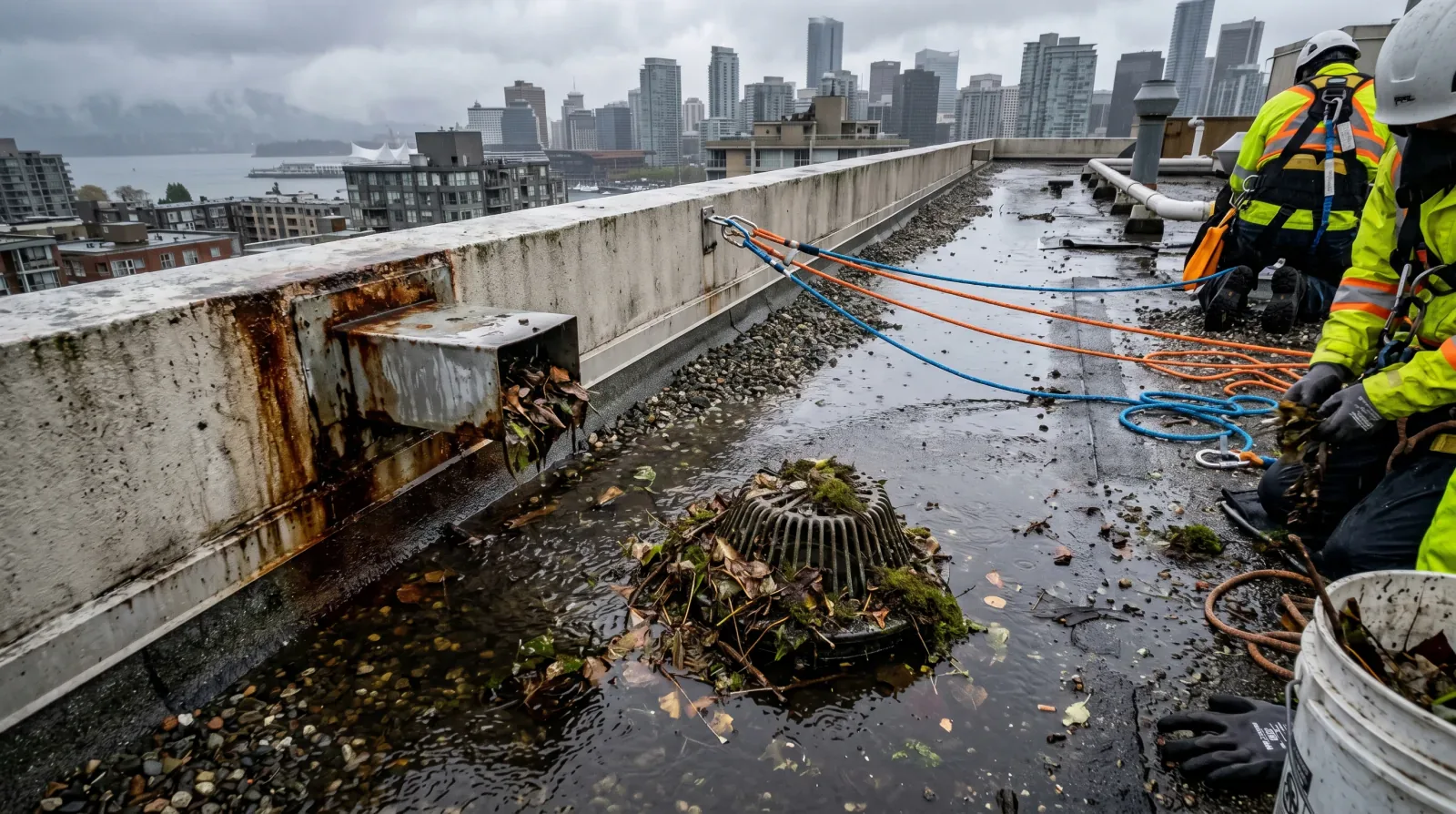
The leak shows up on the top floor in November, right after the first real storm of the season. A resident reports a brown ring spreading across a bedroom ceiling. The property manager calls a roofer expecting to hear that the membrane has failed. What the roofer usually finds is a drain buried under a season’s worth of wet leaves, and a roof that has been holding several centimetres of standing water for days.
That is the most common flat-roof failure in Metro Vancouver, and it has nothing to do with the quality of the membrane. It’s a maintenance failure at the one spot where the entire roof drains.
A flat roof is only as good as its drainage
A sloped roof sheds water by gravity no matter what. A flat roof — really a low-slope roof, since they’re built with a slight pitch toward the drains — has exactly two ways to get water off it: the primary roof drains and the overflow scuppers. Block both and the water simply stays there.
Standing water on a membrane is called ponding, and it is the enemy. The membrane is designed to be wet, but not to be submerged for days at a stretch. Ponding accelerates every failure the membrane could have. UV-weakened areas break down faster underwater. Seams that are slightly open wick moisture inward by capillary action. Algae and organic growth take hold and hold moisture against the surface. And in a cold snap, water trapped in or under the membrane freezes, expands, and lifts it. Most membrane manufacturers exclude ponding damage from their warranties precisely because it destroys roofs.
So the drains aren’t a minor detail of the roof. On a flat roof, they are the roof’s only working part.
Why Pacific Northwest roofs clog
The timing is cruel. Deciduous trees drop their leaves through October and November. Conifers shed needles year-round but heaviest in late summer and fall. Moss grows on damp roofs through our long wet season. And all of it migrates downhill to the lowest point on the roof — which is the drain.
The strainer dome over each drain catches the coarse debris, but that’s also how it clogs. Fine grit and decomposing organic matter pack around and under the dome until they seal the opening into a sludge. A roof surrounded by mature trees in a neighbourhood like Kerrisdale or North Burnaby can bury its drains in a single windy week.
Then the rain arrives in volume. The South Coast gets somewhere around 1,150 to 1,200 millimetres of rain a year, most of it between October and March, increasingly delivered in concentrated atmospheric river events. You can check the long-term figures through Environment Canada’s climate normals. A drain that was working fine in September is buried and useless by the time the building needs it most. We covered how those concentrated storms stress the whole envelope in our piece on atmospheric rivers and the building envelope.
Scuppers are the backup you hope you never need
A scupper is an opening cut through the parapet wall at roof level that lets water escape over the edge. On most buildings, scuppers serve as overflow drainage — a secondary path that kicks in when the primary drains can’t keep up or have clogged. The BC Building Code requires overflow drainage for exactly this reason: if the main drains fail, something has to stop water from building to a dangerous depth.
The catch is that scuppers clog too. They sit at the same low elevation as the debris, and an overflow scupper that’s blocked is no backup at all. When both the primary drain and the overflow are buried, you have a roof designed to hold water — and water is heavy.
The structural risk people forget
Water weighs roughly a kilogram per litre. Picture a few centimetres of standing water across a large strata roof and you’re talking about tonnes of dead load that the structure was never meant to carry on a permanent basis. On older buildings, or any roof with marginal drainage design, prolonged ponding has caused decks to deflect and sag. In severe cases — heavy ponding plus a snow load on top — it has caused partial collapse.
This isn’t scaremongering. It’s why the code mandates overflow drainage and why insurers care about roof maintenance records. A clogged drain is usually just a leak. Occasionally it’s a great deal worse.
The inspection cadence that actually works
For a Metro Vancouver strata, the baseline is twice a year:
- Fall, before the rains — the most important service of the year. Clear every drain, every scupper, and sweep the debris off the field of the roof before the storm season hits. Late September into October is the window.
- Spring — clear out whatever accumulated over winter and check for ponding marks and membrane damage that the wet season may have caused.
Buildings under heavy tree canopy need more. Monthly checks through October and November are reasonable when there are mature deciduous trees nearby. And any building should add an inspection after a major windstorm — the same storms that drop the rain also strip the trees and dump debris straight onto the roof.
A proper service isn’t just lifting a strainer and pulling out a handful of leaves. It includes removing and inspecting each strainer dome, clearing the drain bowl and the top of the leader pipe, flushing to confirm the water actually flows, clearing all scuppers, sweeping the roof field, and inspecting the membrane around each drain — the area that suffers first when water ponds. This work belongs on the same calendar as the rest of your seasonal envelope tasks; our fall maintenance checklist for strata buildings puts it in context with the other items that need attention before winter.
Why this lands on the strata council
In a BC strata, the roof is almost always common property. Under the Strata Property Act, that makes the strata corporation responsible for maintaining and repairing it. Drain clearing is therefore a strata operating expense and a council duty, usually delegated to the property manager to schedule with a roofing or building maintenance contractor.
Two things make documentation worth the trouble. First, membrane warranties often require evidence of regular maintenance, and “we never cleared the drains” is a fast way to void a claim. Second, the condition and remaining life of the roof feed directly into the building’s depreciation report, which BC stratas are required to commission and update. A well-maintained roof with clear maintenance records reads very differently in that report than one that’s been neglected — and we walk through that obligation in our guide on the depreciation report deadline and the building envelope.
When the membrane is the real problem
Sometimes clearing the drains reveals that the membrane itself is failing — open seams, blisters, cracking, or areas that have been compromised by years of repeated ponding. At that point you’re past maintenance and into repair or recoating. For buildings with spray polyurethane foam roofs, the considerations are a bit different, and the membrane needs its own assessment.
But the order of operations matters. Clear and maintain the drains first, because a perfectly good membrane will still fail if it’s left sitting under water. The cheapest roof repair you’ll ever do is the one you prevent by keeping the drains open through a Vancouver winter.
Related guides
- Strata Maintenance and Restoration Guide — how building envelope work fits into strata governance
- Fall Building Maintenance Checklist for Strata — the full pre-winter task list
- Property Manager Envelope Maintenance Checklist — building the year-round plan
- SPF Roofing for BC Commercial Buildings — when the membrane itself needs attention
Frequently Asked Questions
More from Flat Roof Systems Guide
Metal Flashing Detail Failures in BC Rainscreen Walls
Good cladding doesn't keep a Burnaby wall dry — flashing does. Reverse laps, missing end dams, and bad transitions are why rainscreen buildings still leak, and why the metal almost nobody looks at deserves the attention.
Read article →EPDM vs TPO Flat Roof Membranes for BC Strata Buildings
Choosing between EPDM and TPO single-ply membranes on a Burnaby strata low-rise comes down to seams, reflectivity, and how each ages in Pacific NW rain.
Read article →Spray Polyurethane Foam Roofing on BC Commercial Buildings: When It Makes Sense
Spray polyurethane foam (SPF) roofing is well established in colder North American climates but used sparingly in coastal BC. Where it works, where it fails, and how it compares to the membrane systems that dominate Metro Vancouver flat-roof installations.
Read article →