Why leaks show far from the source
A stain is where water leaves a building assembly. It says almost nothing about where the water got in. Between those two points, water rides framing, membranes, conduit, and concrete, sometimes for metres, sometimes for floors. Understanding that journey is the difference between a repair that ends a leak and a repair that redecorates around one.
The three forces that steer water
Three forces steer water once it crosses the envelope. Gravity pulls it down. Surface tension keeps it clinging to whatever it lands on, so it follows surfaces instead of falling freely. And capillary action pulls it sideways and even upward through narrow gaps and porous materials. A building interior is a dense network of surfaces to follow: studs, strapping, sheathing, pipes, wires, slabs. The water takes the network, and the network was not drawn on any leak report.
The result is a consistent rule from decades of Metro Vancouver investigations: the entry point sits at or above the exit, and usually off to one side. Everything else about the path is building-specific.
The five carriers
Framing and strapping
Water clings to the underside of horizontal members and runs along them, and it follows sloped members downhill. A stud bay carries it floors downward; a run of strapping carries it metres sideways. The water lets go where the member ends, changes direction, or meets a fastener, and that drop point becomes the stain.
Sheathing membranes and building paper
The weather barrier behind cladding is designed to shed water downward, so it becomes a slide. Water entering at a parapet can travel the full height of an elevation between paper and sheathing, exiting only where a lap faces the wrong way, a penetration interrupts, or a flashing collects it.
Conduit, pipes, and cables
Anything round and continuous is a water highway. Water wraps around conduit and follows it through joists, walls, and cable trays, dripping off at bends and couplings. Electricians find envelope leaks this way regularly: the junction box fills, and the entry point is a window head two suites away.
Concrete surfaces and cavities
On towers, water tracks the cavity side of shear walls and columns, hugging the concrete by surface tension, until fire blocking, a floor slab, or a beam pocket interrupts it. Concrete also wicks moisture internally, so the damp patch on the finish side can sit well away from the wetted face.
Floor plates and fire blocking
Horizontal interruptions collect travelling water and pool it. The pool spreads sideways along the plate until it finds a penetration or a drywall edge, which is why one entry point can stain two or three suites along the same floor line, and why the middle stain is rarely under the source.
What this did at province scale
The travel problem is not a curiosity; it is a large part of why the leaky condo crisis grew as expensive as it did. Face-sealed assemblies admitted water at flashings and joints, the water travelled and wetted framing far from every visible symptom, and years of stain-level repairs left the entries open while rot spread. The bill across the Lower Mainland reached roughly $4 billion over 900+ buildings. The buildings changed after that era; the physics did not, and a 2026 tower leak travels exactly the way a 1994 walk-up leak did.
The case files keep proving it. In one of our high-rise investigations, covered in the post on causes of water ingress in high-rises, water surfacing at a 9th-floor window corner traced back to an expansion joint at floor 12: down the shear wall on the cavity side, pooled at fire blocking, out through the drywall three floors later. The window took the blame for two repair cycles before the test found the joint.
Two habits that make the travel visible
The first is a building-wide leak log rather than suite-by-suite complaints. Water travel means one entry can produce stains in several suites, and the connection between them only appears when the reports sit in one place with dates and weather attached. Three "separate" leaks that always activate after the same southeast storm are one leak, and the log is usually the first thing to say so. The second habit is photographing stains over time. A stain that grows along a ceiling edge is tracing a floor plate; one that migrates down a wall corner is tracing a stud line. The shape of the spread sketches the last metres of the path for free, before any instrument arrives.
Both habits cost minutes. Both regularly save the first day of an investigation, because they hand the investigator a pattern instead of a single wet data point.
Working the problem upward
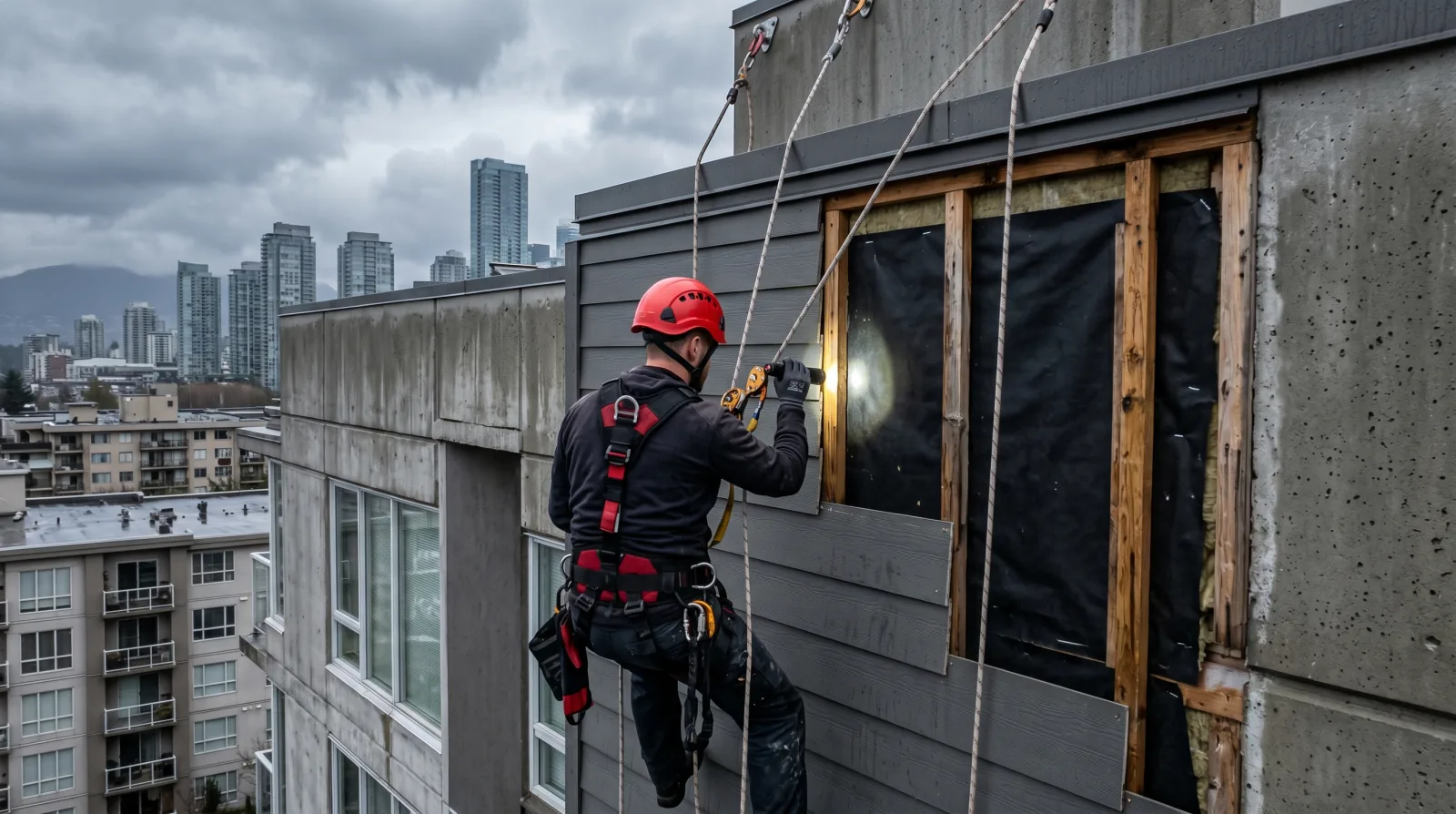
A proper trace starts at the exit and climbs. The stain and its timing define a search cone: every envelope detail at or above that height on the weather-facing elevations. Close inspection, on ropes where the details are at height, shortens the suspect list; moisture mapping and thermal imaging sketch the wet path from inside; then isolated water testing confirms the entry by reproducing the leak. The tools and their order have their own guide, moisture testing methods, and the full sequence from records review to scoped repair is walked through in how a professional leak investigation runs.
Reading this because a window near a stain already got recaulked and the stain came back? That failed repair narrowed the field: the window is likely innocent, and the real entry sits higher, possibly at the roof-to-wall junction. When the path is finally confirmed, the fix itself is usually modest, a joint, a flashing, a termination, handled as a targeted leak repair. The rest of the family of guides lives in the water ingress hub.
Quick answers
Why is a leak never where the stain is?
Because water only becomes visible where it leaves the assembly, and between entry and exit it travels: along framing, down sheathing membranes, around conduit, and across floor plates. The stain marks the exit. Gravity guarantees the entry point sits higher, and the horizontal building elements in between can carry the water metres sideways. Treating the stain as the target is the single most common and most expensive error in leak repair.
How far can water travel inside a building before showing?
Farther than most people find believable: multiple floors down and several metres sideways is routine in our Metro Vancouver investigations. A high-rise expansion joint failure can surface three floors below its entry, and a parapet leak can exit at a second-floor window head. There is no fixed limit, because distance depends on what the water finds to follow. What is consistent is direction: the entry always sits at or above the exit.
Why did recaulking around the stain not fix the leak?
Because the repaired joint was the nearest suspect rather than the actual entry. When crews caulk whatever detail sits closest to the stain, the true entry point, often a flashing or joint higher on the elevation, keeps feeding the same path, and the stain returns with the next storm. Failed repairs of this kind are diagnostic gold, though: each one eliminates a suspect and pushes the investigation upward, where it should have started.
Leak travel questions
Why is a leak never where the stain is?
Because water only becomes visible where it leaves the assembly, and between entry and exit it travels: along framing, down sheathing membranes, around conduit, and across floor plates. The stain marks the exit. Gravity guarantees the entry point sits higher, and the horizontal building elements in between can carry the water metres sideways. Treating the stain as the target is the single most common and most expensive error in leak repair.
How far can water travel inside a building before showing?
Farther than most people find believable: multiple floors down and several metres sideways is routine in our Metro Vancouver investigations. A high-rise expansion joint failure can surface three floors below its entry, and a parapet leak can exit at a second-floor window head. There is no fixed limit, because distance depends on what the water finds to follow. What is consistent is direction: the entry always sits at or above the exit.
Why did recaulking around the stain not fix the leak?
Because the repaired joint was the nearest suspect rather than the actual entry. When crews caulk whatever detail sits closest to the stain, the true entry point, often a flashing or joint higher on the elevation, keeps feeding the same path, and the stain returns with the next storm. Failed repairs of this kind are diagnostic gold, though: each one eliminates a suspect and pushes the investigation upward, where it should have started.
Can a leak on the 9th floor come from the 12th?
Yes, and cases like this are well documented in high-rise investigations. Water can enter at a facade joint or window detail several floors up, travel down the cavity face of a shear wall or inside a wall assembly, pool against fire blocking or a slab, and push through finishes floors below. The suite reporting the leak frequently sits nowhere near the failed detail, which is why suite-by-suite patching fails on towers.
What does water travelling along conduit look like?
From inside, it looks like an electrical problem: a damp junction box, a light fixture that drips in storms, or corrosion inside a panel. The water is riding the outside of the conduit from wherever it entered the envelope, following the run through walls and ceiling spaces, and letting go at bends and boxes. Water at any electrical fixture deserves urgent attention and an entry-point investigation that starts at the envelope, uphill of the conduit run.
Why does one leak stain several suites on the same floor?
A floor plate or fire blocking collects water travelling down an assembly and spreads it horizontally along the plate line. The pool exits wherever it finds penetrations or drywall edges, which can be in two or three suites along the run. One entry point, several stains. The giveaway is timing: all the stains activate together after the same weather, which a shared leak log picks up quickly and individual suite complaints never do.
Does the stain location tell you anything useful at all?
It tells you plenty, as long as you read it as the bottom of a path rather than the target. The stain fixes the exit point, its timing fixes the weather dependence, and the building geometry above it defines the search cone: every detail on the envelope at or above that height, on the wetted elevations, is a candidate. Investigators work up that cone detail by detail. What the stain never justifies is repairing whatever sits closest to it.
How do investigators trace a leak back to its entry point?
From the exit upward. Map where and when water shows, then inspect the envelope details in the search cone above: joints, flashings, terminations, penetrations. Moisture meters and thermal imaging map the wet path inside; on towers, rope access technicians inspect and water-test each suspect detail in isolation until the leak reproduces. The confirmed path, entry to exit, is what turns a repair from a guess into a scope.
Is the entry point always directly above the stain?
At or above the stain's height, yes; directly above it, often not. Horizontal carriers, strapping, membranes, conduit, floor plates, shift water sideways as it descends, so the entry can sit metres to either side of the vertical line through the stain. That is why the search area is a cone opening upward rather than a plumb line, and why water testing that isolates one detail at a time beats visual inspection alone for the final confirmation.
Why does this matter for repair budgets?
Because chasing stains multiplies costs. Each misdirected repair spends real money, leaves the entry open, and adds another wet season of hidden damage to framing or reinforcing steel before the next attempt. One properly traced path costs more up front than one blind recaulk and less than three of them, and it ends the cycle. On buildings with recurring "mystery" leaks, the cheapest line in the whole history is almost always the investigation.
Chasing a leak that keeps coming back?
We trace leaks from the stain back to the entry point on strata and commercial buildings across Vancouver, North Vancouver, West Vancouver, and Burnaby, and we test the path before anyone writes a repair scope.