Efflorescence on Vancouver Concrete Walls: Causes and Fixes
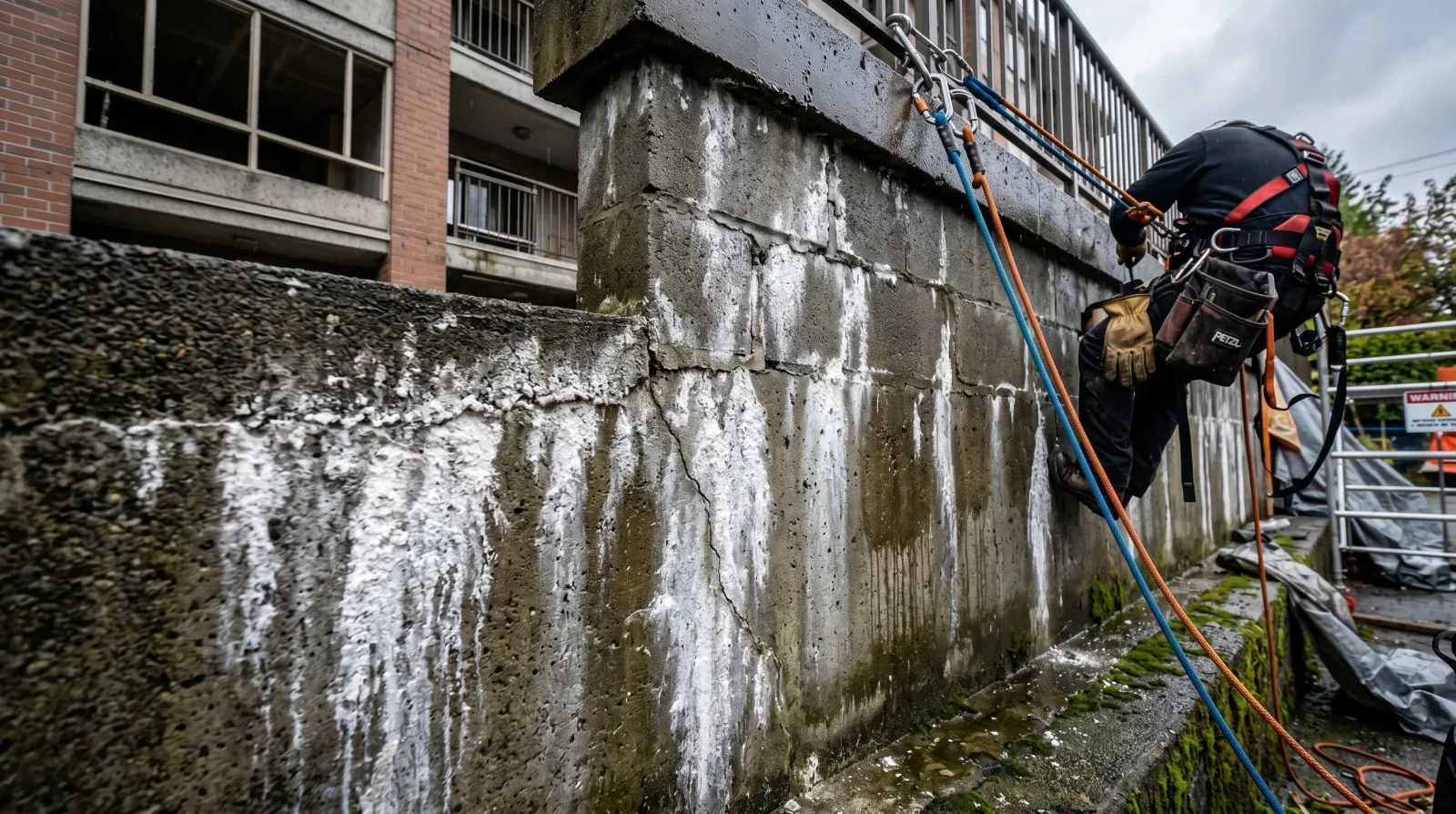
A property manager in North Vancouver sends a photo: a white, chalky bloom spreading across a concrete wall, heaviest below a row of windows and along a horizontal joint. The question is always the same — “Is this just cosmetic, or do we have a problem?” The honest answer is that the white stuff itself is harmless. What it tells you is the whole point.
Efflorescence is salt. It forms when water moves through concrete, dissolves the soluble salts that live inside the mix, carries them to the surface, and then evaporates — leaving the salt behind as a visible deposit. So the bloom is a record of water movement. Wherever you see it, water has been travelling through the wall and coming out at that spot. That makes efflorescence one of the most useful diagnostic signs on a building, if you read it instead of just wiping it off.
Cosmetic versus a warning
Not all efflorescence means trouble. There are two broad situations.
The first is harmless. New concrete contains construction moisture, and as it dries out over the first months it can push a light bloom of salts to the surface. This kind of efflorescence is a one-time event — it appears, you clean it, and it doesn’t come back, because the source was just the water that was always in the fresh concrete.
The second is a warning. Efflorescence that keeps returning, that shows up on older concrete, or that concentrates at cracks, joints, and the base of walls is telling you that water is actively getting into the structure from somewhere and moving through it. That ongoing water movement is the real concern. It is the same mechanism that drives most of the causes of water ingress in high-rise buildings — water finds a path, and efflorescence marks where that path surfaces.
The test is simple: clean it off and watch. If it comes back, you have an active water source, not a cosmetic leftover.
Read the pattern
Where the efflorescence appears is evidence about where the water is getting in. The bloom is a map, and the map points at the source.
- Below windows — points at the window perimeter sealant or the head flashing above. Water entering at the opening tracks down through the wall and surfaces below.
- At horizontal joints — points at a failed joint, a missing or back-pitched flashing, or a detail that’s collecting water instead of shedding it.
- At cracks — the crack is the water path. Water enters through it and the salts deposit along its line.
- At the base of a wall or on a foundation — points at drainage problems or moisture wicking up from the ground or the soil side of the wall.
- On a balcony or parkade slab underside — points straight up at a failed waterproofing membrane above. The efflorescence on the underside is the exit point for water passing through the slab.
That last one is common on strata buildings and worth taking seriously, because efflorescence on the underside of a balcony or parkade slab almost always means the membrane on top has failed and water is moving through the structural concrete.
Why it’s connected to rebar corrosion
Here is why persistent efflorescence on a structural concrete wall is more than a housekeeping issue. The water that dissolves and carries those salts to the surface is the same water that can reach the reinforcing steel buried in the concrete. In Metro Vancouver, that water often carries chloride from coastal salt exposure and de-icing salt.
Steel embedded in sound, alkaline concrete is naturally protected from rust. Chloride breaks down that protection. Once the reinforcing starts to corrode, it expands to several times its volume and cracks the concrete from within — the spalling and delamination that drives major structural repair. This is the full progression covered in rebar corrosion and concrete delamination on coastal buildings. Efflorescence is often the earliest visible surface symptom of the moisture path that, left alone, ends in that kind of damage. It is the smoke before the fire.
Why our climate makes it worse
Efflorescence is common on Vancouver buildings for a straightforward reason: the walls stay wet. Coastal BC gets roughly 1,150 to 1,200 millimetres of rain a year per Environment Canada climate normals, much of it as prolonged wind-driven rain that keeps concrete saturated for long stretches through the wet season. That gives water every opportunity to penetrate, dissolve internal salts, and migrate to the surface. Add coastal and de-icing salt to the load, and frequent efflorescence is partly just a feature of building in a wet, salty coastal environment.
The mistake that costs money: coating over it
The single most expensive error with efflorescence is painting or coating over it. Two things go wrong. First, the salt deposits and the dampness leave a poor bonding surface, so the coating doesn’t adhere properly. Second — and this is the real problem — sealing an active moisture path behind a coating doesn’t stop the water. The salts and moisture keep pushing from behind, and the coating blisters, peels, and fails, often within a single wet season.
This is why an elastomeric wall coating on a concrete tower only performs when it goes onto a sound, dry, properly prepared substrate. A good coating is a weather barrier, not a band-aid over a leak. Put one over active efflorescence and you have spent money sealing a moisture problem behind a film that is already failing. The coating gets blamed, but the real fault was applying it before the water was dealt with.
How to actually fix it
The job has two halves, and most people only do the first.
The cosmetic half is removal. Light efflorescence comes off with dry brushing or water and a stiff brush. Heavier or hardened deposits may need a specialized masonry cleaner, used carefully and rinsed thoroughly — acidic cleaners can etch concrete and react with the salts, so this isn’t a job for guesswork.
The half that matters is stopping the water. Use the pattern of the bloom to identify the source — the failed sealant, the cracked joint, the missing flashing, the blocked drain, the failed membrane above. Then fix that source and let the wall dry before any coating or repair goes on top. A building envelope condition assessment traces the path properly, combining where the efflorescence concentrates with inspection of the sealant, flashing, drainage, and surrounding details. The bloom tells you roughly where to look; the assessment confirms it.
Remove the salt without fixing the water and you have done nothing but reset the clock. It comes back with the next wet spell, on the same schedule, in the same place — because the wall is doing exactly what it did before. Read the white bloom as the map it is, follow it to the water, and stop the water. The salt takes care of itself after that.
Related guides
- Concrete Restoration Hub — concrete repair, waterproofing, and structural protection
- Elastomeric Wall Coatings for Concrete Towers in Vancouver — why surface prep and a dry substrate matter before coating
- What Causes Water Ingress in High-Rise Buildings — the water paths efflorescence reveals
- Rebar Corrosion and Concrete Delamination on Coastal Buildings — where unchecked water movement leads
Frequently Asked Questions
More from Concrete Restoration Guide
Concrete Carbonation on Coastal BC Buildings
Not all rebar corrosion is salt. On older Victoria concrete buildings, carbonation quietly lowers the concrete's pH until the steel loses its protection.
Read article →Vapour Barrier Failure and Interstitial Condensation in BC Walls
The water staining a Coquitlam condo's interior wall isn't always a leak. Sometimes the wall makes its own water — warm air condensing inside the cavity.
Read article →Corroding Balcony Guardrail Anchors on Vancouver Strata Towers
The rust staining at the base of a balcony railing post in Burnaby isn't cosmetic — it's a corroding anchor pushing the concrete apart, and a safety problem.
Read article →