Rebar Corrosion and Concrete Delamination in Coastal BC Buildings
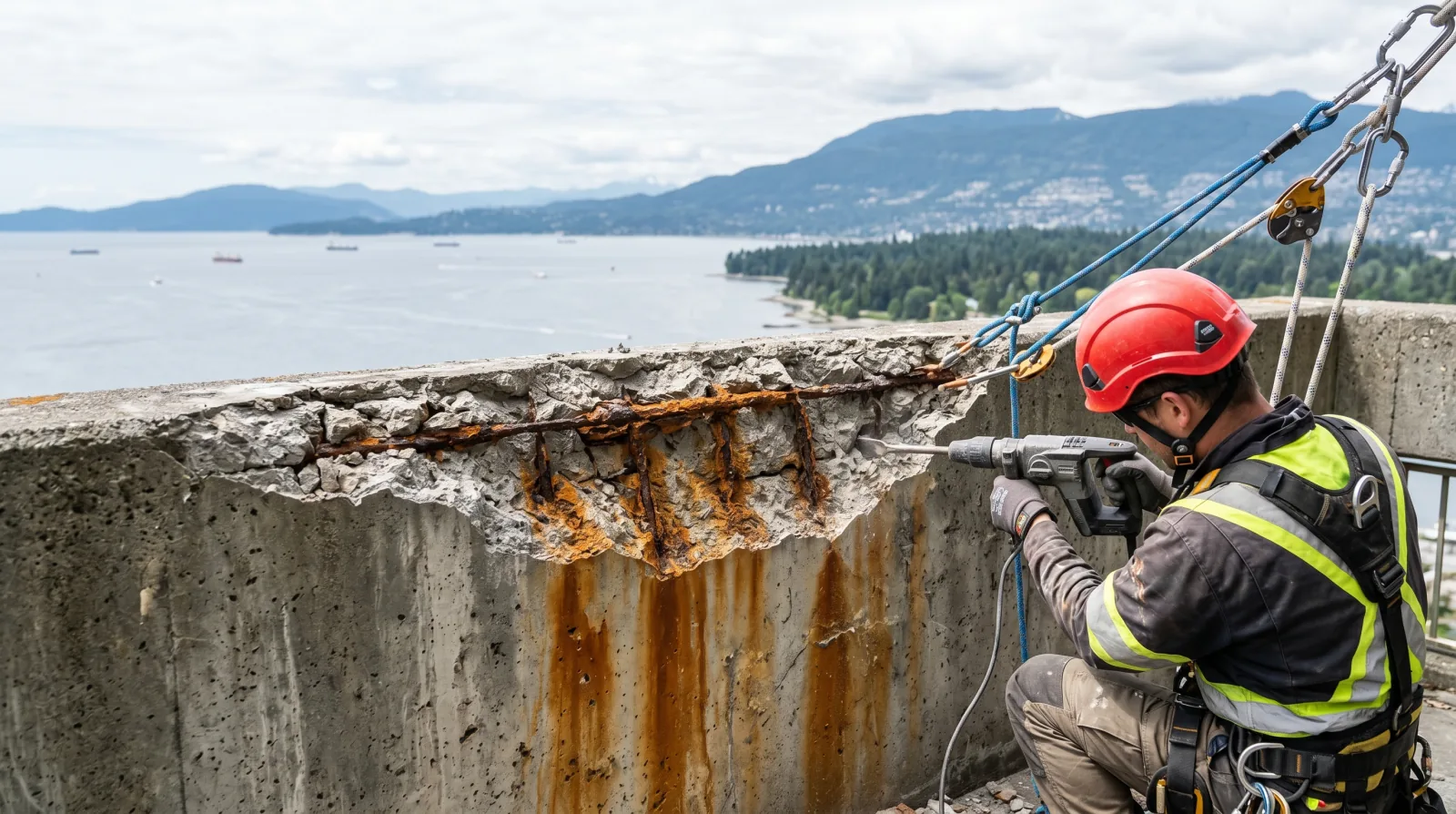
The damage starts inside the slab, not on the surface
By the time a chunk of concrete falls off a West Vancouver balcony edge, the problem is years old. What you see — the flaking, the exposed grey aggregate, the rust streaks — is the final act. The real story happened inside the slab, where the reinforcing steel has been quietly corroding and expanding, prying the concrete apart from within. Understanding that is the difference between fixing the cause and chasing the symptom, and on coastal buildings the difference is expensive.
Reinforced concrete is supposed to last a very long time. The steel gives it tensile strength, and the concrete around the steel is highly alkaline, which forms a passive protective film on the rebar that stops it rusting. As long as that alkaline environment holds and the steel stays sealed away from water and salt, the system is stable for decades. Coastal Metro Vancouver is very good at breaking that stability.
Two ways the coast attacks your concrete
There are two mechanisms that destroy the protection around rebar, and waterfront buildings in West Vancouver, Vancouver, and North Vancouver frequently face both.
The first is chloride attack. Sea-salt air carries chloride ions, and on a coastal building those chlorides land on the concrete and, helped by wind-driven rain, penetrate into it. When they reach the steel, they break down its protective film and trigger localized pitting corrosion — concentrated, aggressive rust at specific points. Salt-laden coastal air drives this far faster than anything an inland building sees.
The second is carbonation. Atmospheric carbon dioxide slowly penetrates concrete and reacts with it, lowering its pH. As carbonation advances through the cover and reaches the steel, it strips away the alkalinity that was protecting the rebar, and corrosion begins even without salt. On older buildings with thin concrete cover over the steel, the carbonation front can reach the rebar within a few decades.
Either way, the result is the same: the steel loses its protection and starts to rust.
Why rust tears concrete apart
Here is the mechanism that makes this a structural problem and not just a stain. When steel corrodes, the rust it forms takes up much more space than the original steel did. That expansion has to go somewhere, and it goes outward, into the surrounding concrete, as enormous internal pressure.
Concrete is strong in compression but weak in tension, so that outward pressure cracks it. First fine cracks form along the line of the bars. Then the cracked layer separates from the slab — delamination. Finally the delaminated piece loses its grip and falls off — spalling. Every stage feeds the next: the cracks let in more water and salt, which accelerates the corrosion, which generates more pressure, which opens more cracks. It is a self-reinforcing cycle, and it does not stop on its own.
That is why we tell owners a rust stain on a balcony slab edge is never cosmetic. It is the visible signal of expanding steel underneath, and the clock is running.
Reading the warning signs
You do not need to be an engineer to spot the early signs on your own building. The things to look for across a Metro Vancouver tower:
- Rust-coloured staining weeping from cracks, slab edges, or around balcony railing posts.
- Cracks that run in straight lines following the path of the reinforcing bars beneath the surface.
- Hollow-sounding concrete — tap a suspect area and a drummy, hollow sound means the layer has delaminated and separated from the steel, even if it still looks solid.
- Visible spalling where concrete has already broken away and the rusted steel is exposed.
Balconies are usually where it shows first, because the slab edges and railing penetrations take the brunt of wind-driven rain and salt. The concrete spalling causes in strata towers post goes deeper on what to look for and where.
Doing the repair properly
This is where shortcuts cost the most. A proper concrete repair removes the damaged concrete back to sound material and fully exposes the affected rebar. The steel is then cleaned of corrosion — or replaced where it has lost too much section to be structurally adequate — and treated to resist further rusting. Only then is the area rebuilt, typically with a polymer-modified repair mortar engineered to bond to the existing concrete and match its properties.
The critical, non-negotiable part is chasing the corrosion back to clean steel. If you patch over rusted rebar without addressing it, two things happen: the steel keeps corroding under the new patch and pushes it off within a year or two, and in some cases the repair can actually accelerate corrosion in the adjacent untreated steel through an electrochemical effect. We have been called to re-do plenty of cosmetic patches on Burnaby and Vancouver buildings that failed for exactly this reason. The repair has to address the mechanism, not hide it.
On a high-rise, certified rope access technicians reach the balcony edges, soffits, columns, and slab faces on two independent safety lines, making targeted repairs without full scaffolding. Larger restoration scopes may justify a swing stage or scaffold, but rope access is what makes early, localized repair affordable — and early is everything when the alternative is letting the corrosion cycle run.
Why catching it early changes the whole cost curve
The single most important thing a strata can understand about rebar corrosion is that the cost of fixing it does not rise in a straight line. It accelerates. The same defect costs a fraction to address early that it does once the corrosion cycle has run for a few more years, and on a coastal building that timeline moves faster than owners expect.
Early on, the problem is small and accessible. A bit of rust staining, a hairline crack along a bar, a patch of concrete just starting to sound hollow — at this stage the affected steel is shallow, the sound concrete around it is intact, and a rope access crew can address a localized area without major mobilization. The repair is contained. Catch it here on a West Vancouver or North Vancouver balcony and you are managing a maintenance-scale item.
Let the same spot run a few more wet seasons and the picture changes on every axis. The corrosion spreads along the bar and to adjacent bars, so the repair area grows. The expanding rust opens more cracks, which admit more water and salt, which accelerates everything. Delaminated concrete starts falling, which turns a maintenance question into a safety hazard and often forces emergency protection measures — netting, exclusion zones, drop protection over walkways — before the actual repair even begins. And once the steel has lost enough section, the repair stops being cosmetic restoration and becomes structural, with engineering, possibly shoring, and far more removal and rebuild. The bill does not double; it can multiply.
There is a building-wide version of this curve too. Corrosion rarely affects just one balcony. The conditions that started it — coastal exposure, the building’s age, the original concrete cover over the steel, failed membranes or joints letting water in — are usually present across the whole structure. So a building that ignores the first spalling balcony is typically not looking at one repair in its future, but a wave of them. Acting on the early signs, and fixing the water-entry problems that drive the corrosion, is what keeps that wave from arriving all at once as a major special levy.
This is why we push so hard on early assessment. It is not upselling; it is the actual economics of reinforced concrete on the coast. The crews, the access, and the materials are the same whether you address corrosion early or late. What changes is how much of the building you are repairing, and whether you are doing it on a plan or in an emergency.
Engineering, and protecting the repair
Structural concrete repair on balconies, slab edges, and columns generally needs an engineer to assess the damage, specify the repair, and confirm the structure is adequate, particularly on a high-rise where falling concrete is a serious safety hazard. If you see loose or spalling concrete over an area people use, barricade the ground below and book a site assessment before scheduling any repair. On a Metro Vancouver strata this also connects to the building’s depreciation report and to any building permit the municipality requires. We work to the engineer’s specification rather than improvising structural repairs, and the strata restoration process guide walks through how that coordination works.
Once the concrete is repaired, the job is to keep salt and water away from the steel so the cycle does not simply restart. That usually means a breathable protective coating or a penetrating sealer that slows chloride entry while letting the slab dry, working together with intact waterproofing membranes and sealed joints. Repair the concrete, protect it, and keep the water and salt out — on a coastal building, that is what buys the slab another few decades. The concrete restoration service page and our rebar corrosion and spalling guide cover how we approach it from assessment through protection.
Frequently Asked Questions
More from Concrete Restoration Guide
Concrete Carbonation on Coastal BC Buildings
Not all rebar corrosion is salt. On older Victoria concrete buildings, carbonation quietly lowers the concrete's pH until the steel loses its protection.
Read article →Vapour Barrier Failure and Interstitial Condensation in BC Walls
The water staining a Coquitlam condo's interior wall isn't always a leak. Sometimes the wall makes its own water — warm air condensing inside the cavity.
Read article →Corroding Balcony Guardrail Anchors on Vancouver Strata Towers
The rust staining at the base of a balcony railing post in Burnaby isn't cosmetic — it's a corroding anchor pushing the concrete apart, and a safety problem.
Read article →