Salt-Spray Corrosion on West Vancouver Oceanfront Buildings
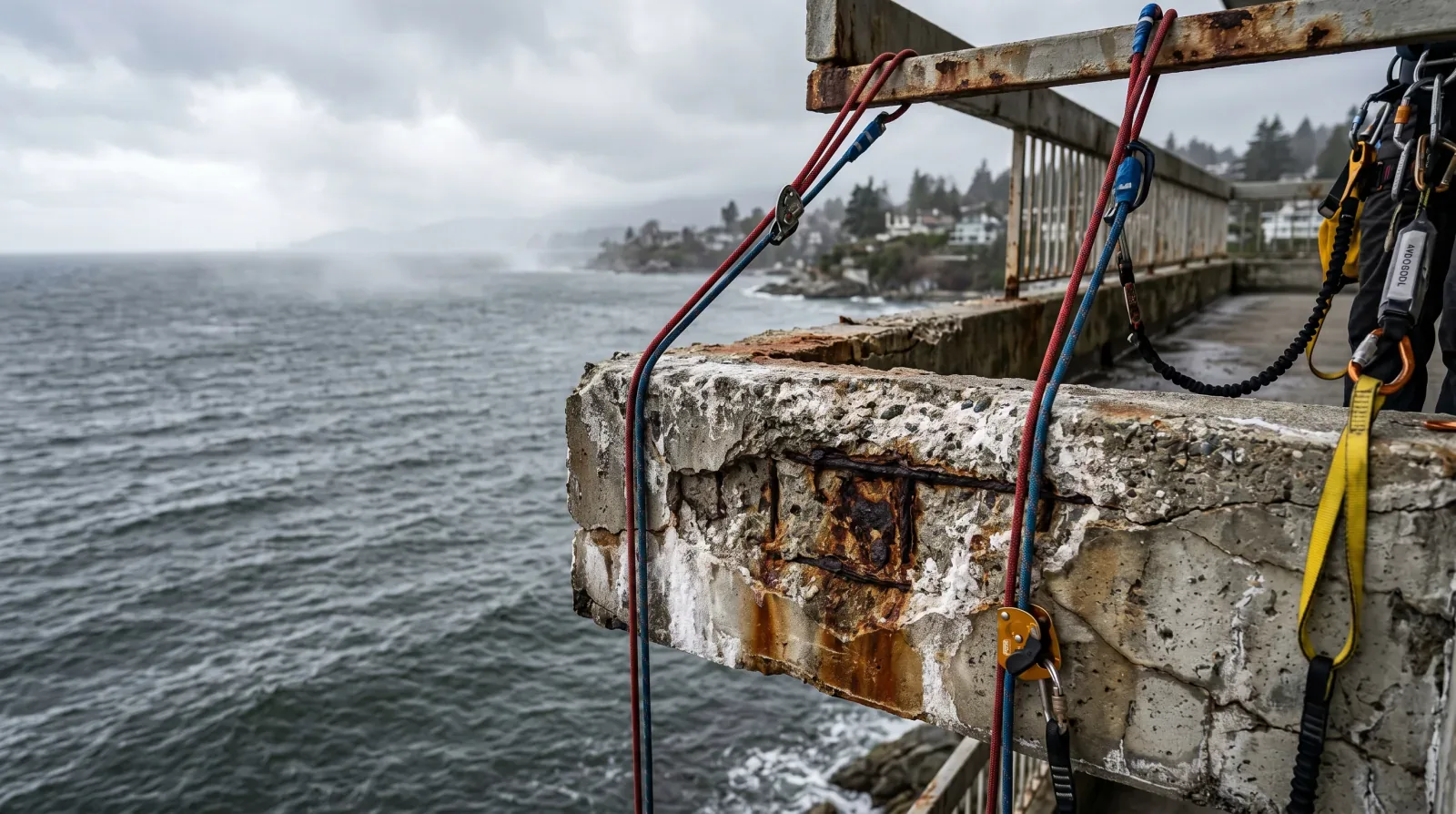
Picture two identical concrete buildings — same age, same builder, same design. One sits on the water in West Vancouver. The other is three kilometres inland. A decade on, the oceanfront building is showing rust stains and spalling concrete, and the inland one is fine. The buildings are the same. The conditions are not. The difference is salt.
Sea salt is the reason oceanfront concrete ages on a faster clock than anything inland. It drives a chemical process inside the concrete that plain rain never triggers, and it does so continuously, day after day, on the elevations facing the water. For owners and strata councils on the West Vancouver waterfront, understanding that process is the difference between catching a problem as a cheap surface repair and discovering it as a structural one.
The chain reaction salt sets off
The damage runs in a sequence, and salt starts it. Wind off the water carries sea salt — and the chloride in it — onto the exposed faces of the building. The chloride settles on the concrete, dissolves in rain and ambient moisture, and soaks in. Concrete is porous, so the dissolved chloride migrates inward through the pore structure, working its way toward the reinforcing steel embedded inside.
Concrete normally protects that steel. The alkaline environment of sound concrete forms a passive layer on the rebar that keeps it from rusting. Chloride breaks that protection down. Once enough chloride accumulates at the steel, the passive layer fails and the rebar begins to corrode. And corroding steel expands — rust takes up far more volume than the original metal — so it pushes outward and cracks the concrete from within.
That internal cracking is what eventually surfaces as the spalling you can see. By the time a chunk of concrete falls off a balcony edge, the corrosion has been working invisibly for years. This is the same mechanism behind concrete spalling in strata towers everywhere, but on the coast the chloride loading accelerates every step of it.
Why oceanfront buildings get so much more chloride
The whole process depends on how much chloride reaches the concrete, and that is exactly where an oceanfront building differs from an inland one. Wind off the water carries salt spray and salt-laden mist directly onto the seaward elevations. It is not an occasional event — it is a continuous load, applied to the same faces of the building over and over.
An inland building a few kilometres back gets almost none of this. Same Pacific Northwest rain, but without the salt riding in on the wind. So the oceanfront building accumulates chloride far faster, corrosion starts sooner, and once started it progresses more quickly. The deeper relationship between coastal exposure and reinforcing steel is covered in the guide on rebar corrosion and concrete delamination on coastal buildings.
It is worth being clear about why salt matters more than rain alone. Plain water wets and dries concrete, which is hard on it over time, but water by itself does not trigger the chemical breakdown that starts the corrosion. Chloride does. A coastal building faces both — the moisture load of a wet climate and the chloride load from the ocean — and it is the combination that makes oceanfront exposure its own category of demanding.
What it looks like, and where it shows first
The early signs are subtle and easy to miss from the ground. Rust staining bleeding through the concrete surface. Fine cracking that follows the line of the reinforcing steel inside. Concrete that sounds hollow when tapped — a sign it is delaminating from the rebar as the rust pushes it apart. Later, the surface spalls off in chunks and exposes rusted steel.
On an oceanfront building, certain places show it first. Balcony edges and undersides, exposed slabs, and the seaward elevation take the most direct salt spray and usually lead. Balconies are a particular concern — they are exposed concrete with reinforcing steel relatively near the surface, they take direct spray on edges and soffits, and they often hold standing water. Thin concrete cover plus direct exposure plus water is the recipe for early spalling, and a spalling balcony edge is a safety issue because it can drop debris.
Slowing it down with coatings and detailing
You cannot move a building away from the ocean, but you can slow the chloride load reaching the concrete. Protective coatings are the front line. An elastomeric or protective coating on the concrete acts as a barrier that reduces how much chloride and water get into the surface, and on a coastal building those coatings have to be maintained and renewed on a tighter cycle because they take more abuse from the salt and weather.
The important caveat: coatings work best as prevention on sound concrete. They reduce ingress, which slows or delays corrosion from starting. They do not reverse corrosion already underway inside the concrete — coating over rusting steel just hides the problem. So the time to coat is before the damage, not after.
Detailing matters alongside coatings. Good drainage that keeps water off the concrete, adequate concrete cover over the steel, low-permeability concrete, and edge detailing that sheds water away rather than letting it pool all lengthen the time before corrosion starts. On a new oceanfront building, getting these right buys years. None of it makes the building maintenance-free — but prevention is far cheaper than restoration.
It is not only the concrete
Chloride goes after more than the reinforcing steel inside the slab. On an oceanfront West Vancouver building, the salt attacks every exposed metal component on the envelope. Aluminum window frames and railings pit and corrode. Steel guardrail posts, anchor plates, and fasteners rust, and where a steel anchor is embedded in concrete, the rusting metal can crack the concrete around it from the inside. Galvanized and painted metal finishes break down faster than they would inland.
The exposed metal that matters most is anything structural or life-safety related — guardrail anchors, balcony connections, and rooftop fall-protection anchors. A corroding guardrail anchor on a seaward balcony is both a concrete problem and a safety problem, and on the coast it arrives sooner. Anything bolted to the building on the ocean side is on the same accelerated clock as the concrete.
Sealant and coatings take the hit too. Salt accumulation on the surface, combined with relentless UV and wind-driven rain on the seaward faces, shortens the service life of the weatherseals around windows and the protective coatings on the walls. A sealant joint that might last fifteen years inland can need attention years sooner on an exposed oceanfront elevation. That is why a coastal maintenance plan looks at the whole envelope as a system on a faster wear cycle — not just the concrete, but the metal, the sealant, and the coatings together.
The case for a tighter maintenance cycle
This is the practical conclusion for any oceanfront owner or council. Because the salt load drives corrosion faster, an oceanfront building needs a tighter inspection and maintenance cycle than an inland one. Same building, harder conditions, faster clock.
The reason is purely about cost and timing. Catch the corrosion at the surface-stain or fine-cracking stage and the response is a coating renewal and minor repair — manageable, scheduled, and relatively inexpensive. Let it run until the concrete spalls and the steel is exposed, and now it is a concrete restoration: removing the damaged concrete, cleaning the steel back to sound metal, treating or supplementing it where section has been lost, and recasting with repair material. The repair has to stop the corrosion mechanism, not just patch the surface over rusting rebar, or it will fail again.
The cost drivers on coastal concrete work are the extent of corrosion, how much concrete and steel are affected, the access method, and how early it was caught — there is no flat rate, and the earlier the assessment, the smaller the eventual job. An oceanfront building is worth assessing on a closer schedule precisely because the salt never takes a season off. Request an assessment and we will look at what the exposure has done so far and what the building needs to stay ahead of it.
Related guides
- Concrete Restoration Hub — repair methods for coastal concrete structures
- Rebar Corrosion and Concrete Delamination on Coastal Buildings — the corrosion mechanism in depth
- Concrete Spalling Causes in Strata Towers — how spalling develops and what it signals
- Elastomeric Wall Coatings for Concrete Towers in Vancouver — protective coatings that slow chloride ingress
Frequently Asked Questions
More from Concrete Restoration Guide
Retaining Walls and Shotcrete: Waterproofing What Holds the Hillside Back
On Vancouver's slopes, retaining walls carry soil, water pressure, and drainage all at once. When the drainage behind them stops working, the wall becomes a dam.
Read article →Concrete Cover Depth: Why It Decides When Your Building Starts Spalling
The concrete between the surface and the reinforcing steel is the only thing protecting that steel. How thick it is on your building determines how long you have before corrosion starts.
Read article →Concrete Crack Injection in BC: Epoxy vs Polyurethane
A leaking foundation crack in a North Vancouver building needs polyurethane, not epoxy. The difference matters. How to choose the right crack injection resin — and when injection isn't the answer at all.
Read article →