Concrete Crack Injection in BC: Epoxy vs Polyurethane
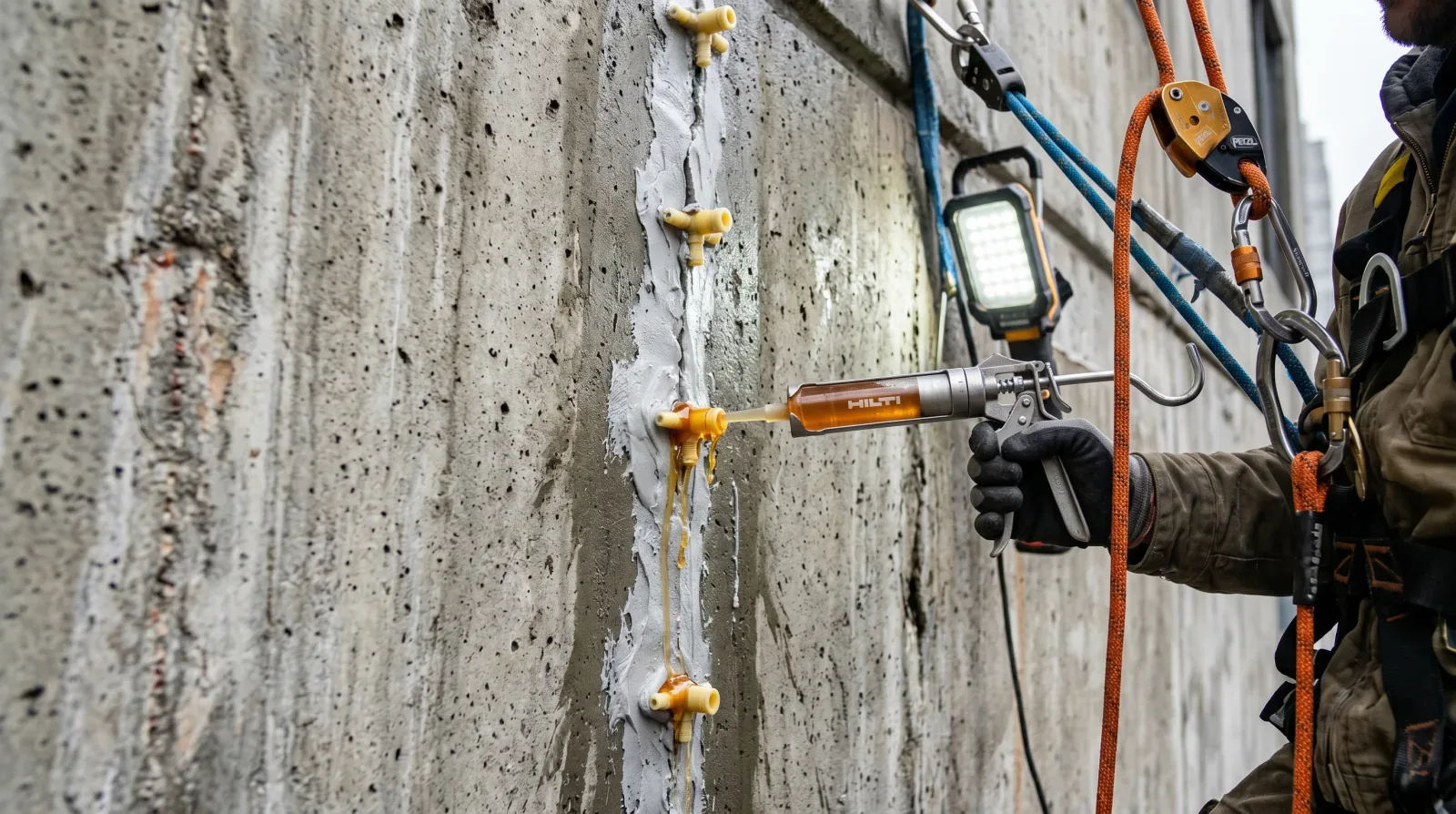
A property manager calls about a crack in a parkade wall that is weeping water every time it rains. The last contractor injected it with epoxy, and it is leaking again. The epoxy did not fail. It was the wrong material for the job from the start.
Concrete crack injection is one of the most useful repairs in the building envelope toolkit — and one of the most commonly misapplied. Get the resin right and you have a long-term fix that repairs the crack through its full depth. Get it wrong and you have wasted money on a repair that was never going to hold. The whole decision turns on one question: are you fixing structure, or stopping water?
What crack injection actually does
Crack injection fills a crack from the inside. Surface ports are mounted along the crack, the face between them is sealed, and a liquid resin is pumped in under pressure. The resin travels into the depth of the crack — through the full thickness of the wall or slab — and cures there. It is not a surface patch. Done correctly, it repairs the crack within the concrete.
Two families of resin do this work, and they are not interchangeable. Epoxy and polyurethane behave differently, cure differently, and solve different problems. Choosing between them is the entire job.
Epoxy: for structure, on dormant cracks
Epoxy injection resin is rigid and high-strength. When it cures inside a crack, it bonds the two faces back together so completely that the concrete can transfer load across the crack as if it were never there. For a crack that has compromised the structural continuity of a beam, column, or wall, epoxy restores it.
But epoxy has firm requirements. The crack has to be dormant — not actively moving — because epoxy is rigid and will not tolerate ongoing movement. And it needs a relatively dry crack to bond properly. Pump epoxy into a wall with water tracking through it and the resin cannot wet the concrete faces to bond. It will not seal the leak, and it will not bond the structure.
So epoxy is the right answer for a structural crack that is stable and dry. It is the wrong answer for a leak. The mistake I see most often is a crew reaching for epoxy on a damp crack because that is what was on the truck — and then being surprised when the wall still weeps. The water was always going to win that one.
Polyurethane: for water, on active leaks
Polyurethane injection resin is the opposite tool. It is flexible rather than rigid, and — this is the part that matters — it is water-reactive. It cures on contact with moisture and expands as it cures, filling and sealing the crack. That means polyurethane works on a wet, actively leaking crack, exactly the condition where epoxy fails.
This makes polyurethane the standard choice for stopping water through foundation walls, parkade slabs, and below-grade structures. In Metro Vancouver, where heavy rainfall and high water tables push water against below-grade concrete for months at a time, leaking foundation and parkade cracks are common. Polyurethane is injected into the crack, reacts with the water already present, and expands to seal the leak path through the full wall thickness.
Its flexibility is a second advantage. Because the cured resin stays elastic, it tolerates slight ongoing movement without cracking again — useful on a building that experiences minor seasonal movement. Sealing these leak paths is part of the broader picture of what causes water ingress in a high-rise, where below-grade water is often the hardest source to trace.
How the ports go in
The installation drives whether the repair works. Surface ports are mounted along the crack at spacing set by the wall thickness — thicker walls need wider spacing so the resin reaches the full depth. The crack face between the ports is sealed with a surface paste, which holds the resin inside the crack while it is under injection pressure.
On a vertical crack, the technician injects from the bottom up: pump resin through the lowest port until it appears at the next port up, cap the lower one, and move up the wall. This sequence fills the crack completely from the bottom, with no trapped air pockets. Rushing the sequence or spacing the ports wrong leaves voids — which is where leaks come back.
The crack also has to be reasonably clean and the right width for the resin to travel. A hairline crack may be too tight for some resins to penetrate fully, and a crack packed with dirt, efflorescence, or old patching material will block the resin before it reaches the depth. Part of the prep on a foundation or parkade wall is cleaning out the crack and confirming it will actually take the injection. Skipping that step is a common reason a repair seals the front face but leaves the back of the wall open — so the leak reappears from a different spot weeks later.
When injection is the wrong tool
Injection is precise. It seals a discrete crack. It is the wrong choice when the problem isn’t a defined crack at all. Widespread seepage across a wall, generally deteriorated or crumbling concrete, or active rebar corrosion all call for different repairs — and trying to inject your way out of those problems wastes money.
It also will not hold if the underlying cause keeps working. If the structure is still moving, the crack reopens. If rebar corrosion is expanding the concrete from within, injecting the surface crack does nothing about the steel rusting inside, and the concrete will continue to spall. Injection seals the crack you have. It does not fix why the crack formed.
That is why diagnosis comes before resin selection. A crack is a symptom. Before injecting it, you need to know whether it is a one-time shrinkage crack, a sign of ongoing structural movement, or the surface evidence of corrosion working inside the slab. The repair only lasts if the cause is stable. On parkades especially, this ties into the wider scope of parkade slab restoration, where crack injection is one tool among several.
Why DIY kits go wrong
Consumer injection kits are sold at hardware stores, and they are easy to misuse. The common failures: the wrong resin for the conditions, cracks left under-filled, ports spaced badly so the resin never reaches the full depth, and surface sealing that blows out under injection pressure. On a structural crack or a below-grade leak in a multi-unit building, a failed DIY attempt makes the eventual professional repair harder — the crack is now partly filled with the wrong material that has to be dealt with before a proper injection can be done.
For anything load-bearing, anything below grade, or anything in a strata where the repair affects shared structure, this is contractor work. The cost drivers are the length and number of cracks, wall thickness, access, and whether the crack is structural or a leak — there is no flat rate. The right move is a close-up assessment to confirm what is causing the crack and which resin the conditions call for. Request an assessment and we will diagnose before we inject.
Related guides
- Concrete Restoration Hub — repair methods for concrete structures in coastal BC
- Concrete Spalling Causes in Strata Towers — why concrete fails and what drives it
- Parkade Slab Restoration in Vancouver — full-scope repair of below-grade concrete
- What Causes Water Ingress in High-Rise Buildings — tracing leaks to their source
Frequently Asked Questions
More from Concrete Restoration Guide
Retaining Walls and Shotcrete: Waterproofing What Holds the Hillside Back
On Vancouver's slopes, retaining walls carry soil, water pressure, and drainage all at once. When the drainage behind them stops working, the wall becomes a dam.
Read article →Concrete Cover Depth: Why It Decides When Your Building Starts Spalling
The concrete between the surface and the reinforcing steel is the only thing protecting that steel. How thick it is on your building determines how long you have before corrosion starts.
Read article →Salt-Spray Corrosion on West Vancouver Oceanfront Buildings
Oceanfront buildings in West Vancouver age faster than inland ones — airborne sea salt drives chloride into the concrete and corrodes the rebar. Why coastal exposure demands a tighter maintenance cycle.
Read article →