Retaining Walls and Shotcrete: Waterproofing What Holds the Hillside Back
Vancouver, North Vancouver, West Vancouver, Burnaby, and Coquitlam are built on slopes, and slope sites need retaining structures. Parkade entrances cut into hillsides, terraced landscaping, walls holding a road above a property or a property above a road, and the shotcrete faces left from excavation shoring.
These structures rarely fail because the concrete was not strong enough. They fail because of water, and the mechanism is worth understanding because the fix is usually about drainage rather than about the wall.
The assumption every retaining wall is built on
A retaining wall holds back soil. That is the obvious part.
The less obvious part is that the wall was designed on an assumption: that the drainage system behind it keeps the retained soil from becoming saturated. Behind a properly built wall sits a drainage layer, usually free-draining granular material, and a perforated drain pipe that collects water and carries it away. Weep holes through the wall face provide additional relief.
That system exists because saturated soil behaves very differently from drained soil. Standing water in the soil exerts hydrostatic pressure against the wall, and that pressure increases with depth. A wall designed for drained soil conditions can be substantially overloaded once the soil behind it saturates.
So when the drainage clogs, the assumption the wall was designed on no longer holds. The wall is now carrying a load nobody designed it for, and it has become a dam. That is the mechanism behind the large majority of retaining wall problems, and it explains why a wall that performed for decades can begin moving without anything about the wall itself having changed.
How the drainage stops working
Drainage systems behind walls fail quietly, because every part of them is buried.
Soil fines migrate into the granular drainage layer over years and reduce its permeability. This is why filter fabric is specified, and where fabric was omitted, undersized, or damaged during backfilling, the drainage layer silts up.
Drain pipes block with fines, roots, or collapsed sections. Roots are particularly effective at finding perforated pipe, because it offers exactly what they are looking for.
The outlet blocks or was never adequately provided. A drain pipe that discharges into a system that has itself blocked, or that daylights at a point later covered by landscaping, stops functioning while the pipe behind the wall remains clear.
Weep holes get blocked from behind by fines, or from the front by coating, landscaping, or debris. Weep holes are sometimes painted over during a cosmetic upgrade by someone who took them for defects, which removes a pressure-relief path deliberately.
None of these are visible from the front of the wall. The first sign is usually water appearing where it should not, or the wall beginning to move.
Shotcrete and how it deteriorates
On slope sites in this region, shotcrete is common. It is concrete applied pneumatically, sprayed at high velocity onto a surface rather than poured into forms, which makes it well suited to irregular faces and to vertical work without formwork. Excavation shoring, slope stabilization, and retaining structures all use it.
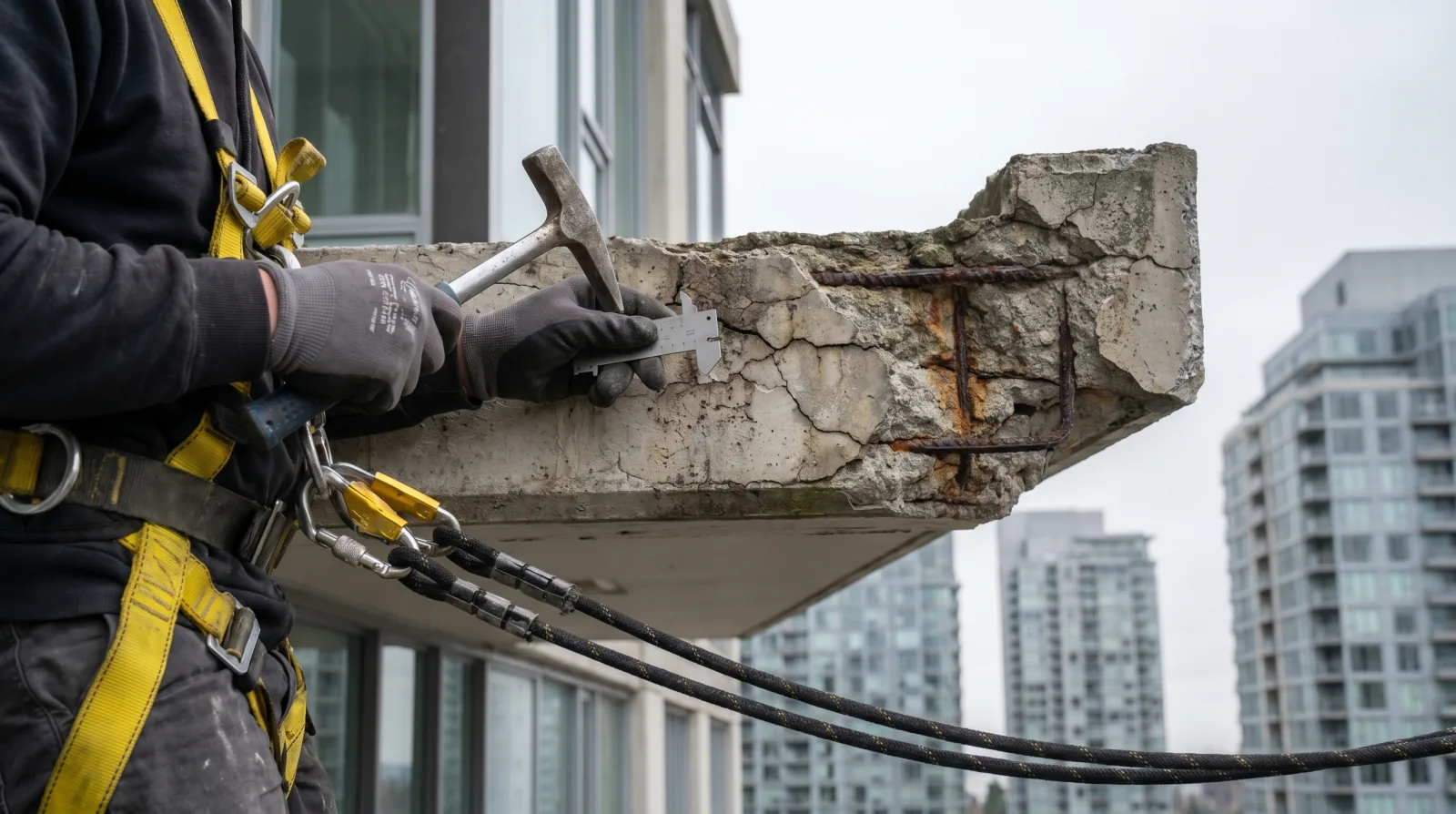
Shotcrete deteriorates through the same mechanisms as other concrete. Carbonation lowers the alkalinity from the surface inward, chloride penetrates where salt is present, and once either reaches the reinforcing steel, corrosion begins and the expanding rust cracks the concrete. The process is set out in the guide on rebar corrosion and spalling.
It also has some vulnerabilities specific to how it is applied. Because the material is sprayed, reinforcing bars can shadow the area behind them, leaving voids or sand pockets where the concrete never properly consolidated. And where it was applied to a surface that was inadequately prepared or contaminated, it can delaminate from that substrate.
Both defects create paths for water and points where deterioration concentrates. Both are also invisible at the surface, which is why sounding for delamination matters on shotcrete faces just as it does on a building structure.
The distinction between application methods and where each is appropriate is covered in the guide on shotcrete versus form and pour.
What to watch for
Several signs are visible without any special equipment.
Weep holes that are not weeping. During and shortly after heavy rain, weep holes should be discharging water. Dry weep holes during a downpour mean water is not reaching them, which means it is sitting behind the wall instead. This is the most useful single check available and it costs nothing.
Efflorescence on the face. White mineral deposits mean water is passing through the concrete, dissolving minerals on the way, and evaporating at the surface. The deposit itself is not damaging, but it is direct evidence of water moving through rather than being drained away, as explained in the post on efflorescence on concrete walls.
Persistent damp patches on the face, particularly ones that stay wet well after rain has stopped.
Spalling, cracking, and exposed reinforcing, which indicate the corrosion process is well advanced.
Movement. Bulging, leaning, new cracking, displacement at joints, or separation from adjacent structures.
That last category is different from the others. The first four are maintenance findings. Movement is a structural finding, and it should be assessed by a geotechnical or structural engineer promptly rather than scheduled for the next maintenance cycle. Retaining wall failures can occur suddenly, and the consequences on a slope site are serious.
Repair depends entirely on access
The right repair depends on whether the back of the wall can be reached.
Where excavation is feasible, the proper fix is available. Expose the back of the wall, inspect and replace the drainage layer and pipe, confirm the outlet is functioning, apply positive-side waterproofing to the exterior face, and backfill correctly with appropriate material and filter fabric. This addresses the cause. It is expensive, disruptive, and often constrained by what sits above the wall, but it is the repair that lasts.
Where excavation is not feasible, which is common on developed sites where the back of the wall is under a road, a neighbouring property, or established landscaping, the options manage the problem rather than solving it.
Clearing existing weep holes, or drilling new relief drains through the wall, restores pressure relief. This is often the highest-value intervention available relative to its cost, because it directly addresses the hydrostatic loading.
Improving surface drainage above and around the wall reduces how much water reaches the soil behind it in the first place. Regrading so surface water runs away from the wall, ensuring downspouts and area drains discharge well clear, and correcting landscaping that directs water toward the wall all reduce the load. The principles are covered in the guide on site grading and perimeter drains.
Negative-side waterproofing on the interior face manages water that has already come through, which matters where the interior side is occupied space such as a parkade. It does not relieve pressure and does not stop the concrete being saturated, so it treats a symptom, as explained in the post on negative-side waterproofing below grade.
Concrete repair addresses the deterioration that has already occurred, and it should follow the drainage work rather than precede it. Repairing spalled concrete on a wall whose drainage is still blocked means repairing it again.
The strata angle
Retaining walls on common property are the strata’s responsibility, and they are frequently missing from depreciation reports because they are not part of the building. A report that carefully schedules roof, envelope, and parkade renewal while omitting a substantial retaining structure has a gap in it.
Two things are worth doing. Confirm whether the retaining walls on the property appear in the depreciation report at all, and have them assessed if they have not been looked at. And check the title and any registered agreements for walls on a property boundary, since responsibility may be shared with a neighbour and that arrangement is far easier to establish before a repair is needed than during one.
The cheap things first
Before commissioning anything substantial, two checks cost almost nothing and address the most common cause.
Walk the walls during heavy rain and see whether the weep holes are discharging. Dry weep holes in a downpour is the finding that matters.
Look at what is above the wall. Where surface water is running toward it, where downspouts discharge, and whether landscaping or paving directs water into the retained soil. Water that never reaches the soil behind the wall cannot build pressure there, and surface grading is usually the cheapest lever available.
If either check turns up a problem, fixing it may resolve the situation entirely. If the wall is showing movement, skip the checks and call an engineer.
Sources and further reading
- BC Building Code, Division B Part 4 (Structural Design) and Part 9 foundation provisions, referenced 2026
- Canadian Foundation Engineering Manual, referenced 2026
- CSA A23.1/A23.2, Concrete Materials and Methods of Concrete Construction, shotcrete provisions, referenced 2026
- American Concrete Institute, Guide to Shotcrete (ACI 506R), referenced 2026
- Allweathercoating slope site and below-grade project records, Metro Vancouver, 2026
Frequently Asked Questions
More from Concrete Restoration Guide
Concrete Cover Depth: Why It Decides When Your Building Starts Spalling
The concrete between the surface and the reinforcing steel is the only thing protecting that steel. How thick it is on your building determines how long you have before corrosion starts.
Read article →Salt-Spray Corrosion on West Vancouver Oceanfront Buildings
Oceanfront buildings in West Vancouver age faster than inland ones — airborne sea salt drives chloride into the concrete and corrodes the rebar. Why coastal exposure demands a tighter maintenance cycle.
Read article →Concrete Crack Injection in BC: Epoxy vs Polyurethane
A leaking foundation crack in a North Vancouver building needs polyurethane, not epoxy. The difference matters. How to choose the right crack injection resin — and when injection isn't the answer at all.
Read article →