Negative-Side Waterproofing of Below-Grade Walls in Vancouver
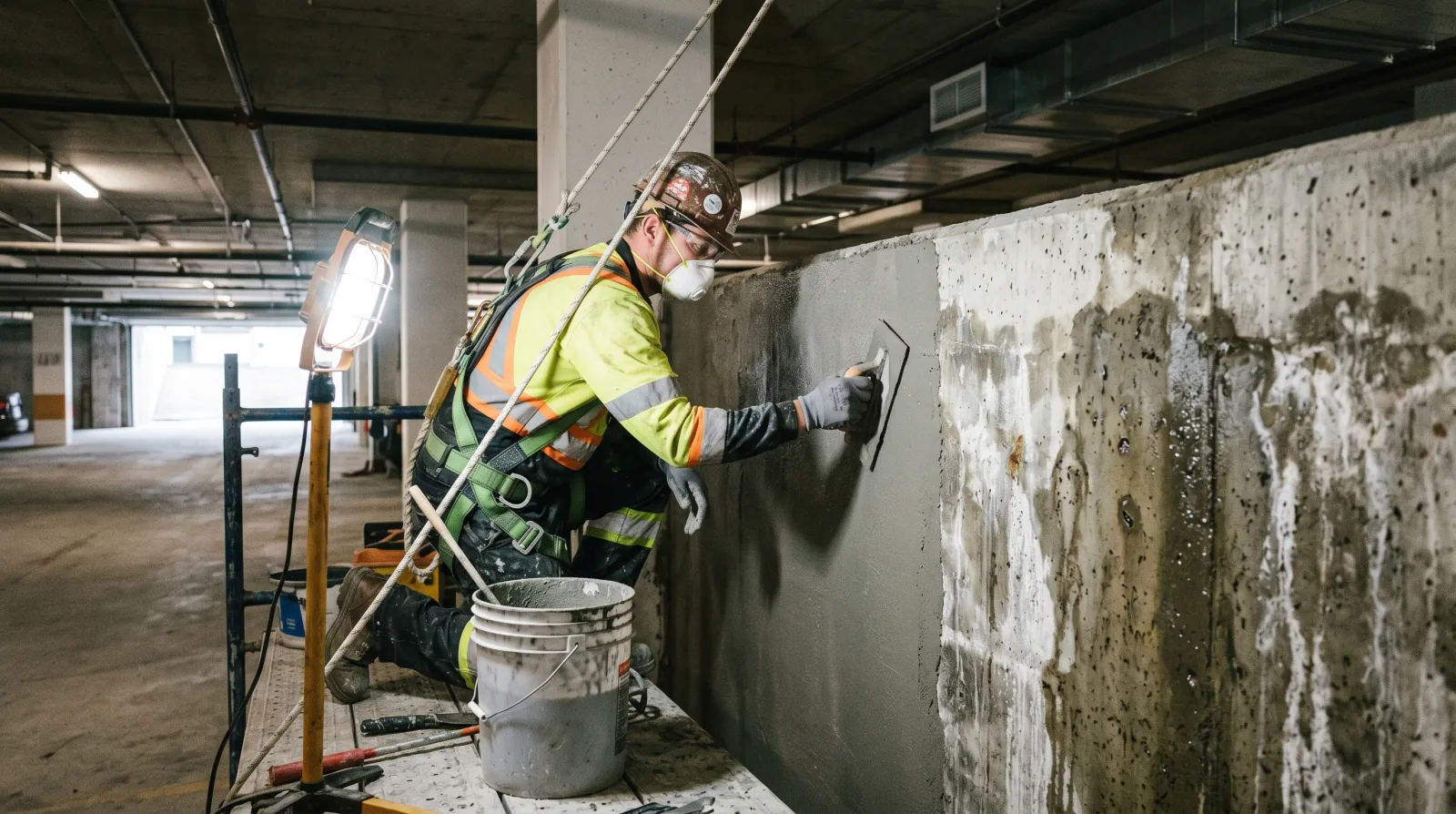
A building owner in Richmond has water seeping through a below-grade foundation wall into a finished basement. The obvious fix — dig down to the outside of the wall and waterproof it properly — runs into a wall of its own. There’s a building on top of the foundation, neighbouring structures close by, soft silty soil, and a water table sitting high in the ground. Excavating there would be expensive, disruptive, and on saturated delta soil, genuinely risky. So the outside of that wall is, for practical purposes, unreachable.
When you can’t get to the water-bearing side, you waterproof from the side you can reach: the inside. That’s negative-side waterproofing, and it’s a different game than working from the outside — because instead of working with the water pressure, you’re working against it.
Positive side versus negative side
The terms describe which face of the wall the waterproofing goes on, relative to the water.
Positive-side waterproofing goes on the exterior, water-bearing face. It stops water before it enters the concrete, and the water pressure actually helps — it pushes the membrane tighter against the wall. This is the more reliable approach because it keeps water out of the structure entirely. When you can excavate, positive-side is what you want.
Negative-side waterproofing goes on the interior face, opposite the water. Now the water pressure is working against the waterproofing, trying to push it off the wall and force water through. A coating that only sits on the surface as a film struggles here — pressure from behind can lift it. So negative-side waterproofing needs a material that works differently, one that resists water from the dry side rather than relying on the pressure to hold it in place.
That material, on below-grade walls, is usually a crystalline cementitious coating.
How crystalline coatings work
Crystalline waterproofing isn’t a film sitting on top of the concrete. It’s a cementitious coating that reacts with moisture and the chemistry inside the concrete to grow crystals within the concrete’s own pores and capillaries — the tiny pathways water uses to travel through the wall. As those crystals form, they block the pathways, making the concrete itself more watertight.
That’s why it can work on the negative side where many surface coatings fail. It isn’t a layer that pressure can peel off the wall; it becomes part of the concrete’s internal structure. Water pressure can’t push off something that’s grown inside the pores. Some crystalline products can even be applied to damp concrete and will keep reacting as moisture moves through, sealing the capillaries over time. On a wall you can only reach from the inside, that behaviour is exactly what the job needs.
Why Richmond and Delta are the hard cases
Metro Vancouver’s geography makes some of these jobs much harder than others. Richmond and Delta sit on low, flat delta land — soft, silty soils with a high water table close to the surface. A below-grade wall there isn’t just dealing with storm water that drains away after a Pacific Northwest downpour. It can face near-constant groundwater pressure, year-round, pushing against the wall.
That sustained pressure does two things. It makes waterproofing harder, because the wall is always under load rather than occasionally wet. And it makes excavation more dangerous — digging a deep trench in saturated silt next to a high water table is unstable and expensive work. So on exactly the sites where the exterior is hardest to reach, the water pressure is also at its most relentless. Negative-side waterproofing is often the only practical option, and it’s also being asked to do its hardest work. Going in with clear expectations matters more here than anywhere.
Active water has to be controlled first
A coating, crystalline or otherwise, isn’t a plug for a running leak. Crystalline systems can handle damp and slowly seeping concrete, and some go onto actively damp surfaces, but a concentrated active flow — water streaming through a crack, a cold joint, or an old form-tie hole — has to be dealt with before the area coating goes on.
That means finding the active entry points and plugging or injecting them separately: hydraulic cements that set fast against flowing water, or injection at cracks and joints to seal the path. Sometimes a concentrated leak needs a controlled drainage path rather than a hard plug, so the water goes somewhere managed instead of building pressure elsewhere. Managing the active water — locating it, controlling it, and only then coating the broader surface — is part of the work, not something the coating does on its own. This is the same investigative discipline behind tracing any leak: the causes of water ingress are rarely where the dampness appears on the surface.
Fix the concrete before you waterproof it
Crystalline coatings work best on sound concrete. Cracks, spalled or delaminated areas, deteriorated form-tie holes, and damaged joints are all water pathways, and coating over them doesn’t make them go away. Before or as part of the waterproofing, the concrete usually needs repair — sound material reinstated, cracks routed and treated, joints addressed.
This is why below-grade waterproofing and concrete restoration belong in one coordinated scope rather than as separate jobs. The same skills that go into a parkade slab restoration — assessing the concrete, repairing deterioration, then protecting the result — apply to a below-grade wall. Coating over problem concrete just buys you a thin film over the same pathways that will keep letting water through.
Know the limits before you commit
Negative-side waterproofing is a legitimate, often necessary solution. It’s also not the equal of a properly installed exterior system, and it’s worth being honest about why.
Working against water pressure is inherently harder than working with it. More than that, negative-side waterproofing doesn’t stop water from entering and saturating the concrete itself — it manages water at the inside face, but the wall is still getting wet from outside. That means it doesn’t protect the embedded rebar from that water the way an exterior system does, so corrosion of the steel remains a concern on a wall that stays saturated. And high, sustained water pressure of the kind you find on a Richmond delta site genuinely tests these systems.
None of that makes it the wrong choice when you can’t excavate. It makes it a choice with trade-offs you should understand. The recurring parkade and below-grade waterproofing problems tend to come from treating waterproofing as a single product applied once, rather than as ongoing water management — controlling active leaks, repairing concrete, addressing drainage and sump systems, and monitoring the result over time.
What to do with a leaking below-grade wall
If you’ve got seepage through a foundation wall you can’t dig up:
- Get an assessment of the water, not just the wall. Where is it coming from, how much, and is the pressure occasional storm water or a constant high water table? That determines what’s realistic.
- Control the active leaks first. Plug or inject concentrated flows at cracks, joints, and tie holes before any area coating.
- Repair the concrete. Crystalline coatings need sound concrete to work; deteriorated areas get fixed as part of the scope.
- Coat the negative side with a crystalline system. Let it grow into the concrete to block the capillaries from the inside.
- Address the bigger water picture. Drainage, sump systems, and managing groundwater around the building matter as much as the wall coating, especially on a high-water-table lot.
- Treat it as ongoing management. On a relentless-pressure site, monitor it over time rather than assuming one application ends the problem forever.
When you can dig, waterproof from the outside. When you can’t — and across much of Metro Vancouver’s dense and low-lying ground, you can’t — negative-side waterproofing is how you keep the water back from the only side you can reach. Just go in knowing exactly what it does and where it stops.
Related guides
- Concrete Restoration Hub — concrete repair and waterproofing together
- What Causes Water Ingress in High-Rise Buildings — tracing leaks to their source
- Parkade Slab Restoration in Vancouver — coordinated concrete and waterproofing work
- Parkade Waterproofing Problems to Watch For — common below-grade waterproofing failures
Frequently Asked Questions
More from Parkade Waterproofing Guide
Expansion Joint Systems on Vancouver Parkade and Plaza Decks
A leak staining the cars in a Vancouver parkade often starts at a deck expansion joint above. How compression seals, strip seals, and membrane joints work — and fail.
Read article →Cathodic Protection for Chloride-Contaminated Parkades in Vancouver
Road salt drives chloride deep into Surrey and Vancouver parkade slabs, and patch repair alone won't stop the corrosion it starts. When cathodic protection makes sense, how it works, and what it costs you to ignore it.
Read article →When to Recoat a Parkade Traffic Membrane in Vancouver
Deferring a parkade traffic-coating recoat is how a Richmond strata turns a maintenance bill into a slab replacement. How to read wear before it's too late.
Read article →