Rebar corrosion and concrete spalling, explained
Almost every concrete restoration project on a Metro Vancouver building traces back to one thing: the steel inside the concrete is rusting. Understand that one mechanism and the cracking, the staining, and the falling chunks all stop being mysterious.
The short version
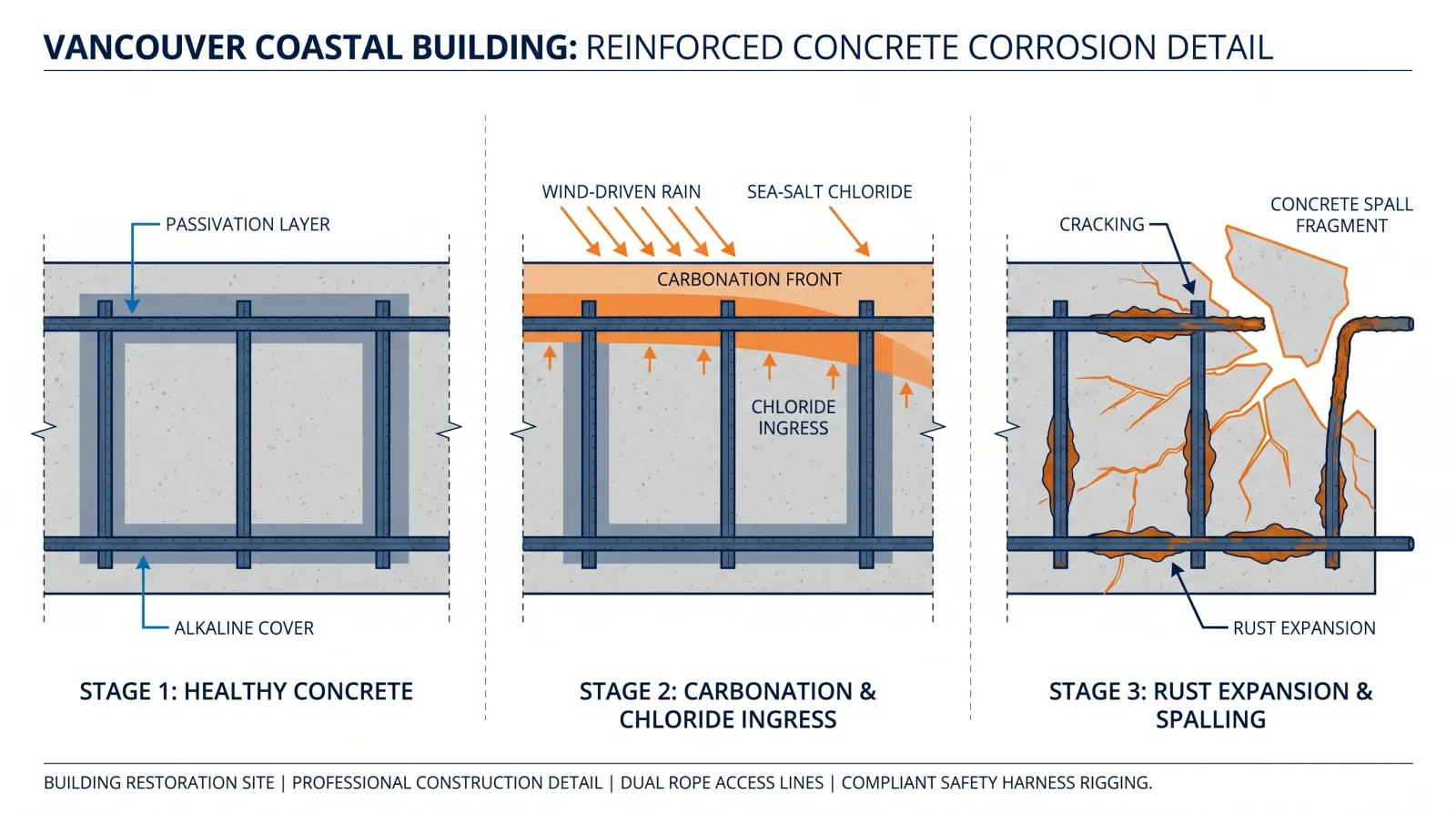
Reinforced concrete works because steel bar inside it carries tension the concrete can't. The steel only lasts because new concrete is strongly alkaline, which keeps a protective film on the metal. Restoration problems begin when that protection breaks down and the bar starts to rust. Rust takes up far more room than the steel it came from, and that expansion splits the concrete and pushes the surface off. The brown stain, the drummy patch, the chunk on the sidewalk — all of it is the rebar expanding.
How the protection breaks down
Two fronts attack the steel on the BC coast, and they often work together.
Carbonation is slow chemistry. Carbon dioxide from the air reacts with the concrete and gradually lowers its pH, advancing inward from the surface as a front. When that front reaches the depth of the bar, the alkaline protection is gone and corrosion can start anywhere along the steel. Older concrete with thin cover loses this race sooner.
Chloride is the faster killer here. Salt — carried in the air off the water in West Vancouver and the downtown waterfront, or tracked into parkades on winter tires — travels through the porous concrete to the steel. It doesn't need to lower the pH; above a threshold concentration at the bar it breaks the passive film in spots and drives intense, localized pitting corrosion. This is why buildings near the ocean and salted parkade slabs deteriorate ahead of sheltered inland structures.
Why the concrete cracks off
Here's the part that surprises people. The load on the building usually isn't what cracks the concrete. The rust does. As steel corrodes it converts to iron oxides that occupy several times the original volume. Inside the tight confinement of the concrete, that expansion generates pressure the cover can't resist. First you get a crack tracking the line of the bar, then delamination — the cover separates but hangs on — and finally a spall, where the piece drops and leaves rusted steel exposed to the weather. Now water and chloride reach the bar directly and the whole cycle speeds up.
The field signs, in the order you usually see them
- Rust-coloured staining bleeding down a concrete face or balcony soffit — the first visible signal, often years before a chunk falls.
- Map cracking or fine cracks running parallel to where rebar sits below the surface.
- A hollow or drummy sound when the concrete is tapped — the cover has delaminated from the steel but has not dropped yet.
- Bulging or a visible bump in the concrete surface as the expanding rust pushes outward.
- Loose fragments, exposed rusted bar, or a fresh spall scar where a piece has already let go.
- Efflorescence — white salt deposits — at crack mouths, a sign water is moving through the concrete.
On residential towers this shows up first at balcony slab edges and undersides. On parkades it's the suspended slab soffit and the column bases near where cars track salt and water. If you're a strata council member doing a walk-around, rust staining and drummy concrete are the two things worth noting and reporting — you don't need instruments to catch them early.
What actually causes it on a given building
- Carbonation: atmospheric CO₂ lowers the concrete pH from the surface inward until it reaches the bar and strips its passive film.
- Chloride ingress: sea-salt aerosol off the Strait of Georgia and de-icing salt in parkades migrate to the steel and break down protection locally, even at high pH.
- Low concrete cover: bars cast too close to the surface — common in older construction — give the corrosion front a shorter trip.
- Cracking from any cause: shrinkage, overload, or thermal movement opens a fast path for water and chloride straight to the steel.
- Standing water and failed membranes: balcony and parkade decks that no longer drain keep the concrete saturated, accelerating everything.
How it gets confirmed before anyone repairs
A surface that looks bad and a surface that is structurally compromised are not the same thing, and you can't tell them apart by eye. That's why a restoration starts with a condition assessment, not a quote. An engineer sounds the concrete to map the delaminated areas, runs half-cell potential readings to find where the steel is actively corroding, measures carbonation depth on a fresh core, and pulls chloride samples at the level of the bar. The results define how much concrete has to come out and how the repair is designed under CSA S448.1, Repair of reinforced concrete in buildings and parking structures. The rainscreen requirements that came out of BC's leaky-condo era — with an estimated $4 billion in damage across more than 900 buildings, per BC's Homeowner Protection Office — were meant to keep water out in the first place; on older buildings that predate them, corrosion is often well underway by the time anyone looks.
When to get an engineer involved
Watch and note
Hairline cracks and faint surface staining with no drummy sound. Photograph, date it, and recheck at the next inspection.
Assess soon
Drummy concrete, widening cracks tracking the rebar, or rust bleed on balcony edges and parkade soffits. Book a condition assessment.
Act now
Loose or fallen fragments, exposed corroded bar over occupied areas, or spalling on a structural column. Barricade below and get engineering review.
Quick answers
What is the difference between concrete spalling and concrete cracking?
Cracking is a line opening in the concrete; spalling is a piece of the concrete breaking away from the surface. Cracking often comes first and is the path that lets water and chloride reach the rebar. Spalling is what happens later, once the steel has corroded and the expanding rust pushes the cover concrete off. A hairline crack is a warning; a spall with exposed rusted bar is active structural deterioration.
How does rebar corrosion crack concrete?
Steel reinforcing bar is protected by the high alkalinity of fresh concrete, which forms a thin passive film on the metal. When carbonation or chloride destroys that film, the steel starts to rust. Rust (iron oxide) occupies up to several times the volume of the original steel. That expansion is enormous in a confined space: it generates internal pressure that fractures the surrounding concrete and pushes the cover off the bar. The rust is doing the cracking, not the load. This is the mechanism CSA S448.1, the current Canadian standard for concrete repair, uses to define when a spall requires removal down to sound, uncorroded steel rather than a surface patch.
Why is rebar corrosion worse on Vancouver-area buildings?
The coast delivers a triple load. Vancouver International Airport averages 1,189 mm of precipitation a year, so the concrete is wet for long stretches. Buildings near the water take sea-salt chloride in the air. And a large share of the Lower Mainland's concrete stock dates to the late-1980s-to-early-2000s period, built before rainscreen detailing became standard — that era produced the leaky condo crisis, with an estimated $4 billion in damage across more than 900 buildings. The buildings that leaked then are the buildings whose balconies and facades are spalling now. Wet, salty, chronically damp, and with envelopes that were never properly detailed: that is the recipe for fast, widespread corrosion.
Rebar corrosion and spalling questions
What is the difference between concrete spalling and concrete cracking?
Cracking is a line opening in the concrete; spalling is a piece of the concrete breaking away from the surface. Cracking often comes first and is the path that lets water and chloride reach the rebar. Spalling is what happens later, once the steel has corroded and the expanding rust pushes the cover concrete off. A hairline crack is a warning; a spall with exposed rusted bar is active structural deterioration.
How does rebar corrosion crack concrete?
Steel reinforcing bar is protected by the high alkalinity of fresh concrete, which forms a thin passive film on the metal. When carbonation or chloride destroys that film, the steel starts to rust. Rust (iron oxide) occupies up to several times the volume of the original steel. That expansion is enormous in a confined space: it generates internal pressure that fractures the surrounding concrete and pushes the cover off the bar. The rust is doing the cracking, not the load. This is the mechanism CSA S448.1, the current Canadian standard for concrete repair, uses to define when a spall requires removal down to sound, uncorroded steel rather than a surface patch.
Why is rebar corrosion worse on Vancouver-area buildings?
The coast delivers a triple load. Vancouver International Airport averages 1,189 mm of precipitation a year, so the concrete is wet for long stretches. Buildings near the water take sea-salt chloride in the air. And a large share of the Lower Mainland's concrete stock dates to the late-1980s-to-early-2000s period, built before rainscreen detailing became standard — that era produced the leaky condo crisis, with an estimated $4 billion in damage across more than 900 buildings. The buildings that leaked then are the buildings whose balconies and facades are spalling now. Wet, salty, chronically damp, and with envelopes that were never properly detailed: that is the recipe for fast, widespread corrosion.
Why do balconies spall before the rest of the building?
Balcony slabs are the most exposed horizontal concrete on a tower — open to wind-driven rain across the top and the edge — and they depend on a waterproofing membrane that has a finite service life. When the membrane fails or the edge sealant opens, water and coastal chloride reach the rebar faster there than on sheltered vertical walls. That is why balcony slab edges and soffits are almost always where spalling appears first on a Metro Vancouver concrete building.
Is concrete spalling dangerous?
It can be, in two ways. Falling concrete is a direct hazard — a spall coming off a high balcony edge onto a sidewalk is a serious risk, which is why barricades go up the moment loose material is found. And progressive corrosion reduces the cross-section of the reinforcing steel, which over time lowers the load capacity of the element. A small stain is not an emergency; a section of a parkade soffit with exposed, heavily corroded bar warrants prompt engineering review.
How do engineers test concrete for hidden corrosion?
A condition assessment combines several methods: sounding the surface with a hammer or chain drag to find delaminated (drummy) areas, half-cell potential mapping to find where the steel is actively corroding, carbonation-depth testing with a pH indicator on a fresh core, and laboratory chloride sampling at the depth of the bar. Together these show how far the deterioration has spread and how deep the contamination goes, which is what sets the repair scope under CSA S448.1.
Can you stop rebar corrosion without removing all the concrete?
Sometimes. Where corrosion is early and chloride is moderate, options like migrating corrosion inhibitors, galvanic (sacrificial) anodes embedded at the patch edges, or in severe cases impressed-current cathodic protection can slow or arrest the corrosion. But where the concrete is already delaminated or chloride-saturated to the bar, that material has to come out — no surface treatment fixes concrete that has lost its bond to the steel. An engineer decides which case applies after testing.
Seeing rust stains or drummy concrete?
We assess concrete deterioration on strata and commercial buildings in Vancouver, North Vancouver, West Vancouver, and Burnaby — sounding, testing, and scoping the repair to CSA S448.1.