Elastomeric Wall Coatings on Vancouver Concrete Towers: When They Work
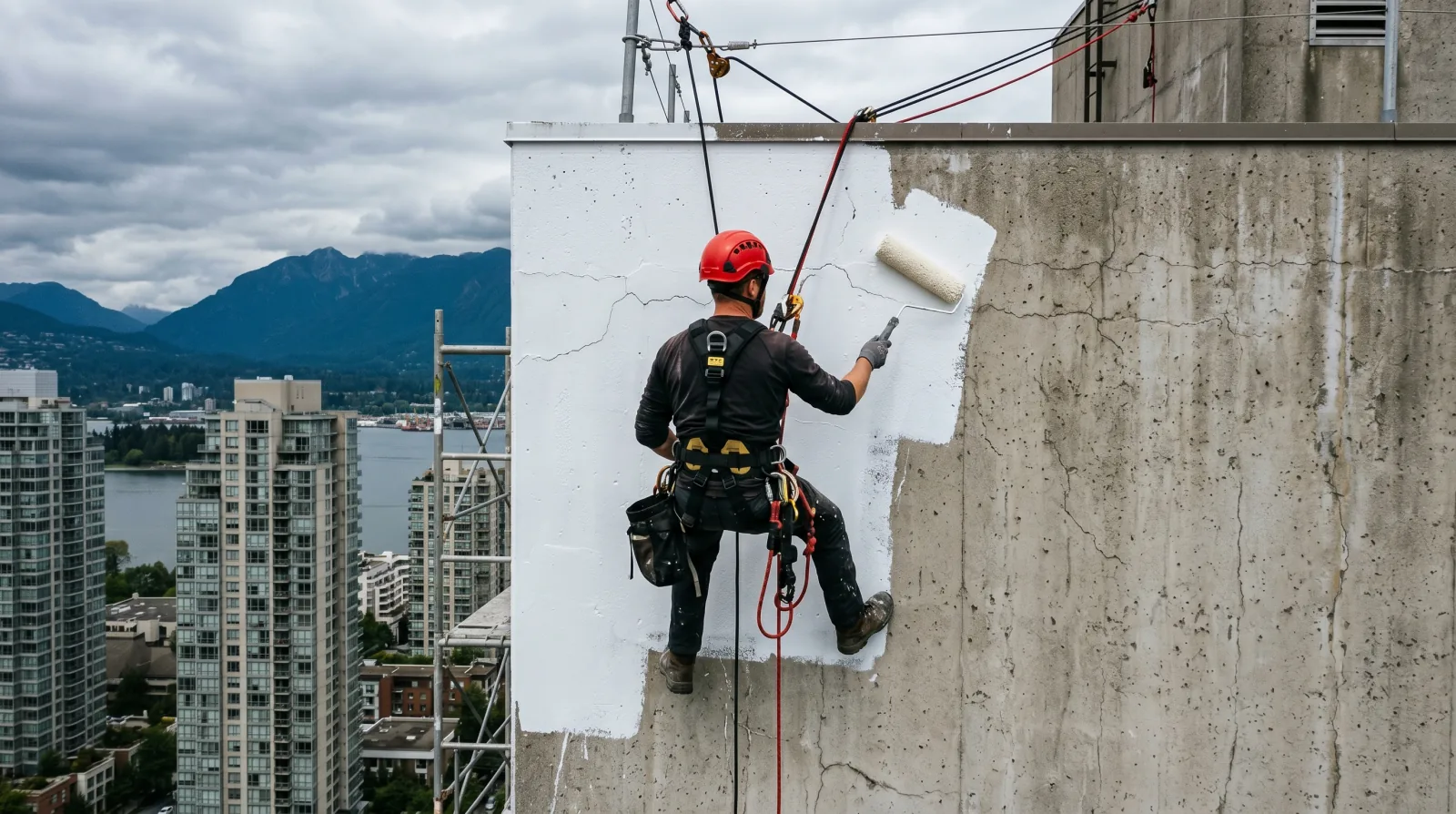
A coating is only as good as the wall under it
Elastomeric wall coatings are one of the most cost-effective things you can do for an aging concrete tower — and one of the most commonly wasted. We have been called to plenty of Metro Vancouver buildings where a fresh, expensive coating was blistering and peeling within a year of going on. The coating was not the problem. The wall under it was wet when it went on, and no coating survives that.
So before getting into where these coatings shine, the single most important thing to understand is this: an elastomeric coating is a finishing layer over a sound, dry, prepared substrate. Get the substrate right and the coating earns its keep for a decade or more. Get it wrong and you are paying to apply a coating that is very likely to fail.
What an elastomeric coating actually does
An elastomeric wall coating is a thick, flexible, acrylic-based coating for concrete and masonry. The word elastomeric just means it stretches — and that stretch is the point. Applied at several times the film thickness of ordinary paint, it can flex with the wall as it expands and contracts, and it can bridge the fine hairline cracks that open in concrete over time, keeping water out of them.
Manufacturers formulate these products specifically for cracking substrates — Sika, for example, rates Sikagard-550 W Elastocolor for crack-bridging on concrete subject to cracking. On a Metro Vancouver concrete tower, that crack-bridging plus water-shedding makes the coating part of the above-grade weather barrier, not just a colour finish.
But there is a hard limit. Elastomeric coatings bridge fine, non-structural hairline cracks. They do not fix structural cracks, and they do not seal moving expansion joints — those need routing and a proper sealant, with engineering review where the crack is structural. Spreading a coating over a moving crack and expecting it to hold is asking the wrong material to do a sealant’s job.
Why breathability keeps the coating attached
Here is the bit of building science that decides whether a coating lasts: vapour permeability. A good elastomeric coating keeps liquid water out from the outside while still letting moisture vapour from inside the wall escape through it. That two-way behaviour — waterproof to liquid, open to vapour — is what keeps the coating bonded.
When a coating is not breathable, or when it goes over a wall that is already holding moisture, the vapour has nowhere to go. As the wall warms, that trapped moisture turns to vapour and pushes outward, and the pressure lifts the coating off the concrete in blisters. On the coast, where walls absorb months of wind-driven rain, a non-breathable coating or a damp substrate is a recipe for exactly that failure. This is why we specify vapour-permeable systems and insist on a dry wall — the two work together.
The moisture rule we won’t bend
The most common reason coatings fail in Metro Vancouver is simple and avoidable: someone coated over a damp wall. Concrete that has soaked up a wet Vancouver winter holds a lot of moisture, and it has to dry to the coating manufacturer’s moisture limit before anything goes on — confirmed with a moisture meter or a plastic-sheet test, not a guess.
This is where scheduling and physics collide. The spring, when stratas want their building freshened up, is often when the concrete is still carrying winter moisture. We would rather delay a coating job a few weeks until the wall is genuinely dry than spray a beautiful finish onto a wall that will blister by fall. An owner who pushes a crew to coat a damp wall to hit a deadline is buying a failure. We have learned to say no to that, because we are the ones who get called back.
What proper preparation looks like
Beyond moisture, the substrate has to be prepared. That means cleaning off dirt, chalk, and any old failing coating; repairing the concrete where it is cracked or spalled; priming appropriately; and only then coating. On a high-rise in Vancouver or North Vancouver, all of this happens from rope access or a swing stage, working methodically down the facade.
And it means not coating over damage. If the concrete is spalling or the rebar is corroding, a coating over the top just hides a structural problem that keeps growing underneath the new finish. The spalled concrete and corroding steel have to be repaired first — our concrete spalling causes in strata towers post explains why — and the coating then goes over sound, repaired concrete. A coating is a weather finish, not a structural repair, and treating it as one buries problems that resurface bigger.
Recoating an existing coating versus a first application
Not every coating job is a fresh start. A lot of the work we do on Metro Vancouver towers is recoating a building that was coated years ago, and that is a different problem from coating bare concrete for the first time — with its own way of going wrong.
The decisive question on a recoat is what is happening with the existing coating. If the old elastomeric is still well bonded, sound, and compatible, a recoat can go over it after proper cleaning and any spot repairs, and the building gets another long service interval for far less disruption than a full strip. But if the existing coating is failing — blistering, peeling, chalking heavily, or debonding in patches — coating over it just bonds your new finish to a layer that is already letting go. The new coat is only as attached as the old one underneath it. We have seen fresh coatings peel off in sheets within a year because they were rolled over a failing coat that should have been removed first.
So a recoat starts with assessment, not paint. The crew checks adhesion, looks for blistering and debonding, tests compatibility between the old and new systems, and determines how much of the existing coating has to come off. Sometimes the answer is a straightforward clean-and-recoat. Sometimes it is a full removal back to concrete because the old system has failed widely. Most often it is somewhere in between — sound areas recoated, failed areas stripped and rebuilt. Pricing and planning a recoat without that assessment is guesswork, which is why we never quote one sight unseen.
Colour and exposure deserve a thought at recoat time too. Darker colours absorb more heat and more UV, and on a south or west elevation in Burnaby or downtown Vancouver they weather faster and drive more thermal movement in the wall beneath. A building choosing a deep colour for its recoat is, all else equal, signing up for a shorter interval before the next one than a building in a lighter tone. It is a legitimate design choice, but worth making with eyes open, because the maintenance clock is part of the cost.
The through-line, first coat or recoat, is the same one this whole article keeps returning to: the coating is a finish over a substrate, and the substrate — bare concrete or an existing coat — has to be sound and properly prepared before anything new goes on. Get that right and a recoat is excellent value. Skip the assessment and you are bonding good money to a failing layer.
Where elastomeric coatings genuinely earn their place
None of this is an argument against these coatings. Applied correctly, an elastomeric coating on a prepared, dry concrete facade is excellent value — it sheds rain, bridges the hairline cracking that every aging concrete building develops, refreshes a tired exterior, and typically runs 10 to 15 years or more before recoating, depending on exposure and colour. South-facing and exposed elevations in Burnaby or downtown Vancouver weather faster than sheltered faces, which is worth planning for, but the protection is real.
The key is to see the coating as one layer in an above-grade strategy, not a cure-all. It works alongside sealant renewal, flashing repair, and good drainage — it does not replace them. A coating will not fix a failed window perimeter joint or a bad parapet flashing, and selling it as a fix for active water ingress is how buildings end up disappointed. Our elastomeric versus acrylic coatings guide and the exterior coatings service page lay out where these systems fit. Choose the right system, put it over a dry and sound wall, and it protects your concrete for years. Rush it onto a damp or damaged substrate, and you will be repainting before you have finished paying for the first coat. We would rather lose the job to a contractor who will spray a wet wall than be the name attached to a facade that blisters by the next autumn in Burnaby or North Vancouver — because in this climate, the wall under the coating always gets the last word. A coating buys a concrete building years of protection and a fresh appearance, but only ever as a partnership with the substrate beneath it. Respect that, and it is some of the best value a strata can spend on its exterior.
Frequently Asked Questions
More from Exterior Coatings Guide
Pressure Washing vs Soft Washing Building Exteriors in Metro Vancouver
High-pressure water strips algae off a Coquitlam wall fast — and can blast the coating, sealant, and concrete off with it. When soft washing is the right call, and why surface prep before coating decides everything.
Read article →Cold-Weather Exterior Restoration in Coastal BC: What Works in Winter
Winter restoration on a West Vancouver building is possible, but coatings, sealants, and concrete have temperature and dew-point limits. How crews manage it.
Read article →EIFS vs Traditional Stucco for BC Multifamily Buildings
Exterior Insulation and Finish Systems (EIFS) and traditional three-coat stucco look similar from the street but fail in completely different ways. What BC strata councils and developers need to know before specifying, repairing, or buying a building with either system.
Read article →