Cold-Weather Exterior Restoration in Coastal BC: What Works in Winter
“Let’s wait until spring.” It is the most common instinct a strata council has when a coating or restoration project lands in front of them in October. The reasoning seems sound — why paint a building in the rain? But the instinct is often wrong, and the reasons it’s wrong come down to a few facts about coastal BC weather and how coatings, sealants, and concrete actually cure.
Winter restoration in this region is routine. It is not a compromise or a desperate measure. It is controlled work that, done properly, performs every bit as well as summer work. The difference is that winter demands more control, and a crew that doesn’t understand the controls can do real damage. So let’s go through what actually limits cold-weather work, and how it gets managed.
In coastal BC, the enemy is water, not cold
Start with the climate, because it shapes everything. Metro Vancouver winters are mild. Hard freezes are uncommon, and the deep-cold problems that govern construction on the Prairies rarely apply here. What we get instead is rain — the bulk of our 1,150 to 1,200 millimetres of annual precipitation per Environment Canada climate normals falls in the cooler months, much of it as prolonged wind-driven rain through a wet season that runs for months.
So the real winter challenge isn’t keeping materials from freezing. It is keeping surfaces dry enough, long enough, for coatings and sealants to bond and cure. The same atmospheric rivers that batter the building envelope are exactly what a winter restoration crew has to keep off the work. Manage the water and the temperature, and the cold itself is rarely the obstacle.
Temperature limits — and why curing matters more than application
Every coating, sealant, and repair mortar has a minimum application temperature on its data sheet, commonly somewhere around 5 to 10 degrees Celsius. But the number that catches people out isn’t the application temperature — it’s the cure. The product needs the air and surface to stay above the minimum not just at the moment it goes on, but through the hours and days it takes to cure.
A coating applied at noon when it’s warm enough, then left exposed as the temperature drops below the limit overnight, can fail to film properly. You can end up with incomplete film formation, poor adhesion, blistering, or a surface that stays soft and tacky and never fully hardens. The danger is that this failure often doesn’t show immediately. The coating looks fine, the crew leaves, and months later the building owner discovers the whole application has compromised performance and has to be redone — at full cost, again. Respecting the cure window, not just the application moment, is what separates a coating that lasts from one that has to be torn off.
Dew point: the number nobody warns you about
Here is the control that matters most in our damp climate, and the one most often ignored: dew point.
Dew point is the temperature at which moisture in the air condenses into liquid on a surface. The working rule is that the surface being coated must stay at least about 3 degrees Celsius above the dew point during application and cure. If the surface is at or below the dew point, an invisible film of condensation forms on it — even on a surface that looks and feels dry — and that film ruins adhesion.
In coastal BC’s humid winter air, the gap between the surface temperature and the dew point is often narrow. A wall that has cooled overnight can sit right at the dew point in the morning, with a microscopic layer of condensation that no one can see. Coat over that and the coating fails. This is why a competent crew measures surface temperature and dew point through the day, and why understanding it is part of doing any elastomeric wall coating on a concrete tower right — the best coating in the world fails if it goes onto a surface that’s secretly damp.
Sealants and concrete in the cold
The same principles extend across the trades.
Sealants have their own minimum application temperatures and need clean, dry, frost-free joint surfaces to bond. Cold slows the cure and makes some products stiffer to gun and tool. Apply sealant onto a wet or frosted joint and the bond is gone before it starts. With the joint kept dry and warm, sealant work continues through winter without trouble.
Concrete repair needs fresh repair material protected from freezing while it cures — early freezing can permanently weaken a repair. Hard freezes are rare here, but cold slows the cure and overnight lows still need watching. Insulated blankets, enclosures, and sometimes supplemental heat keep repairs above their minimum cure temperature, and the repair materials carry their own temperature limits that have to be respected.
Weather enclosures turn winter into a workable season
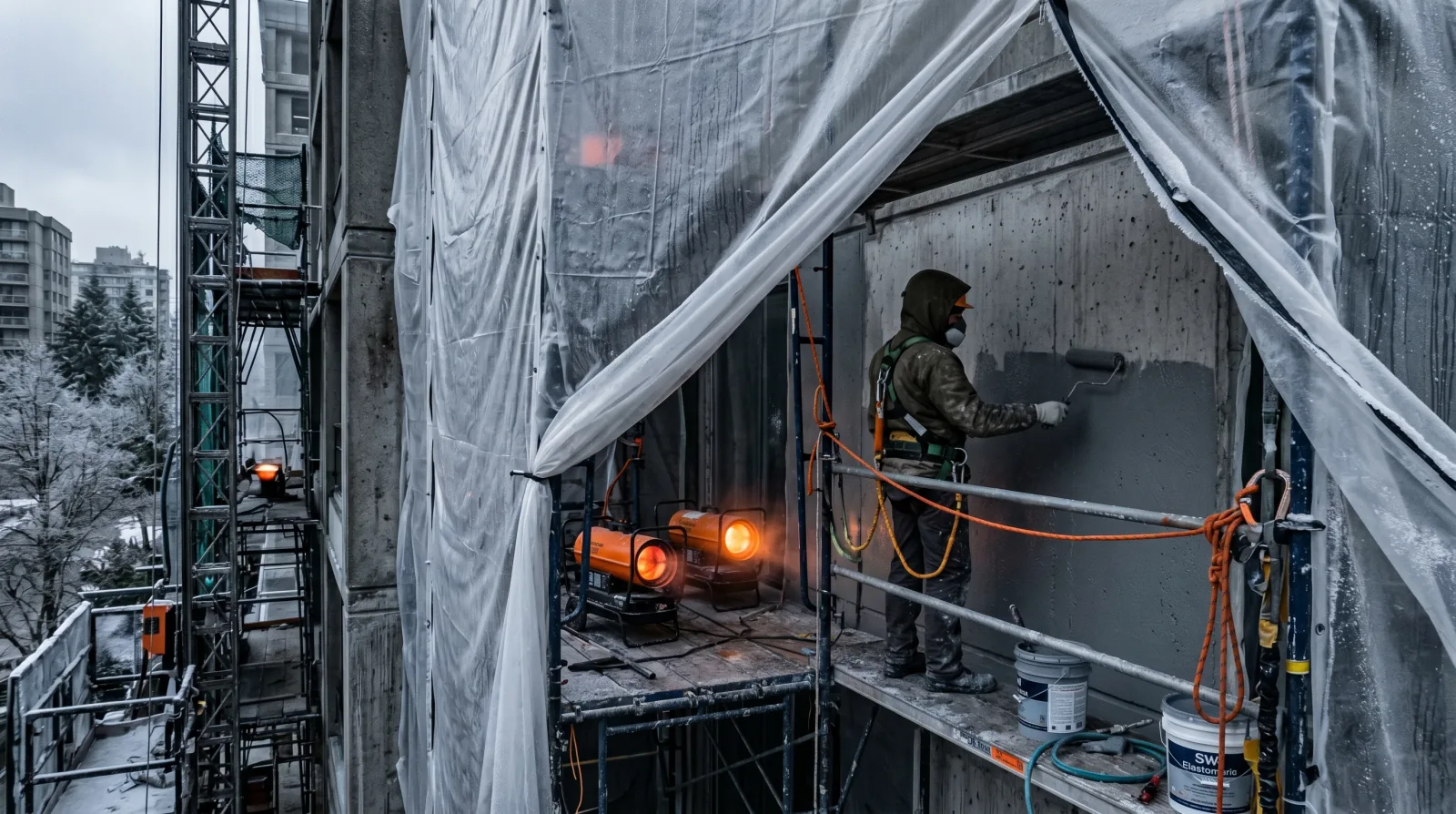
The tool that makes all of this possible is the weather enclosure — scaffolding wrapped in tarps or shrink-wrap, creating a controlled space around the work area. An enclosure keeps rain off the surface, holds heat in, and lets the crew maintain the temperature and dryness the materials need. Combined with heaters and, where the air is too humid, dehumidification, the enclosure turns an exposed winter facade into a controlled environment.
Inside a heated, dry enclosure, the dew-point and temperature problems become manageable. The crew controls the conditions rather than fighting the weather. That control is the whole reason quality work can continue through the wet season — and it’s why winter restoration is a matter of preparation and equipment, not luck.
Short daylight is the other winter factor, handled through staging. Crews sequence the work so surfaces are prepped and coated within the usable, warmer part of the day, leaving time to set before temperatures drop. Enclosures with lighting and heat extend the workable window, and because winter curing is slower, the schedule is built with realistic timelines and more time between coats rather than rushed.
So should you wait for spring?
Sometimes, yes. If the work is discretionary and the building is sound, the drier, warmer months make a large coating project faster and simpler, with fewer enclosure and weather constraints. There’s nothing wrong with scheduling non-urgent work for the dry season.
But waiting is the wrong call when the building has active water ingress, deteriorating concrete, or failing sealant. Delaying protective work through a full wet season lets the damage grow — water keeps getting in, concrete keeps deteriorating, and the repair scope expands with every storm. The protective value of exterior coatings on a building is exactly what an exposed, deteriorating facade is missing through those months.
The honest comparison isn’t winter versus summer. It’s controlled winter work under an enclosure versus a whole season of continued deterioration. Winter restoration carries added costs — enclosures, heating, dehumidification, longer cure times — but for urgent protective work, those costs are almost always smaller than the additional damage that waiting until spring would cause. The smart approach is to do the urgent protective work now, under control, and schedule the discretionary work for the dry season. The weather doesn’t have to stop the work. It just has to be managed.
Related guides
- Exterior Coatings Hub — coating systems, application, and service life
- Elastomeric Wall Coatings for Concrete Towers in Vancouver — surface prep and application conditions
- Atmospheric Rivers and the Building Envelope in Vancouver — the wet-season conditions winter work contends with
- How Exterior Coatings Protect Buildings — why delaying protective work costs more
Frequently Asked Questions
More from Exterior Coatings Guide
Pressure Washing vs Soft Washing Building Exteriors in Metro Vancouver
High-pressure water strips algae off a Coquitlam wall fast — and can blast the coating, sealant, and concrete off with it. When soft washing is the right call, and why surface prep before coating decides everything.
Read article →EIFS vs Traditional Stucco for BC Multifamily Buildings
Exterior Insulation and Finish Systems (EIFS) and traditional three-coat stucco look similar from the street but fail in completely different ways. What BC strata councils and developers need to know before specifying, repairing, or buying a building with either system.
Read article →Stucco Crack Repair on Vancouver Low-Rise Buildings Before the Wet Season
Hairline cracks in stucco on a Lower Mainland low-rise turn into wet-season leaks if they're not sealed in late summer. What cracks matter, what to ignore, and how the repair is actually done before October.
Read article →