What a Building Envelope Condition Assessment Covers in BC
The difference between guessing and knowing
Most strata councils in Metro Vancouver run their building on a mix of resident complaints and educated guesses about the exterior. Something leaks, they fix that spot. A balcony looks rough, they wonder how bad it is. That reactive approach works until it doesn’t — until the small problem nobody assessed turns out to have been quietly soaking a wall for three years. A building envelope condition assessment replaces the guessing with knowing.
A building envelope condition assessment — usually shortened to BECA — is a technical report by a qualified consultant on the real condition of a building’s exterior shell. As building assessment guidance for BC condo corporations describes, it draws on a detailed visual review and specific testing — sometimes including infrared thermography to see behind the cladding — then sets out the deficiencies and recommends how to fix them on a repair timeline. It is, in plain terms, a thorough physical exam of the building envelope.
What “the envelope” includes
The building envelope is everything that separates inside from outside: the walls and cladding, the roof, the windows and exterior doors, the balconies and decks, and all the connecting details — sealant joints, flashings, parapets, and transitions. A BECA looks at all of it, assessing how each component is performing and where it is failing or approaching the end of its service life.
On a Metro Vancouver high-rise, certain components always get the closest attention because they are where this climate does its damage: the balconies and their waterproofing membranes, the window perimeters, and the sealant joints across the facade. These are the details that let wind-driven rain in when they fail, so they are where a good assessment concentrates.
Why visual-only is not enough
Here is where the quality of an assessment really shows. Anyone can stand on the ground with binoculars and note that the building looks tired. A proper BECA gets hands and instruments on the actual envelope.
That means moisture testing to find water that has gotten into wall assemblies, and sometimes targeted destructive testing — making a small, controlled opening in the wall to see what is actually happening behind the cladding. This matters because the most damaging envelope problems are hidden. A wall can look perfectly fine from outside while the framing or sheathing behind it is saturated and deteriorating. Visual review alone walks right past that. The testing is what turns an opinion into evidence, and on a Burnaby or Vancouver building that evidence is what justifies — or rules out — a major repair.
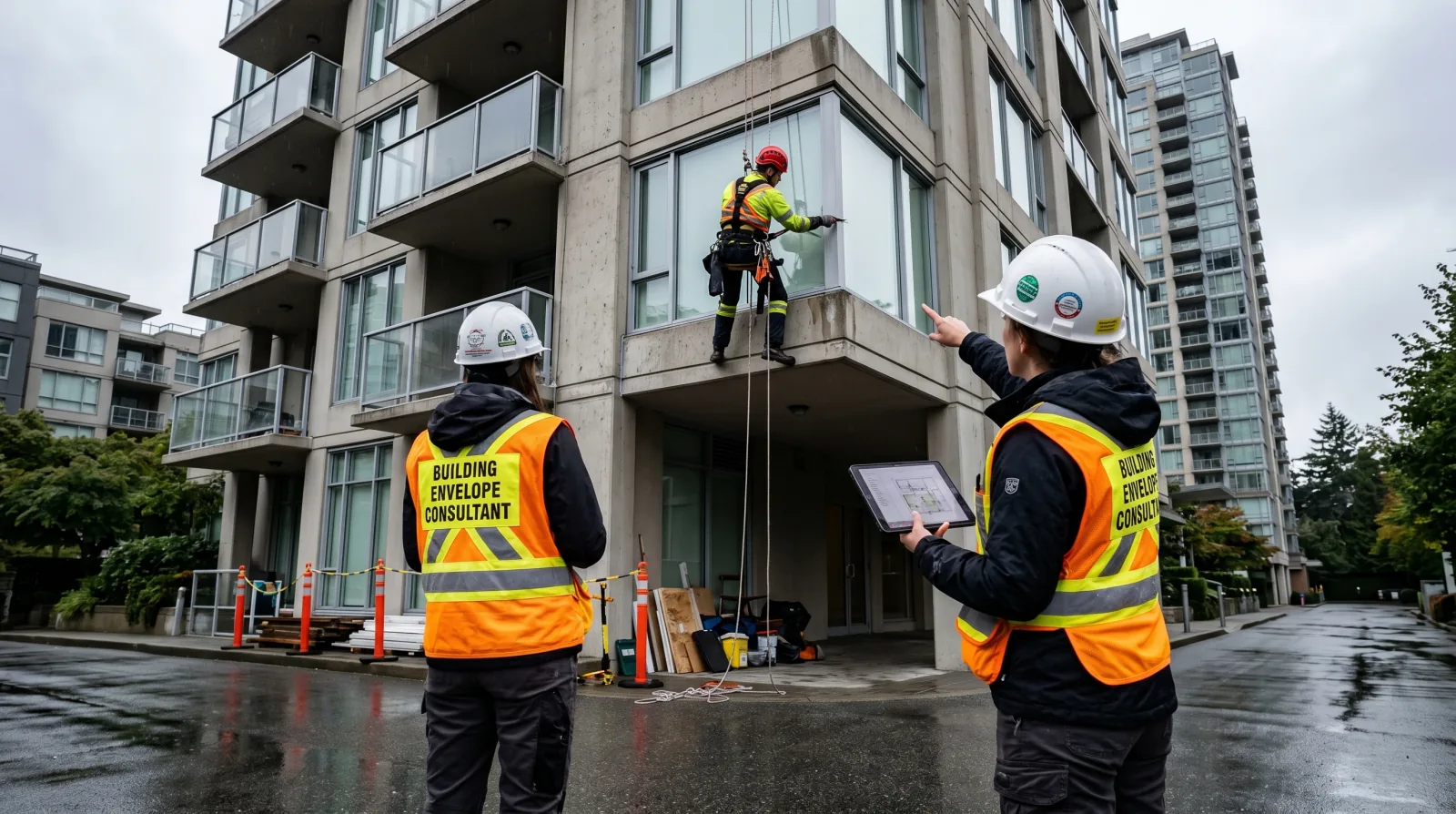
To do this on a high-rise, the consultant works with a rope access or swing stage crew. The access crew puts the consultant’s eyes, hands, and instruments directly on every elevation of the facade, instead of assessing the upper floors from the ground. You cannot moisture-test a 20th-floor window perimeter from the sidewalk.
What the report gives you
The deliverable is a report the strata council can actually act on. A good BECA does four things: it documents the condition of each envelope component, it identifies the deficiencies and explains what is causing them, it prioritizes those deficiencies by urgency, and it recommends a scope of remediation — often with a suggested sequence and an opinion on relative cost.
That structure is what makes it useful. Instead of a vague sense that the building needs work, the council gets a ranked list: this is urgent, this can wait two years, this is monitoring-only, and here is roughly what addressing each one involves. It is the basis for planning repairs, staging work across budget cycles, and engaging a contractor with a defined scope rather than an open-ended “come look at our building.”
Catching problems while they are still cheap
The real return on a BECA is timing. Envelope problems get dramatically more expensive as they progress. A failing sealant joint is a maintenance item. The same joint, left until wind-driven rain has saturated the wall behind it, becomes a wall repair with concealed damage. Early concrete spalling on a balcony is a localized repair; ignored, it becomes structural restoration.
A BECA catches these on the exterior, while they are still exterior maintenance, before they become interior damage and emergency special levies. On an aging building in an exposed North Vancouver or Coquitlam location, where the weather is relentless, that early warning is worth far more than the assessment costs. The whole point is to find the problems on your schedule, not on the building’s.
How often a building should be reassessed
A condition assessment is a snapshot, not a permanent verdict. The envelope keeps aging after the consultant leaves, so the question of how often to reassess matters as much as the first assessment.
For most Metro Vancouver strata buildings, a periodic envelope review every few years is a sensible baseline, with the interval tightening as the building ages and as components approach the end of their service life. A 30-year-old tower in an exposed North Vancouver location needs eyes on its envelope more often than a sheltered 12-year-old building. Certain events should also trigger a reassessment regardless of the schedule: a major storm season that produced leaks, the discovery of unexpected deterioration, the approach of a warranty deadline on a newer building, or the lead-up to a depreciation report or a planned capital project. The assessment is most valuable right before you have to make a decision, because that is when current data is worth the most.
Between full assessments, the building should not go dark. Ongoing visual monitoring by the property manager or a maintenance contractor — noting new stains, cracks, failed joints, or ponding — fills the gap and flags when an early reassessment is warranted. The formal BECA and routine monitoring work together: the assessment sets the baseline and the plan, the monitoring catches changes against it.
What an assessment can and can’t tell you
It is worth being honest about the limits, because an assessment oversold is an assessment that disappoints. A building envelope condition assessment is focused on the envelope — the walls, roof, windows, balconies, and the details that keep weather out. It is not a full building assessment of every system, so it will not speak to the elevators, the plumbing, the electrical, or the structure beyond what relates to the envelope. A strata that needs a whole-building picture for long-range planning needs a broader study; the BECA is the envelope-deep dive within that.
There is also a reality about hidden conditions. Even a thorough assessment with testing is sampling — it cannot open every wall on a high-rise. A consultant uses visual review, moisture readings, and targeted openings to build a well-supported picture, but there is always some possibility that conditions behind an unopened section differ from what the sampling suggested. A good consultant is clear about this and recommends further investigation where the evidence points to a concern that the visible signs cannot fully confirm. That is not a weakness of the method; it is the honest scope of it.
What the assessment does deliver is the thing a strata cannot get any other way: an evidence-based, prioritized understanding of the building’s exterior, written by someone who physically examined it. That is enough to plan repairs, sequence them sensibly, fund them through the reserve, and stop being surprised by the envelope. Knowing the limits just means using the assessment for what it is — the best available read on the building’s exterior condition, not a guarantee about every square metre of concealed wall.
Pairing the assessment with reserve planning
There is a timely reason for Metro Vancouver stratas to think about this now. A current envelope condition assessment feeds directly into the depreciation report. Instead of the report preparer assuming a generic service life for the membranes, sealants, and coatings, a BECA gives them real condition data for this specific building — which produces a far more defensible 30-year reserve forecast.
With the July 1, 2026 depreciation report deadline bearing down on stratas across Metro Vancouver, pairing a condition assessment with the report is one of the smarter moves a council can make. The BECA versus depreciation report guide lays out exactly how the two documents differ and work together, and the building envelope repair service page covers what happens once the assessment identifies work to be done. Know what shape your building is really in, and every decision after that — what to fix, when, and how to fund it — gets easier and cheaper. The councils that struggle are almost always the ones making envelope decisions blind, reacting to whatever failed most recently; the ones that run smoothly are the ones working from a current assessment, on a building in Burnaby, Richmond, or the North Shore that they actually understand from the cladding in. The assessment is not the expensive part of caring for a building envelope. Not having one is — because everything you do without it is a guess, and on a Metro Vancouver tower the guesses get paid for in special levies.
Frequently Asked Questions
More from BC Strata Building Envelope Guide
Building Envelope Warranty Claims for BC Strata Corporations
When a New Westminster strata finds an envelope defect, the first question is who pays — the 2-5-10 warranty or the owners. How to tell a warranty defect from maintenance, document it, and meet the deadlines that decide the answer.
Read article →Building Envelope Engineer vs Contractor: Roles on a BC Strata Project
On a Coquitlam strata restoration, the engineer specifies and the contractor builds. Who does what, who warranties what, and why you need both on a project.
Read article →Building Envelope Due Diligence for Vancouver Condo Buyers
Before you write an offer on a Metro Vancouver condo, the building envelope is the single biggest source of surprise costs. What to ask, what documents to read, and what red flags to walk away from — written for buyers, not for engineers.
Read article →