Why Restoration Budgets Grow After the Work Starts
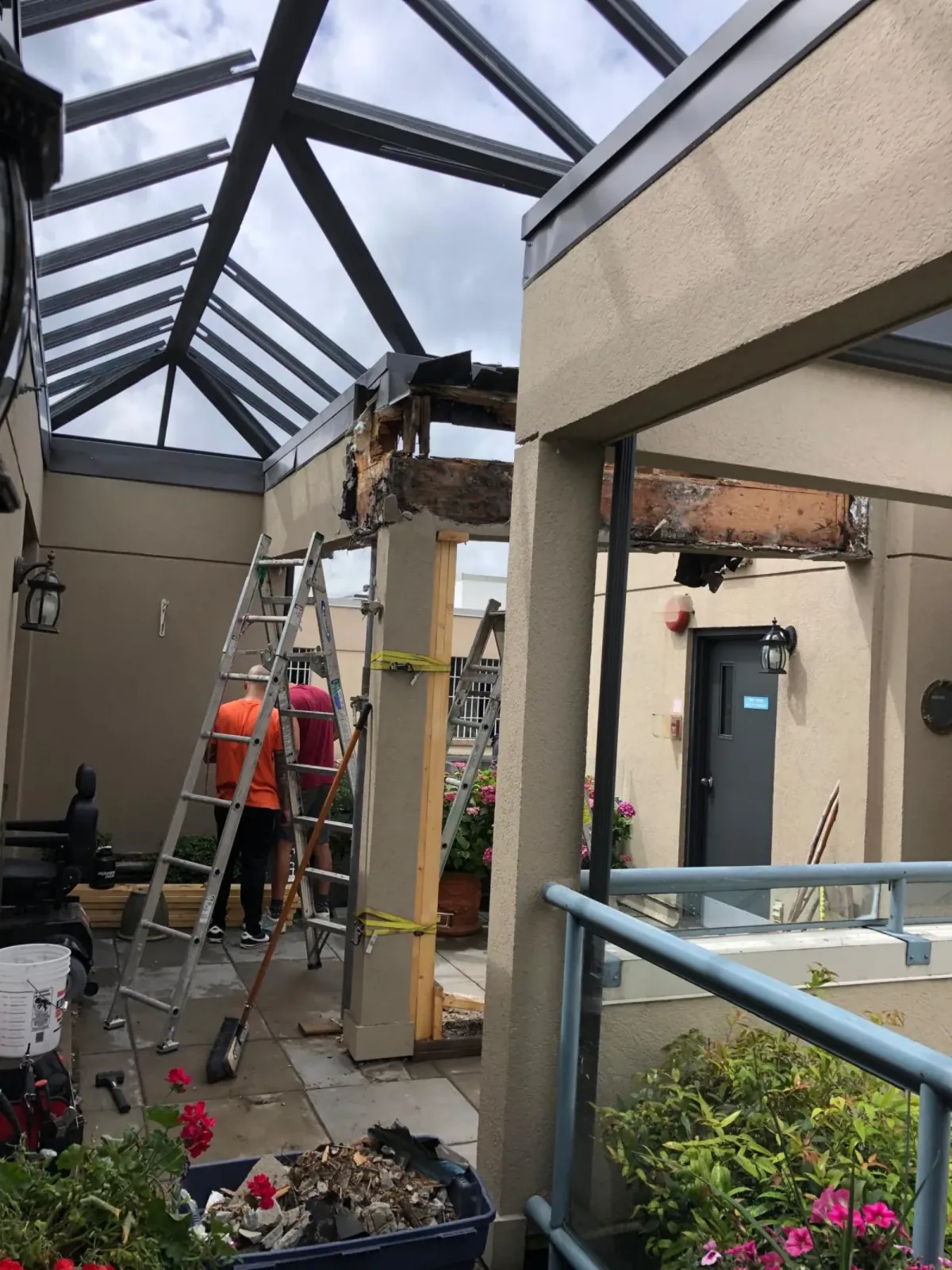
Every strata that has been through a major envelope restoration knows the pattern. A budget is approved, the work starts, and within two months there is a conversation about additional cost.
Owners generally interpret this as somebody being taken advantage of. Occasionally they are right. Far more often, the project is behaving the way restoration projects behave, and the problem is that nobody explained this before the vote.
Restoration is priced on incomplete information
New construction is priced from drawings. Everything in the scope is drawn, specified, and countable before anyone breaks ground.
Restoration is not. The scope is a building that has been standing in Metro Vancouver rain for thirty years, and the condition that matters most is behind the cladding, under the membrane, and inside the wall assembly.
A pre-tender assessment reaches what it can reach. Test openings, sounding, moisture readings, and visual inspection at accessible points produce a picture of the condition at those points, and the rest is inferred. The inference is educated and it is frequently accurate, and sometimes it is wrong in the direction of more work.
So a contractor removes cladding on the north elevation and finds sheathing that has been wet for years, in an area where no test opening happened to land. That deterioration was not in the contract, because it could not be seen. It is real, it is now exposed, and it has to be addressed before anything goes back on.
That is a legitimate change order. It is also completely unavoidable, and the only question is how well the project is set up to handle it.
Change order or scope creep
These get conflated and they are different things.
A change order is a documented response to a condition or an instruction outside the original contract. It has a description, a price, an approval, and a paper trail. Whether or not anyone likes it, it is a managed event.
Scope creep is work being added incrementally without a clear decision. It happens through conversations on site: a council member mentions something while walking past, a contractor agrees it makes sense to handle it while they are there, and nobody prices it or writes it down. Three months later the invoice includes work nobody remembers authorizing.
Change orders make budgets grow predictably. Scope creep makes them grow invisibly, and it is far more damaging because it removes the strata’s ability to say no at the point of decision.
The investigation that pays for itself
The single most effective way to reduce change orders is to open test areas before tender.
This means paying, before the project is approved, to remove sections of cladding or membrane at representative locations so that the actual condition is known. Bidders then price a documented condition rather than a guess, and the guesses are exactly what return as change orders later.
Councils resist this because it is money spent on a project that has not been approved, and it feels like paying twice. In practice the investigation typically costs a small fraction of the eventual change orders it prevents, and it produces something more valuable than the saving: bids that can be compared against each other on equal information.
The same logic underlies the approach set out in the post on mock-up testing before envelope restoration, where the test area also confirms the proposed repair method works on that building before it is committed across the whole facade.
Unit rates, agreed in advance
The second protection is commercial rather than technical.
Before the contract is signed, agree unit rates for the categories of work most likely to increase: additional concrete repair per square metre, additional sealant per linear metre, additional sheathing replacement per sheet, and so on. The tender should require these, and they should be compared alongside the lump sum when bids are evaluated.
With agreed rates in place, a change order becomes an argument about quantity, which is measurable and verifiable on site. Without them, it is an argument about price, in a negotiation where the contractor is already mobilized and the strata has no practical alternative. That is not a position anyone should choose to be in.
This is a specific item to build into the tender documents described in the post on envelope tender scope of work, and it is frequently missing from strata tender packages.
Who says yes, and how fast
Projects fail in both directions on approval authority.
Where every change requires a full council decision, the project stalls. Crews stand down, the schedule slips, and in this climate a schedule slip in September means working through the wet season, with the weather delays and protection costs that brings.
Where anyone on site can authorize work, the strata has no budget control at all.
The workable arrangement is a named approver with a defined dollar threshold, agreed in writing before the work starts. Below the threshold, the approver decides and reports. Above it, the council decides on a defined timeline that everyone has committed to in advance. Property managers who run these projects regularly build this into the contract as a matter of course.
Contingency is not optimism
A contingency in an envelope restoration budget is not padding, and it is not an admission that the estimate is poor. It is the recognition that some of the scope is genuinely unknown at approval.
The right amount depends on how much investigation preceded the tender and on what condition the building is in. What matters more than the exact figure is that it exists and that owners were told it exists at the vote, so that using it is a planned event rather than a crisis.
A project that discovers additional deterioration and has no contingency has to stop and go back for funding approval, which in a strata means a general meeting. That process takes weeks, during which a partially demolished building sits open, protected by temporary measures, accruing cost. The approach set out in the post on contingency allowance in envelope restoration budgets exists precisely to avoid that outcome.
Telling owners before it happens
Most of the anger about change orders is not about the money. It is about being surprised.
Owners who were told at the outset that the budget includes a contingency, that concealed conditions are expected, and that they will receive a monthly figure showing where the project stands, generally handle the news well. Owners who voted on a number and then heard nothing until a second number arrived do not.
Report the same way every month: committed cost against approved budget, with a plain explanation of what moved and why. A trend is manageable. A sequence of shocks is not, and the difference is entirely in the reporting rather than in the project.
The projects that finish with a council still on speaking terms are rarely the ones with no change orders. They are the ones where everybody understood in advance that there would be some.
Sources and further reading
- Condominium Home Owners Association of BC, guidance on major repair project management, referenced 2026
- Government of British Columbia, Strata Property Act, provisions on expenditures and general meeting approvals, referenced 2026
- BC Housing, Building Enclosure Design Guide, investigation and assessment practice, referenced 2026
- Allweathercoating project records, Metro Vancouver, 2026
Frequently Asked Questions
More from BC Strata Building Envelope Guide
The Survey That Has to Happen Before Anyone Touches the Building
Older sealants, coatings, and roofing can contain asbestos or lead. In BC the survey is a legal requirement before demolition work starts, and finding out late stops the job.
Read article →The Contingency Line: Why Envelope Budgets Need Room for the Unknown
You cannot see behind cladding until it comes off. A restoration budget without a contingency is a budget that will be exceeded, and everyone in the room knows it.
Read article →Telling Residents What's Coming: Communication on an Envelope Project
Most complaints during a restoration project are about surprise, not about the work. Noise, balcony access, and privacy are manageable when people know what is happening and when.
Read article →