Scheduling envelope work in a wet climate
Every coating, sealant, and membrane carries the same fine print: dry substrate, minimum temperature, cure time before weather. In a region that concentrates its dry days into a few summer months, that fine print becomes the project schedule. The stratas that get their envelope work done well, and done this year, are the ones that plan against the climate instead of hoping past it.
The climate is the project manager
Vancouver International Airport averages 1,189 mm of precipitation a year on the 1991 to 2020 climate normals, and the distribution matters more than the total: the rain concentrates into the months from fall to spring, leaving a compressed dry season in which nearly all weather-critical envelope work wants to happen. That compression, not contractor capacity alone, is why summer books out.
The materials set the rules. Products bond and cure within the conditions printed on their technical data sheets, and those sheets, not the calendar or the contract, decide whether a given day is workable. Substrate dryness is the sneaky constraint: a wall that took a week of rain needs dry days before coating, so a "dry Tuesday" between systems is often not an application day at all. Scheduling is the art of stacking scope, forecast, and data sheet until they agree.
What fits where in the year
| Work type | Best window | Wet-season reality | Scheduling notes |
|---|---|---|---|
| Elastomeric and exterior coatings | Late spring through early fall | Possible only under hoarding with heat; substrate must be dry and warm enough for the product to cure | Coatings need dry substrates, and concrete or stucco that spent a week in the rain stays damp long after the sun comes out. The drying time before application belongs in the schedule alongside the application days themselves. |
| Sealant and caulking replacement | Dry stretches, spring through fall | Short runs achievable in dry windows; joint faces must be dry and within the product’s application temperature range | The most weather-window-friendly envelope trade, because work proceeds joint by joint. A crew can pull off and resume without losing completed work, which makes winter sealant repair practical in a way winter coating is not. |
| Traffic and balcony membranes | Summer, on dry decks | Tenting and heat make small areas possible; fast-cure systems widen the window | Liquid-applied membranes are unforgiving of damp substrates and cold cures. Fast-curing systems like PMMA tolerate cooler weather better than conventional polyurethanes, which is one reason they get specified for shoulder-season deck work. |
| Concrete repair and restoration | Dry season for exposed work | Localized repairs proceed under protection; repair mortars have minimum application temperatures per their data sheets | Demolition and forming can run in worse weather than the material placement can. Sequencing the noisy, weather-tolerant phases into the shoulder season and saving placement for windows is how winter concrete programs stay on schedule. |
| Inspections, leak investigation, drain clearing | Year-round | Fully practical, and often most useful mid-season | Water testing and leak tracing actually benefit from the wet season, because active leaks show their paths. Rope access inspection runs in most weather short of high wind. |
Winter work is real work, with real conditions
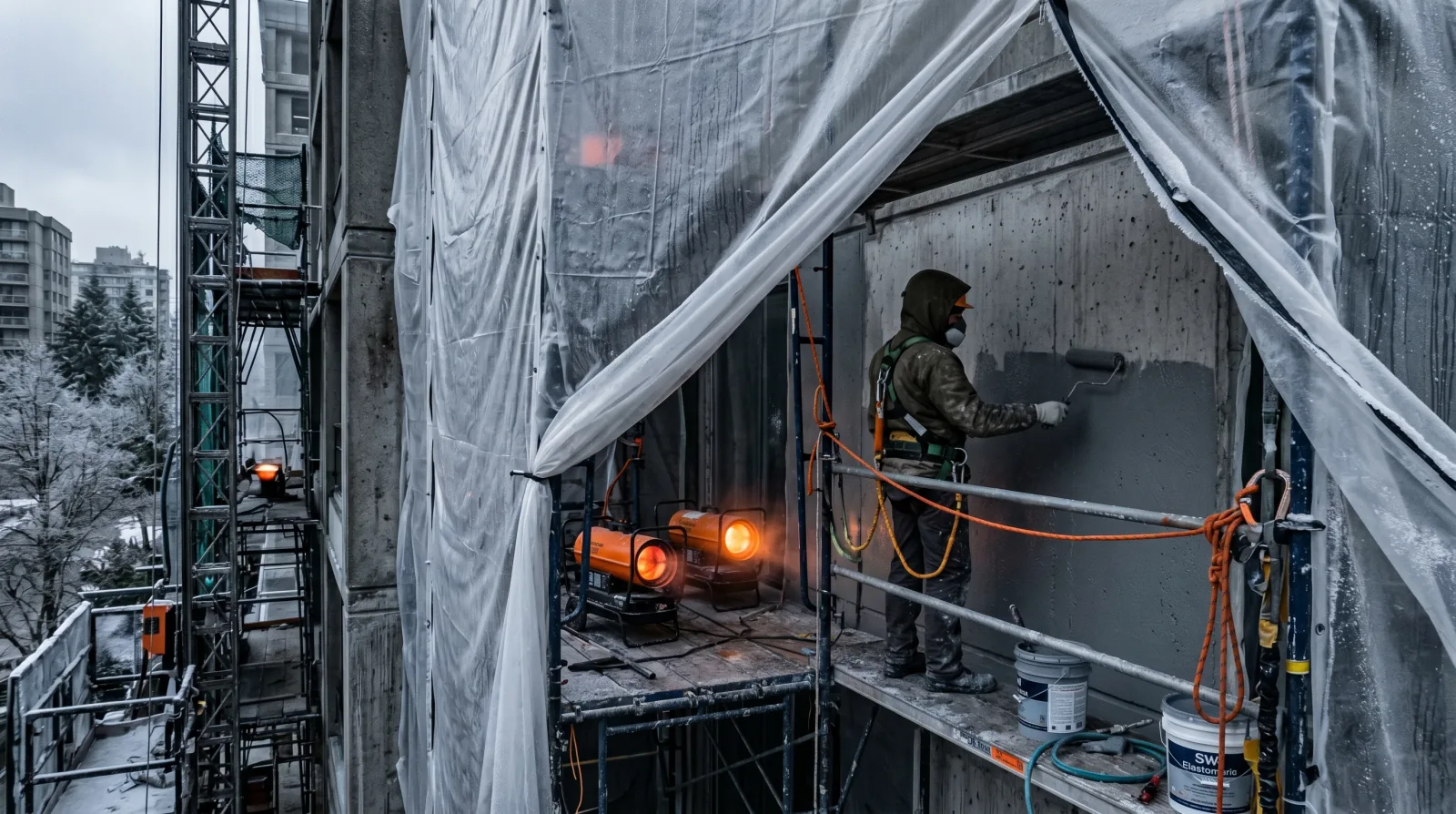
The wet season does not close the industry; it changes the setup. Hoarding and heat create a controlled pocket in which coatings and repair mortars can cure to specification, and phased trades like sealant replacement work the dry gaps between systems. Our crews run restoration through BC winters this way, and the techniques, enclosures, heated cures, fast-cure materials, are covered in our article on winter restoration and cold-weather coating application.
The honest trade-off is efficiency. Winter programs carry enclosure costs, standby days, and slower production, which is why they suit urgent and localized scopes better than discretionary full-elevation work. What winter is genuinely good for is everything diagnostic: leak investigation runs best when leaks are active, and the wet season supplies the test conditions free of charge. That is also the logic of the after-storm routine in monitoring between storms.
The planning calendar that avoids the squeeze
Work backward from the dry season. Fall: inspect, using the pre-storm inspection checklist, and let the winter's storms confirm or expand the findings. Winter: scope the repairs, run the engineering review where one is needed, and take the project through council and owner approvals. Late winter: contract, so the crew calendar still has summer room. Summer: execute. A strata on this cycle gets its pick of windows; a strata that starts scoping in May joins the queue behind everyone who did not wait.
Winter damage feeds the same loop. A joint that failed in a January storm gets an interim measure, per temporary repairs done right, a line in the log, and a place in the summer scope, rather than a rushed wet-season repair that fights its own curing conditions. For the full repair side of that pipeline, from scoping through execution, see our building envelope repair service; for the season-wide picture this calendar belongs to, the storm season readiness hub.
Quick answers
What is a weather window for envelope work?
A weather window is a forecast stretch of conditions that lets a specific product be installed and cure properly: dry enough, warm enough, and long enough. Every material defines its own window; a sealant may need the joint dry and a modest temperature for a day, while a coating may need a dry substrate beforehand and dry days after application to cure. Scheduling envelope work in Metro Vancouver is largely the craft of matching scopes to windows.
What conditions do coatings and sealants need to cure properly?
The pattern across products: a clean, dry substrate, air and surface temperatures within the manufacturer’s stated application range, and enough dry time afterward for the product to set before rain hits it. The exact numbers vary by product and are printed on each technical data sheet, which is the document that governs. In practice the substrate is the usual constraint on the coast: walls and decks need dry days before application as well as during it.
Why does envelope work book out in summer in Vancouver?
Because the region’s reliable dry weather is compressed into a few months and every strata, property manager, and contractor plans around the same stretch. Coatings, membranes, and large sealant programs all want those weeks, so crews, swing stages, and engineering reviews get spoken for months ahead. Councils that approve work in winter get summer dates; councils that approve in June are usually choosing between fall risk and next year.
Scheduling questions
What is a weather window for envelope work?
A weather window is a forecast stretch of conditions that lets a specific product be installed and cure properly: dry enough, warm enough, and long enough. Every material defines its own window; a sealant may need the joint dry and a modest temperature for a day, while a coating may need a dry substrate beforehand and dry days after application to cure. Scheduling envelope work in Metro Vancouver is largely the craft of matching scopes to windows.
What conditions do coatings and sealants need to cure properly?
The pattern across products: a clean, dry substrate, air and surface temperatures within the manufacturer’s stated application range, and enough dry time afterward for the product to set before rain hits it. The exact numbers vary by product and are printed on each technical data sheet, which is the document that governs. In practice the substrate is the usual constraint on the coast: walls and decks need dry days before application as well as during it.
Why does envelope work book out in summer in Vancouver?
Because the region’s reliable dry weather is compressed into a few months and every strata, property manager, and contractor plans around the same stretch. Coatings, membranes, and large sealant programs all want those weeks, so crews, swing stages, and engineering reviews get spoken for months ahead. Councils that approve work in winter get summer dates; councils that approve in June are usually choosing between fall risk and next year.
Can sealant work be done in winter on the coast?
Yes, selectively. Sealant replacement proceeds joint by joint, so a crew can work productive dry days and stand down through systems without losing completed work. The requirements do not relax: joint faces must be dry and the products used within their stated temperature ranges, which some low-temperature formulations extend. Winter is a legitimate season for urgent joint repairs and phased programs, and a poor one for racing large elevations against the forecast.
What envelope work can proceed in the rain?
Investigation and preparation, mostly. Leak tracing and water testing work fine in wet weather, and an active storm is diagnostic gold. Drain and scupper clearing, inspections, demolition, surface preparation under protection, and rigging all proceed. What cannot proceed in rain is bonding: applying coatings, membranes, or sealants to wet surfaces produces work that fails early, and a contractor willing to caulk in the rain is solving their schedule problem with your building.
When should a strata book summer envelope work?
The season before it. A summer coating or membrane program needs its scope, engineering review where applicable, owner approvals, and contract in place by late winter or early spring, because crew calendars for the dry months fill first. The sequence that works: assessment in fall, scoping and approvals over winter, mobilization as the dry season opens. Depreciation report timelines give councils the planning runway to run exactly that sequence.
What happens if coating is applied to a damp surface?
The bond fails, usually within seasons rather than decades. Moisture in the substrate turns to vapour under sun and warmth, and the pressure lifts the coating in blisters; adhesion that never formed properly lets sections peel under wind and thermal movement. The failure often looks like a product defect but is an application defect, and the repair means stripping and redoing the work. Waiting for a genuinely dry substrate costs days; recoating a failed elevation costs a season.
How do contractors protect envelope work from rain mid-project?
With sequencing and shelter. Sequencing means opening only as much of the wall or deck as can be closed before weather: joints stripped in the morning get sealed the same day, and membranes are detailed so each day ends watertight. Shelter means hoarding, tarping, and tenting, up to full scaffold enclosures with heat for winter programs, so weather-critical steps happen inside a controlled pocket. Both are planned before mobilization, not improvised when the forecast turns.
Is winter envelope work more involved than summer work?
Generally yes, in setup rather than in standards. Winter programs add hoarding and heat to create curing conditions, build weather standby into the schedule, and favour scopes that tolerate interruption, sealant runs, localized repairs, investigation, over large continuous applications. The specification does not change; the effort to meet it does. For urgent repairs the added logistics are simply the cost of not waiting; for discretionary work, the comparison against a summer slot is worth making.
What is the best season for membrane replacement in Metro Vancouver?
Summer, planned like a harvest. Liquid-applied membranes want dry decks, warm cures, and consecutive rain-free days, which the coast concentrates into the summer months. Fast-cure systems and tenting stretch the practical season on both ends, and small areas can be done under protection in winter when a failure will not wait. But a full deck or plaza program belongs in the dry season, booked the winter before, with the fall inspection cycle feeding the scope.
Want your envelope work in the right window?
We scope in the wet season and execute in the dry one, and we tell you honestly which repairs cannot wait, across Vancouver, North Vancouver, West Vancouver, and Burnaby.