Monitoring between storms
Storm response on most buildings is episodic: a leak, a scramble, a repair, then silence until the next one. Monitoring replaces the episodes with a routine, the same short checks, the same photo angles, the same log, repeated through the wet season. It is the least dramatic practice in this hub and, per hour spent, the one that saves Metro Vancouver stratas the most money.
Why the routine beats the response
A wet season here is a series of loading events with short gaps between them, and the gaps are where the information is. Right after a storm, every drainage fault is marked by standing water, every new stain is fresh, and every resident who saw a drip still remembers it. Two weeks later the roof has dried, the stain has faded into the ceiling texture, and the memory is gone. Monitoring is simply the discipline of collecting the evidence while the building is still presenting it.
The other reason is trend. Envelope problems rarely announce themselves; they drift, a crack widening by millimetres, a damp patch that dries a little less each time. No single observation catches drift. A log does, which is why the routine is built entirely around repeatable measurements: same spots, same angles, same instruments, different dates.
The routine, on three clocks
After every major storm
Walk the roof or have it walked: confirm drains and scuppers cleared, note any ponding still standing hours after the rain. Sweep the corridors, parkade, and top-floor ceilings for new stains. Collect resident reports. Fifteen to thirty minutes on most buildings, and it catches the problems while they are one storm old.
Monthly through the wet season
Shoot the recurring photo points: the same drains, joints, cracks, and stains from the same positions. Take moisture readings at any spot on the watch list and log them beside the previous numbers. Review the incident log for patterns, the same elevation, the same stack, the same weather direction.
At the season's edges, fall and spring
Fall gets the full pre-storm inspection before the first systems arrive. Spring gets the damage review: compare the photo points against October, list what the winter changed, and feed the findings into repair scoping while the summer weather windows are still bookable.
Drains are the heartbeat check
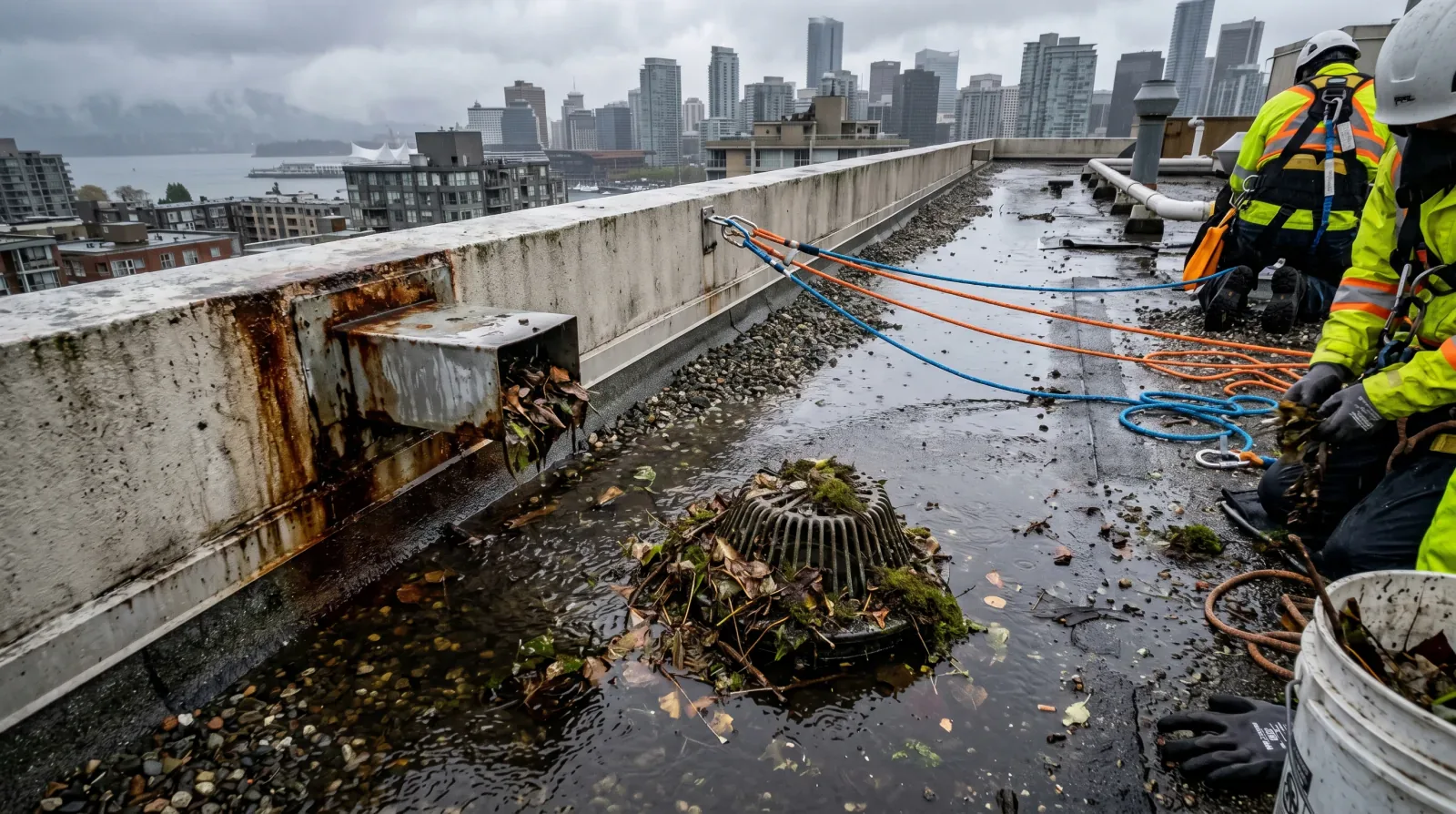
If the routine only had one item, it would be drainage. Roof drains and scuppers fail gradually and invisibly: each storm adds leaves and granules, capacity drops, and the failure announces itself only when a big system finally exceeds what is left. Post-event drain checks break that pattern, and fall leaf drop makes them non-negotiable between October storms. On buildings where the roof is not casually accessible, this is a natural rope access task, often combined with the visual checks, and our article on roof drain and scupper maintenance covers what a proper clearing visit includes. The crews that do this work are the same ones behind our rope access building maintenance service.
The log is the product
Everything the routine collects lands in one place: the incident log started in documenting damage for insurance, extended with the photo points and moisture series. Kept for a season, it becomes the building's storm biography, and it changes decisions. Councils stop debating whether the northeast stain is getting worse, because the photos answer it. Repair scopes shrink, because the pattern shows which storms and which elevations produce the symptoms. And when something does need a professional, the diagnostic phase starts from data instead of from zero, which is exactly the head start described in storm damage triage.
The log also closes the seasonal loop. Spring findings feed the repair scoping cycle in scheduling envelope work in a wet climate, and the fall reset is the pre-storm inspection checklist, which rebuilds the photo baseline the winter's monitoring will run against. Routine in, planning out, year after year.
Keep it small enough to survive
Monitoring programs die of ambition. A twelve-page checklist gets done twice and abandoned; a fifteen-minute walk with eight photo points runs all winter. Start with the known weak spots, the drains, and whatever leaked last year. Add points only when findings earn them. The comparison to draw is with a fitness habit rather than a project: frequency beats thoroughness, and the pass that happens beats the perfect one that does not. The rest of the seasonal system this routine belongs to is in the storm season readiness hub.
Quick answers
What should a strata monitor between storms?
Three things, on a rhythm: drainage, watch-list spots, and new symptoms. Drainage means roof drains, scuppers, and gutters checked after each major event, because every storm delivers fresh debris. Watch-list spots are the known cracks, stains, and past repairs, photographed and measured on a recurring cycle. New symptoms come from a quick sweep of ceilings, the parkade, and resident reports. The routine is short; its value is in the repetition.
What is a moisture log?
A moisture log is a dated series of readings taken with a moisture meter at fixed, marked locations, the damp patch in the stairwell, the stain under the roof drain, the wall that leaked last winter. A single reading tells you little; the series tells you whether an assembly is drying between storms or staying saturated, and whether a repair actually worked. Record the location, date, reading, and meter used, and keep it with the strata records.
What are recurring photo points?
Recurring photo points are fixed camera positions, marked on a plan or described precisely, from which the same building details get photographed on every monitoring pass: the same drain, the same joint, the same crack, framed the same way. Lined up over months, they turn slow change into something visible, a crack widening, a stain spreading, sealant opening. They cost minutes to shoot and routinely settle questions that would otherwise take an investigation.
Monitoring questions
What should a strata monitor between storms?
Three things, on a rhythm: drainage, watch-list spots, and new symptoms. Drainage means roof drains, scuppers, and gutters checked after each major event, because every storm delivers fresh debris. Watch-list spots are the known cracks, stains, and past repairs, photographed and measured on a recurring cycle. New symptoms come from a quick sweep of ceilings, the parkade, and resident reports. The routine is short; its value is in the repetition.
What is a moisture log?
A moisture log is a dated series of readings taken with a moisture meter at fixed, marked locations, the damp patch in the stairwell, the stain under the roof drain, the wall that leaked last winter. A single reading tells you little; the series tells you whether an assembly is drying between storms or staying saturated, and whether a repair actually worked. Record the location, date, reading, and meter used, and keep it with the strata records.
What are recurring photo points?
Recurring photo points are fixed camera positions, marked on a plan or described precisely, from which the same building details get photographed on every monitoring pass: the same drain, the same joint, the same crack, framed the same way. Lined up over months, they turn slow change into something visible, a crack widening, a stain spreading, sealant opening. They cost minutes to shoot and routinely settle questions that would otherwise take an investigation.
How soon after a storm should drains be checked?
Within a day or two of any major system, and ideally while the roof is still wet, because standing water marks every drainage problem for you. Ponding that persists hours after rain ends points at a blocked or restricted drain; debris rafts show where the next blockage is forming. Fall is the high-risk period, when leaf drop can refill a strainer between storms that arrive days apart, so post-event checks matter most exactly when they are easiest to skip.
How does monitoring fit into a depreciation report?
A depreciation report estimates the remaining service life of envelope components on an inspection cycle measured in years; monitoring supplies the ground truth in between. A log showing a membrane pondings after every storm, or photo points showing a joint opening season by season, gives the next report author real condition data instead of an educated guess, and it gives the council early warning when a component is aging faster than the report assumed.
Who should keep the monitoring records in a strata building?
The same single owner who keeps the damage documentation, usually the property manager or a designated council member. One person maintains the log, holds the photo point list, and schedules the passes; anyone can contribute observations. Continuity is the entire point of monitoring, and records split across personal phones and inbox threads lose exactly the comparability that makes the routine worth doing.
What changes between storms signal a developing envelope problem?
Trend is the signal. A stain that grows after each event, a moisture reading that climbs instead of falling back, a crack that photographs wider each month, ponding that appears where it never used to, efflorescence tracking further down a wall: each says the building is taking on water faster than it sheds it. Any one of them earns a closer look, and a pattern across several is a scheduled investigation, not a spring maybe.
Can monitoring replace professional envelope inspections?
No, and it is not meant to. Monitoring is surveillance: cheap, frequent, and shallow, done by whoever manages the building. Professional inspection is diagnosis: less frequent, deeper, done with training and access equipment, and able to open assemblies and test rather than observe. The two feed each other. Monitoring tells the professionals where to look and when to come early; inspections reset the watch list monitoring works from.
What tools does a between-storms monitoring routine need?
A phone camera, a shared document or spreadsheet for the log, the photo point list, and ideally a basic moisture meter, the whole kit fits in a pocket. Binoculars help for flashing and upper walls. What the routine needs more than equipment is a calendar slot and a named owner, because the failure mode of monitoring is never the tools; it is the month nobody did the pass.
How does monitoring between storms save a strata money?
By moving discoveries earlier on the damage curve, where the fixes are small. A blocked drain found after a storm costs a clearing visit; found in February under a failed membrane, it costs a roofing repair. The log also makes repairs cheaper to buy: a contractor arriving to a dated photo series and moisture history skips most of the exploratory phase, and scopes tightly instead of defensively. The routine costs staff hours; what it prevents costs special levies.
Want the roof checked after every major storm?
We run recurring drain clearing and envelope monitoring visits on strata and commercial buildings across Vancouver, North Vancouver, West Vancouver, and Burnaby, with photos and findings delivered for the strata records.