Documenting damage for insurance
One note before anything else: this page is about record keeping, and only record keeping. What a policy covers, whether to report an event, and how a claim proceeds are questions for the strata's insurance broker, and we recommend every council put that conversation on the agenda early. What a contractor can tell you is what records turn out to be useful, because we read them, and their gaps, on Metro Vancouver buildings all winter.
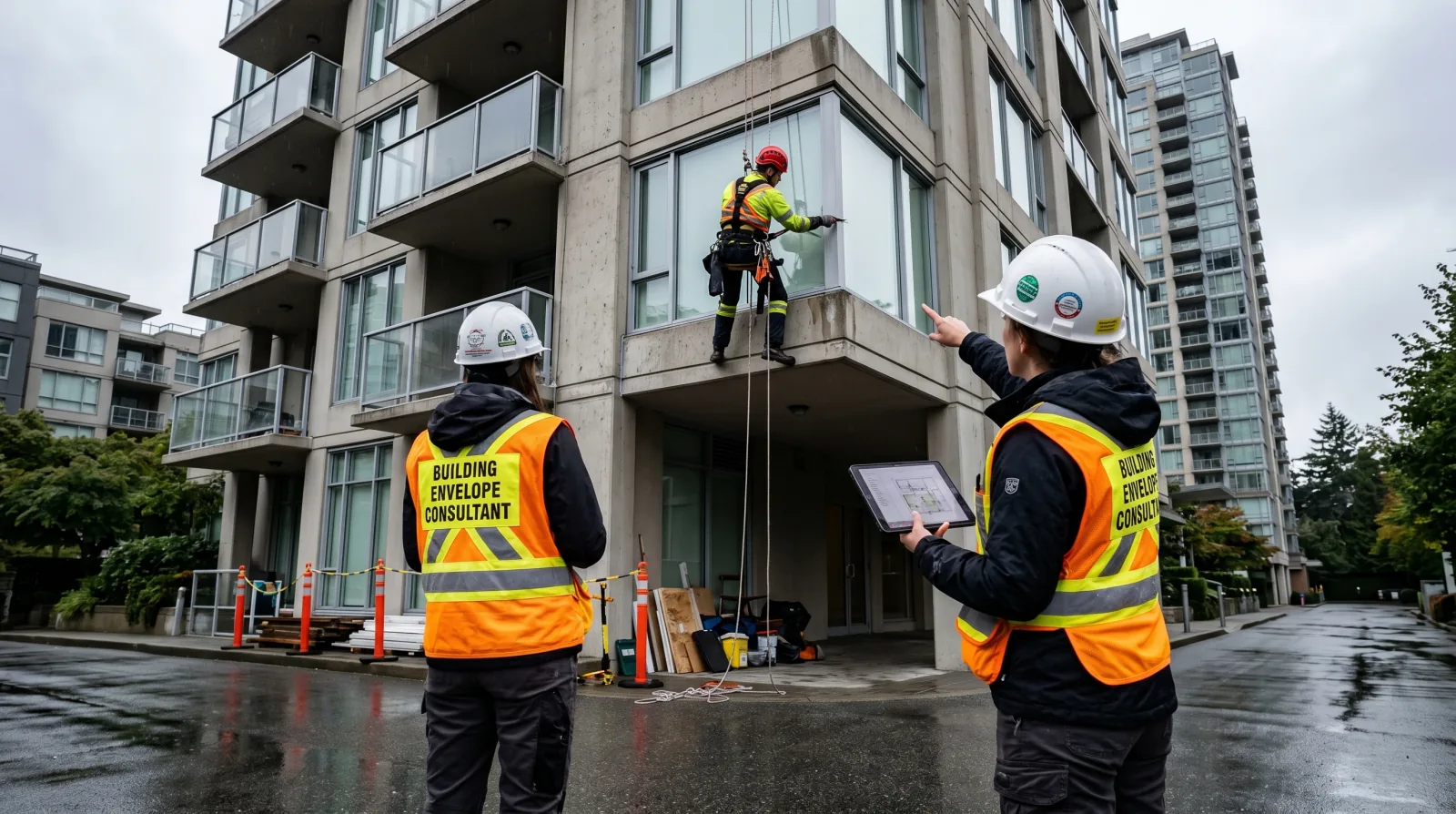
Why records beat memory every time
A wet winter produces more events than anyone can hold in their head. Councils turn over, managers rotate portfolios, and by the time a stain becomes an investigation, the person who saw it happen has moved to Kelowna. The building's paper memory is the only memory that survives, and it is either built in the week of the event or reconstructed, badly, years later.
Good documentation serves three audiences at once. The council uses it to prioritize and to answer owners. Contractors use it to diagnose, because a dated photo series often replaces a day of exploratory work. And the strata's broker works from it when an event becomes a claim conversation. One set of records, three jobs.
What to record
Six items, none requiring special equipment beyond a phone and, ideally, a basic moisture meter.
Date, time, and conditions
Every entry starts with when. Record the date and approximate time water was first noticed, and a sentence about the weather: heavy rain, strong wind, direction if known. Weather context is what lets anyone later connect a specific storm to a specific finding, and it costs one line to capture.
Photos from repeatable positions
Photograph each affected area wide, medium, and close, from spots you can stand in again next month. Include something for scale, and shoot the same angles used in the pre-storm record so before and after line up. Phone photos carry their own timestamps and location data, so keep the original files; copies pasted into a report lose that metadata.
Where the water showed, and how much
Plain description beats adjectives: which unit or common area, which wall or ceiling, dripping or damp, area affected in rough dimensions. Note what was directly above and outside the wet spot. If the water stopped when the rain stopped, say so; that correlation is diagnostic gold later.
Moisture readings, if available
A moisture meter reading with its date, location, and the meter type turns "still damp" into a number that can be compared next week. A series of readings at the same spot shows whether an assembly is drying or staying wet between storms, which is often the fact that decides how urgent the repair is.
The incident log
One running document per building: every event, every resident report, every finding, every temporary measure with its date, every contractor visit. Kept with the strata records, it becomes the building's storm history, and patterns emerge from it that no single entry shows, like the same stack leaking in three different storms.
Repair and maintenance records alongside
File what was done about each finding next to the finding: quotes, invoices, scope descriptions, and photos of completed work. Records that show the strata inspected, maintained, and responded on a reasonable schedule are precisely the ones worth having when the damage becomes a claim conversation.
Start the record before the damage
The most valuable photo in any damage file is the one taken before the storm. A dated image of the sound condition turns every later argument about "was this pre-existing" into a comparison of two pictures. That is why the photo set from the pre-storm inspection checklist doubles as the opening chapter of the damage record, and why the recurring photo points described in monitoring between storms keep that record alive through the season instead of restarting it at every event.
For property managers running multiple buildings, the same discipline scales: one log per building, one owner per log, same fields every time. Our property manager envelope maintenance checklist covers how this folds into the broader maintenance records a portfolio needs anyway.
Keep the diagnosis out of the record, and the facts in
A practical habit from reading many of these files: record observations, not conclusions. "Water dripping from ceiling tile grid, northeast corner of the level 3 corridor, during high wind from the southeast" ages well. "Roof leaking again" ages badly, especially when the eventual investigation finds the water came from a wall joint two floors up. Triage decisions about what needs action first belong in storm damage triage; the record's job is to preserve what was actually seen.
When the record points at an envelope breach, the investigation and repair are where we come in: our leak repair and water ingress service starts from exactly these logs, and a good one routinely saves the strata the cost of the exploratory phase. The rest of the seasonal playbook, from preparation through repair scheduling, lives in the storm season readiness hub.
Quick answers
What should a strata document after storm damage?
Document five things for every event: the date, time, and weather; photos of each affected area from repeatable angles; a plain description of where water showed and how much; moisture readings if anyone can take them; and what was done in response, including temporary measures and contractor visits. Keep it all in one running incident log with the strata records. The goal is that someone who was not there can reconstruct the event a year later.
What photos are most useful when documenting storm damage?
Three distances of the same subject: a wide shot that shows where in the building the damage sits, a medium shot of the affected assembly, and a close-up of the damage itself, ideally with something for scale. Shoot from positions you can repeat so the next storm's photos are comparable, and keep the original files, which carry timestamps. Matching angles from the pre-storm photo set make change visible at a glance.
Should moisture readings be part of storm damage records?
Where possible, yes. A dated moisture reading at a marked spot converts an impression into a trackable number, and a series of readings shows whether the assembly is drying between storms or staying saturated, which changes the urgency of the repair. Record the location, the date, and the meter used. Building managers can take surface readings; deeper investigation with pin meters or scans is work for an envelope professional.
Damage documentation questions
What should a strata document after storm damage?
Document five things for every event: the date, time, and weather; photos of each affected area from repeatable angles; a plain description of where water showed and how much; moisture readings if anyone can take them; and what was done in response, including temporary measures and contractor visits. Keep it all in one running incident log with the strata records. The goal is that someone who was not there can reconstruct the event a year later.
What photos are most useful when documenting storm damage?
Three distances of the same subject: a wide shot that shows where in the building the damage sits, a medium shot of the affected assembly, and a close-up of the damage itself, ideally with something for scale. Shoot from positions you can repeat so the next storm's photos are comparable, and keep the original files, which carry timestamps. Matching angles from the pre-storm photo set make change visible at a glance.
Should moisture readings be part of storm damage records?
Where possible, yes. A dated moisture reading at a marked spot converts an impression into a trackable number, and a series of readings shows whether the assembly is drying between storms or staying saturated, which changes the urgency of the repair. Record the location, the date, and the meter used. Building managers can take surface readings; deeper investigation with pin meters or scans is work for an envelope professional.
What is an incident log for a strata building?
An incident log is a single running record, a shared document or logbook, where every water event, resident report, inspection finding, temporary repair, and contractor visit gets an entry with its date. Its value is continuity: councils turn over, managers change, and memory leaves with them. The log is also where patterns surface, like one elevation leaking in every southeast storm, which is exactly the kind of fact that focuses a repair scope.
How long should storm damage records be kept?
Keep them with the strata's permanent records rather than treating them as seasonal paperwork. Envelope problems develop over years, and the record of a small 2026 leak may be what explains a 2030 investigation finding. BC stratas already maintain records under the Strata Property Act, and damage documentation belongs in that same system. For retention questions tied to claims or disputes, the strata's manager, broker, or lawyer is the right source, not a contractor.
Who in a strata should own the damage documentation?
Name one owner, usually the property manager where there is one, or a designated council member where there is not. Everyone can contribute photos and reports, but one person maintains the log, files the records, and checks that each entry has its follow-up. Documentation by committee produces gaps, and gaps cluster around exactly the busy storm weekends the record most needs to cover.
Why record the date and time of a storm event?
Because correlation is most of the diagnosis. Knowing that a leak appeared during the windstorm on a specific date, and not during the calm heavy rain two weeks earlier, tells an investigator the path is probably wind-driven and points at the exposed elevation. Dates also let findings be matched to public weather records later, and they order events when several problems develop in the same wet season.
Do maintenance records matter when storm damage happens?
They matter a great deal. Records showing drains were cleared, sealant was inspected, and past repairs were completed establish that the building was cared for on a reasonable schedule, which is context every subsequent conversation benefits from, with contractors scoping repairs, with owners at a general meeting, and with the strata's insurance broker. A documented maintenance history also shortens diagnosis, because it rules things out.
Should the strata talk to its insurance broker after storm damage?
For anything beyond trivial damage, yes, and early. The broker is the right party to advise what the strata's policies cover, what deductibles apply, and whether and how to report the event; none of that is a contractor's call, and this page offers no advice on it. What the strata controls is the quality of its records, and organized photos, dates, and logs make whatever conversation follows with the broker faster and better grounded.
How does damage documentation help contractors scope the repair?
A dated photo series and an incident log often cut the diagnostic phase dramatically. They show where water appeared, under which weather, how it progressed, and what interim measures are already in place, which lets a crew arrive with a hypothesis instead of starting cold. Documentation that links symptoms to specific storms also helps distinguish a wind-driven path from a drainage failure, two problems with different repairs and different urgencies.
Have a log full of leaks that need a diagnosis?
Send us the incident log and the photos. We trace the entry points and scope the repairs, on strata and commercial buildings across Vancouver, North Vancouver, West Vancouver, and Burnaby.