Temporary repairs done right
Between storm damage and the permanent repair there is a gap, sometimes days, sometimes a season. Temporary repairs exist to hold that gap. The good ones shed water, respect the wall's drainage, and leave the real repair clean. The bad ones trap water inside the assembly and turn a small breach into a concealed one. The difference is a handful of principles, all learnable.
The one rule under everything: never seal an exit
Modern envelopes assume some water gets past the outer surface, and they provide exits for it: weep holes in window frames, drained cavities behind rainscreen cladding, gaps at the base of walls. To someone hunting a leak with a caulking gun, those exits look like entries. Seal them and the water that used to drip visibly to the outside starts pooling invisibly inside the frame or wall cavity.
So before any quick fix goes on, ask which way the water was moving through that opening. Openings that let water out stay open. Only openings that let water in are candidates for closing, and even then only in ways that shed rather than dam. When in doubt, cover and divert instead of plugging; a tarp can always come off, but foam and sealant leave marks on the diagnosis and the substrate.
What buys time
A properly lapped and weighted tarp
Run the tarp up-slope of the breach so water sheds over it, lap it like a shingle, and secure it with battens or sandbags rather than fasteners through the membrane. A good tarp keeps the next storm out of the assembly while the permanent repair is scheduled. Check it after every wind event; a flapping tarp abrades whatever is under it.
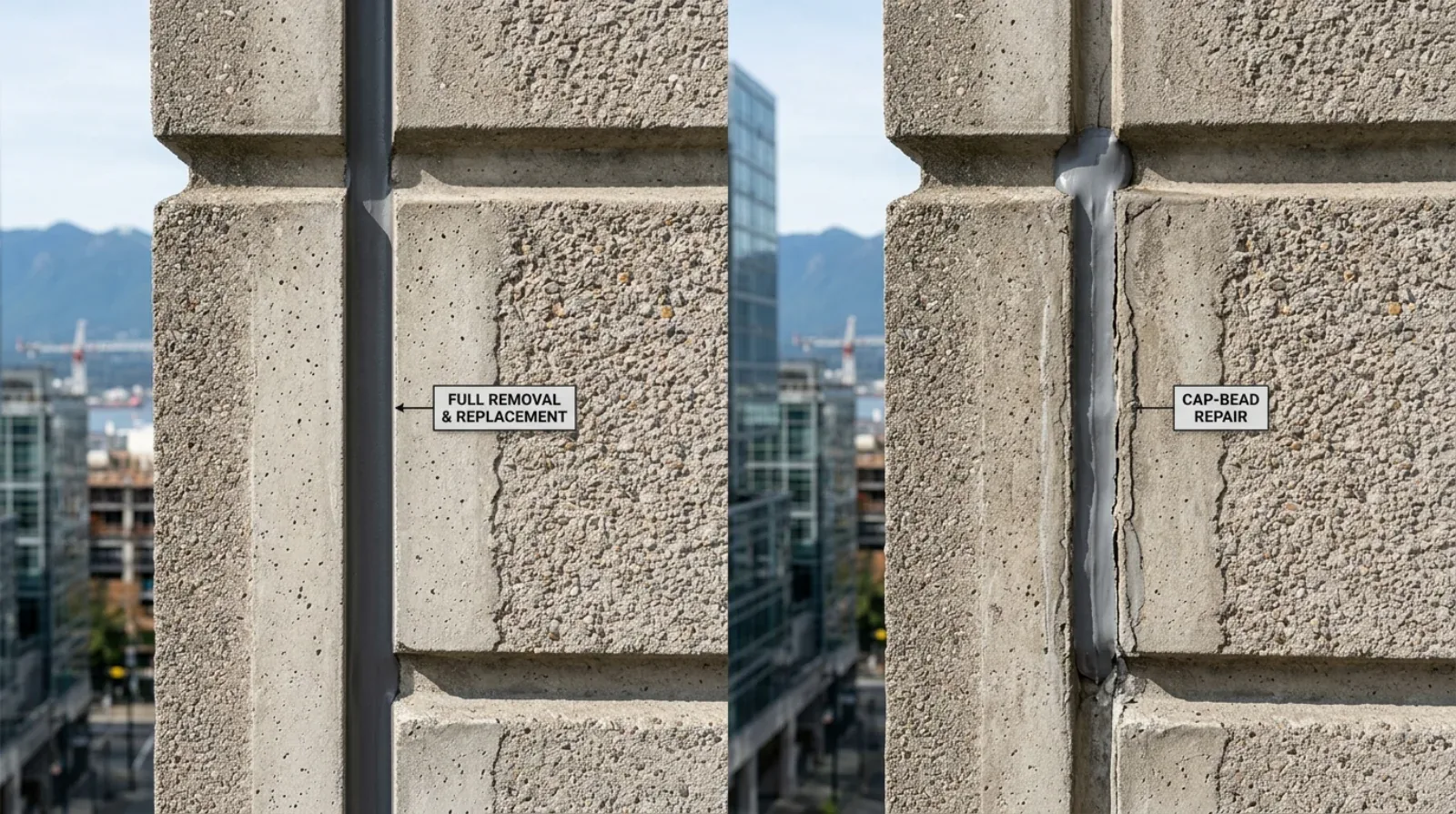
A cap bead of sealant on a clean, dry joint, labelled as temporary
Where a joint has split and weather is incoming, a compatible sealant bead over the cleaned joint can hold a season. Do it on a dry day, log it in the strata records as interim work, and scope the proper removal and replacement. The cap bead fails quietly if it gets treated as the repair.
Plywood over a broken opening, sealed at the top edge only
For a broken window or damaged louvre, exterior-grade plywood keeps rain and wind out. Flash or seal its top edge so water sheds over the panel, and leave the bottom edge unsealed so anything that gets behind it can drain out. Fasten to the frame, never through surrounding membrane or cladding.
Interior containment and drying
Poly sheeting, buckets, and a dehumidifier or fans in the affected suite protect finishes and slow the secondary damage while the exterior work is arranged. Move contents, lift carpet if it is soaked, and keep the affected assembly ventilated rather than boxed in behind plastic.
What makes it worse
Caulking over weep holes, vents, and drainage gaps
The most common self-inflicted wound we find. Weeps and rainscreen gaps are exits, not defects. Sealing them traps water inside the wall or window system, and the leak that was dripping harmlessly to the exterior starts soaking the assembly instead. If a hole looks deliberate and regular, leave it open.
Sealant applied to wet or dirty surfaces during the storm
Sealant on a wet, contaminated joint does not bond; it bridges. It will look done, shed the light rain that follows, and peel open in the first real wind, sometimes taking the diagnosis with it, because now the joint looks repaired. If conditions do not allow adhesion, use a tarp or panel instead and wait for the dry window.
Screwing tarps or boards through the roof membrane
Every fastener through a membrane is a new leak with a warranty problem attached. Weight tarps with sandbags or lumber, tie to existing anchorage, or clamp to structure. A tarp that needed twenty screws through the field of the roof has converted one breach into twenty-one.
Expanding foam in envelope gaps
Foam blocks the visible hole, wicks and holds water, defeats drainage paths, and has to be dug out before any proper repair. It also cures against surfaces the permanent repair needs clean. Outside the building, foam is almost never the right interim move.
Painting or patching over active moisture
Coating a damp stain seals moisture into the substrate and hides the evidence the investigation needs. The stain is data: its shape, its edge growth, its response to each storm. Dry it, log it, trace it, and only then repaint, after the source is fixed.
Temporary means dated
The failure mode of interim work is not technical, it is administrative: the patch works, the pressure drops, and the permanent repair slides quietly off the agenda. Every temporary measure should enter the strata records with three facts attached: what was done, when, and when it will be replaced. That log is the same one used for documenting damage for insurance, and it is what keeps a cap bead from becoming the de facto joint design for a decade.
The replacement date has to respect the climate. Sealant wants a dry window and workable temperatures; membrane work wants more. Metro Vancouver's wet season makes those windows scarce, which is exactly the scheduling problem covered in scheduling envelope work in a wet climate. Book the permanent repair when the temporary one goes on, not when it fails.
Where the quick fix should come from
At ground level, a competent building manager can execute most of the good moves on this page. At height, none of them are DIY: post-storm surfaces are wet and loose, and the person securing flapping cap metal on a parapet needs to be on two lines with engineered anchorage, per WorkSafeBC Part 11. Our rope access crews do this triage-and-secure work all winter, and the permanent joint work that follows is the core of the sealant and caulking service; the decision framework between cap beads and full replacement is covered in depth in the sealant and caulking hub. What to check first, and in what order, is the previous guide in this series, storm damage triage, and the full seasonal playbook is in the storm season readiness hub.
Quick answers
What makes a good temporary repair after storm damage?
A good temporary repair does three things: it keeps the next storm out of the assembly, it avoids creating new damage, and it leaves the permanent repair easier rather than harder. In practice that means shedding water over the breach the way shingles do, fastening to structure rather than through membranes, leaving drainage paths open, and logging what was done so the interim fix is replaced instead of forgotten.
How should a tarp be installed on a building so it does not make things worse?
Lap it like roofing: the up-slope edge runs under or over the intact surface so water sheds across the tarp and past the breach, never into it. Weight it with sandbags or battens tied to structure instead of screwing through the membrane, pull it tight so wind cannot work it, and inspect it after every wind event. A loose tarp abrades the surface beneath and can rip away in gusts, so treat a tarp as a monitored measure, never a set-and-forget one.
Is temporary caulking over a leaking joint a good idea?
Sometimes, with conditions. A cap bead of compatible sealant over a clean, dry, failed joint can hold through a season and is a legitimate bridge to a proper removal and replacement. It goes wrong when applied to wet or dirty surfaces, where it bridges without bonding, or when it gets mistaken for the permanent repair. Apply it in a dry window, record it as temporary in the strata records, and book the real sealant work.
Temporary repair questions
What makes a good temporary repair after storm damage?
A good temporary repair does three things: it keeps the next storm out of the assembly, it avoids creating new damage, and it leaves the permanent repair easier rather than harder. In practice that means shedding water over the breach the way shingles do, fastening to structure rather than through membranes, leaving drainage paths open, and logging what was done so the interim fix is replaced instead of forgotten.
How should a tarp be installed on a building so it does not make things worse?
Lap it like roofing: the up-slope edge runs under or over the intact surface so water sheds across the tarp and past the breach, never into it. Weight it with sandbags or battens tied to structure instead of screwing through the membrane, pull it tight so wind cannot work it, and inspect it after every wind event. A loose tarp abrades the surface beneath and can rip away in gusts, so treat a tarp as a monitored measure, never a set-and-forget one.
Is temporary caulking over a leaking joint a good idea?
Sometimes, with conditions. A cap bead of compatible sealant over a clean, dry, failed joint can hold through a season and is a legitimate bridge to a proper removal and replacement. It goes wrong when applied to wet or dirty surfaces, where it bridges without bonding, or when it gets mistaken for the permanent repair. Apply it in a dry window, record it as temporary in the strata records, and book the real sealant work.
Can plywood be used to close a storm-damaged opening?
Yes, exterior-grade plywood is the standard interim closure for a broken window, damaged door, or wrecked louvre. Fasten it to the frame or structure rather than through the surrounding cladding or membrane, seal or flash the top edge so water sheds over the panel, and leave the bottom edge open so anything behind it drains. It keeps weather and entry risk out while the replacement unit is ordered.
Which temporary repairs trap water and cause more damage?
The recurring offenders: sealing weep holes and rainscreen vents, which blocks the drainage the wall depends on; expanding foam in exterior gaps, which wicks water and defeats drainage; screwing tarps through membranes, which adds punctures; and coating over damp substrates, which locks moisture in. Each one converts a controlled leak into a concealed one. The common thread is closing an exit instead of closing the entry.
How long can a temporary repair stay in place?
Until the permanent repair can be executed properly, and no longer. For sealant that can mean the next dry window; for a membrane breach under a tarp, the next roofing mobilization; for a broken window, the replacement lead time. The risk is drift: interim fixes that survive a few storms stop being urgent and quietly become permanent. Date every temporary measure in the strata records and give it a scheduled replacement before the crew leaves the site.
Should sealant ever be applied in the rain?
Not if the goal is adhesion. Sealants need clean, dry surfaces to bond, and a joint wetted by rain will not give them one; the bead will bridge the gap without gripping its sides and will open under the first significant movement or wind pressure. During active weather, divert and cover instead, with tarps, panels, or drip control, and hold the sealant work for a dry window when the joint can be prepared properly.
Why should weep holes and drainage gaps never be sealed?
Because modern walls and window systems are designed to leak in a controlled way. Weep holes in window frames and the gaps at the base of rainscreen cladding are exits for water that got past the outer surface, which some water always will. Sealing them does not stop the water entering; it stops the water leaving, so it accumulates inside the frame or wall cavity and soaks the assembly. If an opening looks intentional, uniform, and repeated, it is functional.
Who should do temporary repairs at height on a high-rise?
Certified rope access technicians or crews with equivalent engineered fall protection, full stop. Storm-damaged flashing on a tower parapet or a failed joint on the fifteenth floor is not a ladder job, and post-storm surfaces are wet, loose, and unpredictable. IRATA and SPRAT certified technicians working on two independent lines under WorkSafeBC Part 11 can secure loose metal, rig interim protection, and photograph the damage in the same visit, usually within days rather than the weeks scaffolding would take.
How do you plan the permanent repair after a temporary fix?
Start from the diagnosis, not the patch: confirm the actual entry point and the extent of wetting behind it, because the visible breach is often only part of the path. Then scope the proper repair, sealant replacement, membrane work, flashing, or concrete, and book it into a realistic weather window. Temporary measures buy exactly the time between those two dates. Keep the interim fix on a checklist with its removal date so it cannot silently become the repair.
Need damage secured before the next system?
Our rope access crews secure storm damage and install interim protection at height, then scope and schedule the permanent repair, across Vancouver, North Vancouver, West Vancouver, and Burnaby.