The pre-storm inspection checklist
Most storm damage we repair in January was findable in September. The pre-storm walk-around is a short, focused inspection of the details that fail first, done while there is still dry weather left to fix them. It takes a morning on most buildings, and it is the highest-return maintenance hour of the year for a Vancouver or Burnaby strata.
Why the walk-around beats the emergency call
Storms do not create weaknesses; they find existing ones, and they find them all in one night. Every item on this checklist corresponds to a leak call we take every winter across Vancouver, North Vancouver, and Burnaby. The same blocked scupper, the same twenty-year-old window sealant, the same flashing that had been rattling in the wind since spring. The storm season hub covers the whole seasonal cycle; this page is the September morning that decides how the rest of it goes.
Timing is the constraint. Sealant replacement needs dry joints and cooperative temperatures, and roofing repairs need a dry membrane. Book the walk-around early enough that its findings can be repaired while dry weather remains.
The checklist
Six items, in the order water meets them. Work top-down: roof first, walls second, ground level last.
Roof drains and scuppers
The single most common cause of storm water damage we see. A drain that is half blocked with leaves and roofing granules passes a shower and backs up under a real storm, putting standing water against the membrane and up over flashings. Clear every drain, strainer, and scupper, and look inside the overflow scuppers too, they only matter on the worst day of the year.
Gutters and downspouts
On low-rise and townhouse buildings, a blocked downspout sends a winter of roof water down one wall. Check that gutters are clear, slopes still drain to the outlets, and downspouts actually discharge away from the building instead of against the foundation.
Sealant joints
Walk the accessible joints and look for cracking, hardening, and adhesion loss where the bead has pulled off one side. Window perimeters, panel joints, and penetrations are the priority. A failed joint that gets replaced in October is a small job; the same joint found by an atmospheric river in December is a leak investigation.
Flashing and cap metal
Look for lifted edges, missing fasteners, open laps, and sealant that has let go at terminations. Wind works on loose metal mechanically during a storm, so a flashing that is merely loose in September can be gone in November, taking its waterproofing function with it.
Balcony drains, doors, and thresholds
Balcony drains blocked by pots, mats, or debris flood the deck and push water over the door threshold. Check the drains are open, door tracks are clear, and the threshold sealant is intact. Residents can do most of this themselves if the strata tells them what to look for.
Documentation photos
Photograph the roof, each elevation, and every known problem area from repeatable positions. Date the photos and file them with the strata records. When a storm changes something, the before picture turns an argument into a comparison, for the council, the contractor, and the insurance broker alike.
Who does what
Split the list by access. Council members and building managers handle what can be reached safely from the ground and from balconies: drains, thresholds, visible sealant, downspouts, and the photo record. A note to residents asking them to clear their balcony drains and report sticky door tracks turns every unit into an inspection point.
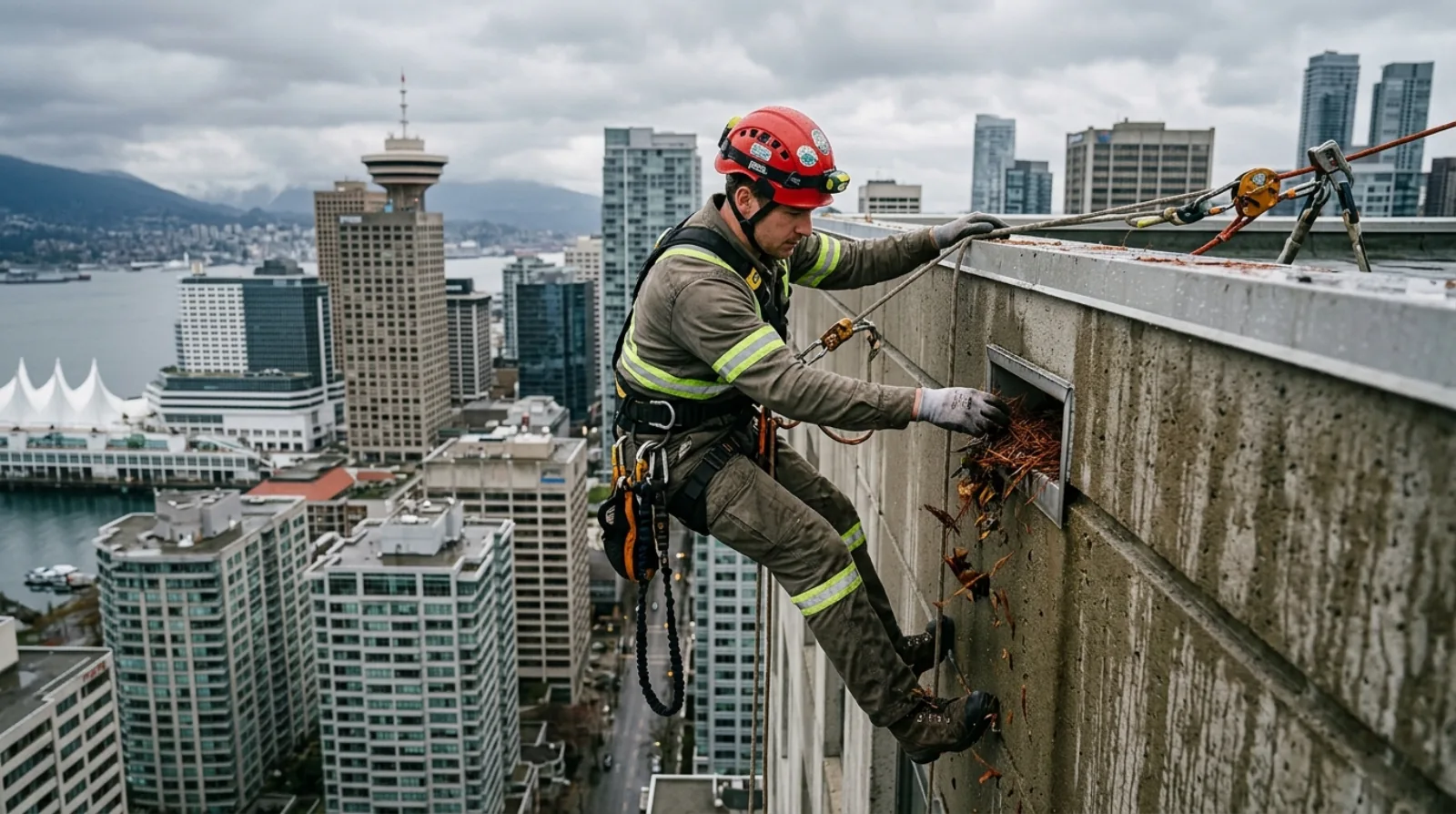
The roof and the upper wall areas belong to people equipped for them. On low-rise buildings that may be a contractor with a ladder and fall protection. On towers, it means IRATA or SPRAT certified technicians on two independent lines, which is the core of our rope access building maintenance work. A rope crew can clear every scupper, sight every flashing lap, and photograph every joint on a 25-storey elevation in a day, without scaffolding and without closing the sidewalk. Our article on gutter and scupper cleaning by rope access walks through what that visit looks like.
What the findings usually mean
Expect three categories. First, housekeeping: debris in drains and gutters, which gets cleared on the spot. Second, aged details: sealant at end of life, small flashing repairs, a worn threshold. These are quick, schedulable jobs, and our sealant and caulking service exists largely because of them. Third, the occasional real finding: a soft spot in a membrane, staining that suggests water is already inside, cracked stucco on an exposed elevation. Those need a proper assessment before the weather arrives, and on stucco buildings the case for acting before the storms is laid out in our article on pre-storm stucco crack repair.
Whatever you find, write it down with a photo. The list of what was sound matters as much as the list of what was not, because it becomes the baseline for monitoring between storms and for next year's walk.
After the first storm, check your work
The first real system of the season is the exam. After it passes, walk the building again briefly: did the drains keep up, did any resident report water, did anything move? A building that comes through the first atmospheric river dry has earned some confidence for the winter. What those events do to an envelope, and why the first one of the season is the most revealing, is covered in atmospheric rivers and your building. And for the broader fall maintenance picture beyond the envelope, see the fall building maintenance checklist.
Quick answers
What should a pre-storm building inspection cover?
A pre-storm building inspection covers the details storms exploit: roof drains, strainers, and scuppers cleared of debris, gutters and downspouts flowing, sealant joints checked for cracking and adhesion loss, flashing checked for lifted edges and missing fasteners, balcony drains and door thresholds clear and sound, and a set of dated photos recording the building's condition. It is a focused walk-around, not a full envelope condition assessment.
When should a strata do its pre-storm walk-around?
Do the pre-storm walk-around in early fall, September or early October in Metro Vancouver, before the first big systems arrive. That timing leaves enough dry weather to complete any repairs the walk finds, especially sealant work, which needs dry substrates and workable temperatures. A second, shorter check after the leaves come down is worth the hour, because fall leaf drop is what blocks most drains.
Can a strata council do the pre-storm inspection itself, or does it need a contractor?
A council or building manager can do the ground-level portion: balcony drains, visible sealant, downspouts, and the photo record. The roof and high elevations need whoever can reach them safely, which on most buildings means a contractor, and on high-rises means rope access technicians working under WorkSafeBC fall protection rules. A practical split is resident and manager checks at ground level, contractor checks for the roof and the wall areas nobody can see.
Pre-storm inspection questions
What should a pre-storm building inspection cover?
A pre-storm building inspection covers the details storms exploit: roof drains, strainers, and scuppers cleared of debris, gutters and downspouts flowing, sealant joints checked for cracking and adhesion loss, flashing checked for lifted edges and missing fasteners, balcony drains and door thresholds clear and sound, and a set of dated photos recording the building's condition. It is a focused walk-around, not a full envelope condition assessment.
When should a strata do its pre-storm walk-around?
Do the pre-storm walk-around in early fall, September or early October in Metro Vancouver, before the first big systems arrive. That timing leaves enough dry weather to complete any repairs the walk finds, especially sealant work, which needs dry substrates and workable temperatures. A second, shorter check after the leaves come down is worth the hour, because fall leaf drop is what blocks most drains.
Can a strata council do the pre-storm inspection itself, or does it need a contractor?
A council or building manager can do the ground-level portion: balcony drains, visible sealant, downspouts, and the photo record. The roof and high elevations need whoever can reach them safely, which on most buildings means a contractor, and on high-rises means rope access technicians working under WorkSafeBC fall protection rules. A practical split is resident and manager checks at ground level, contractor checks for the roof and the wall areas nobody can see.
Why do roof drains and scuppers matter so much before a storm?
Because a flat roof is a basin, and the drains are its only exit. A blocked drain during a multi-day storm turns the roof into a pond, which loads the structure, submerges flashings that were never meant to be underwater, and finds any seam in the membrane. Overflow scuppers exist for exactly that failure, so they need to be clear too. Drain clearing is the cheapest storm preparation a building can buy.
What sealant joints should be checked before storm season?
Prioritize the joints that face the weather and move the most: window and door perimeters, cladding panel joints, expansion joints, and any penetration through the wall, vents, conduits, anchors, and signage mounts. Look for beads that have hardened, cracked, or pulled cleanly off one surface. Joints on exposed elevations age fastest and matter most, since those walls take the wind-driven rain.
How do you check flashing before a storm?
Sight along parapet caps, window head flashings, and roof edge metal for lifted edges, open laps, and missing or backed-out fasteners, then confirm the sealant at terminations is still bonded. Anything that moves under hand pressure will move a lot more under storm wind. On tall buildings this is rope access work; from the ground, binoculars and a zoom lens catch more than most people expect.
Should balcony doors and windows be part of a pre-storm check?
Yes. Balcony doors are one of the most common storm leak paths because wind pushes deck water over thresholds and through worn track drainage. Check that balcony drains are unblocked, door tracks are free of grit, weep holes in the frames are open, and the threshold and perimeter sealant is intact. Residents can check their own doors if the strata sends a short instruction note, which multiplies the inspection at no cost.
What photos should be taken during a pre-storm inspection?
Take wide shots of the roof and each elevation, then closer shots of every drain, scupper, known crack, stained area, and previously repaired detail, all from positions you can repeat next time. Make sure the date is recorded and file everything with the strata records. The value shows up later: after a storm, the same angles show exactly what changed, which speeds up both the repair scope and any conversation with the insurance broker.
What happens if a pre-storm inspection finds a problem too late to fix before the storms?
Triage it. Some findings can still be handled fast: drain clearing takes a day, and a rope access crew can refasten loose flashing quickly. Sealant replacement needs a dry window but short sections are often achievable between systems. For anything that must wait, plan interim protection, document the condition, and book the permanent repair now, because spring schedules fill early. A known weak point with a monitoring plan beats an unknown one every time.
How is a pre-storm check different from an annual envelope inspection?
The pre-storm check is narrow and seasonal: drainage, joints, flashing, thresholds, photos, all aimed at the next three months of weather. An annual or depreciation-report-driven envelope inspection is broader and slower, covering membranes, cladding condition, concrete, and remaining service life of components. The two complement each other; the fall walk-around catches what changed since the last full inspection, right before the weather that will test it.
Want the roof and high elevations checked properly?
Our rope access crews clear drains and scuppers, inspect sealant and flashing, and photograph every elevation on strata and commercial buildings across Vancouver, North Vancouver, West Vancouver, and Burnaby.