Atmospheric rivers and your building
An atmospheric river is a long corridor of concentrated water vapour that delivers much of the BC coast's heaviest rain. That is the meteorology. For the person responsible for a building, the working definition is simpler: a rain event that lasts long enough, and arrives with enough wind, to find every marginal detail on the envelope in a single pass.
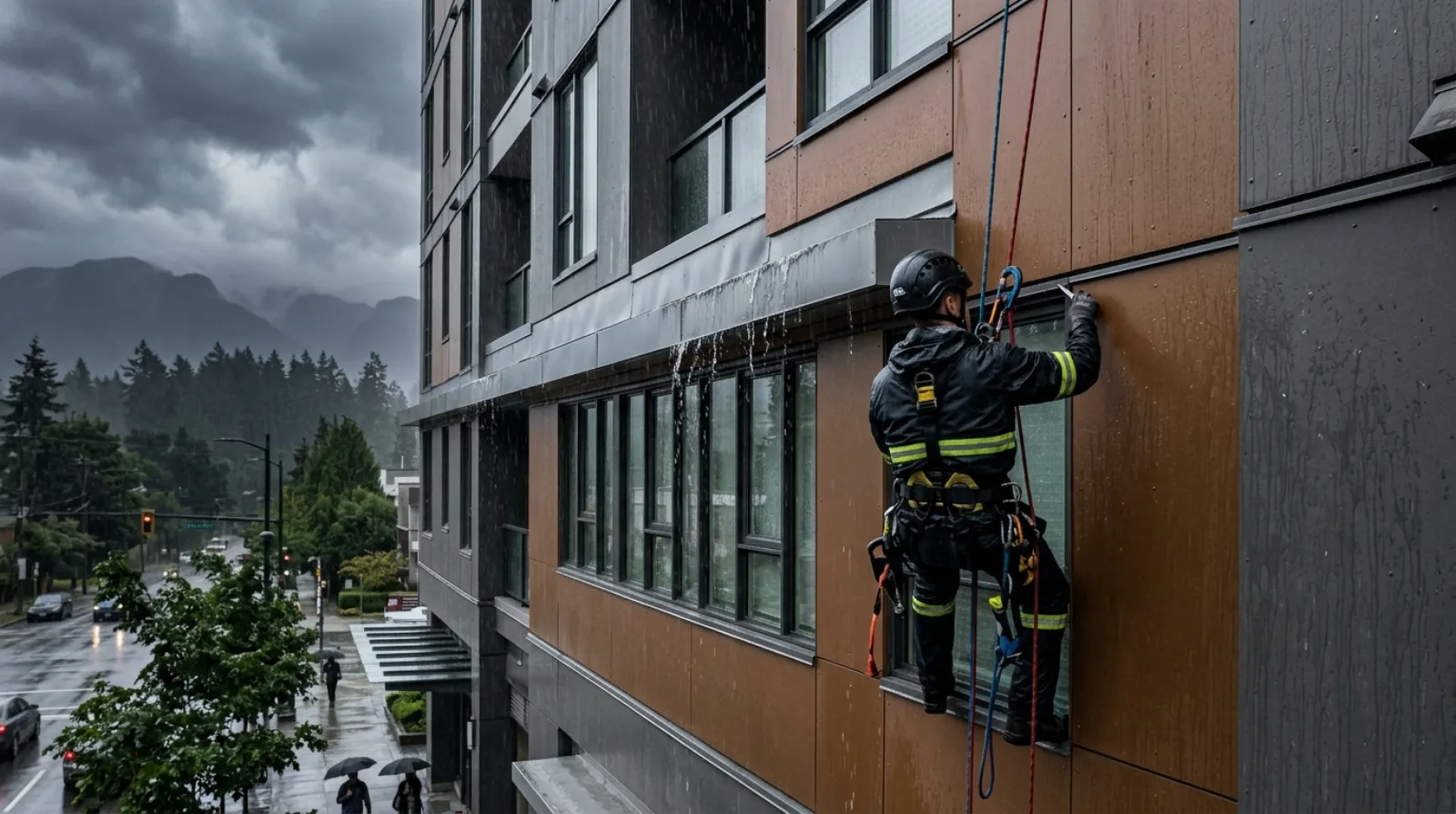
What makes these events different
Metro Vancouver buildings live with rain. Vancouver International Airport averages 1,189 mm of precipitation a year over the 1991 to 2020 climate normals, and most local buildings shed the ordinary version of that without complaint. An atmospheric river changes the character of the loading along with the amount.
Three things change at once, and each one attacks a different part of the envelope. We break them out below because the distinction decides what you check before and after an event.
Duration loading
The rain does not stop for a day or more. Drains and scuppers must move water continuously, membranes sit under standing water far longer than in a normal shower, and every marginal detail gets tested for hours instead of minutes. A joint that weeps slightly in a squall runs steadily through an atmospheric river.
Wind-driven rain
These systems usually arrive with strong wind, so rain travels horizontally and under pressure. Water reaches the underside of flashings, the tops of window frames, and cladding laps that vertical rain never touches. Wind pressure also pushes water uphill through gaps, which is why leaks appear in places that make no sense from a gravity-only view.
Saturated assemblies
Between systems the envelope barely dries. Stucco, concrete, and wood sheathing absorb water through the event, and if a second river arrives within days the assembly starts the next storm already wet. Saturated materials pass water inward faster, hold it against fasteners and rebar, and give trapped moisture time to start rot and corrosion.
Where the water actually gets in
After these events, our leak calls cluster in the same places. Window perimeters where the sealant has aged and pulled away from the frame. Wall-to-window head flashings that wind-driven rain gets behind. Roof scuppers and drains that were passing water fine at half capacity and backed up at full capacity. Balcony door thresholds, where wind pushes water over a track that gravity alone never defeats.
Notice what is not on that list: the open field of the wall. A sound rainscreen wall, a healthy membrane, an intact panel of stucco, these almost never leak during an atmospheric river. The event finds details, and mostly details that were already at the end of their service life. That is genuinely good news, because details are inspectable and repairable at a fraction of the cost of wall reconstruction. The pre-storm inspection checklist exists precisely because the failure points are this predictable.
The repeat-event problem
One atmospheric river is a load test. Two or three in a month, which is a normal wet-season pattern on this coast, is a different kind of problem. The envelope enters each new event wetter than the last. Stucco that absorbed water through the first storm passes water inward faster during the second. Wood sheathing that never dried holds moisture against framing for weeks. On concrete buildings, water sitting in cracks and at slab edges keeps chloride and oxygen against the reinforcing steel.
This is why the response to an event goes beyond fixing whatever visibly leaked: confirm the drainage is clear again, check whether anything moved, and log what you saw so the next event has a baseline. That routine is covered in monitoring between storms.
Wind is half the event
The rain gets the headlines, but much of the damage mechanism is wind. Horizontal rain under pressure reaches geometry that vertical rain cannot: the tops of window frames, the underside of flashings, the laps in cladding. Wind pressure differences across the wall can pull water through gaps that would never leak under gravity. If a leak appears somewhere that seems impossible, above the stain, behind an overhang, on the sheltered side of a detail, wind pressure is usually the explanation. The mechanics get their own guide in wind-driven rain explained.
What to do with this
Treat atmospheric rivers as scheduled exams. The forecast gives you days of notice, the failure points are known, and the preparation is ordinary maintenance done on time. Before the season: inspect and restore the details, above all sealant joints and drainage. During the season: quick checks before and after each event. When water does get in: trace it while the evidence is fresh, because an active leak is far easier to source than a dried stain. If a leak has already shown up inside, our leak repair and water ingress service starts with that tracing work rather than guessing from the stain.
For the deeper science of these systems, how they form over the Pacific and why our mountains wring so much water out of them, read our article on atmospheric rivers and the building envelope. This guide stays with the practical half: what the event does to your building, and what you can do about it. The rest of the seasonal picture is in the storm season readiness hub.
Quick answers
How does an atmospheric river affect a building envelope?
An atmospheric river loads a building envelope in three ways at once: duration, wind, and saturation. Rain falls continuously for a day or more, so drainage runs at capacity and marginal details leak steadily instead of briefly. Wind drives the rain horizontally into joints and laps. And the assembly absorbs water through the whole event, so walls and decks stay wet long after the sky clears. Details that pass a normal shower fail under that combination.
Why do atmospheric rivers cause leaks that normal rain does not?
Normal Vancouver rain is mostly vertical and short enough that assemblies drain and dry between showers. An atmospheric river removes both advantages: the water arrives sideways under wind pressure, and it keeps arriving for hours. Sealant gaps, lifted flashing edges, and blocked scuppers that shrug off drizzle get found because water is pushed at them continuously from angles the original detailing never faced. The leak was always possible; the event supplies the pressure and the time.
How long does an atmospheric river event last over the BC coast?
An atmospheric river event over the BC coast typically runs much longer than an ordinary frontal shower, often holding heavy rain over the same area for a day or more, sometimes with systems arriving back to back. For a building the exact hour count matters less than the pattern: continuous loading with little drying time in between. That is why post-event checks and drain clearing between systems matter as much as preparation before the season.
Atmospheric river questions
How does an atmospheric river affect a building envelope?
An atmospheric river loads a building envelope in three ways at once: duration, wind, and saturation. Rain falls continuously for a day or more, so drainage runs at capacity and marginal details leak steadily instead of briefly. Wind drives the rain horizontally into joints and laps. And the assembly absorbs water through the whole event, so walls and decks stay wet long after the sky clears. Details that pass a normal shower fail under that combination.
Why do atmospheric rivers cause leaks that normal rain does not?
Normal Vancouver rain is mostly vertical and short enough that assemblies drain and dry between showers. An atmospheric river removes both advantages: the water arrives sideways under wind pressure, and it keeps arriving for hours. Sealant gaps, lifted flashing edges, and blocked scuppers that shrug off drizzle get found because water is pushed at them continuously from angles the original detailing never faced. The leak was always possible; the event supplies the pressure and the time.
How long does an atmospheric river event last over the BC coast?
An atmospheric river event over the BC coast typically runs much longer than an ordinary frontal shower, often holding heavy rain over the same area for a day or more, sometimes with systems arriving back to back. For a building the exact hour count matters less than the pattern: continuous loading with little drying time in between. That is why post-event checks and drain clearing between systems matter as much as preparation before the season.
What is duration loading on a building envelope?
Duration loading means the envelope is exposed to water continuously for an extended period rather than in short bursts. Under duration loading, small defects pass meaningful volumes of water because the flow never pauses, ponding sits on membranes for hours, and absorbent materials like stucco and concrete take on water steadily. Under duration loading, the useful rating for a detail is how long it can stay wet before it leaks.
What does a saturated wall assembly mean?
A saturated wall assembly is one whose materials, cladding, sheathing, insulation, or concrete, have absorbed close to as much water as they can hold. Saturated assemblies behave differently: they pass water inward more readily, they dry slowly even in clear weather, and they hold moisture against wood framing and reinforcing steel. A wall that enters a second storm still saturated from the first is far more likely to show interior damage.
Which buildings are most affected by atmospheric rivers in Metro Vancouver?
Buildings with exposed elevations and marginal details take the worst of an atmospheric river: towers whose upper floors face open water or open terrain, older stucco low-rises with unrestored joints, and any building with blocked drainage. Sheltered mid-block buildings with recent sealant work often ride the same event without a drip. Exposure and maintenance condition predict the outcome far better than building age alone.
Can a building envelope dry out between atmospheric rivers?
Partly, and that is the problem. Drying takes days of dry, moving air, and the gap between systems in a wet Metro Vancouver winter is often shorter than that. Surfaces dry first while sheathing, insulation, and concrete stay damp underneath, so the building can look recovered while the assembly is still wet. This is why moisture readings over time tell you more than a visual check after each storm.
Do atmospheric rivers bring wind as well as rain?
Usually, yes. These systems ride in on strong Pacific flows, so the heavy rain arrives with sustained wind and gusts, and that pairing is what makes them hard on buildings. Wind converts vertical rain into horizontal rain, drives water into joints under pressure, and works on loose flashing and cladding mechanically at the same time. A calm heavy rain and a windy heavy rain are very different events for an envelope.
What should a strata council do when an atmospheric river warning is issued?
When a warning is issued, run a short version of the pre-storm check: confirm roof drains, scuppers, and balcony drains are clear, close and latch windows and balcony doors in common areas, secure loose items on roofs and decks, and remind residents how to report leaks. After the event, walk the building and note anything new. The warning is most useful to buildings that already did the full fall preparation.
Where can I read the science behind atmospheric rivers?
Start with the general reference on atmospheric rivers for the meteorology: how the vapour corridors form, why landfall on mountainous coasts wrings so much rain out of them, and how forecasters track them. For a building owner, the science matters less than the operational picture: long duration, strong wind, and repeat events. Our blog article on atmospheric rivers and building envelopes connects the meteorology to what actually fails on Metro Vancouver buildings.
Is your building ready for the next system?
We inspect and restore the details atmospheric rivers exploit, sealant joints, flashing, and drainage, on strata and commercial buildings across Vancouver, North Vancouver, West Vancouver, and Burnaby.