Wind-driven rain explained
A wall that sheds vertical rain for years can leak in its first real windstorm. The water has not changed; the direction and the pressure have. Understanding how driven rain moves is the difference between recaulking at random and fixing the joint that actually leaks, especially on Vancouver towers where the top ten floors live in different weather than the lobby.
Gravity protects a wall. Wind cancels gravity.
Almost every traditional envelope detail is a gravity device. Laps face down. Drips throw water clear of the face. Flashings slope out. Thresholds sit above the deck. All of it assumes water is falling, and against falling water it works.
Wind rewrites the assumptions. Rain arrives horizontally and strikes the wall face directly. Gusts push water up the underside of flashings and over thresholds. And the pressure difference between the outside and the inside of the wall pumps water through openings too small to leak on a calm day. A joint does not need to be visibly open to admit driven rain; it only needs a defect and a pressure difference across it.
This is why storm leaks confuse people. Water appears above the window, on the sheltered side of a column, three metres from any plausible source. Driven water travels inside the assembly before it shows, and it enters at geometry that a gravity-trained eye never suspects.
The joints are the battlefield
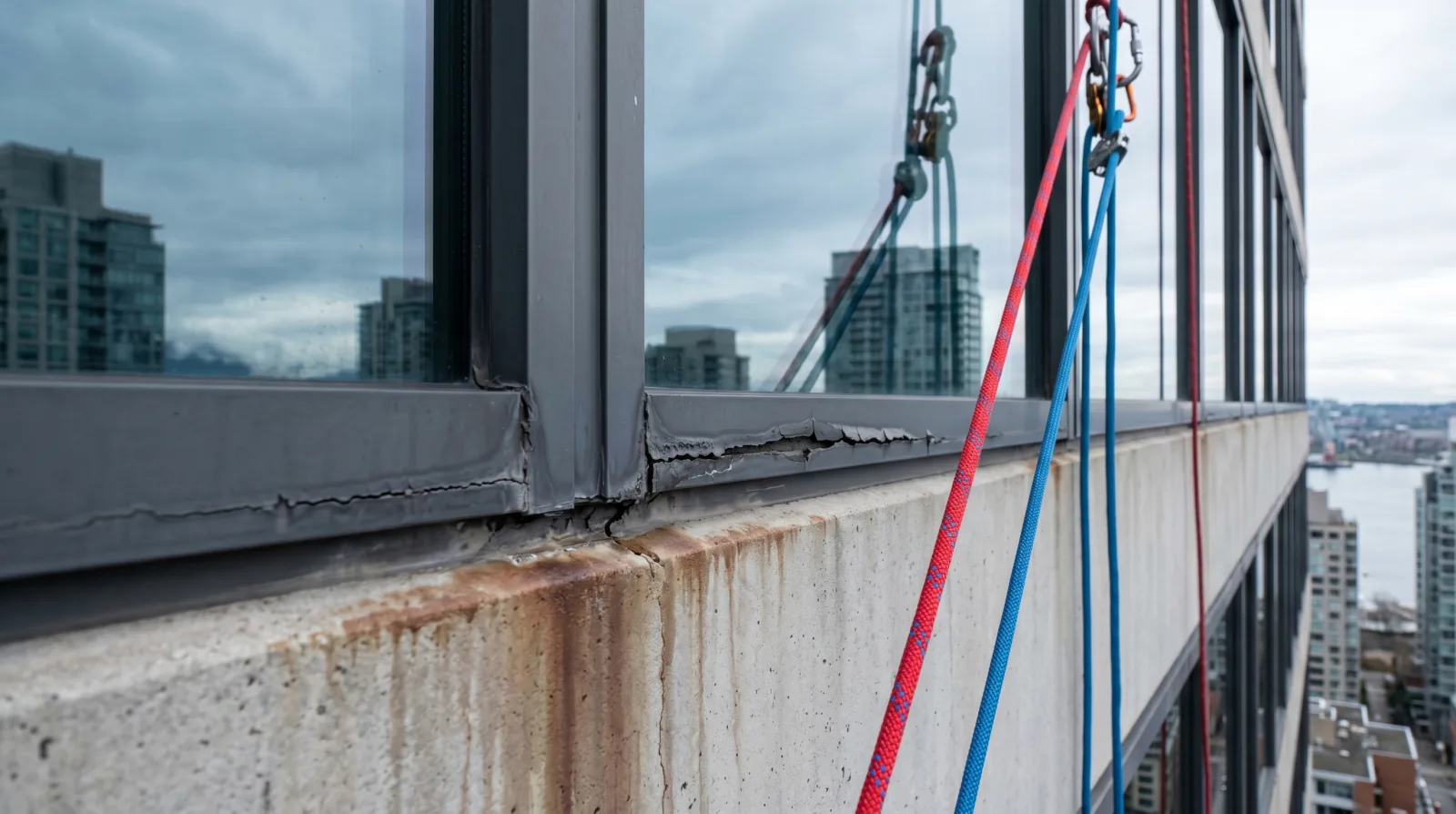
The field of a wall, the uninterrupted concrete, stucco, or cladding, resists driven rain well. The vulnerable points are wherever the wall plane is interrupted: window and door perimeters, panel-to-panel joints, expansion joints, penetrations, and transitions between materials. Each of those interruptions is bridged by sealant, gaskets, or flashing, and each of those bridges ages.
Sealant is the usual weak link, because it is the component with the shortest service life on the wall. Hardened, cracked, or debonded caulking that sheds vertical rain perfectly will pass driven rain freely. Restoring those joints is the single most effective driven-rain defence on most buildings, which is why it anchors both our sealant and caulking service and the wider sealant and caulking resource hub. On high-rises, the interaction between window systems and driven rain is a large enough topic that our article on the causes of water ingress in high-rises treats it separately.
Exposure by height and elevation
Exposure is not uniform across a building. Two variables dominate: how high the wall is, and what the wind crosses before reaching it. The table below is the mental model we use when deciding where to start an inspection.
| Wall zone | Driven-rain exposure | What it means in practice |
|---|---|---|
| Ground to mid floors, sheltered elevation | Low | Neighbouring buildings and trees break up the wind, so rain stays mostly vertical. Leaks here usually trace to drainage and ground-level detailing rather than driven rain. |
| Ground to mid floors, open elevation | Moderate | Streets, parks, and water gaps give wind a run at the wall. Window perimeters and door thresholds see periodic driven rain during larger systems. |
| Upper floors, sheltered elevation | Moderate to high | Height lifts the wall into faster wind even when the ground floor is protected. Joints and thresholds on high floors leak in storms that leave low floors dry. |
| Upper floors, open or waterfront elevation | Highest | Full wind speed plus open fetch. These walls take rain nearly horizontally during major storms, and their sealant and flashing age fastest. Inspect these first and most often. |
| Corners and parapets, any height | Elevated at any floor | Wind accelerates around corners and over roof edges, so corner units and parapet details see stronger pressure swings than the middle of the same wall. |
The practical consequence: inspect and budget by exposure, not by floor number alone. The southeast corner of the top third of a waterfront tower may need sealant twice as often as the sheltered podium of the same building, and treating them identically wastes money on one and underprotects the other. Buildings with serious exposure, West Vancouver waterfront above all, get their own treatment in exposed and oceanfront buildings.
What this means during a storm
During a major system, driven rain and duration loading arrive together, and the combination is what makes atmospheric rivers so effective at finding weak details; that mechanism is covered in atmospheric rivers and your building. While the storm is running, there is little to do on the wall itself, and nobody should be working at height in storm winds. The useful work happens before, restoring the joints, and after, tracing anything that leaked while the evidence is fresh.
One caution for after the storm: resist the urge to caulk over whatever looks suspicious. Sealing the wrong opening can trap water inside the assembly or close a drainage path that was doing its job; weep holes and rainscreen vents must stay open. Diagnosis first, then repair. The full seasonal playbook, from preparation through response, lives in the storm season readiness hub.
Quick answers
What is wind-driven rain?
Wind-driven rain is rain carried horizontally by wind so that it strikes walls, windows, and joints directly instead of falling past them. Under storm winds, water hits the wall under pressure and can be pushed upward, sideways, and into gaps. Building details are mostly designed around gravity, water running down and off, which is why wind-driven rain is the loading that separates a sound envelope from a marginal one.
Why does wind-driven rain cause leaks that vertical rain does not?
Vertical rain only touches horizontal surfaces and runs down the wall face, so gravity does most of the protective work. Wind-driven rain strikes vertical surfaces directly and arrives with pressure behind it, so it reaches the tops and sides of window frames, the underside of flashings, and cladding laps, and it can be forced through gaps that water would never enter on its own. The same joint can be watertight in drizzle and leaking in a storm.
Which parts of a building are most exposed to wind-driven rain?
The most exposed parts are the upper floors of walls facing open terrain or water, building corners where wind accelerates, parapets and roof edges, and any detail that interrupts the wall plane: window perimeters, balcony door thresholds, panel joints, and penetrations. Sheltered lower walls behind other buildings see the least. Exposure maps closely onto where storm leak calls actually come from on Metro Vancouver towers.
Wind-driven rain questions
What is wind-driven rain?
Wind-driven rain is rain carried horizontally by wind so that it strikes walls, windows, and joints directly instead of falling past them. Under storm winds, water hits the wall under pressure and can be pushed upward, sideways, and into gaps. Building details are mostly designed around gravity, water running down and off, which is why wind-driven rain is the loading that separates a sound envelope from a marginal one.
Why does wind-driven rain cause leaks that vertical rain does not?
Vertical rain only touches horizontal surfaces and runs down the wall face, so gravity does most of the protective work. Wind-driven rain strikes vertical surfaces directly and arrives with pressure behind it, so it reaches the tops and sides of window frames, the underside of flashings, and cladding laps, and it can be forced through gaps that water would never enter on its own. The same joint can be watertight in drizzle and leaking in a storm.
Which parts of a building are most exposed to wind-driven rain?
The most exposed parts are the upper floors of walls facing open terrain or water, building corners where wind accelerates, parapets and roof edges, and any detail that interrupts the wall plane: window perimeters, balcony door thresholds, panel joints, and penetrations. Sheltered lower walls behind other buildings see the least. Exposure maps closely onto where storm leak calls actually come from on Metro Vancouver towers.
Does building height change wind-driven rain exposure?
Yes, substantially. Wind speed generally increases with height above ground because the surrounding buildings and terrain slow the wind near street level. The upper floors of a Vancouver tower therefore take faster wind, and with it more horizontal rain and stronger pressure differences across the wall, than the podium levels of the same building in the same storm. This is why storm leaks concentrate on high floors and corner suites.
Why do upper floors leak in storms when lower floors stay dry?
Upper floors sit in faster wind, so rain strikes their walls more horizontally and with more pressure, and there is no overhang or neighbouring building providing shelter. The same window detail installed on floor 3 and floor 23 faces two different climates. When a tower reports leaks only on its top third during storms, the envelope is usually consistent; the loading is what differs, and the repair scope should start where the loading is highest.
Can wind-driven rain get past sealant that looks intact?
It can if the seal has failed in ways a glance does not catch: adhesion loss along one edge, hairline splits from movement, or a bead applied over a contaminated surface years ago. Under wind pressure, water exploits openings far too small to leak under gravity. This is why sealant assessment involves probing and pull testing on top of the visual pass, and why joints that pass a dry summer can announce themselves in the first November storm.
How does a rainscreen handle wind-driven rain?
A rainscreen accepts that some driven rain will pass the outer cladding, and manages it: a drained and vented cavity behind the cladding breaks the wind pressure and gives the water a path back out, while the inner moisture barrier stays dry. That is the lesson Vancouver learned from the leaky condo era, when face-sealed walls relied on a single perfect outer surface. Driven rain is precisely the loading rainscreens were adopted to resist.
Which elevations of a building take the most wind-driven rain in Metro Vancouver?
The elevations facing the building's longest open approach: open water, parks, wide streets, or low surrounding development. Waterfront walls in West Vancouver and along Burrard Inlet are classic cases because wind crosses kilometres of water without obstruction. On any specific building, the honest answer comes from its own history: where sealant ages fastest, where stains appear, and where residents report noise and water in storms.
What is the difference between storm water ingress and condensation?
Storm water ingress is outside water entering through the envelope, and it correlates with weather: it appears during or right after wind and rain, often at a consistent spot. Condensation is inside moisture reaching a cold surface, and it correlates with temperature and indoor humidity: it shows up on cold clear nights, on window glass and frames, without any storm. The distinction matters because the fixes are different, and misdiagnosing one as the other wastes a repair budget.
How do you find where wind-driven rain is getting in?
Start from the inside evidence and work out: map where and when water appears against which storms and wind directions. Then inspect the candidate details above and upwind of the stain, since driven water travels before it shows. Where inspection alone cannot confirm the path, controlled water testing on the suspect details, spraying one detail at a time while watching inside, isolates the entry point. Guessing and recaulking everything is slower and often misses the actual path.
Leaks that only show up in windstorms?
We trace wind-driven leaks to their actual entry point and restore the joints, on strata and commercial buildings across Vancouver, North Vancouver, West Vancouver, and Burnaby.