Exposed and oceanfront buildings
Stand on the seawall in Ambleside during a November storm and you can watch the difference: wind that crossed the Strait of Georgia without touching anything hits the first row of buildings with rain, spray, and salt, all at once. Those buildings are built from the same materials as everything else in Metro Vancouver. They just live a harder life, and their maintenance has to admit it.
The three extra loads a waterfront wall carries
Every load described in the storm season hub applies to a waterfront building, and then three more stack on top. They interact: salt keeps the wall damp, dampness feeds corrosion, and wind keeps delivering more of both.
Salt in the air and on the wall
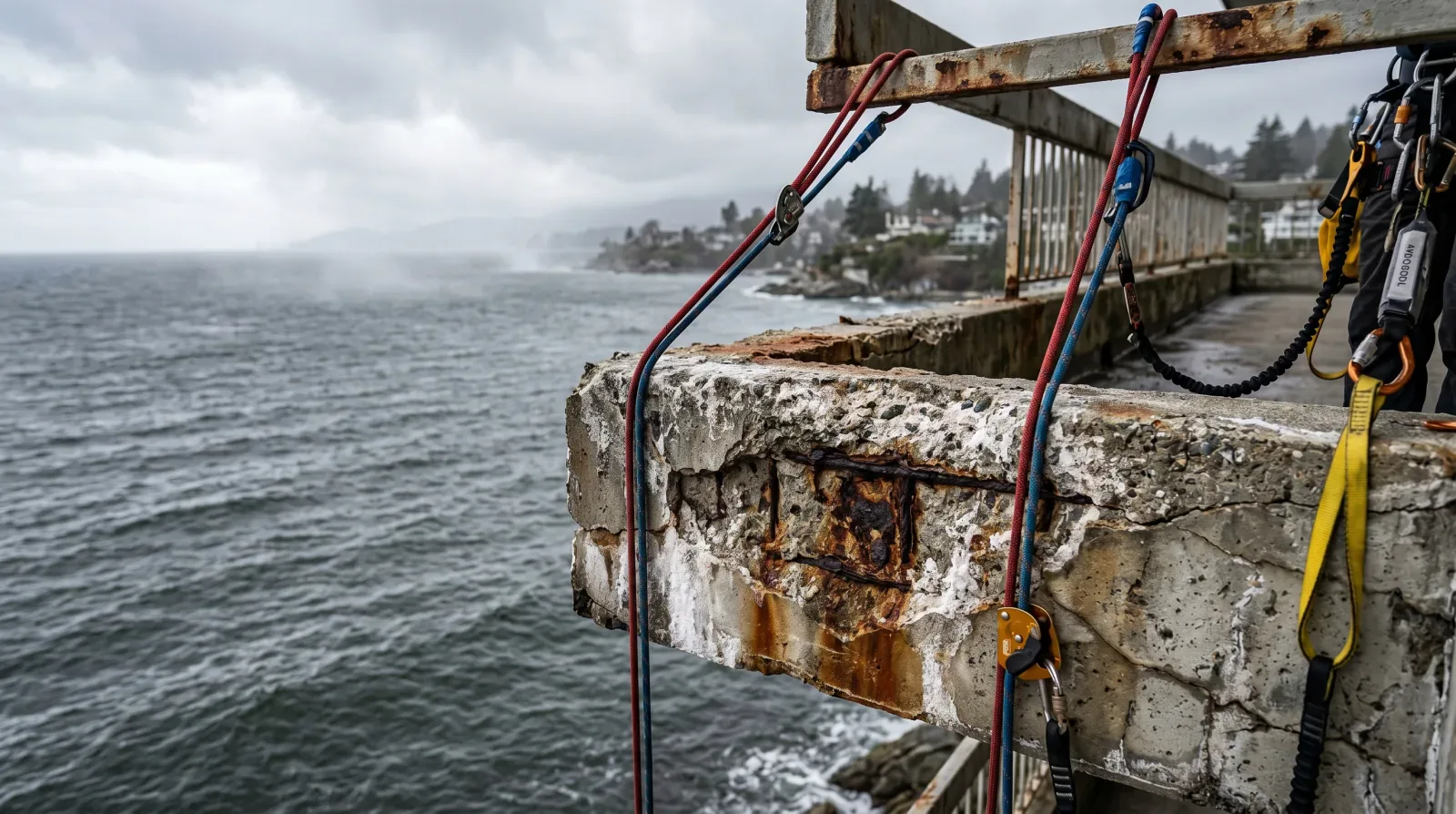
Wind carries sea spray onto oceanfront facades, and the salt stays after the water dries. Chloride attacks exposed metal, fasteners, railings, and flashing, and works into concrete toward the reinforcing steel, where it accelerates corrosion. Salt also keeps surfaces damp longer, because it draws moisture from the air.
Wind fetch over open water
Fetch is the distance wind travels without obstruction before it reaches the wall. A facade facing Burrard Inlet or the Strait of Georgia meets wind that has crossed kilometres of open water at full speed, carrying rain and spray horizontally. The same storm arrives noticeably harder on a waterfront elevation than three streets inland.
No shelter, no recovery time
Inland buildings get shielding from neighbours and terrain, and their walls dry between events. Exposed waterfront elevations face every system head-on and stay wetted longer, so coatings, sealants, and metals all age faster than the same materials on a protected site. The material is identical; the duty cycle is not.
What we actually see on these buildings
The signature of marine exposure is metal failing before its time. Railing bases weeping rust onto balcony faces. Flashing fasteners with rotted heads. Staining at slab edges where chloride has reached the rebar. On the sealant side, joints on the water elevation crack and debond seasons ahead of the identical joints on the street side, because they take more UV, more movement from wind pressure, and more wetting.
Concrete tells the story last but loudest. Chloride-driven rebar corrosion cracks and spalls the cover concrete, usually starting at balcony edges, parapets, and guardrail anchorages, exactly the components closest to the spray. By the time rust stains show, the corrosion is established, and the repair is concrete restoration rather than a coating. On waterfront buildings, treating cracks early is not cosmetic: every open crack is a chloride highway. The same logic drives the winter mechanics described in freeze-thaw after rain, and the two attack modes often work the same crack together.
Cadence is the strategy
There is no product that makes a waterfront wall inland. The workable strategy is rhythm: inspect more often, wash the salt off on a schedule, restore sealant before it fails rather than after, and treat every storm season as a maintenance cycle rather than an interruption. The fall walk-around in the pre-storm inspection checklist matters doubly here, and so does the after-event routine, because an exposed building generates findings at a rate a sheltered one never will.
Budgeting should follow the same logic. A depreciation report that assigns waterfront components the same service life as sheltered ones will be optimistic on exactly the items that fail first. Councils in West Vancouver and White Rock do better assuming shorter cycles for sealant, coatings, and exposed metal, and letting inspection findings extend the interval when the building earns it.
Access shapes the response
Waterfront elevations are often the hardest to reach from the ground: seawalls, slopes, landscaping, and public walkways sit exactly where a boom lift would need to park. Rope access solves most of that, since certified technicians rig from the roof and work the water elevation directly, for inspection, washing, sealant replacement, and repairs alike. When wind-driven rain has found a joint on the twentieth floor of a water-facing wall, that is the practical way to reach it; the mechanics of how driven rain finds those joints are in wind-driven rain explained.
For the repair side, from sealant restoration through concrete and flashing work on exposed elevations, our building envelope repair service covers the full scope, with crews certified for rope access under WorkSafeBC Part 11 fall protection rules. The buildings that do best on the waterfront are the ones that stopped treating exposure as bad luck and started treating it as the design condition.
Quick answers
Why do oceanfront buildings in West Vancouver need more envelope maintenance?
Oceanfront buildings in West Vancouver face three loads inland buildings largely escape: salt spray carried onto the facade by onshore wind, storm wind that crosses open water at full speed, and longer wetting times because exposed walls face every system directly. Salt corrodes metal and works into concrete, wind drives rain into joints, and the extended wet time ages sealants and coatings faster. The same components simply wear out sooner there.
What does salt spray do to a building envelope?
Salt spray deposits chloride on the facade, and chloride is corrosive to nearly every metal on the wall: flashing, fasteners, railing bases, window frames, and anchors. On concrete buildings it migrates through the cover concrete toward the reinforcing steel, where it accelerates the corrosion that leads to cracking and spalling. Salt is also hygroscopic, meaning it holds moisture against the surface, so salty walls stay damp longer after rain.
What is wind fetch and why does it matter for a building?
Wind fetch is the open distance wind travels before reaching a surface. Over land, buildings, trees, and terrain slow the wind; over water there is nothing to slow it. A facade at the end of a long fetch, facing English Bay, Burrard Inlet, or the Strait of Georgia, takes storm wind at close to full speed, which means more wind-driven rain, more spray, and more mechanical working of flashing and sealant joints than an inland wall in the same storm.
Oceanfront exposure questions
Why do oceanfront buildings in West Vancouver need more envelope maintenance?
Oceanfront buildings in West Vancouver face three loads inland buildings largely escape: salt spray carried onto the facade by onshore wind, storm wind that crosses open water at full speed, and longer wetting times because exposed walls face every system directly. Salt corrodes metal and works into concrete, wind drives rain into joints, and the extended wet time ages sealants and coatings faster. The same components simply wear out sooner there.
What does salt spray do to a building envelope?
Salt spray deposits chloride on the facade, and chloride is corrosive to nearly every metal on the wall: flashing, fasteners, railing bases, window frames, and anchors. On concrete buildings it migrates through the cover concrete toward the reinforcing steel, where it accelerates the corrosion that leads to cracking and spalling. Salt is also hygroscopic, meaning it holds moisture against the surface, so salty walls stay damp longer after rain.
What is wind fetch and why does it matter for a building?
Wind fetch is the open distance wind travels before reaching a surface. Over land, buildings, trees, and terrain slow the wind; over water there is nothing to slow it. A facade at the end of a long fetch, facing English Bay, Burrard Inlet, or the Strait of Georgia, takes storm wind at close to full speed, which means more wind-driven rain, more spray, and more mechanical working of flashing and sealant joints than an inland wall in the same storm.
Do oceanfront buildings need different sealants or coatings?
The bigger difference is specification discipline and cadence rather than exotic products. Marine-exposed walls justify sealants selected for movement and UV performance, corrosion-resistant fasteners and flashing metals, and coatings applied at the full specified thickness on properly prepared substrates, because shortcuts that survive inland get found quickly on the waterfront. Whatever is installed, plan for a shorter service life than the same system achieves on a sheltered site.
How often should an exposed waterfront building be inspected?
More often than a sheltered building of the same age, with the interval set by observed condition rather than a fixed rule. A practical approach is a professional envelope review on a regular cycle aligned with the depreciation report, plus a focused pre-storm check every fall and a post-storm walk after major events. The building's own history is the best guide: where salt staining, sealant failure, and corrosion have appeared before is where they will appear next.
Does salt air affect concrete as well as metal?
Yes. Chloride from sea spray penetrates concrete gradually through its pores and cracks. When enough reaches the reinforcing steel, it breaks down the passive layer that normally protects the steel inside concrete, and corrosion starts. The rust expands, cracking and spalling the cover concrete, which then admits water and salt faster. Waterfront concrete balconies, parapets, and slab edges are the classic locations, and cracks accelerate the whole process.
Are higher floors on waterfront towers more exposed than lower floors?
Generally yes. Wind speed increases with height, and upper floors on the water side have no shelter at all, so they take more driven rain and more spray carry. Lower floors can be partly protected by seawalls, landscaping, and neighbouring structures, though they may collect more direct splash near grade in heavy weather. On most waterfront towers, the upper water-facing elevations are where sealant and coatings age first.
What maintenance rhythm suits an Ambleside or Dundarave waterfront building?
Anchor the year on the envelope: a fall pre-storm inspection with drain clearing and a sealant review, a post-storm check after each major system through winter, and a spring assessment to catch what the season did, feeding a running repair list. Add periodic facade washing to remove salt, and track metal components, railings, flashing, anchors, more closely than an inland building would. The rhythm matters more than any single intervention.
Can washing a facade actually reduce salt damage?
It helps, for a simple reason: corrosion needs the chloride to be present, and washing removes it. Rinsing salt accumulation off metal components, glazing frames, and concrete surfaces reduces the standing chloride load between storms, which is why coastal maintenance programs commonly include facade and window washing on a recurring cycle. Washing does not reverse existing corrosion, so it complements inspection and repair rather than replacing them.
Which Metro Vancouver areas count as high exposure for storm and salt loading?
The waterfront strips are the obvious ones: West Vancouver from Ambleside through Horseshoe Bay, the downtown Vancouver and Coal Harbour shoreline, Kitsilano and Point Grey facing English Bay, and White Rock facing Semiahmoo Bay. Beyond the shoreline, high exposure includes tower floors above the surrounding roofline anywhere, and buildings facing long open approaches such as parks or the Fraser River. Exposure follows what the wind crosses on its way to the wall, wherever the postal code sits.
Managing a waterfront building?
We inspect, wash, seal, and repair exposed and oceanfront envelopes across West Vancouver, Vancouver, North Vancouver, and White Rock, with rope access crews who can reach the water elevation.